
Norfolk Beefing apples before cooking
The orchard at Gressenhall Farm and Workhouse Museum, Norfolk, conceals a sacred secret – it was once the workhouse burial ground, where paupers were interred in simple, unmarked graves. And there appears to be no record of who is buried where.
Today the area serves as a demonstration plot for a wide range of Norfolk fruit trees, especially apples. A field gate displays a large number of plaques recording donations of different Norfolk apple trees to the orchard.

Gate to the Orchard showing plaques recording different varieties of donated Norfolk apple trees
One famous local variety, the ‘Norfolk Beefing’ (or ‘biffen/biffin’), is a cooking apple of some reknown. It is recorded as far back as the 1690’s on Lord Walpole’s estate at Mannington, Norfolk. Cottagers used to pick the apples and wrapped them in straw for a while in a warm oven, after which they would be squashed down and baked again. The final apples were packed in boxes and sent to London where they were a real delicacy, known as a ‘Biffin’.
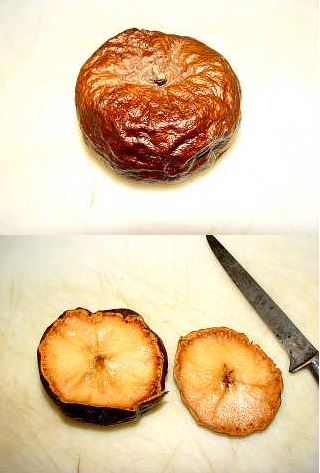
A Norfolk Biffin after cooking
Biffin/Beefing apples have very tough skins, which allows them to be baked whole, and then preserved cold. Apparently when cooked this way they are “creamy with hints of cinnamon and nutmeg”. They were mentioned in Dickens’ story “Holly Tree” and also in “A Christmas Carol” :
“Norfolk Biffins, squab and swarthy, setting off the yellow of oranges and lemons, and in the great compactness of their juicy persons, urgently entreating and beseeching to be carried home in paper bags and eaten after dinner.”
Nearby, lies the site of a former Windmill. This can be seen if you look carefully at one of the earliest paintings of the workhouse, by Kerrison. Built in 1781, the Mill provided the workhouse with meal and flour for about 50 years. The Workhouse Master would buy a year’s supply of wheat from the local markets and this was then ground at he Mill.
In 1783, records show that William Pulling (of nearby Shipdham) was the Miller and was paid 6d a week (in old pence, or 2.5 new pence!).
By 1829 just a baker was employed, suggesting that the windmill was no longer in use. In 1837 the remains of the mill were removed. This was just one of the special buildings or rooms set aside for meeting the food and drink requirements of the workhouse, it having had a brewery as well as a bakehouse and kitchens!

Early painting of Gressenhall Workhouse (Kerrison) with windmill ringed in red
Next to this site sits the modern compost making area, well organised and used by the volunteer gardeners to improve the soil and mulch the gardens at the Museum. Originally designed for maintenance by farm machinery, it became under used and recently has been reorganised so that the gardeners can maintain it. A system of different bays provide for the different stages of turning vegetable matter into compost (including stems and branches which are periodically chipped into smaller pieces and incorporated into the mix). There are also areas for creating leaf mould, for depositing paper waste generated by the Museum (which is incorporated into the compost) and also a turf mound which will eventually decompose into a fine loam for use in the gardens. The resulting compost is of a coarse texture, but rich in organic matter which is so good for improving soil structure, moisture retention and adding nutrients to the soil.
 The Museum hosts an annual ‘Apple Day’ in October which is a great family day out with a range of stalls, activities and attractions including the fresh pressing of apple juice and an opportunity to bring along any ‘mystery apples’ to get them identified by a number of local experts. This lively event contrasts with the peace of the orchard, which is a fitting commemoration of those buried here long ago.
Other posts in this series:
Down on the Farm – Gardens to ‘dye’ for at Norfolk Museum…
From Grand entrance to Grand Central at Norfolk Museum
Gypsies, tramps and thieves: garden where poor once trod at Norfolk Museum
Cottage Garden recreates 1930’s at Norfolk Museum
Old Workhouse Garden a wildlife oasis at Norfolk Museum
Unique Heritage Gardens at Norfolk Museum
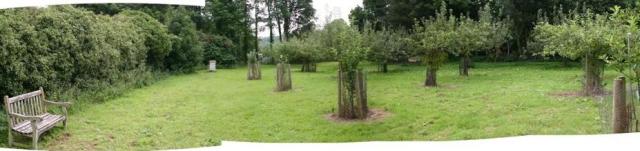
Gressenhall’s orchard – a peaceful place to remember the unamed poor once buried here
Old School Gardener
If you’ve enjoyed reading this post and others on this blog, why not comment and join others by signing up for automatic updates via email (see side bar, above right ) or through an RSS feed (see top of page)?




 Old School Garden