Tag Archive: mulch


800px-Fuchsia_2008

With winter around the corner, this week’s question comes from Penny Rose in Hampshire:

‘I’ve moved house earlier this year and planted some fuchsias in the garden. I bought these from a local nursery and they are described as ‘hardy’. Can I leave them in the ground over winter and if so do I need to protect them in some way?’

Well, Penny, In the coldest parts of the UK you’ll have no option but to dig up your plants and put them in a conservatory or greenhouse. It’s also a good insurance policy to take cuttings (preferably in early autumn) to bring on new plants in case of a particularly severe frost or disease problems. In warmer areas you can leave plants in the ground but take steps to protect them by not cutting down the stems in Autumn, and by making some holes in the ground around each plant with a a border fork, to help water drain away- particularly important if you have heavy soil that retains water. Once this is done you should put a mulch of leaf mould, wood ashes or soil around the base of  the plant to protect it further. Some Fuchsia varieties are hardier than  others; the toughest are F. magellanica, F.’Riccartonii’ and F. ‘Mrs. Popple’ which can withstand temperatures down to between -5C and -15C.

So in somewhere like Hampshire, you’ll probably be OK  to leave your Fuchsias outside (but take the action suggested above). For me here in Norfolk, it’s a little more difficult to be sure, so I’ll leave some outside (in a pot in a warmish courtyard) and either bring others in or mulch my sandy loam soil (forming drainage holes isn’t as important).

Old School Gardener

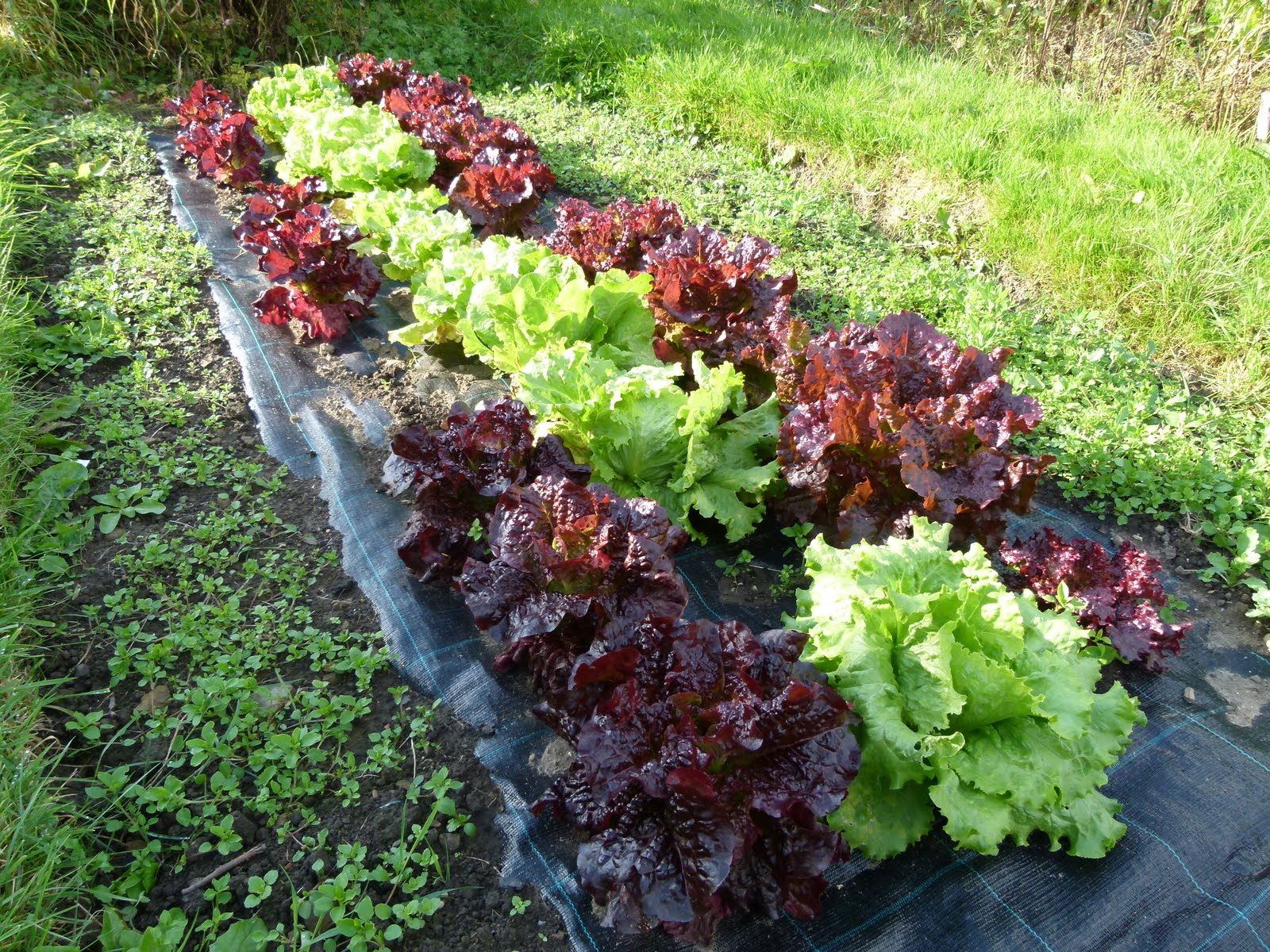
Weed - proof membranes can be an effective way of controlling weeds around vegetable crops

Weed – proof membranes can be an effective way of controlling weeds around vegetable crops

A weed might be a ‘plant in the wrong place’ but some ‘weeds’ have positive features. They can look good; some are edible; some provide food and shelter for birds, butterflies and beneficial insects and many can also be used in the compost heap (though if you don’t have a ‘hot’ compost system its probably unwise to put in the tap-rooted perennials).

But much of a gardener’s time is taken up with preventing, removing or controlling those plants that if left alone might quickly over run less vigourous species and rob them of precious moisture and nutrients. So what are the best ways of keeping these invaders under control?

  1. Try to ‘design out’ weeds by close planting, crop rotation, weed-proof membranes under paths and effective barriers (possibly including some plunged into the soil to prevent spreading roots) to keep weeds from entering the garden from surrounding land.

  2. Know your weeds it will help to work out the best way of dealing with them.

  3. Take time to clear perennial weeds effectively before any permanent planting- this might take more than one year and be realistic – don’t clear more than you can keep weed free. Cover the rest up with black plastic or other covers. And wait for the soil to be moist to aid removal.

  4. Choose methods to suit the time and energy you have using  glyphosate- based herbicides might be the quickest and most effective for large, difficult areas

  5. Never leave soil bare plant it including with green manures. Use man made covers or nautural mulches which can both prevent and eradicate weeds- for little effort.

  6. Create ‘stale seed beds’ by preparing the ground a few weeks before you need it – this will allow weed seeds to germinate and mean that you can clear the weeds before you sow,  or cover the ground with black plastic for a couple of months. This will give your plants a better chance of survivial.

  7. Use transplants rather than sowing directly into the ground where strong weed competition is likely.

    Weed or food source?

    Weed or food source?

Old School Gardener

If you’ve enjoyed reading this post and others on this blog, why not comment and join others by signing up for automatic updates via email (see side bar, above right ) or through an RSS feed (see top of page)?

Keep the bird bath topped up in hot weather

Keep the bird bath topped up in hot weather

Well, yesterday was St. Swithin’s day and folk lore decrees that the weather on that day sets the pattern for the next 40, so we can ‘look forward’ to days in the mid to upper 20’s Celsius (and warm nights too):

‘St. Swithin’s day if thou dost rain
For forty days it will remain
St. Swithin’s day if thou be fair
For forty days ’twill rain nae mair.’

dost = does
thou = you
nae mair = no more.

And the forecasters seem to be saying this hot weather is likely to continue for the next couple  of weeks at least. So how can we care for the fragile eco systems that are our gardens? It’s all about moisture- using it wisely, keeping it in place in the plants and making sure wildlife has enough to survive. Here are 7 tips that might help:

1. Apply a mulch around plants that are most sensitive to water loss – grass clippings are ideal as they are light reflective (though you might well not have many that are usable in a heat wave- see tip 5 below). Straw is another option.

grass_mulching_tomatoes tiny farm blog

Grass mulching tomatoes from  tiny farm blog

2. Water your garden early morning or late evening (ideally from your own saved rainfall or ‘grey water’ forom the house) – morning is best as the plants need most of their water during the day time when they are growing. Leave a bucket or watering can full of water inside the greenhouse to help keep up humidity and so reduce the rate at which plants lose water through transpiration.

3. Get creative about shading your tenderest plants and crops – use shade netting, cloth, or fleece and maybe even think about using picnic awnings, table parasols and even tent poles with bedsheets!

movable awning

Movable awnings can bea useful shade for tender plants

4. If you need to plant out seedlings try to plant them alongside taller neighbours to help provide some protection, or even better hold off transplanting until the weather is more suitable – you can better care for seedlings in a container if you remember to water and shade them (and pot them into bigger pots if need be).

5. If you haven’t already stopped mowing your lawn then do so and leave at least 5 – 8cms of growth to help conserve moisture.

6. Avoid adding fertiliser to your ground as plants don’t need it in the heat as their growth rate slows.

7. Look after the wildlife – top up ponds, bird baths and drinking bowls for hedgehogs etc. and put out some food for these critters too, as it will be harder for them to find natural food like worms which bury themselves deeper into the ground.

Here’s hoping you and your garden survive the heat – how long before we Brits are hankering after a ‘traditonal’ Summer!

Old School Gardener

Mulch Madness

mulching

A guide to mulching from Organic Gardening Magazine

Echeveria- overwintering in Old School Garden Greenhouse

Echeveria- overwintering in Old School Garden Greenhouse

To Walter Degrasse:-

Dear Walter,

It’s been a while since we were in touch, and as it’s windy and wet outside, I thought I’d drop you a line about what’s been going on in ‘my gardening life’. I hope all is well with you and your beautiful garden. It seems ages since I was in my garden for any time to get a sweat up, but it’s that time of year when the pace of things is rather slow, very much focused on ‘basic maintenance jobs’, I suppose. Anyway I’ve used the time in other ways, not least getting my blog up and running, which I’m pleased to say I’m enjoying and also the new relationships it’s bringing with gardening fans around the world!

More practically, I’ve more or less finished my pruning jobs, those new Felco secateurs I had for Christmas are a real joy to use! I’ve got one more Buddleja to do and I’ll need to get the ladders out to do my Fremontodendron, which, on a south-facing wall, has romped away – I think last year’s wet weather gave it a surge of growth, so it’s now over 5 metres tall! The Dogwoods have all been laid low so hopefully we’ll get a good flush of new stems in the summer that give us that wonderful ‘winter glow’. I’ve done my annual cut back of the Eucalyptus to encourage large, colourful new leaves – it always looks forlorn after this major hack back (photo enclosed), but is such a swift grower.
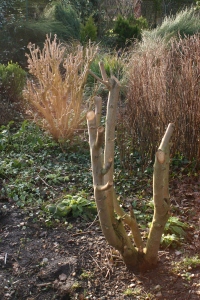
Eucalyptus & Buddleja - pruned

Eucalyptus & Buddleja – pruned

I’ve also been tilling over the beds in the kitchen garden. Did you read my blog post about planning the crops here? It has a layout of what I’m intending to grow and where, trying to rotate crops as best I can in a complex border layout and thinking about succession crops too. You may remember that I put on a layer of leaf mould over most of them (as well as the fruit trees) in the autumn as well as digging in some green manure I grew towards the end of last season – we’ll see if this latter experiment has any marked effect on the crops to come.

I’ve been lightly turning over the topsoil and incorporating the remains of the leaf mould etc., in preparation for some of my friend Rob’s horse manure, which I’m able to collect from his paddock about 2 miles way. It really is lovely stuff, so I’ll use it to mulch my roses, clematis, shrubs, fruit trees and bushes etc. as well as putting a good load down for the potatoes and some of the other vegetables.
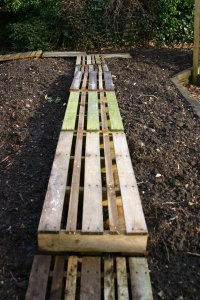
New boardwalk made of old wooden pallets

New boardwalk made of old wooden pallets

You know how poor my carrots were last year – the rotten weather didn’t help, I know, but I think that the bed I grew them in is still a little heavy (in contrast to the rest of the soil) and they don’t respond well to this and over – rich soil (I mistakenly put manure on the area a short time before the new season began). This encourages them to fork, whereas by keeping the soil relatively under – fed early on you apparently encourage them to grow straight and true as they seek out the nutrients further down – at least that’s what I heard Bob Flowerdew say on ‘Gardeners’ Question Time’ last week! Oh, and you remember I’d been collecting a load of old pallets? I’ve finally got round to making good use of them. They cut up nicely into sturdy 500mm – wide board walks which I’ve lain over the top border – this means that I have two manageable – width beds and don’t have to walk on the soil between them.

I’ve also been clearing out a side bed which was becoming choked with a Lilac that was suckering all over the place. This border is a bit on the edge of the kitchen garden and is not ideal for food growing, so I think that I might use it for flowers to attract insects etc. I’ve a good supply of Marigold seeds from last season, so they can go in there.
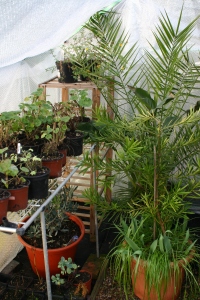
Over-wintering plants in the Old School Garden greenhouse

Over-wintering plants in the Old School Garden greenhouse

The greenhouse seems to be working well at over wintering my pelargoniums and ‘exotics’ and the pots of broad beans and sweet peas I put out a week or two ago are starting to push new growth through. I’ve sown some other seeds in my propagators – just some brightly – coloured Cosmos, Iceland Poppies and Leeks – these seem to be doing well, and hopefully I can pot them up shortly. I’m also chitting two varieties of early potato. You know how much I love ‘Charlotte’, the waxy ‘second early’ and alongside this I’m growing ‘Pentland Javelin’.

It looks like the weather is going to be a bit warmer in the coming week – in fact as I’m writing the rain has stopped and the sun is out! Hopefully I can get out tomorrow and catch up with a few more jobs that need doing – for example putting some pesticide on a couple of Hosta- filled containers to eradicate Vine Weevil (didn’t quite manage to get rid of these last year through a soil change), spraying my dwarf Peach tree with Bordeaux Mixture to help prevent ‘Peach leaf curl’, replanting the many Nerine bulbs I dug up recently from the kitchen garden and getting some more seeds into the propagators.
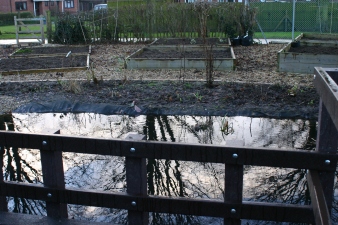
The primary school garden from the new pond dipping platform

The primary school garden from the new pond dipping platform

On the broader front my work with Norfolk ‘Mastergardener’ seems to be picking up once more. I’m helping the local Primary school with their School Garden, as you know. I’m shortly going off to meet with their garden coordinator to discuss plans for the coming year. I’ve offered to go into school one day per week to work with different classes and I’m looking forward to helping them get the most out of the garden, which is now starting to look really good. You may recall that we (staff, parents and children) managed to get a new wildlife pond installed over the summer and I also installed a pond dipping platform for them (made from recycled plastic), so the children will have this new resource for nature study in the coming months.

Yesterday I visited a new food grower I’m supporting for Norfolk Mastergardener. She lives in the next village and has recently moved to a large house with a super plot. I was impressed with the 2 polytunnels she has as well as a fenced off, structured vege growing area. She’s a keen animal lover and has this enormous pig (which her granddaughter rides like a pony!) as well as chickens, ducks, cats, dogs etc! The pond has a large number of enormous Carp in it too.

Any way, she’s a beginner when it comes to gardening and wants me to advise her about food growing for her large family. I’ve suggested she looks at the range of seeds she’s bought (as well as inherited from the previous house owners) and does a rough plan of what she wants to grow and where this might go in her plot. I’ll then talk this through with her and some of the basics about manuring and preparing the soil, sowing seeds, potting up etc. I’ve suggested that she keeps things simple this year and just goes for one crop in each area, rather than think about succession planting, until she sees the amount  of time she’ll need to put in and what her garden will generate in terms of food. We’ll see how it goes, but it’s a wonderful setting and with the polytunnels (one plastic – covered, one netted) she has some great growing areas to play with.
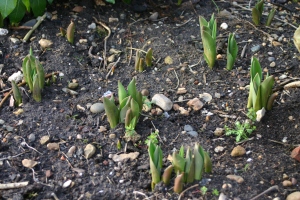
Tulips starting to show themselves in Old School Garden

Tulips starting to show themselves in Old School Garden

Well, I see the time has ticked on and I must be out to my meeting at the School. I’ll drop you another line in a week or two to let you know how I’m getting on, and hopefully we’ll also stay in touch via my blog or by email? By the way I’d welcome any comments or suggestions you might have about the blog, as I’m still finding my way!

Very best wishes from

Old School Garden

If you’ve enjoyed reading this post and others on this blog, why not comment and join others by signing up for automatic updates via email (see side bar, above right ) or through an RSS feed (see top of page)?

Finding Nature

Nature Connectedness Research Blog by Prof. Miles Richardson

Norfolk Green Care Network

Connecting People with Nature

Discover WordPress

A daily selection of the best content published on WordPress, collected for you by humans who love to read.

Susan Rushton

Celebrating gardens, photography and a creative life

Unlocking Landscapes

Writing, photography and more by Daniel Greenwood

Alphabet Ravine

Lydia Rae Bush Poetry

TIME GENTS

Australian Pub Project, Established 2013

Vanha Talo Suomi

The Journey from Finnish Rintamamiestalo to Arboretum & Gardens

Marigolds and Gin

Because even in chaos, there’s always gin and a good story …

Bits & Tidbits

RANDOM BITS & MORE TIDBITS

Rambling in the Garden

.....and nurturing my soul

The Interpretation Game

Cultural Heritage and the Digital Economy

pbmGarden

Sense of place, purpose, rejuvenation and joy

SISSINGHURST GARDEN

Notes from the Gardeners...

Deep Green Permaculture

Connecting People to Nature, Empowering People to Live Sustainably

BloominBootiful

A girl and her garden :)