Tag Archive: mediterranean
The slow trickle of water from a fountain added to the ambience, quite a contrast to the rushing of the arched fountains in the Generalife (I’ll post a couple of videos comparing them in the next day or two). Here are some pictures of the outer Alhambra and the Nasrid Palace…
Well, I got my ‘fix’. Our drive home was a little more eventful than our outward one, as we had both darkness and rain to contend with. But we rolled safely into the Cortijo and managed a late night supper (I think it must have been 11pm before we ate) round the pool. A quieter day tomorrow, perhaps?

It was late September and we had travelled to Spain for a week’s break in a farmhouse home in a remote mountainous region of innner Andalucia. Having settled in, done our first food shop and enjoyed our first evening meal by the pool we decided to make a short trip out on our first full day to the nearby village and lake of Iznajar.

- Felicity enjoying our lunchtime view
Andalucia.com describes the village and area:
‘This small town of some six thousand inhabitants was transformed some years ago by the creation of an ’embalse’, or reservoir, below the promontory on which Iznajar sits in the River Genil valley. Today, to all intents and purposes, Iznajar now has a waterfront, overlooking an inland sea some thirty kilometres long, and containing an estimated 900 million cubic metres of water destined for domestic consumption…
Iznajar itself escaped the submersion that often visits towns and villages in the region of Andalucía’s controversial programme to construct more and more dams and reservoirs to serve this increasingly thirsty region. If anything, the lake below has given further resonance to its unofficial title as the Mirador (viewpoint) del Genil. Surrounding countryside and communications have been radically altered, not least by a bridge built across the reservoir near Iznajar in order to continue to carry traffic on the Archidona/Priego de Córdoba road…
The village was originally a prehistoric Iberian settlement, but flourished in the eighth century when Arab settlers, in the wake of the 711AD invasion by Tariq ibn Zayid and his Moorish armies, built a castle on the promontory and called it ‘Hins Ashar’ (hence the modern Spanish name). It became the focus of battles between various north African factions, finally being taken by the army of Abderramán III. After the fall of the Caliphate of Córdoba, then the capital of Al-Andalus, it fell under the rule of the dependency of Granada. In 1431, in the reign of Catholic monarch Juan II, it was taken back by the Christian rulers, some sixty years before Granada was to fall in 1492. Iznajar gained brief notoriety in 1861 when the town supported an uprising against the monarchy, led by Rafael Perez del Alamo, with grimly predictable consequences…
The ruins of the 1,200-year-old castle are the obvious key attraction for the visitor… Parts of the fortified town walls can also be seen in the upper reaches of the town. Inside the town walls, a small square called the Patio de las Comedias suggests that, despite its defensive position, Iznajar once had a theatre culture that probably tracks back millennia… the Iglesia de Santiago church, (was) built over time during the fifteenth and sixteenth centuries, with a remarkable late addition in the form of a Baroque altar piece. The cemetery next to the church only dates back to 1806…
The most interesting barrio, district, of Iznajar is the Barrio del Coso, a labyrinth of typical whitewashed Andalucían houses dotted around a labyrinth of narrow lanes that criss-cross the promontory. As if often the case in these hill towns, the ‘lower’ part is also the newer part of town…..’
I loved the majestic setting of this lovely village and the obvious care the residents take in looking after their private and public spaces. Having ‘mooched’ around the village in the morning and had a light tapas lunch with a splendid balcony view across the village, we moved off to the nearby ‘beach’, where we had the place almost to ourselves (that’s wife Deborah and friends Nick and Felicity). The beautiful setting, warm sunshine and water (I actually swam!) made for a relaxing beginning to our week’s adventure…
Old School Gardener

Old School Gardener

A Fig fruit
I have a fig in the courtyard here at Old School Garden, growing in a pot and ‘liberated’ as a young transplant when pruning a rather older and very vigourous example at our local primary school a few years ago. I remember gathering it when I helped to plant up the ‘Nectar Bar’ and ‘Eco Park’ there in 2007. Today our tree, along with a Grapevine, Olive and Peach, contributes a mediterranean touch to the space, and with last winter and spring’s mild and wet conditions it has put on some wonderful growth, including a crop of handsome and promising looking fruit. I can’t recall ever really tasting a ripe fig, but my recent experience of fig-flavoured yoghurt is tempting me to try to harvest some this year!
Common name: ‘Common Fig’
Native areas: A native of the Middle East and Western Asia.
Historical notes: The edible fig is one of the first plants that was cultivated by humans, predating the domestication of Wheat, Barley and Legumes, and may thus be the first known instance of agriculture. Figs were also a common food source for the Romans. The fruits were used, among other things, to fatten geese for the production of a precursor of foie gras. In the 16th century, Cardinal Reginald Pole introduced fig trees to Lambeth Palace in London.

An old Fig Tree
Features: A round-headed tree, if properly located and pruned, otherwise it can develop a mass of straggly growth (e.g if grown up against a wall and left untrained and its roots unrestricted). Mature height of 3 – 5 metres, it is grown for both its attractive, deeply lobed foliage, and fruits. Two crops of figs are potentially produced each year; the first or breba crop, develops in the spring on last year’s shoot growth. In contrast, the main fig crop develops on the current year’s shoot growth and ripens in the late summer or autumn. The main crop is generally superior in both quantity and quality to the breba crop.
Uses: It makes a small and elegant tree that is perfect for gardens where space is limited. Grow in a container or open ground. The cultivar ‘Brown Turkey’ has gained the RHS Award of Garden Merit (AGM).
Growing conditions: The fig likes dry, sunny, warm, sheltered sites, where the soil is dry or very well-drained. It thrives in both sandy and rocky soil. As the sun is really important it is better to avoid shade. Excessive growth has to be limited to promote the fruiting. This can be achieved by pruning to achieve the desired shape and encouraging fruiting branches and also by restricting root development; by growing in a container or in an enclosed bay in open ground where brick walls or other barriers keep the roots in check. It is also often grown up against a south-facing wall to maximise fruiting potential. I’ve had experience of pruning back hard a few old unkempt examples successfully in spring; alternatively, phase your pruning over a number of years to lessen the visual impact and reduce stress on the plant. Some varieties are more adapted to harsh and wet climates. It is remarkably pest and disease resistant.
Further information:
Wikipedia- Ficus
RHS- Figs
RHS- Ficus carica ‘Brown Turkey’
How to grow Figs- Daily Telegraph
Barcham trees directory
Old School Gardener
I recently responded to a challenge from fellow blogger, ‘The Anxious Gardener’, to name my favourite garden. This was a light-hearted way of getting people to enter a competition to win a copy of the recent publication ‘The New English Garden’.
The competition was a ‘name out of the hat’ affair so I stood as much chance as winning as the other 30-odd entrants (and I didn’t win, so there’s another item for the Christmas list). Notwithstanding that, I thought I’d try to do the request justice and thought long and hard about where, if any one ‘where’ stood out in front of the many gardens I’ve visited, read about, seen films and pictures of.
It took some time…
In the end I came up with my nomination and set it out here and the reasons why it came out top. Oh, and I thought I’d share some pics with you too. I hope that you enjoy them.
I’ve visited and seen a few gardens over the years and it’s tricky finding one that I’d call a favourite – some have great borders or other spaces, configurations of plants, superb features and so on. Maybe its because it’s relatively fresh in my mind, but the one that does stand out is Felbrigg walled garden in Norfolk (also a local one to me and so visited quite often).
Why? Well I guess it’s the way the garden team (including volunteers and community gardeners), have managed to create a space that meets so many different needs and in a way that seems to hang together naturally:
* a warm, contained, red brick walled space, with a fountain and dovecote as strong structural elements
* glasshouses with old favourite, traditional exotics and other ‘interesting’ plants
* community food growing in plots that are obviously lovingly cared for
* a children’s gardening area complete with digging pits, tools, washing facilities and novelties such as chickens running free, willow teepees and tunnels
* newer areas set out with mediterranean – style planting, meadows and feature shrubs
* plenty of comfortable seats to entice you to stop, look and soak up the atmosphere
* lots of attractive information about the plants themselves (all the significant ones carefully and attractively labelled) as well as some of the current tasks in the garden and information/quiz sheets for the kids.
All in all a visit to Felbrigg is a tremendously rich experience where the general public, serious gardener and trained horticuluralist (and their children) can come together and have their curiosity tickled, be enthused, amazed and go away feeling regenerated.
Do you have a favourite Garden? I’d love to hear from you!! (no prizes I’m afraid)
Further information: National Trust website
Old School Gardener
If you’ve enjoyed reading this post and others on this blog, why not comment and join others by signing up for automatic updates via email (see side bar, above right ) or through an RSS feed (see top of page)?

iLandscape.com.au

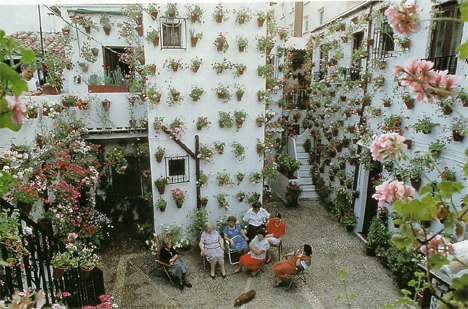
‘Vertical gardening is very popular now, but in Greece and other parts of the Mediterranean it’s been around in courtyard gardens for generations.’ from GrowVeg
This is the second in a series of snippets of information and pictures that try to capture the essence of different garden styles.
Mediterranean style gardens have undefined pathways, often covered with loose material such as gravel, which is used as a mulch over planting areas- this serves to unify the different elements of the garden. Other key features of this style include:
- shady seating areas – pergolas, arbours or under sun awnings
- gravel or paved/tiled floors
- rills and pools of water and the sound of flowing water
- succulents, silver foliage and other drought loving plants
- terracotta pots and tiles
- mosaic wall/floor features
- painted walls
Let me know what you think makes a Mediterranean style garden, and if you have some pictures I’d love to see them!
Old School Gardener
If you’ve enjoyed reading this post and others on this blog, why not comment and join others by signing up for automatic updates via email (see side bar, above right ) or through an RSS feed (see top of page)?

Bougainvillea?