Tag Archive: lisbon


This beautiful tropical garden is  located next to the Palace of Belém (the Portuguese Presidential residence).  The 15 acre garden is a charming, yet often overlooked spot that has maintained a number of ponds, towering palm trees, and many hundreds of species of tropical plants that it had when it was created in the early 1900’s.  The Tropical Botanical Gardens (Jardim-Museu Agrícola Tropical) are also known as ‘Jardim do Ultramar’ (‘Garden of the Colonies beyond the Sea’) or ‘Jardim das Colónias’ (‘Garden of the Colonies’) as most of the plants come from old Portuguese colonies.

The entrance is an avenue created by huge California Fan palms and Mexican Fan palms, and on each side you can see several ‘living fossils’ – species that have not suffered any mutations for millions of years. On the left, Ginkgos, Dawn Redwood and Monkey-puzzle trees go back to the age of the dinosaurs. Close to the lake you can see Sago palms, native from Japan, and sacred figs from south east Asia, also known as the Buda tree. There is an oriental garden that shows off the Chinese Hibiscus.

Created in 1906 by royal decree (King D. Carlos I), and located in the grounds of a former zoo, it was opened in 1912, the presence of natural water influencing the choice of location. It sits on the slopes overlooking the River Tagus in Belem, one of the most interesting of Lisbon’s districts. It is one of three botanical gardens in the Lisbon area, the others being the Ajuda Botanical Gardens (also in Belem) and the Botanical Gardens near the Science Museum in central Lisbon.

The garden has rare tropical and subtropical trees and plants (many of them endangered species) from all over the world, such as Dragon Trees from the Canary and Madeira Islands and Brazilian Coral Trees. Most of them are labeled, so a visit here can also be a learning experience. It is a tranquil place regularly visited by leading international scientists and botanists. Its scientific work continues today and in its grounds you will find a seed bank, greenhouses, in-vitro culture laboratory and a xylarium (wood collection).

A highlight is the Macau Garden complete with mini pagoda, where bamboo rustles and a cool stream trickles. Young children love to clamber over the gnarled roots of a Banyan tree and spot the waddling ducks and geese.

It is a joy to amble along its palm – lined avenues and discover the grottos and ponds, the oriental garden and the topiary accompanied by the friendly birds. A welcome, peaceful, shady retreat on a sweltering summer’s day!

Other articles about Portuguese gardens:

Portuguese Gardens: Estrela Gardens, Lisbon

Oranges and Azulejos: Portuguese Heritage Gardens

Sources and further information:

Go Lisbon

aportugalattraction

Old School Gardener

If you’ve enjoyed reading this post and others on this blog, why not comment and join others by signing up for automatic updates via email (see side bar, above right ) or through an RSS feed (see top of page)?
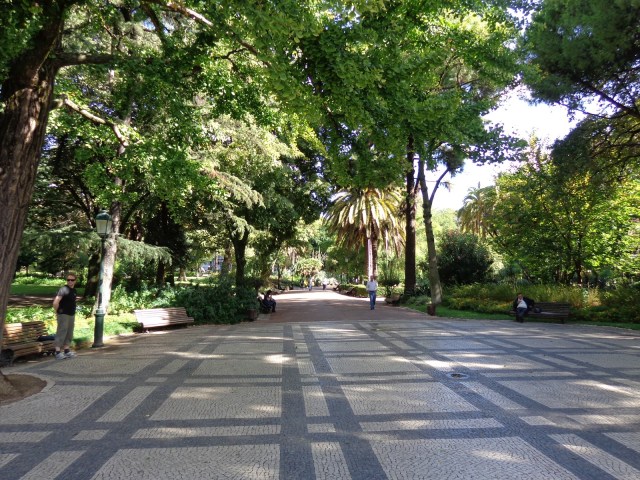
Entrance to the Estrela gardenFollowing my article about Portuguese Heritage Gardens, I thought I’d turn my attention to a few of my favourite public gardens in that country. I’m beginning with one of my real favourites, one I love to return to when I’m in Lisbon (not that that’s very often!).

It’s the Estrela Garden (the Jardim da Estrela or Garden of the Star) which has a wonderful blend of exotic, artful, friendly charm with an atmosphere from the best of classic 19th century neighbourhood parks and gardens. It’s no surprise, then , that it remains as one of the most popular gardens in Lisbon. The orignal layout – 19th century romantic landscape style – features plenty of exotic plants and a central pond.
It is known officially as the Jardim Guerra Junqueiro (Junqueiro was a famous poet and politician who was a key figure in the downfall of the Portuguese monarchy and the establishment of the Portuguese Republic in 1910). In the 1840s the governor of Lisbon saw the need for a public garden in the densely populated city, and thanks to a donation by a wealthy baron, the governor was able to acquire the area  (5 acres) opposite the Estrela Basilica. Work on building the garden started in 1842 but due to the outbreak of war and financial difficulties, it didn’t open to the public for another ten years.

The gardens are laid out in a landscaped style with plenty of exotic trees, cacti, flower beds and a pond with fountains. The garden is especially popular with locals who come here during weekends to socialize, stroll along the paths, have a drink at the café, or play cards at one of the permanent tables among the trees.

The garden was designed by gardeners Bonard and João Francisco and it originally featured several romantic structures such as a gazebo and a Chinese pavilion. These structures are no longer there, but there are plenty of sculptures and a 19th century wrought iron bandstand, originally located at the site of the City’s main boulevard, Avenida da Liberdade. It was moved here in 1936.

After the creation of the Portuguese republic, several statues were installed in the park, the most expressive of which is of a farmer (sculptor Costa Mota,1913).  There is another of a female nude known as ‘O Despertar’ (sculptor Simões de Almeida).The most famous statue in the park is probably that of the Guardadora de Patos (keeper of the ducks) – a limestone replica of the marble original from 1914, it shows the protagonist of a popular fairy tale. Other statues include a dog spouting water from its mouth and 3 other busts depicting poets and an actor. More recent additions include a children’s playground and a pond-side cafe. The garden hosts the annual  Out Jazz festival – on Sunday afternoons during this time (usually May), Jardim Estrela will be alive with music and people enjoying the Sunday evening jazz in the open air auditorium.

Beyond the park is the English Cemetery, founded in 1717 and originally shared with the Dutch community. Novelist Henry Fielding, author of Tom Jones, died during a visit to Lisbon and is buried here.

Here are some images to let you get the feel of the place.

Source: A View on Cities

Old School Gardener

If you’ve enjoyed reading this post and others on this blog, why not comment and join others by signing up for automatic updates via email (see side bar, above right ) or through an RSS feed (see top of page)?

Dear Dad…

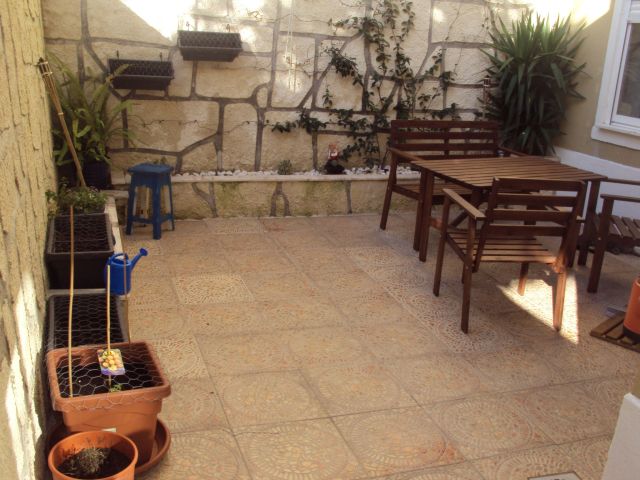
I’ve had an email from my daughter who lives near Lisbon, Portugal (and whose garden is a small, sunken patio with planting mainly in containers – see pic)….

garden 007

15th March 2013

Hi!! Just thought I’d drop you a line to let you know I’ve been busy in the garden!
Bought some cheap plants from the little old lady where you bought our cucumber from last year.

So far we have got 4 cucumbers plants, 6 tomatoes (in a newly strengthened cane system),7 pepper plants,a rosemary plant and 12 strawberry plants. Going to the garden centre tomorrow to get some more earth to fill up those new containers you gave me.  Not sure what else we’ll get yet, but maybe a lemon tree to look nice, and some lavender plants to plant among the jasmine and those little bushes. I’ll probably get some herb seeds too.

What would you recommend with the herbs? Plant them in tiny containers first, until there are shoots, and then transfer them over? Any which are sturdier than others?

Also, do the peppers need a similar system to the tomatoes? Will they grow upwards?

The lady also has some brocolli plants, but do they need a lot of space? Would it be worth the work planting them, for only two or three heads? Is it one plant=one head?

What other plants would you recommend planting, either from little plants or seeds? Radishes? Lettuce? Carrots? Chilli peppers?

Answer:

Hi

Glad to hear that you’ve been busy in your little patio garden! You sound like you’ve purchased a lot of plants already – careful you don’t fill your patio so you can’t use it (especially as it doesn’t get sun all round)!

Lavender need lots of sun and sharp drainage- so put in some gravel if/when you plant them

Herbs- all depends on what you go for- as you’ll probably only need a few plants of each type I’d try to sow individual seeds in modular trays rather than do a complete seed tray. You can raise as seedlings in these modules and then when they’re big enough (say they have a few of their second set of leaves) they can be transplanted to their final spot/pot. I’d go for Basil, Coriander, Parsley, Sage, Thyme.

Peppers will grow as bushy plants so you could sow some seeds in modules as above and then put them in a largish individual pot/container (they’ll probably grow to about 1’ high by 1’ across or possibly larger)- they might need some support as they get bigger, this is easily provided by short canes and string to tie in main stem/branches as they need it.

Broccoli- For the space they need I don’t think its worth it in your restricted area. You could grow them like the peppers- they’ll grow as bushy plants (poss about 2’ tall) and may need some support in due course. Depending on the variety (I’m assuming calabrese type rather than purple sprouting brocooli?) you might get one big head and after you cut this off other side heads will develop (smaller but still good)

Other food- again it depends on what space/ containers you have and what are your favourites to eat fresh! As you like salad I’d go for a few lettuces- possibly the ‘cut and come again’ kind rather than the tight head sort- and maybe carrots in a deepish container- these need a fairly sandy, poorish soil, so avoid rich compost if you do as this makes them fork.

love,

Dad X

Old School Gardener

Great Garden @ Gulbenkian Museum, Lisbon

‘Whenever I want to escape the hustle and bustle of Lisbon, and don’t want to travel far, I retreat to the gardens of the Calouste Gulbenkian Museum.

Covering roughly 17 acres, this beautifully landscaped garden contains a wide variety of well-established tropical as well as indigenous plants and trees that shelter subtly-appointed benches and seats. In the last few months a network of new, flat, winding paths has been opened through the garden.

There are picnic tables situated next to a lake where you can sit on bright winter days and soak up the sun, or watch the ducks with their fleets of ducklings enjoying the water in spring. At the weekends the gardens come alive with the sound of kids playing in the sunshine.

In the summer months, it is nice to disappear into this garden down one of the maze-like paths that snake through the shrubbery and to feel as if you are the only person in the world, surrounded only by birds scurrying around in the undergrowth or flitting in the trees. Somehow, the vast tree canopies manage to dull the sound of Lisbon traffic to the point you forget it is there and will also shelter you from the heat of the day.

The garden contains an open-air amphitheater where, during the summer, a programme of films or music events takes place in the evenings.

Whether on a hot, sultry summer evening or a bright, sunny winter day this garden is the perfect place to be and feel completely relaxed.’

Katy Pugh

Old School Gardener

Finding Nature

Nature Connectedness Research Blog by Prof. Miles Richardson

Norfolk Green Care Network

Connecting People with Nature

Discover WordPress

A daily selection of the best content published on WordPress, collected for you by humans who love to read.

Susan Rushton

Celebrating gardens, photography and a creative life

Unlocking Landscapes

Writing, photography and more by Daniel Greenwood

Alphabet Ravine

Lydia Rae Bush Poetry

TIME GENTS

Australian Pub Project, Established 2013

Vanha Talo Suomi

The Journey from Finnish Rintamamiestalo to Arboretum & Gardens

Marigolds and Gin

Because even in chaos, there’s always gin and a good story …

Bits & Tidbits

RANDOM BITS & MORE TIDBITS

Rambling in the Garden

.....and nurturing my soul

The Interpretation Game

Cultural Heritage and the Digital Economy

pbmGarden

Sense of place, purpose, rejuvenation and joy

SISSINGHURST GARDEN

Notes from the Gardeners...

Deep Green Permaculture

Connecting People to Nature, Empowering People to Live Sustainably

BloominBootiful

A girl and her garden :)