Tag Archive: lisbon


IMG_0788Our 2014 September visit to Portugal featured some interesting new places, including three wonderful gardens. The first I’m featuring was a visit to the home of wealthy ex pat Brits when it was established over a century ago. Monserrate sits in the mountains north-west of Lisbon in the regal suburb of Sintra.

The website which covers many of the Sintra garden gems describes Monserrate gardens and its palace as:

‘..one of the most beautiful architectural and landscape Romantic creations in Portugal… unique representatives of 19th century eclecticism.The Palace combines gothic and Indian influences as well as Moorish suggestions together with exotic and plant motifs which are harmoniously extended to the exterior. The gardens have received species from all corners of the world, which were planted according to their geographical origin. The front lawn of the Palace provides a well-deserved rest, while discovering one of the richest Portuguese botanical gardens.’

It was built in 1858 for Sir Francis Cook, an English baronet who had amassed a fortune as a trader and textile baron and was created Visconde de Monserrate by King Luis. Cook turned to an English architect, James Knowles jr. for the house design. He took inspiration from the many countries Cook had dealings with and also the flamboyantly oriental Royal Pavilion in Brighton, England, built for the Prince Regent, later Goeorge IV over 50 years earlier. I loved the round tower and proportions of the palac, the use of reflected light under the wide eaves with subtle creamy and terracotta hues to create a lovely warm glow. The rich decoration is a generally successful blending of eastern, moorish and gothic revival styles. Here are some pics of the house….

This slideshow requires JavaScript.

Cook hired William Nevil as Botanical expert and landscaper. The project was completed within 5 years and was Cook’s summer residence. The entire estate was put up for sale in the 1920s by Cook’s great-grandson, and after many years of neglect was purchased by the state in 1949. Since then it has been open to the public as a national monument.

The English influence emanates throughout the gardens which have a romantic feel, especially as you wind your way along rough paths through shaded glades with waterfalls, pockets of sunlight and mock ruins, and eventually up to the rather more manicured lawn (the first laid in Portugal) that stretches away from the house down to the grounds. These also include specialist and exotic gardens with non-native plants from Cook’s personal collection. Here are some pics of the gardens and grounds…

This slideshow requires JavaScript.

The Monserrate Palace is the smallest of Sintra’s three palaces but it is by far the most decorative – and beautiful-  and certainly captivated me, as did the winding and varied gardens – especially the Mexican Garden, some pics of which follow…

This slideshow requires JavaScript.

It has taken 20 years to restore the gardens and the result was recognised in 2013 when they were voted the winner of the European Garden Awards in the category for “Historical parks”. In 1995 the park was recognised by the UNESCO as a World Heritage Site as a part of several palaces and parks in Sintra. The citation for its latest award says:

‘Light and shadow, exotic and rare plants, winding paths and breath-taking views, but even new garden sections, such as the rose garden that was opened in the year 2011 by the Prince of Wales, make a visit to Monserrate, in spite of the many other wonderful parks in Portugal, a unique, fascinating and therefore “prize worthy” event.’

 IMG_0786Old School Gardener

IMG_8145

It was our last full day in Portugal and having visited two grand Baroque gardens in Caxias and Oleiras we stopped off in stylish Cascais for lunch. It was also a chance to take a look at a very different garden, one very much more domestic in size and with a more informal air.

Casa da Pergola (‘The Pergola House’)  is a mediterranean – style mansion or Manor House, near the centre of Cascais. I viewed the charming and well kept front garden from outside the locked entrance gates, not having the time (or courage) to ask if I might be let in to look around. Still, I could see enough to be impressed.

The hotel website shows pictures of elegant white marble floors and staircases, beautifully decorated bedrooms with “bas relief” stucco ceilings. The house has been owned by the same family for over a century and its beautiful facade, adorned with hand painted tiles, has been the delight of both amateur and professional photographers. Here’s my take on it!

Further Information: Pergola House website

Old School Gardener


IMG_8032Our October visit to Portugal concluded with a day packed with garden visits to the west of Lisbon and in the regal suburb of Sintra to the north- home to many a splendid palace and garden.

We began at a restored baroque garden in the riverside  town of  Caxias. The Quinta Real de Caxias is located quite close to the train station (direct services to and from Lisbon). It was a leisure residence of Queen D. Maria I, as well as the home of King Luís for a few weeks, before he moved to the Ajuda Palace (which we’d visited a few days before).

Inspired by the gardens at the Palace of Versailles, the formal parterres- woven in intricate patterns – are interspersed with various water features, statuary and tall Brazilian pine trees.

The waterfall, ornamented with terracotta statues (of the Machado de Castro school), is the centre piece. Set out at the end of the principal avenue the fountain itself (made out of weather – beaten limestone), is flanked by two wings of tiered terracing, accessed by staircases at either end – the perfect spot form which to view the patterns of the box parterres.

Awarded a European Prize for the Recovery of Historical Gardens, the local Council has done a superb job in restoring much of the baroque splendour of this ‘off the beaten track’ haven. I could have spent hours here ‘chilling out’ – and it would have been even more alluring if the water features had been in operation. Maybe that’s something for the next phase of restoration?

Old School Gardener

IMG_7887

Thanks for reading this, my 1000th post on Old School Garden. I’ll do a fuller review of my blogging experience on my first anniversary on 17th December. But for now I hope that you enjoy my review of an interesting garden in Portugal.

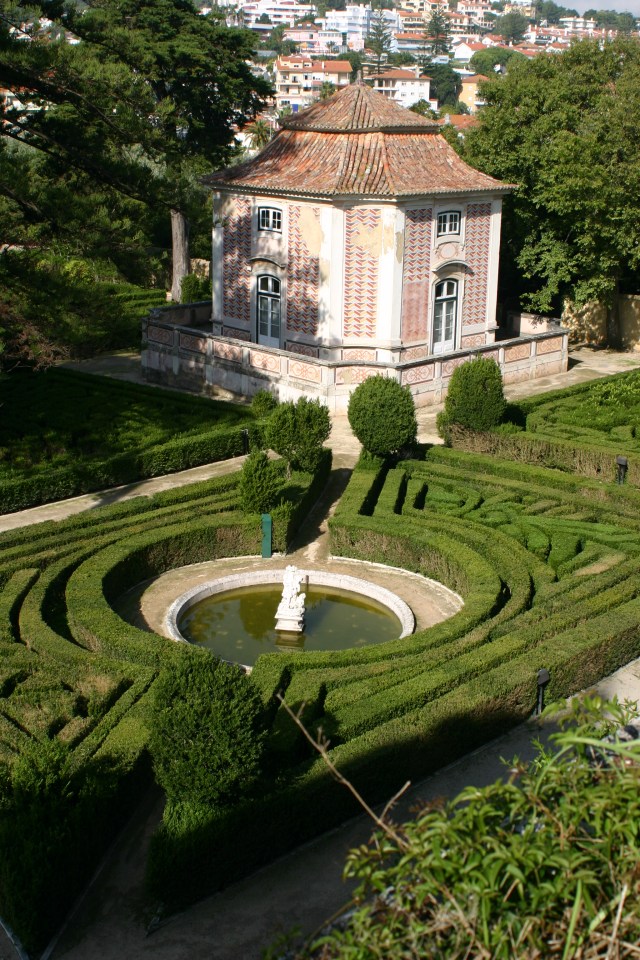
A little off the beaten track in one of Lisbon’s northern suburbs (Lumiar), sit the Gardens of Monteiro Mor (this translates as ‘the High Huntsman of the Royal House’ refering to one of the former grand residents).They come with not one, but two bonuses – small, but fascinating museums, one focusing on Portuguese Theatre and the other Costume.

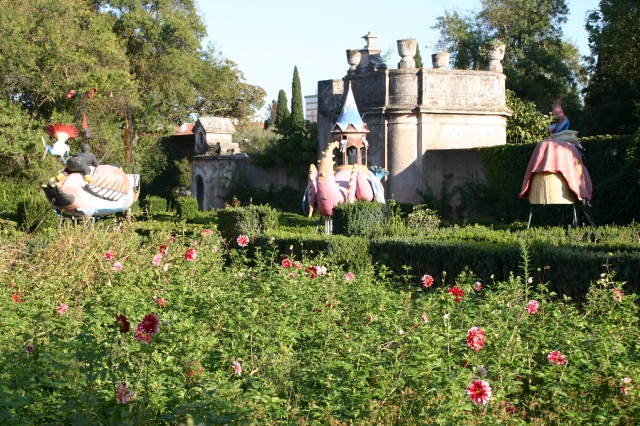
The surrounding gardens are a very engaging mix of formal, botanical display and wilder woodland walks – all very pleasant on a warm autumn day. And there are a number of curious sculptures to see en route too, along meandering paths and steps which take you to a variety of water features and through glades of mixed, mature trees and shrubs.

Interestingly, a communal food growing area seems to have been created on the edge of the parkland, and we also were lucky enough to see a wide range of flowers on display when we visited.

The museums, housed in two former grand houses a few paces from each other, are very well laid out. The Theatre Museum comes stocked with a huge array of printed and pictorial material along with theatre models, sculpture and theatrical props (including some lovely puppets and larger costume displays).

No need for much in the way of interpretation here as the visual richness speaks for itself!

The Costume Museum is an altogether more restrained affair, with displays of clothes and accessories from different periods set off wonderfully in the elegantly decorated rooms of the former palace. Varied lighting levels and effects and a nicely uncluttered feel all contributed to a beautiful wander though time.

This became especially interesting when we reached the 1960’s and more recent displays, which brought back some long-lost memories!

This was a visit well worth the subway ride from central Lisbon, the ‘one for all’ ticket being very good value.

Old School Gardener

IMG_7828 After a stroll through Estrela Gardens in Lisbon we found  our way to somewhere new to us – the English Cemetery just over the road. What a discovery- a quiet, green and fascinating space where a wide range of graves and monuments records the long association of the English with Portugal. The website of the Anglican Church in Lisbon describes it’s past:

‘Part of the Treaty of 1654 negotiated between Cromwell and King João IV of Portugal stipulated that English subjects living in Portugal should have a plot allotted to them “fit for the burial of their dead” in the Lisbon area. Due to opposition from the Inquisition, nothing was done about this until the early eighteenth century and it was only in 1717 that Consul Poyntz was able to report back to London that he had leased a suitable plot near the City “for the burial of our dead”. It became known as St. George’s Cemetery. From those early beginnings until the present day non- Roman Catholic British Nationals have had a traditional privilege of burial at St. George’s; practising Roman Catholics are now also admitted.  

It is an historic site for many reasons and an interesting one too. Probably the most famous British person buried there is the novelist Henry Fielding; he came to Lisbon to try and recover from health problems but actually died on 8th October 1754. No-one knows exactly where he was buried, but a monument to him in the form of a raised tomb was erected by public subscription in 1830. Later on in the Peninsular War Portuguese soldiers acting under orders from Marshal Beresford forced open the door in order to inter the remains of Brigadier General Coleman; legend has it that many other British soldiers were buried there during this period but have no marked graves. From the twentieth century there are rows of Commonwealth War Graves, commemorating servicemen who happened to die in the Lisbon area during World War II. These are but three examples, a wander round confirms that the remains of many interesting people from all walks of life and different nationalities have been interred at St. George’s for almost three hundred years.

In the second half of the nineteenth century many trees and shrubs were planted in the cemetery, some of which survive to this day. It makes it a peaceful, verdant spot, a walled oasis covering several acres in the middle of Portugal’s busy capital.’

Here is my record of our visit in late October 2013.


Old School Gardener

Califorinian Poppies- a possible addition to the new front border

To Walter Degrasse

Dear Walter,

I write this month about lots of gardening related activity, but not so much ‘direct action’ in Old School Garden. The past few weeks have remained relatively mild here in Norfolk, only the slightest of frosts having affected us to date. I think this weather has been one of the reasons I’ve felt able to leave off doing some of the garden jobs I might have gotten on with in other years; leaf raking, dahlia digging, plant moving, bulb planting etc.

Even though the greenhouse is more or less set up for winter with its bubble wrap insulation and electric heater, I haven’t yet hooked the latter up and certainly haven’t felt the need to get it going. The greenhouse now has our Pelargonums, Echeveria and tender pot plants all set out for their winter repose.

You remember the border of old English Lavender as you come into our drive? Well, I decided this has now got to be so ‘leggy’ and large that it was time to take it out and go for something fresh. I’m experimenting a little here, as I’ve transplanted a few Sedum plants  (some of a spectabile variety I salvaged from Peckover House, whilst working there), and these are fronted by some divided Nepeta (‘Catmint’) to mirror a similar edge on the other side of the drive. I’ve spread the Sedum around a bit and inter planted them with the four packs of tulip bulbs I bought in Amsterdam recently.

My hope, then is that the white, violet and blue heads of these will give a good spring show and once these are over I’ll put in some annuals to complement the violet flowers and glaucous foliage of the Nepeta- possibly some Californian Poppies as their shades of orange and red will give a real burst of interest in high summer. I migth also add some grasses (Stipa tennuissima for instance), and some Nerine bulbs that could do with replanting.  These should both work well with the Sedums for some late Autumn colour and interest. I’ll post some photos of this border as the season progresses so that you can see how the plan works out in practice!

Today looks like good plant moving weather, so I think I’ll try to tackle another area at the front of the house, by moving some Perovskia (Russian Sage) to a more suitable location fronting  our big laurel hedge (and with some further Sedums in front to help this rather lax performer stay upright), and possibly plant the remaining 40 bulbs we got from Holland, along with some more Sedum (‘Herbstfreude’) to the front of the house.

I won’t repeat all my other ‘garden related’ news here as you have probably been reading about this in other articles:

  • Trips to Portugal and Amsterdam including lots of interesting garden visits

  •  Completing the courses I’ve been running on ‘Grow Your Own Food’ and ‘Garden Design’, both of which seem to have gone down well with the participants. I hope to be running further courses in the New Year.

  • Doing a ‘mystery shopper’ inspection of a Country Park near here as part of the ‘Green Flag’ scheme.

  • Very satisfying reports on how some of the money raised at the opening of Old School Garden back in July has been used to fund food growing projects in Norfolk under the ‘Master Gardener’ programme.

The splendid ceiling of the bandstand in Estrela Gardens, Lisbon- a highlight of a recent visit

Come to think of it, I haven’t said much of late about my voluntary efforts at the local primary school and Gressenhall Farm and Workhouse. We’ve had some very productive sessions at the school,  with children planting three apple trees in the orchard , weeding and digging over the soil in preparation for next year, sowing broad beans, onion sets, garlic bulbs and some green manure (the latter doesn’t seem to have germinated, probably down to the age of the seed). I’ve been heartened by the children’s enthusiasm for gardening, and I’m getting to know some of the real characters at the school- it’s always a joy to be greeted so enthusuastically when I arrive at the school!

At the recent ‘open day’ one parent commented on how excited her child was when he brought home a runner bean seed in all its wonderful purply violet colours and one pupil who had sown some broad bean seeds in paper pots at this event, proudly presented me with one plant as ‘an early Christmas present’! A couple of ‘Garden Gang’ events have also resulted in the garden being tidied up, more progress being made on our plastic bottle greenhouse and the plumbing in of water butts from the garden shed to help with water supply. Parents are regular helpers at these sessions.

I’ve also had a sort through the school’s seed collection. This was an interesting exercise, there being many packets (and several of these unopened) dating from 3 or more years ago. I’m tempted to give some these a go next year, though there are many packets where I suspect the seed is just too old to bother with. Here’s a useful article about using old seeds.

Can you use old seeds?

At Gressenhall Museum the gardens are slowly fading into dormancy and time has been largely spent here managing the decline to keep the borders presentable, planting up some new entrance barrels with bulbs and pansies for spring interest, as well as helping with other routine tasks such as raking out leaves and excess plants from the wildlife pond, weeding, and mulching the extended front entrance border with compost to help improve a rather poor soil. I think I’ll put in one more session here to complete the tidy up and them things can be left until the spring.

Well, Walter, that’s about the sum of my efforts over the last month, and you’ll probably award me only 5 out of 10 for what I’ve actually done in Old School Garden!

Hopefully today I can make inroads to the remaining jobs and then spend some time working out my priorities for the next couple of months. I know this list will include reorganising the outside sheds, installing a barrier made out of pallets to support the border in which my fan – trained cherry and plum are starting to get established and ordering seeds for next year. The latter will involve paring down the current list from my excited first look at the catalogues! I must remember to check the seeds I already have, including some purchased on the trip to Ryton Gardens a few weeks ago.

I was pleased to hear that you’ve more or less managed to get your autumn garden tasks done, especially as you’ve had a few more frosty days than us. What are your plans for Christmas? Is there a chance that you could both drop in to see us for a weekend before the festivities really kick off? We’d love to see you both!

Old School Gardener

IMG_7805

I wrote an earlier article about the ‘Star Garden’ (Jardim da Estrela) in Lisbon, singing its praises as a wonderful example of a classic public park/ gardens and how it has maintained an important role in the life of the capital. On a recent trip I managed to weave in an early Autumn visit, something I haven’t done before.

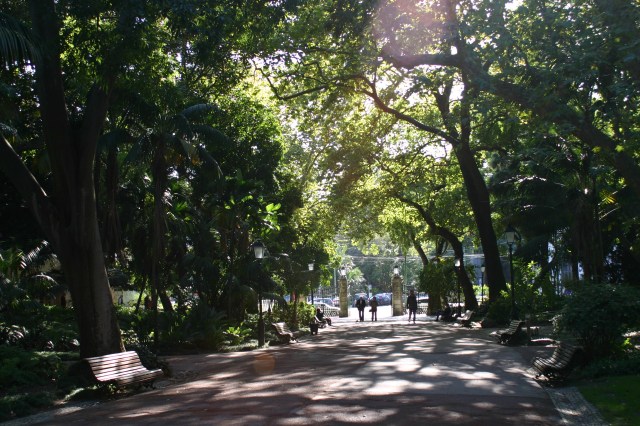
It was even better than in the Spring – luxuriant foliage was everywhere, people were out and about enjoying the space and the low autumn sunshine provided some wonderful lighting effects. I was particularly taken this time with the little ‘public library’ housed in a picturesque kiosk in the centre of the gardens. Obviously popular with a set of older men, who here, as in other parts of the gardens, were reading or playing cards- one suspects that they are regulars.

This seems to be a wonderful amenity and an idea that’s worth a try in UK parks and gardens! (or are there some examples already out there that I’m not aware of?)

I also mentioned in my previous article the various statues in the gardens and how these were placed here after the formation of the Portuguese Republic in the early 20th century. I made a point in this visit to seek some more of them out, as I had not noticed them before, hiding, as they seem to be, under trees or in mature shrubbery.

My visit felt rather like meeting up with an old friend, someone I hadn’t seen for some time. I was able to easily recollect their more important physical features and personaility traits, but was also drawn to some new features or angles on them. My ‘new look’ at Estrela was repaid not only with the uncovering  of more statues, but also with some superb scenes of dappled sunlight (including the dramatic back lighting of large exotic leaves), superb ‘Dragon’ and other trees, a fantastic decorative ceiling on the bandstand roof, lively play area, late summer blooms of Hibiscus and unusual tree conservation measures (filling in a hole in a trunk with brickwork!)

I wonder what the place must be like high summer when various events inlcuding live Jazz add yet another dimension to this magical place? Another visit beckons…..

Related article: Portuguese Gardens: Estrela Garden, Lisbon

Old School Gardener

The view to the River Tagus from the front of the Neccessidades Palace in Lisbon

The view to the River Tagus from the front of the Necessidades Palace in Lisbon

On our recent 15 mile trek across western Lisbon, we took in a park that is not often mentioned in tourist trails- that of the Necessidades Palace. The palace itself is a grand looking affair, now the country’s Foreign Office, so not open to the public. The view from outside is good in all directions- one way you look out across the River and the ‘Golden Gate- look alike’ bridge; turn round and you have the splendid pink and cream stone facade of the palace and ornamental fountains. The park is tucked round the back and has the air of somewhere that’s been a little forgotten of late.

Here’s what Wikipedia has to say about the Palace, a very important site in portuguese history:

‘Formerly a convent… it was built in the 18th century, by order of King John V, in gratitude for prayers answered by Our Lady of Needs, whose first devotional chapel stood on this site…The palace became the residence of the kings of the Braganza dynasty… Ferdinand of Saxe Coburg and Gotha, husband of Maria II, lived in this palace until his death, amassing a large collection of art, which would be dispersed after his death. The palace then underwent several renovations to accommodate the taste of the various monarchs who lived there, the most recent of which was carried out at the beginning of the twentieth century by Carlos I….

…The palace was the scene of memorable events in Portuguese history, some momentous, some tragic, some slightly ridiculous. One famous example: the king Pedro V had installed in the front door of the palace a slot through which his subjects could, if they wished to, leave messages and complaints for the attention of the sovereign. The last significant event at the palace, which would also be the epilogue of the monarchy, was the joint funeral of King Carlos and his son, Prince Luis Filipe, on 8 February 1908, after their assassination by radical republicans…’

The palace was shelled during the republican revolution in 1910 and subsequently most of its art and other treasures were moved to the Ajuda Palace (which we had visited a day or two before).

Today’s park (or ‘tapada’), evolved from a private hunting ground for the Kings of Portugal and it retains the feel of a semi wild place, but with areas of more defined botanical or garden interest. As you progress up the hill from the entrance next to the Palace you alternate between enclosed, wooded areas and open grassy plains. About half way up the scene turns into a more formal park setting with a a terrace sitting alongside a grand, glass-domed estufa (greenhouse) currently undergoing renovation. Looking rather like an enclosed amphitheatre, this space must have once been the setting for a theatrical display of a different kind- tiered ranks of exotic plants. How grand it must have looked. I hope that it will be fully restored and will no doubt be a gem of a place that will raise the profile of the park more generally.

Paths weave upward above the terrace, the otherwise peaceful setting being regularly interrupted by the sound of aircraft coming in to land at the City’s airport. Another grand building sits atop the park, set off by a fine fountain. This gives way to a wilder area with a round building that looks as though it may have been a windmill at one time. There are some superb areas of Agaves and other dramatic plants. The overall impression, though, is one of a parkland that must be great for a summer picnic, rather than a space where growing and showing interesting plants is the dominant activity. Apart from the domed glass house that is.

A place where once glorious scenes are slowly being reclaimed from the passage of time and nature’s path.

Old School Gardener

IMG_7748

Whilst in Lisbon visiting our Daughter and Son-in-law, we trekked across the City one day to take in some sights we hadn’t ‘done’ before. Having crossed the river on the ferry (our daughter lives in Almada on the other side of the River from Lisbon proper), we set off through a former down beat district that is now an up and coming arty crafty quarter and fell upon the ‘LX Factory’. This nestles under the huge April 25th Bridge in the district of Alcantara. ‘LX’ apparently is an acronym for Lisbon and this old factory complex is promoted as the City’s thriving centre of arts, crafts, and all manner of goods in the ‘shabby chic’ look that seems so popular these days.

The ‘passion for vintage’ extends to the site itself. Back in 1846 a threads and fabrics Company called “Companhia de Fiação e Tecidos Lisbonense”, one of the most important manufacturing firms in Lisbon, was estabslished here. Later a number of smaller industrial outfits occupied the buildings- which extend to nearly 25,ooo square meters. More recently, this rather dishevelled site has become  ‘a creative island’ full of many small firms and individual artists and crafts people as well as providing a stage set for a range of events related to fashion, publicity, communication, fine arts, architecture, music, etc.

The day of our visit- admittedly early in the day and out of season-  it was a little quiet and not really the ‘throbbing heart and soul’ it must be in busier times. Still, it was an interesting excursion, including a pavement- side coffee as we watched the maintenance men at work.

There were some fascinating and some beautiful murals on the exterior walls of the buildings (including some thought – provoking statements). I was particularly taken with the huge second hand book store which is housed in an old printing factory. The novelty here is that the printing machinery is still in place, elevated several meters above ground level, and books are shelved precariously way above head height!

Note to Self- must remember to return in high summer.

Further information: LX Factory Website

Old School Gardener

Tiered Box hedging in the lower garden

My recent trip to Lisbon, Portugal, was very much a ‘Garden Fest’ (even though it was really about seeing our Daughter and Son-in-law who live there). I seem to have found several more superb gardens and parks to add to those old favourites covered in earlier articles in the category ‘Portuguese Gardens’. The Jardim Botânico d’Ajuda (Ajuda Botanical Garden) was the first we visited, after an interesting tour of the nearby Royal Palace of Ajuda – richly decorated and with some ‘garden’ interest of its own- (more on that in a later article!).

History

The Ajuda Botanical Garden was a real find. The first and oldest botanical garden in Portugal, it is also without doubt one of the most beautiful I’ve visited in Lisbon. It was created in the 18th century for the Portuguese royal family.When the earthquake of 1755 hit Lisbon, the royal family was living in the palace of Belém (just down the hill next to the River Tagus), and which sustained relatively little damage. However, fearing more tremors, they camped in tents outside the palace for some time, and later, as the king refused to live in a brick building, the Marquis of Pombal (a powerful statesman who led the reconstruction efforts after the earthquake), had a wooden residence built for the royal family furtehr up the valley side. However (and how unlucky must the King have felt), a fire destroyed this building in 1791. So it was later replaced with the Palace of Ajuda.

In 1765, the King ordered naturalist Domingos Vandelli to create a botanical garden near the, then wooden, residence of the royal family. The king wanted to create a garden for his grandchildren, where they could play and learn about horticulture. Vandelli constructed the garden over the course of the following three years with the help of Júlio Mattiazi, who was master gardener of Europe’s oldest botanical garden in Padua, Italy.

About 25 years later Domingos Vandelli was appointed director of the Royal Botanic Gardens and in this position he collected some 5.000 different plant seeds from all over the world. During the 18th until the late 20th century, the garden was maintained by a number of different institutions, and more often than not it was neglected. In 1993, with the support of funds from the EU and the Lisbon Tourist Association, a reconstruction effort started, and the garden regained its earlier glory in 1997.


The Design

The garden is designed in Baroque style with a strict geometric layout and decorated with monuments. Occupying some 3.5 hectares on the side of the river valley, the garden is divided into two terraces connected with each other by a monumental Baroque staircase, the Escadaria Central.

The lower, bottom terrace, has an Italianesque layout with a geometric pattern of paths and long hedges of boxwood arranged around flower beds. Plenty of tall trees provide some welcome shade. At the center of the lower level stands a monumental fountain, the Fonte das Quarenta Bicas (Fountain of the Forty Spouts). The 18th century fountain actually has 41 water spouts, disguised as serpents, fish, sea horses. Other statues of frogs, shells and ducks decorate the fountain that is placed at the center of a large basin with water plants.

At the western end of the lower level there are some exotic plants as well as a small rock garden, but the most interesting exotic plants are housed on the upper level where there are some remarkable specimens, most notably a 400 year old dragon tree and an equally large Schotia Afra. There is also a fair number of smaller plants such as the colorful Tecoma Capensis and the Japanese Camellia.

As a bonus, there are not just plants in the botanical gardens; plenty of peacocks strut around the gardens, doing their best to ignore the visitors!

I also had a pleasant time chatting to one of the gardeners, who was setting out leaf cuttings in one of the large glasshouses, this one devoted to a wide ranging collection of succulents, many beautifully arranged in naturalistic table top settings. This gardener was hugely complimentary of Kew Gardens, where she had worked and  was, she said, trying to recreate something of that wonderful exotic collection here. She was doing a grand job, and I told her so.


Look out for the next instalment in this latest ‘Gardens Tour of Lisbon’!

Source: A View on Cities

Related articles:

Oranges and Azulejos: Portuguese Heritage Gardens

PicPost: Great Garden @ Pena Palace Park

PicPost: Great Garden @ Praça do Império Garden, Belem, Portugal

PicPost: Great Garden @ Buddha Eden, Portugal

Portuguese Gardens: Tropical Botanical Gardens, Belem

Portuguese Gardens: Braga

Portuguese Gardens: Estrela Garden, Lisbon

Old School Gardener

Finding Nature

Nature Connectedness Research Blog by Prof. Miles Richardson

Norfolk Green Care Network

Connecting People with Nature

Discover WordPress

A daily selection of the best content published on WordPress, collected for you by humans who love to read.

Susan Rushton

Celebrating gardens, photography and a creative life

Unlocking Landscapes

Writing, photography and more by Daniel Greenwood

Alphabet Ravine

Lydia Rae Bush Poetry

TIME GENTS

Australian Pub Project, Established 2013

Vanha Talo Suomi

The Journey from Finnish Rintamamiestalo to Arboretum & Gardens

Marigolds and Gin

Because even in chaos, there’s always gin and a good story …

Bits & Tidbits

RANDOM BITS & MORE TIDBITS

Rambling in the Garden

.....and nurturing my soul

The Interpretation Game

Cultural Heritage and the Digital Economy

pbmGarden

Sense of place, purpose, rejuvenation and joy

SISSINGHURST GARDEN

Notes from the Gardeners...

Deep Green Permaculture

Connecting People to Nature, Empowering People to Live Sustainably

BloominBootiful

A girl and her garden :)