Tag Archive: kitchen garden


Old School Garden's Kitchen Garden cropping plan 2016

Old School Garden’s Kitchen Garden cropping plan 2016

It’s getting to that time of year when we ‘kitchen gardeners’ like to think about our plans for next year’s food crops. Here are a few thoughts on how to approach this with an eye on maximising what you get for your efforts and minimising costs and waste….


1. Grow only the crops you’ll eat (but also try out something new?)

2. Think ahead and work out how much time you can spend each week before deciding what to grow.

Maximise space by using vertical growing containers like this simple 'A' Frame made from pallets

Maximise space by using vertical growing containers like this simple ‘A’ Frame made from pallets

3. Draw up a cropping plan of what you will grow during which season and where in the plot, trying to avoid growing the same things in the same place as last year. And try to maximise the use of your plot by early sowings (e.g. Broad Bean, garlic and onion sets in the autumn) and late sowings (e.g. carrots, lettuce and other winter vegetables). Also, think about planting green manures to provide soil cover and which can be dug in as a soil feed before you sow your first crop of vegetables.


4. Choose pest and disease resistant varieties where available (but have an eye on quality too).


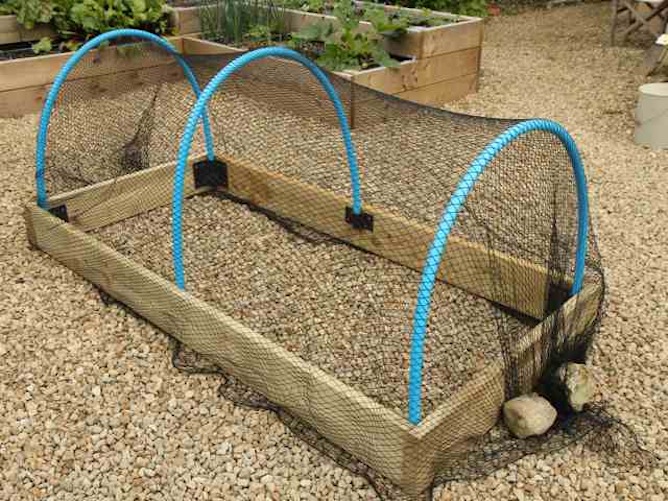
5. Invest in fruit cages and crop covers to protect your produce. Plastic plumbing pipe can provide a relatively cheap frame on which to fix various kinds of protection- including fleece and other material to help warm up your beds as well as keeping pests off.


Plastic pipes can provide a good frame for protection

Plastic pipes can provide a good frame for protection

6. Concentrate on growing fewer crops well.

7. Avoid growing too much of one thing or you’ll have waste to throw away (or perhaps pass on to neighbours). Grow small quantities at different times to avoid a glut (‘succession planting’); think about dividing up your plot into smaller parcels (maybe usuing ‘square foot gardening’) and grow varieties that aren’t ‘F1’ hybrids as their plants tend to produce at the same time.

'Square Foot Gardening' can help to manage the range, timing and amounts of produce

‘Square Foot Gardening’ can help to manage the range, timing and amounts of produce

8. Avoid crops that aren’t worth the effort-  either because they’re difficult to grow, unreliable performers or where the cost and quality of what you can buy in the shops makes it sensible to buy rather than grow your own.

Source: ‘Short Cuts to Great Gardens’- Reader’s Digest 1999

Old School Gardener

WP_20151007_15_37_25_ProI finally got round to visiting a place I’d wanted to see for some time- Voewood, an arts and crafts masterpiece in north Norfolk.

Taking advantage of the ‘Invitation to View’ scheme we set off on a rather wet and windy day a week or two ago to High Kelling, near Holt.

Our tour of this private house was full of surprises and curiosities. Owned by a rare books and art dealer Simon Finch (who now lives in one of the coach houses) it has been decorated over the years in a very individual style with plenty of personal mementoes and artworks, many hailing from the 1960’s and 70’s. The house with its fourteen bedrooms can be hired out and it also acts as a centre piece for an arts festival.

This slideshow requires JavaScript.

The house was designed (1903-5) by Edward S. Prior. Voewood is perhaps one of the greatest achievements of house design of the Arts and Crafts movement. More than almost any other building of the period the house fulfils the ideals for architecture developed by William Ruskin and William Morris.  In the designing and building of Voewood many of Prior’s philosophical ideas found physical expression.

Its design and construction were characterised by the use of radical planning and forms, innovative technologies, such as the use of reinforced concrete, extensive external decoration, a distinct building philosophy involving craftsmanship and the use of quality local materials and the integration of the building and its interiors with the garden and its surroundings.

The house is based on a butterfly plan. The three storey central portion of the house is flanked by splayed two-storey wings. The plan enabled Prior to maximise views out and to give the best orientation to a range of rooms. He could also relate the external spaces to the internal areas. The area contained within the splay faced the gardens, with the northern of the wings acting as the entrance, with a two storey porch and daylight basement. This wing also contained the library and billiard room at ground floor level. The wing opposite contained the kitchen and service accommodation together with the dining room. The fruit and vegetable garden lay adjacent. The entrance, through oak doors, leads into a six-sided hall up a straight flight of Hoptonwood stone stairs into an octagonal lobby.

Though never lived in by its original owners (there seem to be various theories as to why, including its proximity to a then T.B. hospital), the house was turned into an old people’s home and has also been a hotel. And despite some alterations (e.g. the closing in of two flanking loggias), it has retained most of its original features. I was especially impressed by the construction which used concrete formwork on a (then) extensive scale, resulting in nicely rounded corners to walls and window openings and some chunky concrete beams which provide an interesting, simple decorative feature to many ceilings. However, I was a little disappointed with the window and other ironmongery which, in contrast to many other houses of this style and period (see, for example my recent post on Goddards, York), was rather plain. Perhaps this is further evidence of the alterations carried out in the 1930’s.

Though visiting on a damp October afternoon when there was not much floral interest to be seen, the gardens still managed to impress. The main layout from the back of the house appears to follow its original stepped, symmetrical design, whereas the former kitchen garden to the side has been skillfully turned over to a rather more ornamental layout, though retaining many good examples of wall-trained fruit.

This slideshow requires JavaScript.

The original gardens were of great renown and highly regarded. Voewood was perhaps Prior’s greatest garden design. Garden making was a preoccupation of his middle period. Terraces extend from the wings of the house and end in steps leading down to the garden level. The garden is also reached from the terrace by a double flight of steps leading to two stone paths, separated by a water feature in the form of a stepped stone tank containing water-lilies, iris and forget-me-not. The central feature of the garden is a large basin. Pergolas with masonry walls lead east and west.

The garden at Voewood (then called Home Place) was admired by Gertrude Jekyll and Sir Lawrence Weaver, who described and illustrated it in their book Gardens for Small Country Houses;

“The stepped scheme at Home Place, Holt, designed by Professor E.S. Prior will be a counsel of perfection to most people”.

Further information: Voewood website

Old School Gardener


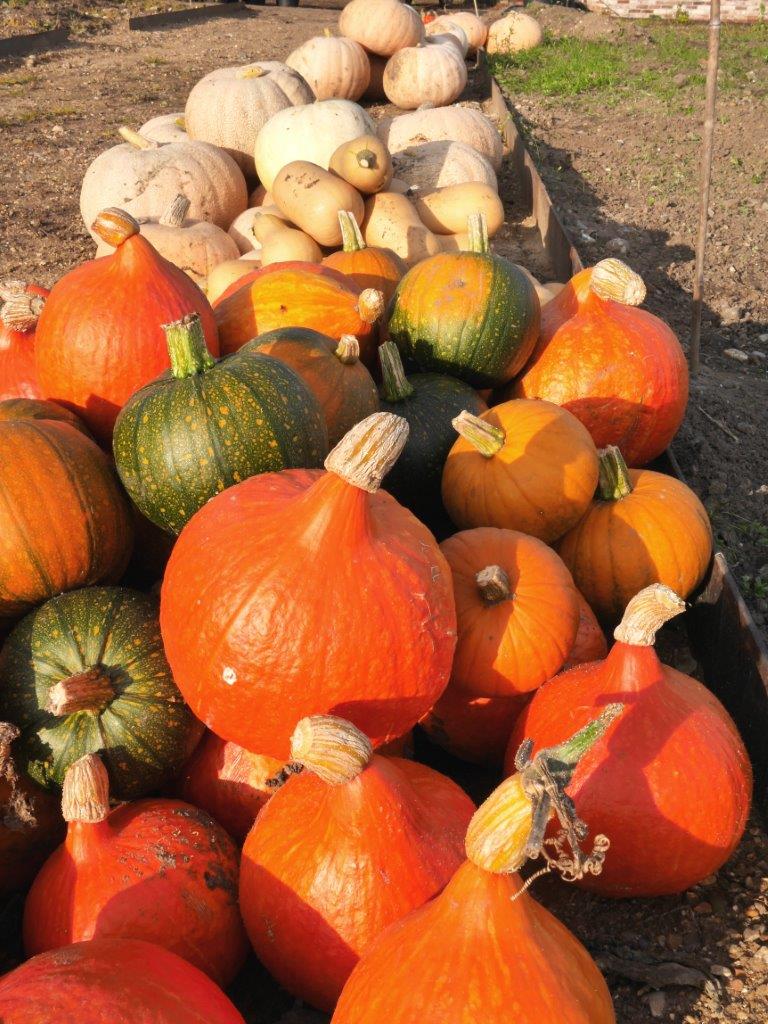
P1000307It was great seeing how the pumpkins and squashes that I’d help to plant only a couple of months ago had taken over a large part of the walled garden.

On my most recent visit to blickling, together with new volunteer Gordon, I picked a large number and many heavy weight fruits on a bright, sunny day. We then managed to fill two trailers with the remaining foliage and stems and raked over the ground to leave it for weedkilling action; Project Manager Mike doesn’t like to use chemicals like this, but manpower is limited so it’s a must do in the short term to keep the ground under control.

The pumpkins will probabaly be used in the Hall’s forthcoming Hallowe’en events and the squashes in the restaurant, so its good to see that the developing kitchen garden is continuing to be of practical value.

After that we joined the ladies in weeding the well stocked veg patch along the south facing wall. This all looks very neat, healthy and tidy, despite the threat of rabbits and pigeons.

The Gardens continue to show a great range of colours and textures with Japanese Anemones, Sedums and various grass flowers now adding their sublety to the mix…

Last week I commented on how pleased I was at being able to identify (with their latin botanical names) three plants I was asked about by visitors. I said then it was probably a fluke, and sure enough this day, when asked by a visitor to name a rather unusual pink flower in the double borders, I was stumped- but then again so was another volunteer and one of the gardening staff! I’m trying to find out its name; I think it might be a Salvia of some sort- I’ll post a picture, and its name in my next Blickling post!

WP_20150917_14_13_26_ProFurther Information:

Blickling Hall website

Blickling Hall Facebook page

A 360 degree tour of Blickling Hall

Old School Gardener


My latest visit to Blickling focused on the Moat- which runs along three sides of the Hall- and tidying the well stocked borders and edging the fine turf.

I also popped along to the Walled Garden and saw Mike the Project Manager hoeing out weeds among the ever- expanding growing areas. The main plot looked splendid.

This slideshow requires JavaScript.

Old School Gardener

WP_20150107_11_25_59_ProIt’s early January and a perfect time to think about what you’re going to grow in the coming year, putting this down on paper (especially for food crops) look through your seed collection, and plugging any gaps. With not much to do in the garden at present, this is just what I’ve been up to in the last couple of days.

I’ve done what I usually do- slotted the packs of seeds I’m going to use into a weekly organiser so that I know when to sow them (always being prepared to adjust this if the weather doesn’t quite go to expectations where outdoor sowings are concerned), adding in a few more things where I want to grow more succession crops (e.g. carrots) or widen the range (e.g. squashes).

I’ve also bought some additional asparagus crowns to add to the bed I started last year (only a couple of plants came through their first season). As last year, I’ve been collecting seed from some plants and adding to my collection through purchases, including taking advantage of the RHS Members’ Seed Scheme where I can buy packs of 12 different seeds for just £8.50. I placed my order yesterday and look forward to receiving some interesting ornamentals to add to Old School Garden.

As far as food is concerned I’ve prepared a new plan for the Kitchen Garden and showed both early and follow on crops…kitchen gdn 2015Changes for this year include:

  • Relocating the three large pots of blueberries – I’m planning to partly sink these into the ground in a spot where I can more easily erect a bird proof cage over them and at the same time release some gravelled space next to the Greenhouse and Cold Frame where I can store pots and trays for ‘hardening off’ new plants.

  • Growing more carrots and parsnips in plastic dustbins, as my experiment last year worked quite well and provides some extra growing space when the rest of the garden is pretty well full.

  • I’ve substituted one Blackcurrant bush with a White currant to improve the balance of the fruit we have and bought ten raspberry canes (two varieties of summer fruiting to plug some gaps in the rows and hopefully improve fruiting).

  • I’m also continuing to install plastic hoops (I’ve used plumbing pipe available from DIY stores) over some more beds to enable me to use plastic/ enviromesh/netting to provide a warm micro climate and protection from pests.

Let’s hope for a productive year!

Old School Gardener

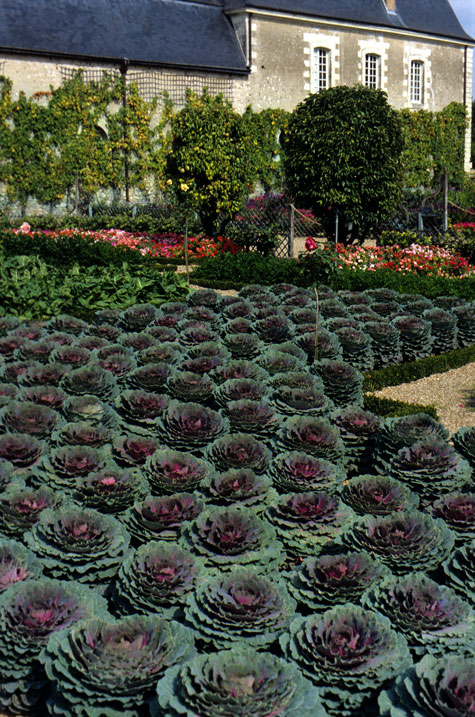
kale-at-the-chateau-villandry

Kale at the Chateau- Villandry

gravetye manor

Elliptical food growing in the walled garden at Gravetye Manor, former home of ‘natural’ gardener William Robinson

IMG_7453

‘If well managed, nothing is more beautiful than the kitchen garden: the earliest blossoms come there: we shall in vain seek for flowering shrubs in March, and early April, to equal the peaches, nectarines, apricots, and plums; late in April, we shall find nothing to equal the pear and the cherry; and, in May, the dwarf, or espalier, apple trees, are just so many immense garlands of carnations. The walks are unshaded: they are not greasy or covered with moss, in the spring of the year, like those in the shrubberies: to watch the progress of crops is by no means unentertaining to any rational creature; and the kitchen- garden gives you all this long before the ornamental part of the garden affords you anything worth looking at.’

William Cobbett: The English Gardener 1829

Old School Gardener

PicPost: Kitchen Garden of the Future?

Old School Gardener

raspberriesAnother guest article by one of the participants in the ‘Grow Your Own Food’ course I ran recently in Foulsham, Norfolk.
Raspberries – A superfood that tastes better than spinach-what’s not to like?!

by Chris Richmond

Health

Antioxidant and anti-inflammatory phytonutrients in Raspberries may have anti-cancer benefits and assist in the management of obesity, though possibly not if eaten with oodles of cream.

However, raspberries are among a small number of foods that contain measurable amounts of oxalates. When oxalates become too concentrated in body fluids, they can crystallize and cause health problems. For this reason, individuals with already existing and untreated kidney or gallbladder problems may want to avoid eating raspberries.

So…everything in moderation, even raspberries- unfortunately.

Varieties

There are two types of raspberry available to the kitchen gardener. Summer-fruiting varieties will crop at any time from the beginning of July to early August on stems of last season’s growth; autumn-fruiters bear their berries over a longer period – from mid-August to the first frosts – on the current season’s growth. Both are similarly easy to care for but require slightly different pruning techniques. As long as you know how to wield your secateurs around them there is little mystery to growing these accommodating fruits and their length of service – up to 12 years – means they give a lot back in return.

‘Glen Ample’ AGM – Delicious, large fruit produced in mid-summer on this extremely heavy-yielding summer cultivar with vigorous, upright, spine-free canes. The berries are produced on long, upright stems, making picking easy.

‘Glen Moy’ AGM – This early summer raspberry bears heavy crops of medium to large berries, which have a good flavour. It may also produce a small crop on the new canes, in autumn. The spine-free canes are compact.

‘Leo’ AGM – This cultivar is one of the latest summer raspberries to ripen, producing large, firm fruits with an excellent flavour. The stems are very long, so harvesting is easy. Site in a sheltered position.

‘Malling Admiral’ – A summer raspberry bearing good yields in mid- to late summer on strong-growing, tall canes, which are best sited in a sheltered spot. The flavour is excellent, and the large berries ripen to deep red.

‘Autumn Bliss’ AGM – The short, sturdy canes of this popular autumn cultivar produce high yields from late summer to mid-autumn. The fruit is large and deep red with a firm texture and excellent flavour.

‘Polka’ – This new autumn cultivar ripens two weeks earlier than ‘Autumn Bliss’, bridging the gap between summer and autumn. It produces very high yields of large, well-flavoured fruit.

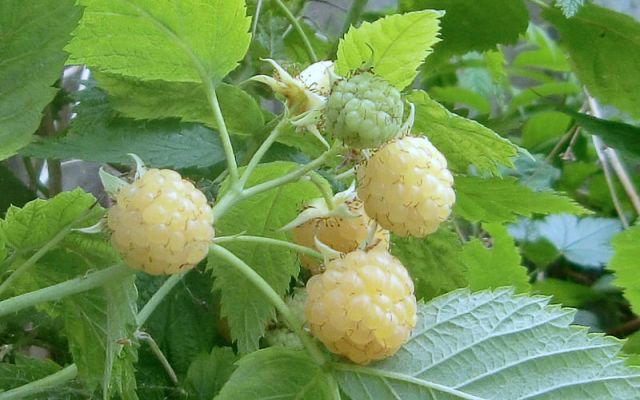
A Golden Raspberry Variety

Preparation

Like most edible crops, raspberries produce a better yield when grown in full sun. However, thanks to their woodland origins, they can be grown in a degree of shade too, as long as they receive at least a few hours of direct sunshine each day. They prefer slightly acidic soils, which is great news for gardeners who struggle to grow plants in these conditions. They like it to be moist as well, so be prepared to water the plants as they establish – but beware of waterlogged winter ground.

Be prepared to put in a bit of effort to get soil conditions just right before planting: thoroughly dig down to a spade’s depth along a row 90cm wide. Turn it over and remove any weeds, especially perennial types (such as bindweed and horsetail) and their roots.

Raspberries are shallow rooted, which means there won’t be much of an opportunity to weed as meticulously once the plants are in place, for fear of damaging their root system. They are also heavy feeders, so for every plant you intend to grow incorporate a bucketful of well-rotted manure or compost while digging, turning it all into the soil. Ideally soil preparation should be complete a month before planting; at the very least you should allow two weeks to give the earth time to settle.

They might play second fiddle to their Wimbledon-associated cousins on shop shelves but on the plot there should be no such bias – raspberry plants crop reliably year-after-year and ask for little in return. They even thrive in partially-shaded areas where few fruit or vegetables would grow. And such is their hardiness that they will produce a bumper crop of their sweet, mildly acidic fruits even in disappointing summers – a valuable trait given the last few we’ve experienced. They’re a great choice for those gardening in cooler, northern climates – as they flower late in the spring there is little danger of them being damaged by unexpected late frosts.

Planting

With a well-prepared growing area in place, planting shouldn’t present any difficulties. Buy in certified disease-free, one-year-old plants (usually called canes) from a reputable nursery or mail-order catalogue. They are usually acquired bare rooted, packaged up into bundles ready for planting. The best to time to plant them is in the autumn, from October through to early December, as the soil still retains a degree of warmth which will help the roots to grow and quickly settle the new introductions into place. If this isn’t possible they can, however, be planted any time up to March.

Position each cane into a shallow hole about 22cm wide and 7cm deep, spreading the roots evenly across the bottom. Backfill and firm in around them as you go, making sure that the soil mark on the canes is at least level with the surface and up to an inch beneath it – this will encourage extra root growth and quickly anchor the plants into place. Space them 45cm apart within the row, leaving 1.8m between further rows to allow room for the roots to spread sufficiently and enough space for picking.

The tall, gangly canes will need to be supported, so set up a suitable support system at planting time. The best system is a simple post-and-wire set-up – hammer in two sturdy, 2.4m-high posts at either end of the row, 60cm into the ground and 3m apart. Stretch three galvanised wires horizontally in-between them at heights of 75cm, 1m and 1.5m.

The top wire can be omitted if you’re growing an autumn-fruiting variety as they are much sturdier and require less support.

Grow your own tip- If you only intend to grow a few plants you can do away with a complete post and wire system and simply position up to two plants at the base of a single post for support. As the stems grow upwards, tie them loosely to the post using garden string.

Growing

Immediately after planting your canes, cut each one just above a bud so that they’re 30cm in height. By spring, new shoots will appear from the base of the old cane and these will need to be tied into the wires as they reach them. The original cane can be cut right down to about 3cm above ground level at this point, again just above a bud. Remove any weak shoots in this first summer and any appearing more than 20cm from the row. Be disciplined and remove any flowers that develop in the initial season too – the object of the first year is to establish a good base and allowing plants to channel energy into setting fruit will compromise this effort. In the following years pruning is simple, although it’s important to use the correct method depending on whether you’ve opted for summer- or autumn-fruiting varieties. The former should be cut right back to ground level as soon as they have finished cropping.

At this stage there will already be plenty of new growth at the base of the plant and these will be the fruiting stems for next year. Tie them into your support system using garden string, so that each stem is spaced around 10cm from the last. Cut down any spindly stems or those growing away from the row. Towards the end of the growing season, loop over and tie in place any really tall stems to prevent them falling over in the wind over winter. In early spring, before growth commences, cut them back to a bud about 15cm above the top wire so that they are uncluttered and in a good position when they start fruiting.

Pruning autumn-fruiters is much more straightforward – just cut back all of last year’s canes to ground level before growth starts in February. New shoots will appear from the base by spring and these should all produce fruit on the upper stem sections.

Crop care

Feeding and watering are pivotal to the success of a raspberry crop. Keep your canes moist and well-fed and, coupled with the correct pruning regime, you should be carrying away punnets full of berries. Watering is particularly important at flowering time, as the fruits swell, and during any dry spells.

Applying a thick layer of organic matter as a mulch in early spring will help to lock-in moisture (make sure the soil is moist beforehand) as well as feed the canes. Be generous – make it at least 5cm deep and more if you can spare it. Any well-rotted organic matter such as compost or manure will do but avoid mushroom compost – it is alkaline and therefore unsuited to the acid-loving plants. Mulches will also help to naturally nourish the soil and stifle weed growth. As raspberry roots are very shallow and can easily be damaged by hoeing, any weeds that make it through the mulch will need to be removed by hand.

New shoots that appear away from the main row or post are called suckers. It will be difficult to tie them in to the support system – instead, you should remove them by lifting them out of the soil, then use secateurs to sever them from the parent plant below ground level.

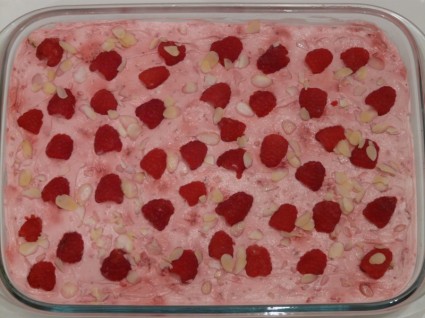
Raspberry curd quark dessert- one of many delicious sweets using raspberries

Raspberry curd quark dessert- one of many delicious sweets using raspberries

Stolen without permission from various websites including:

www.rhs.org.uk

www.growfruitandveg.co.uk

Finding Nature

Nature Connectedness Research Blog by Prof. Miles Richardson

Norfolk Green Care Network

Connecting People with Nature

Discover WordPress

A daily selection of the best content published on WordPress, collected for you by humans who love to read.

Susan Rushton

Celebrating gardens, photography and a creative life

Unlocking Landscapes

Writing, photography and more by Daniel Greenwood

Alphabet Ravine

Lydia Rae Bush Poetry

TIME GENTS

Australian Pub Project, Established 2013

Vanha Talo Suomi

The Journey from Finnish Rintamamiestalo to Arboretum & Gardens

Marigolds and Gin

Because even in chaos, there’s always gin and a good story …

Bits & Tidbits

RANDOM BITS & MORE TIDBITS

Rambling in the Garden

.....and nurturing my soul

The Interpretation Game

Cultural Heritage and the Digital Economy

pbmGarden

Sense of place, purpose, rejuvenation and joy

SISSINGHURST GARDEN

Notes from the Gardeners...

Deep Green Permaculture

Connecting People to Nature, Empowering People to Live Sustainably

BloominBootiful

A girl and her garden :)