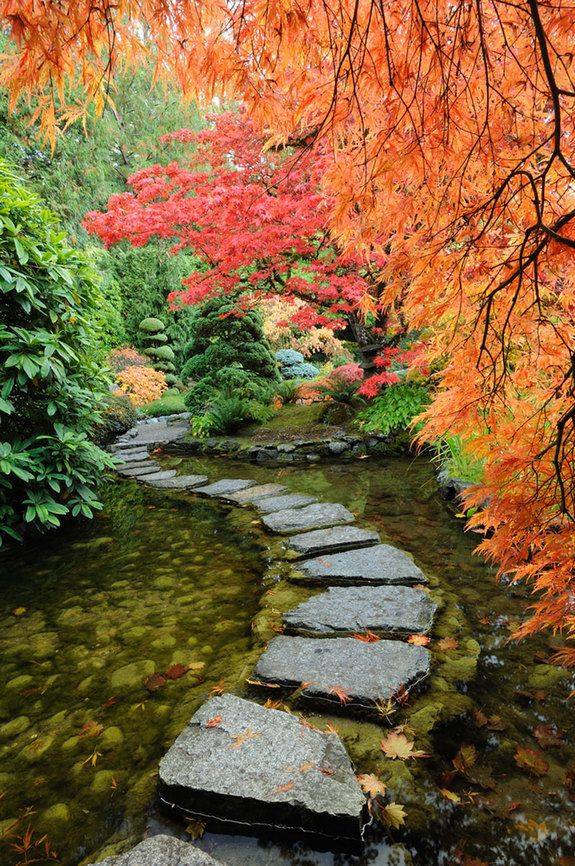
Maples (Acers) provide glorious autumn colour in this Japanese style garden
Today’s ‘snippet’ on different garden styles focuses on a very distinctive form, ‘Japanese Gardens’.
Japanese gardens have a balance which is achieved through the careful placing of objects and plants of various sizes, forms and textures. These are placed asymmetrically around the garden and are often used in contrast – rough and smooth, vertical and horizontal, hard and soft. These gardens often create miniature idealized landscapes, frequently in a highly abstract and stylised way. Pruning and garden layout are usually considered to be more important than the plants themselves which are used sparingly and with restricted use of both different species and colours.
Historically, there are four distinctive types of Japanese garden:
Rock Gardens (karesansui) or Zen Gardens, which are meditation gardens where white sand replaces water
Simple, rustic gardens (roji) with tea houses where the Japanese Tea ceremony is conducted
Promenade or Stroll Gardens (kaiyū-shiki-teien), where the visitor follows a path around the garden to see carefully composed landscapes
Courtyard Gardens (tsubo-niwa)
Saihouji kokedera- the moss garden begun in the 14th century
Heian jingu shinen – stepping – stones in the garden of the first Kyoto Imperial Palace- these stones were originally part of a 16th century bridge over the Kamo river which was destroyed by an earthquake
A modern japanese garden from 1934 (designed by Mirei Shigemor), built in the grounds of a 3rd century Zen temple in Kyoto
Other key features of Japanese Gardens include:
Typical Japanese plants – e.g. Azalea, Camellia, Bamboo, Cherry (blossom), Chrysanthemum, Fatsia japonica, Irises, Japanese Quince and Plum, Maples, Lotus, Peony, Wisteria and moss, used as ground/stone cover
Water features and pools
Symbolic ornaments
Gravel and rocks
Bamboo fencing
Stepping stones
Adachi Museum of Art garden
A modern Moss garden in Kyoto
Use of gravel and rocks along with bamboo screens
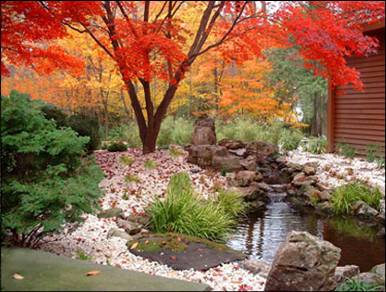
Water landscape with typical japanese planting
Bonsai- literally meaning ‘plantings in tray’ – is a Japanese art form using miniature trees grown in containers. The purposes of bonsai are primarily contemplation (for the viewer) and the pleasant exercise of effort and ingenuity (for the grower). Bonsai is not intended for food production, medicine, or for creating domestic or park-size gardens or landscapes, though some people display their bonsai specimens in garden settings, as this video shows.
Let me know what you think makes a Japanese style garden, and if you have some pictures I’d love to see them!
If you’ve enjoyed reading this post and others on this blog, why not comment and join others by signing up for automatic updates via email (see side bar, above right ) or through an RSS feed (see top of page)?





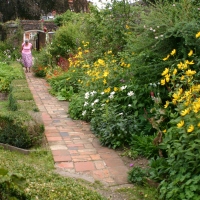


 Old School Garden