Tag Archive: heritage


My mother – in – law is currently on a two week visit to us. A keen gardener (she was until a year ago Chair of the Tavistock Ladies Gardening club), she is not as mobile as she once was (she celebrated her 83rd birthday last week). However, she still enjoys looking at gardens so this is a great excuse (as if I needed one) to get out and about to see some interesting local gardens. The weather has also been kind so we’ve been to a few places that I haven’t been before, or haven’t seen for a good number of  years. Two of them are in Norwich, our local cathedral city, and they are fine examples of gardens developed for very different reasons; the one out of  the passion of a Victorian entrepreneur, the other based on a medieval religious garden.

The Plantation Garden

The Garden in 1897

In 1856, a prosperous upholsterer and cabinet maker living in Norwich, took a long lease on an industrial site just outside the old City walls. His name was Henry Trevor, and for the next forty years, he spent considerable sums of money and much effort transforming a chalk quarry into a magical garden.

Henry Trevor

In many ways, Henry Trevor’s garden was typical of Victorian taste and technology. He built a fountain, terraces with balustrades, rockworks, a Palm House, and a rustic bridge. He planted elaborate carpet beds, woodlands and shrubberies. He designed serpentine paths to conduct the visitor along circular routes, and he built and heated several greenhouses with boilers and hot water pipes.

Henry Trevor, however, was also a man of strong personal tastes. His “Gothic” fountain is unique, and he displayed great enterprise in using the fancy bricks from a local manufacturer to create medieval style walls, ruins and follies. Within less than 3 acres, he established a gentleman’s residence and garden that reflected in miniature the grand country houses of the Victorian period. Visitors were frequently welcomed in the garden by Henry Trevor, for he was always ready to allow his garden to be used for charitable causes.

The Garden in Victorian times- the Palm House no longer exists.

After the 1939-45 war, the garden was virtually abandoned. Fortunately, much of the structure has survived, and is gradually being restored by the The Plantation Garden Preservation Trust. The first task of its members was to clear a forest of sycamores and a blanket of ivy to reveal what had become hidden during the past 40 years. Since then, they have restored the flowerbeds, fountain, balustrading, Italian terrace, rustic bridge and in 2007, the Gothic alcove.

Trevor’s original passion has been matched by this band of volunteers and our visit, on a beautifully sunny afternoon, showed considerable progress in the restoration programme since my last visit some years ago. I was particularly impressed with the enormous amount of work done to stabilise, weed – proof and replant the steeply sloping sides of the garden, which remain topped off with a range of majestic Beech and other trees.

The Bishop’s Garden

Our second visit, on one of it’s open days in aid of local charities, was to the Bishop’s Garden, a four acre green oasis in the centre of Norwich, sitting in the shadow of the Gothic cathedral.

There has been a garden of sorts since around 1100 AD when Bishop de Losinga began to build the cathedral and palace. From the existing garden one can still marvel at the original detailing of Norman stonework on the North Transept of the cathedral which is only visible from the Bishop’s Garden.

In the early 14th century, Bishop John Salmon greatly increased the size of the garden by compulsory purchase of additional land. The general form of the garden was laid down at least 300 years ago. The lower end was cultivated and separated by a wall running straight across the garden. The colossal Old Bishops Palace which still stands was completed in around 1860. In 1959 a major change took place when a new Bishops House built and the Old Palace came to be used by Norwich School. The garden was reduced from 6 and half acres down to the present 4 acres. Records show that in the 1940s up to 15 gardeners were employed reducing to 9 in the 1950’s and today the garden is looked after by 1 fulltime and 1 part time gardener, plus a team of volunteers.

The garden has a range of features typical of many grand gardens developed over the last hundred plus years – large herbaceous borders (which have a persistent ground elder problem and are to be successively dug up and weeds systematically removed in the coming couple of years), a small woodland walk and box – edged rose beds. There is a long shade border with Hostas, Meconopsis and tree ferns, all but the latter looking splendid on our visit. There is also a large wild grass labyrinth, very popular with children (I walked it and contemplated my life as I went…). This is of a size where it can be easily mown using a ride on mower, the gardener told me that he cuts it all down in the autumn and then the path edges are left for the various wild flowers and other species to grow up over the growing season.

There are also extensive shrubberies containing many rare and unusual plants, among these being a Hebe planted from a sprig taken from Queen Victoria’s wedding bouquet in 1840. There is an organic kitchen garden and  ‘bambooserie’. The garden continues to evolve with new plants and features being introduced year by year. The Bishop’s Garden has developed links with Easton College, helping horticulture students gain valuable experience.

Though busy on our visit, including delightful music from a local Youth Orchestra and Choir, one can imagine the garden creating a peaceful mood – one where a succession of Norwich Bishops, stretching back 1000 years, paused to reflect, pray and secure spiritual renewal.

Sources and Links:

The Plantation Garden

The Bishop’s Garden

Old School Gardener

If you’ve enjoyed reading this post and others on this blog, why not comment and join others by signing up for automatic updates via email (see side bar, above right ) or through an RSS feed (see top of page)?

An Oscar Winner?


‘The pargetting at 25-27 Church Street, Saffron Walden (below and featured in my recent post ‘Milling, Mazes and Millionaire Shortbread’), has just been shortlisted for the prestigious Museum + Heritage awards in the restoration and conservation category, the conservation equivalent of an Oscar according to owner, Douglas Kent.

Church St

The work involved the exterior pargetting, especially of two huge figures which, legend says, were the giants, Gog and Magog. Kent, however, has discovered that they were more likely to be taken from a novel by the 17th century owner and author, William Winstanley. ‘I knew they were in a parlous state but when we looked closely there were doubts they could be saved.’ New techniques and £30,000 have stabilised them – very important as the two figures are perhaps the most memorable feature of the town. Kent, who had no grants towards the work, has decided to paint them in a creamy off-white though they were probably buff coloured originally. He has also decided on three extra ‘Invitation to View’ opening days, Wednesday, June 26 at 2.30 pm; Thursday, August 1 at 11 am and Wednesday, September 4 also at 11 am. The winner of the award will be decided on May 1.’

Source: ‘Invitation to View’ Newsletter, April 2013

Entrance to the Estrela gardenFollowing my article about Portuguese Heritage Gardens, I thought I’d turn my attention to a few of my favourite public gardens in that country. I’m beginning with one of my real favourites, one I love to return to when I’m in Lisbon (not that that’s very often!).

It’s the Estrela Garden (the Jardim da Estrela or Garden of the Star) which has a wonderful blend of exotic, artful, friendly charm with an atmosphere from the best of classic 19th century neighbourhood parks and gardens. It’s no surprise, then , that it remains as one of the most popular gardens in Lisbon. The orignal layout – 19th century romantic landscape style – features plenty of exotic plants and a central pond.
It is known officially as the Jardim Guerra Junqueiro (Junqueiro was a famous poet and politician who was a key figure in the downfall of the Portuguese monarchy and the establishment of the Portuguese Republic in 1910). In the 1840s the governor of Lisbon saw the need for a public garden in the densely populated city, and thanks to a donation by a wealthy baron, the governor was able to acquire the area  (5 acres) opposite the Estrela Basilica. Work on building the garden started in 1842 but due to the outbreak of war and financial difficulties, it didn’t open to the public for another ten years.

The gardens are laid out in a landscaped style with plenty of exotic trees, cacti, flower beds and a pond with fountains. The garden is especially popular with locals who come here during weekends to socialize, stroll along the paths, have a drink at the café, or play cards at one of the permanent tables among the trees.

The garden was designed by gardeners Bonard and João Francisco and it originally featured several romantic structures such as a gazebo and a Chinese pavilion. These structures are no longer there, but there are plenty of sculptures and a 19th century wrought iron bandstand, originally located at the site of the City’s main boulevard, Avenida da Liberdade. It was moved here in 1936.

After the creation of the Portuguese republic, several statues were installed in the park, the most expressive of which is of a farmer (sculptor Costa Mota,1913).  There is another of a female nude known as ‘O Despertar’ (sculptor Simões de Almeida).The most famous statue in the park is probably that of the Guardadora de Patos (keeper of the ducks) – a limestone replica of the marble original from 1914, it shows the protagonist of a popular fairy tale. Other statues include a dog spouting water from its mouth and 3 other busts depicting poets and an actor. More recent additions include a children’s playground and a pond-side cafe. The garden hosts the annual  Out Jazz festival – on Sunday afternoons during this time (usually May), Jardim Estrela will be alive with music and people enjoying the Sunday evening jazz in the open air auditorium.

Beyond the park is the English Cemetery, founded in 1717 and originally shared with the Dutch community. Novelist Henry Fielding, author of Tom Jones, died during a visit to Lisbon and is buried here.

Here are some images to let you get the feel of the place.

Source: A View on Cities

Old School Gardener

If you’ve enjoyed reading this post and others on this blog, why not comment and join others by signing up for automatic updates via email (see side bar, above right ) or through an RSS feed (see top of page)?

‘At the heart of this serene rural estate is Mottisfont Abbey, set in glorious grounds alongside the fast-flowing River Test.

There are many layers of history for visitors to explore, including the Gothic remains of the original 13th-century Augustinian priory.

In the mid-20th century the final private owner, society hostess and patron of the arts, Maud Russell, used the Abbey as a base for her racy and intriguing life.

The River Test is one of the finest chalk streams in the world and the walled gardens house the National Collection of old-fashioned roses.’

On a recent trip to southern England I visited Mottisfont Abbey, Hampshire. Now run by the National Trust this house and gardens is famous for its roses – alas I will need to return in the summer to appreciate them! It also has a rather good Winter Garden and because of the bright sunshine I was able to capture some attractive images of the gardens and grounds. I hope you enjoy them.

Old School Gardener

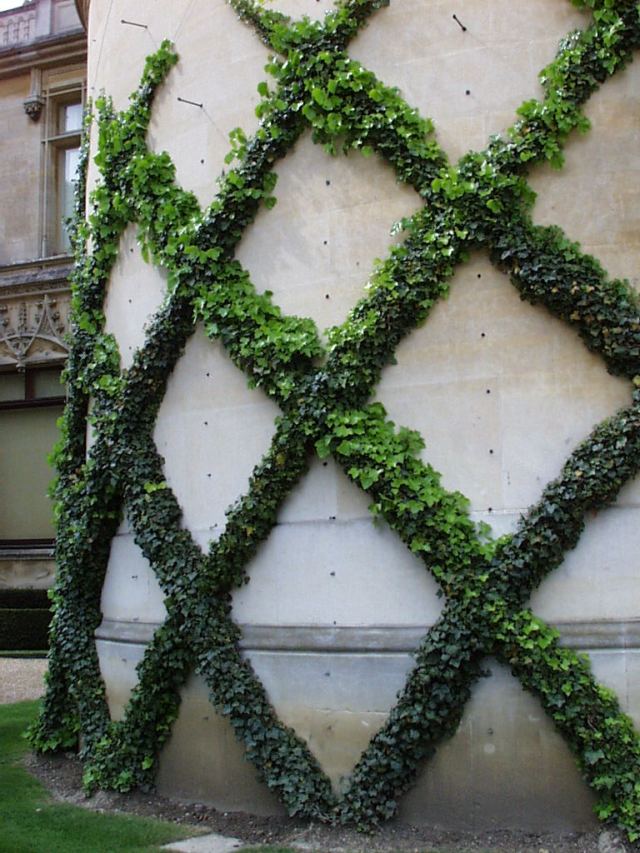
ivy

Waddesdon Manor was built by Baron Ferdinand de Rothschild in 1874 to display his outstanding collection of art treasures and to entertain the fashionable world.The 45 rooms on view combine the highest quality French furniture and decorative arts from the 18th century with superb English portraits and Dutch Old Masters. The Victorian garden is considered one of the finest in Britain with its parterre, seasonal displays, fountains and statuary. At its heart lies the aviary, stocked with species once part of Baron Ferdinand’s collection.’

Source and further information:

National Trust Website

Wikipedia

Waddesdon Manor Website

Old School Gardener

Pena PalaceThe Pena National Palace (Palácio Nacional da Pena) is a Romanticist palace in Sintra, Portugal. The palace stands on the top of a hill above the town of Sintra, and on a clear day it can be easily seen from Lisbon. It is a national monument and constitutes one of the major expressions of 19th century Romanticism in the world. The palace is a UNESCO World Heritage Site and one of the ‘Seven Wonders of Portugal’.

Pena Palace Park is a vast forested area completely surrounding the Pena Palace, spreading for over 200 hectares of uneven terrain. The park was created at the same time as the palace by King Ferdinand II, who was assisted in the task by the Baron von Eschwege and the Baron von Kessler. The exotic taste of the Romanticism was applied to the park as it was to the palace. The king ordered trees from diverse, distant lands to be planted there. Those included North American Sequoia, Lawson’s cypress, Magnolia, and Western Red Cedar, Chinese Ginkgo, Japanese Cryptomeria  and a wide variety of ferns and tree ferns from Australia and New Zealand, concentrated in the Queen’s Fern Garden (Feteira da Rainha). The park has a labyrinthine system of paths and narrow roads, connecting the palace to the many points of interest throughout the park, as well as to its two gated exits.

Source: Wikipedia

PicPost: Great Garden @ Cambridge Botanic Garden

‘Since its opening in 1846, Cambridge University Botanic Garden has been an inspiration for gardeners, an exciting introduction to the natural world for families and a refreshing oasis for all our visitors. This heritage-listed Garden has been designed for both year-round interest and seasonal inspiration so, whenever you visit, you will find plants to intrigue and enchant.’

PicPost: Great Garden @ The Old Vicarage

The Old Vicarage – East Ruston, Norfolk

“Throughout the garden you will see many rare and unusual plants growing…. Our garden lies 1½ miles from the North Sea in an exposed prairie landscape containing large arable fields. Many of the wildlife habitats have long been swept away and we have endeavoured throughout the garden to replace these by the planting of mixed hedgerows, banks, wildflower areas and ponds.

The soil here is of excellent quality, a light sandy loam with a neutral pH. Due to the maritime influence the garden suffers little in the way of serious frost damage and we have planted large shelter belts of Pinus radiata, the Monterey Pine, Alnus cordata, the Italian alder and many Eucalyptus. This enhances the garden’s unique microclimate which enables us to grow such a huge range of plants.”

Source : Old Vicarage website

Old School Gardener

Roses are one of the splendours of the gardens

Roses are one of the splendours of the gardens

The Peckovers – a quaker banking family – left behind them a secret gem of a house and garden in Wisbech, Cambridgeshire. This is one ‘banker’s bonus’ that can be shared by everyone.

Peckover House is said to be one of the finest Georgian town houses in the country. It stands proudly fronting the River Nene in this Fenland market town of 20,000 people. Originally built in 1722, the house was initially rented by the Peckovers in 1794, and purchased soon after. Jonathan Peckover had a grocery business and then moved into banking, setting up the first bank in Wisbech in partnership with the Gurney family- who later founded Barclays Bank. Peckover established a good reputation – it was said that during times of financial crisis the Peckover Bank was safer than the Bank of England!

Peckover House was initially called Bank House, reflecting the role of the house and it’s newly built banking wing. The property remained in the family for over 150 years, eventually passing over to the National Trust from its last owner, Alexandrina Peckover, in 1948.

The gardens – of around 2 acres – extend to the rear of the house and grew over the years as the family purchased ground from adjacent landowners. They also included a much larger estate extending to 48 acres, much of which today is used as playing fields and has some character-ful old trees. The Peckovers were also  keen collectors, and introduced a number of foreign plants into the garden. The gardens today maintain the basic layout from Victorian times –  including the old walls that used to mark the boundaries of adjacent properties.

The rear of the hous with the Croquet lawn in front- surrounded by some glorious trees such as the Tulip Tree (Liriodendron tulipifera)

The rear of the house with the Croquet lawn in front- surrounded by some glorious trees such as the Tulip Tree (Liriodendron tulipifera)

Step out into the garden and you feel as though you are back in Victorian times, as you move from one delightful space to another.

Once needing a team of 17 gardeners, todays gardening team of three is headed up by Allison Napier. She finds it difficult to single out her favourite part of the garden –  ‘It depends on the time of year’, she says. ‘In late winter and early spring the Wilderness Walk is full of the colours and scents from bulbs, Hellebores, Winter Honeysuckle, Christmas Box and an impressive Cornus mas. There is also the  fantastic trunk of an old Ginkgo which stands out and this with surrounding evergreens, deciduous shrubs and trees creates a strong framework.’

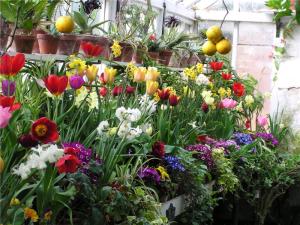
‘In spring the Orangery is a riot of colour and fragrance from the various bulbs and other spring plants all arranged in terracotta pots on the staging and if the flowering of the Wisteria on the front of the house coincides with the wall flowers in the various formal beds at their peak, then that is a wonderful spot.’

Inside the orangery- a heady mix of seasonal colour and fragrance

Inside the Orangery- a heady mix of seasonal colour and fragrance

And what about the summer The various rose gardens come into their own. There are over 60 species of rose here, many lovingly pruned and tied in every year over several metal pergolas and against walls. The area christened ‘Alexandrina’s Rose Garden‘ is a particular focal point.

But the show isn’t over yet. In late summer and autumn a ‘Red Border’ provides an array of warm colours and varied textures which are set off brilliantly against a golden privet hedge. This and an Autumn Border provide a glorious conclusion to the year. Jenny Windsor, one of the gardening team, loves these herbaceous borders and especially the contrast that they offer to other, more formal areas of the garden. ‘I love nothing more than to ‘have a play’ in the borders,’ she says –  ‘weeding, dead heading, tying in etc.’

Herbaceous borders

Herbaceous borders surrounding the Orchard Lawn with a fine old Quince tree

Many first-time visitors are surprised at the size and variety of plants in the garden. And, not surprisingly, they also commend the high standards of care maintained by the team.

Very few chemicals are used in the gardens and Allison finds that biological controls are effective in the glasshouses. As she says,

‘The healthy populations of beneficial insects, frogs and birds in the garden are testament to the ‘greener gardening’ policies we like to follow.’

The orangery (left) has rotten timbers and is due for a major renovation this year

The orangery (left) has rotten timbers and is due for a major renovation this year

The gardening team is well supported by local volunteers and a small number of trainees who come to gain practical horticultural experience (as I know, because I had the pleasure of being one last year!). Allison also thinks it important to encourage future generations of potential gardeners, so the team actively seeks school visits and has a Garden Club with students from the local grammar school.

Gardeners Jenny and Janet digging over and mulching the 'Red Border'

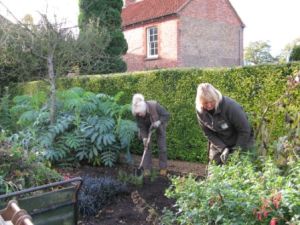
Gardeners Jenny and Janet digging over and mulching the ‘Red Border’

What of the future? Well,the forthcoming restoration of the Orangery – with its 300 year old orange trees – is a major project due to get under way this year. Allison plans to complete work on the Conservation Plan for the garden this year, but it will be a major challenge working out the priorities and policies for the future, especially as the climate appears to be entering a very unpredictable phase affecting decisions about the range of plants to be used.

Still, the team seem to be a pretty content bunch, even though on occasions paperwork and ‘office stuff’ may get in the way of being outside and doing what they love. As Allison says, even the laborious turning of the compost heaps can sometimes be rewarding:

  ‘.. it gives you a good workout and you can find a surprising  number of lost hand tools!’

Gardener in charge Allison Napier- normally not sitting on the compost, but turnning it!

Gardener in charge Allison Napier- normally not sitting on the compost, but turning it!

Acknowledgement: thanks to Allison, Jenny and Janet, the Peckover Gardening Team for their contributions.

Quizzicals:

answers to the two on the post ‘Lock down- pros and cons of garden ties’

  • Hello Miss Black – Hyacinth
  • A punch up in the water – hydrophyte

Old School Gardener

If you’ve enjoyed reading this post and others on this blog, why not comment and also join some other people and sign up for automatic updates via email (see side bar, above right ) or through an RSS feed (see top of page)?


MartineauGardens_homepage

The Green Flag Award® scheme is the benchmark national standard for parks and green spaces in the UK. It was first launched in 1996 to recognise and reward the best green spaces in the country.

The first awards were given in 1997 and, many years later, it continues to provide the benchmark against which our parks and green spaces are measured. It is also seen as a way of encouraging others to achieve high environmental standards, setting a benchmark of excellence in recreational green areas.

Entries for the Green Flag Award® are open to parks/green spaces located in the UK. We are also currently piloting the scheme in The Netherlands and Germany.

To apply go to Green Flag Award website


Old School Gardener

Finding Nature

Nature Connectedness Research Blog by Prof. Miles Richardson

Norfolk Green Care Network

Connecting People with Nature

Discover WordPress

A daily selection of the best content published on WordPress, collected for you by humans who love to read.

Susan Rushton

Celebrating gardens, photography and a creative life

Unlocking Landscapes

Writing, photography and more by Daniel Greenwood

Alphabet Ravine

Lydia Rae Bush Poetry

TIME GENTS

Australian Pub Project, Established 2013

Vanha Talo Suomi

The Journey from Finnish Rintamamiestalo to Arboretum & Gardens

Marigolds and Gin

Because even in chaos, there’s always gin and a good story …

Bits & Tidbits

RANDOM BITS & MORE TIDBITS

Rambling in the Garden

.....and nurturing my soul

The Interpretation Game

Cultural Heritage and the Digital Economy

pbmGarden

Sense of place, purpose, rejuvenation and joy

SISSINGHURST GARDEN

Notes from the Gardeners...

Deep Green Permaculture

Connecting People to Nature, Empowering People to Live Sustainably

BloominBootiful

A girl and her garden :)