Tag Archive: heritage
My first ‘Over My Head’ post was of architectural detailing in Canterbury High Street. The second features pictures in and around Canterbury Cathedral also taken last week, as before looking up.
Some of the newly – cleaned outside of the cathedral was looking rich and creamy gold, probably how it must have looked a thousand years ago. And the interior was as awe inspiring as you might expect for this most important of Anglican religious centres.
I find it interesting that so much trouble and effort (as well as skill) was put into making buildings and objects look great in places you wouldn’t normally expect to look, well at least casually that is. Maybe in days gone by people had their heads in the clouds more…..
Old School Gardener
Quite a contrast with the previous Cornish garden visit to Glendurgan, Trelissick (yes another ‘tre’) was all about late summer colour. A mixture of woodland planting and smaller borders and walled gardens full of herbaceous perennials (including some beautiful exotics), this is another wonderful coastal garden in the damp and mild south west, between Falmouth and Truro.
This ‘Technicolour’ treat was a wonderful last garden visit on our summer trip to Cornwall, though we managed one more garden (Devonian this time) before heading back home. Here are some close-ups of the variety of blooms on show when we visited Trelissick towards the end of August.
I was most impressed with the overflowing border nestling towards the bottom of the grass – lined valley close to the entrance. A billowing display of colourful masses of flowers and foliage, the Cotinus coggygria (I think it might have been the variety ‘Grace’) looking especially vivid as a low sun caught its large leaves of reds – purples. Here is a gallery to show you what I mean.
The Fal valley with smaller creeks and inlets branching off on either side is reached via wooded slopes with oaks and beeches overhanging the mudflats of the tidal creeks. The King Harry Ferry below Trelissick is the only connection across the water to the Roseland peninsular on the other side of the estuary.
In about 1750 a modest two-storey villa was built at Trelissick on the foundations of an earlier building. This house was remodelled in 1825 by Peter Frederick Robinson who added the columned portico which rises to the height of the south front. Robinson’s patron was Thomas Daniell whose father had bought the estate in 1800 with the fortune he inherited from tin-mining interests. Thomas Daniell planted much of the woodland along the shores of the estuary and the carriage drives he laid out in the park are now shady woodland walks. Between 1844 and 1913 the estate was owned by the Gilbert family who made great improvements to the grounds. They planted ornamental woodlands and some of the huge holm oaks and conifers in the garden. The wonderful garden seen today was largely created by Mr and Mrs Ronald Copeland after Mrs Copeland inherited Trelissick in 1937.
This has been in the ownership of the National Trust since 1955 when it was donated by Ida Copeland following the death of her son Geoffrey. Many of the species that flourish in the mild Cornish air, including the rhododendrons and azaleas (such a feature of the garden, but not in bloom when we visited), were planted by the Copelands including hydrangeas and camellias, flowering cherries, and exotics such as the Ginkgo and various species of palm. They also ensured that the blossoms they nurtured had a wider, if unknowing audience. Ronald Copeland was chairman and later managing director of his family’s business, the Spode china factory, and flowers grown at Trelissick were used as models for those painted on the pottery produced at the works.
The garden is noted for its rare shrubs (it holds the national collections of Photinias and Azaras) and features a large park, woodland walks, views over the Fal estuary and Falmouth – there are ‘peep hole’ glimpses of water punching through the sloping woodland canopy that surrounds the extensive park path system. After a pleasant afternoon break in the courtyard restaurant (though we were joined by some cream tea loving wasps) we took a leisurely drive onward to re-enter Devon on our way back to East Anglia.
Here are some images of this wider, parkland setting, which,along with the rest of the place, is kept in tip-top condition, a credit to the garden team.
Sources: Wikipedia and Tour UK
Further information: National Trust website
Why not take a look at my other articles on West Country Gardens – click on the ‘category’ on the right
Old School Gardener

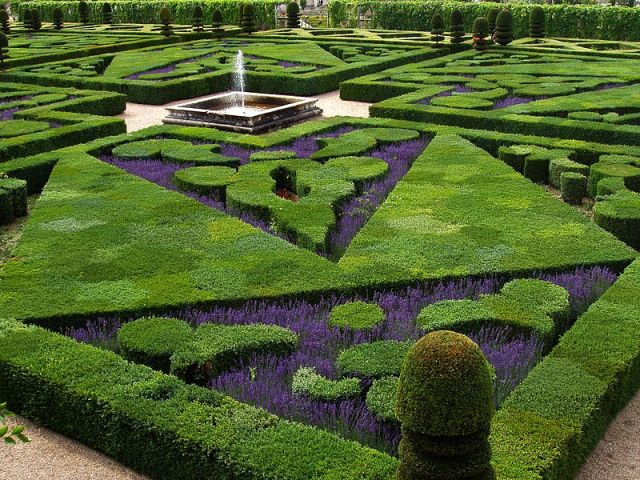
Villandry, France via Jean Aernoudts
A rather lower key garden visit this one, but still very enjoyable.
The Godolphin Estate is the former seat of the Dukes of Leeds and the Earls of Godolphin. It contains one of the most fashionable Tudor/Stuart mansions in Cornwall. The present house is remnant of a larger mansion. At one time it was a secondary seat of the Dukes of Leeds, but the Duke sold it in 1929. The Estate is a total of some 550 acres (220 ha). The early formal gardens (dating from around 1500) are said to be among the most important historic gardens in Europe, having barely changed over the years.
These include some interesting formal walled gardens and further afield remnants of grassed areas, ponds and ancient trees, with the addition of some meadow areas. The atmosphere is one of quiet and restraint, typical of its age and predating some of the more exuberant formal and landscape gardens of the following centuries.
It was very pleasant exploring the gardens on a sunny August afternoon, the peace and quiet, interrupted only by the sound of bees humming around a series of hives which are part of a study looking into the qualities of the Cornish bee, one of the oldest breeds around. In some areas the gardens and planting are in need of careful restoration and renovation, to bring out their full interest and attractiveness. This process is being pursued by the National Trust, which has also been improving public access to the Estate. since they acquired it in 2000.
Further information :
National Trust Website
Old School Gardener
If you’ve enjoyed reading this post and others on this blog, why not comment and join others by signing up for automatic updates via email (see side bar, above right ) or through an RSS feed (see top of page)?
I was privileged to be invited to the opening of a ‘new’ glasshouse at Peckover House, Wisbech last week.
You may recall that I spent some time here as a Heritage Gardening Trainee last year, and really learnt a lot from the Gardener in Charge, Allison and her cheerful accomplices, Jenny and Janet. I wrote a lengthier piece about the garden earlier in the year (see link below), and at that time it wasn’t yet certain that the fast – decaying Orangery in this superb Victorian Garden was going to be saved. But thanks to some local fundraising and additional funds and wisdom of the owners, the National Trust, I’m very pleased to say that this focal point in the garden has been saved. Or rather, recreated, as the original was in such a poor condition, that further repairs weren’t possible. The replacement is a faithful rendition of the old structure, with a few minor amendments to make life easier for the gardeners. The former tiled floor, surrounding walls and walled containers with three ancient Orange trees have been retained, now with a new covering made, as was the original, in timber and glass. It includes sash window ventilation and roller blinds to help with temperature and light control.
During the rebuild the 300 year old orange trees were exposed to the elements and what a stroke of luck that we had one of the best summers in recent years, for they have obviously benefitted from that exposure to fresh air and sunshine!
The overall feeling is of a light, colourful and inviting atmosphere. The old Orangery had a typically Victorian air of ‘gothic gloom’ about it, especially as some of the older specimens accompanying the oranges were mature and shaded the interior. I guess the replacement plantings alongside the outer wall will eventually make their mark, but for now I do like the open, bright interior. The inner, sun – facing side of the Orangery is once more populated with a colourful array of terracotta pots containing a wide variety of tender specimens, all laid out on benches ans shelves in the spirit of the Victorian passion for collecting the unusual and exotic. Here are some pictures of the opening event and the new Orangery.
The overall project cost over £200,000. I’m sure it will be worth it as the garden- already a jewel in the National Trust’s crown – would have seemed empty without it. If you’re ever near to Wisbech in Cambridgeshire the place is well worth a visit – as you can see from this selection of pictures taken last week.
Congratulations National Trust, the Peckover House Gardening team and all those others who contributed to the project!
Related article- ‘Banker’s bonus: Secret Garden Gem’
Old School Gardener
Whilst visiting friends recently, we were fortunate to be given a guided tour of an historic garden and house in the course of renovation.
Copped Hall, close to Epping in Essex, is a substantial Georgian mansion which I remember visiting about 30 years ago.
At that time I can remember the house being a gutted shell, having no roof and pigs being kept in what remained of the ground floor!
There has been a grand house here since Norman times, with the current building dating from the middle of the 18th century. It has a fascinating history, culminating in the near destruction of the latest house by fire in 1917. Since then, various attempts have been made to redevelop the site, but local opposition has fought these off. The outcome was the formation of a charitable trust which raised funds to purchase the site with the aims of:
- preventing development of the buildings or in their vicinity
- raising further funds to carry out sympathetic restoration of the buildings and grounds
- educating the public on the site and it’s social and natural history.
An active ‘Friends’ group supports the trust, including a small band of gardening volunteers, 2 of whom (Marion & John), kindly showed us around. The house itself has been made wind and weatherproof and some progress has been made in reinstating the interior structure. As anything portable and of value was stripped out of the buildings and grounds in the 1950’s, much of what remains are functional, structural features such as the brick piers supporting former stone steps and stairs. These tumbled down ruins are interesting in themselves, and with the still significant columns of clipped Yew give a gothic, romantic ruin feel to what was once a grand, formal, elevated approach to the house along with parterres and clipped hedges and bushes.
This space gives way to a wooded walk to the walled garden. There are some open archaelogical excavations in these grounds, adding further interest, and some more recent large scale landscaping projects in areas on the site of what was once the Tudor Manor house. Originally built in 1740, the 4 acre walled garden (one of the largest in Britain), is clothed on the approach to its outer wall with a glorious herbaceous border. Several metres deep, with excellent variation in height, this border also features large groupings of plants providing a strong structure and rhythm through their repetition, along the full 100 metres or so of its length.
Inside, a series of original Boulton and Paul glasshouses- most in urgent need of renovation, contain a fascinating collection of fruit and flowers, including vines and peaches now open to the elements as the former covering of glass has fallen away.
The scale of the renovation task, especially here, is enormous, but the small band of volunteers is making steady progress, though could perhaps do with an overall ‘Conservation Plan’ to help to channel their efforts and encourage others along. We wish them well, and but for the distance from home, would offer to help them!
Copped Hall is open to the public one day a month and guided tours are available – see the weblink below for more information.
Further information:
Old School Gardener
If you’ve enjoyed reading this post and others on this blog, why not comment and join others by signing up for automatic updates via email (see side bar, above right ) or through an RSS feed (see top of page)?