
Tag Archive: hebrides
On our recent trip to the Hebrides I was taken by the beautiful textures and ‘art works’ that nature can produce; in this case on the beach and featuring some very subtle effects. Here’s the first of a two part gallery of pictures I took, mainly at Calgary Bay on the Isle of Mull.
Old School Gardener
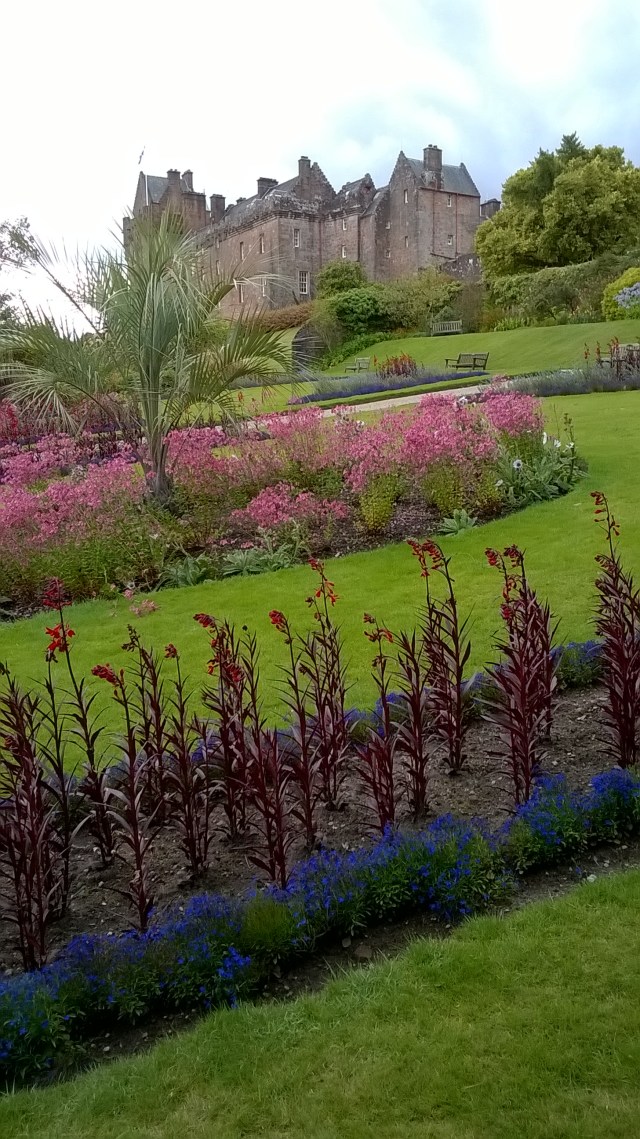 So, we are on Arran in the final ‘leg’ of our Hebridean ‘hop’. We decided to visit Brodick Castle, a Scottish National Trust property that overlooks the town and bay of the island’s main setlement.

Brodick is a commercial centre and its good ferry connections to the mainland result in it being a hive of retail and other activity; quite a contrast to the rest of the island and indeed the other parts of our trip- though I suppose it does have some similarities to Oban.
The Scottish N.T. website captures the essence of the Castle:
‘The quintessential Victorian ‘Highland’ estate… Dramatically set against the backdrop of Goatfell mountain, the grand red sandstone Scottish baronial-style castle has stunning views over Brodick Bay to the Firth of Clyde..the W A Nesfield-influenced landscaped gardens … provide an unrivalled experience, from the formal walled garden to the woodland walks. Brodick holds three national collections of rhododendron that flower in almost every month of the year…’
The house was interesting, and boasts many royal connections throughout it’s (and it’s predecessor castles’) history. Today’s Brodick Castle is largely the result of a large-scale expansion of the earlier castle undertaken in the years after 1844. Until this time, the resident family- the Hamiltons- had focused their attentions on their estates on mainland Scotland and especially on Hamilton Palace. But a number of factors came together which made the conversion of Brodick Castle into a grand stately home a viable and desirable option.

Very Baronial…
But it was the gardens I came to see, and they didn’t disappoint. The walled garden dates back to at least 1710 (according to a date in the enclosing wall). Further work was undertaken from 1814, but most of today’s gardens date back to the elevation of the castle to a stately home in 1844. The gardens were subsequently a passion of the Hamiltons and especially of the Duchess of Montrose in the years from 1895. Like the Castle, its gardens offer a glimpse into another world and another time. I especailly loved some of the subtle planting combinations in the walled garden…
Undiscovered Scotland describes the wider park:
‘In the surrounding country park, visitors can follow waymarked routes that extend for a half mile or a mile, or simply find their own way around. For some it is the plants themselves that will form the highlight of the tour. Others will enjoy the ice house under its heavy turf roof….’


The park provides an interesting route, gently following the hillside towards the sea. There were some delightful ‘cloth art’ installations en route, and it was noticeable that felling and shrub lopping were underway- I guess many of the specimens planted over a hundred years ago are now getting a little too big and drastic action is needed; but replanting is also underway…
Towards the bottom of the park, nearest the sea, lies the Bavarian summer house; an amazing concoction of natural materials. As Undiscovered Scotland says:
‘A real oddity is offered by the Bavarian Summer House. This has an outer surface imitating tree roots; and the interior is largely lined with pine cones. The end result is impressive, but in a way that is more spooky than simply pleasant, bringing to mind the story of the gingerbread house, or even the more recent fable of the Blair Witch Project.’


Old School Gardener

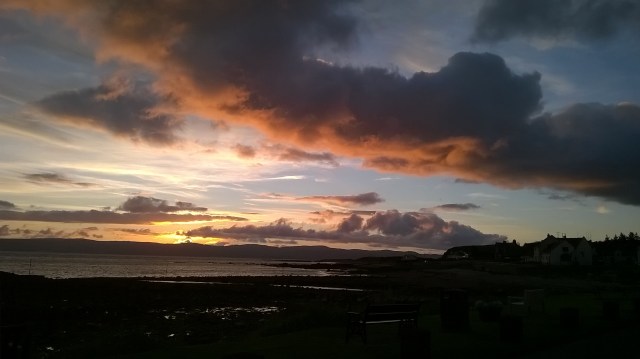
Sunset at Blackwaterfoot, Arran
We had driven down the Mull of Kintyre to our next ferry crossing -from Claonaig to Lochranza on the Isle of Arran- famed for being ‘all of Scotland in miniature’.
Whilst waiting on the quayside a group of motorcyclists drew up; a rather unusual group too. Astride their ageing 50cc mopeds (the men were also veteran) this happy band come together every year from around Scotland and northern England to share their love of machines and wend their way, gently, around Britain’s roads. This year’s ‘Tiddlers’ Tootle’ was around much of Scotland and it was great talking to them about their trip and their interests.


Our journey was again smooth and having landed at Lochranza we made our way along (slightly wider than Mull’s) roads to our stop for the next three nights- a hotel in Blackwaterfoot in the south west of the island. I won’t bore you with the details of this; suffice to say it was a comfortable (after we managed to get an over heating towel rail switched off) and lovely setting overlooking the firth of Clyde towards Campbeltown on Kintyre.
We had three major outings whilst here and I’ll post about one of these- Brodick Castle – separately, as it had an interesting garden worthy of extended coverage.

The impresive cliffs on our ‘Cave Walk’
Our other two trips out commenced with a walk along the impressive coastline near to the hotel where we passed some fun mini cairns on the beach, I guess made by fellow walkers; we couldn’t resist piling up some stones of our own and trying to see how precarious a balancing act we could create…

Pebble Cairns on the beach…

…and some of our efforts…


Our main objective, however, was to get to the caves a bit further north and in particular the ‘King’s Cave’- where legend has it that Scotland’s King Robert the Bruce sat in contemplation before fighting (and defeating) the English at Bannockburn in 1314- yes the cave where he watched a spider repeatedly tumbling to the floor, only to keep getting up and trying to forma web. the story that supposedly inspired the King to ‘try again’ and eventually win out over his enemy. I think this is in fact a rather more modern myth created to boost tourism about a century ago, but never mind, it makes for a good walk and an amusing tale!

View from the top of our ‘Cave Walk’

..and a fascinating, effusive memorial to a vicar of ‘sterling worth’
The final trip out involved a walk from around Lamlash Bay through woods and along cliff tops to an area called Clauchlands where once an Iron Age fort stood overlooking the bay. This has impressive views of the ferry route from Brodick to Ardrossan and Holy Isle (yes another one). In fact we watched the ferries crossing that morning only to discover the following day that it was the ferry we had been booked on (in error)! Fortunately we arrived at Brodick ferry port early enough to grab a spare place on the ferry we thought we had booked! Apart from its beauty, Lamlash Bay is interesting as Scotland’s first ‘no take’ zone- where any fishing is banned in order to help replenish marine life. As the very interesting ‘COAST’ website says:
‘The Scottish NTZ is approximately a one square mile area at the north end of Lamlash Bay on the isle of Arran set up to protect Maerl beds and to promote natural regeneration of all marine life. Following 13 years of campaigning by COAST, it was designated by the Scottish Government on 20 September 2008.
In 2013, COAST and the community of Arran and the Clyde celebrated five years of the NTZ being in place. Surveys taken show that after five years, the seabed is now 40 per cent more complex and healthier than the area outside the NTZ. There are higher densities of scallops, crabs and lobsters, both older and larger, being recorded and increased numbers of juvenile cod and haddock…’

the walk up from Lamlash


looking towards Holy Isle

Back towards Brodick from Clauchlands

..that was our ferry!
Arran is certainly beautiful. It is less remote than Mull, and we saw several day or weekend coach groups (probably from Glasgow) taking in the scenery. The roads tend to be wider too and it’s better accessibility may result in a greater level of second or holiday homes and perhaps less sense of settled community, but I may be wrong.
 Old School Gardener

Old School Gardener
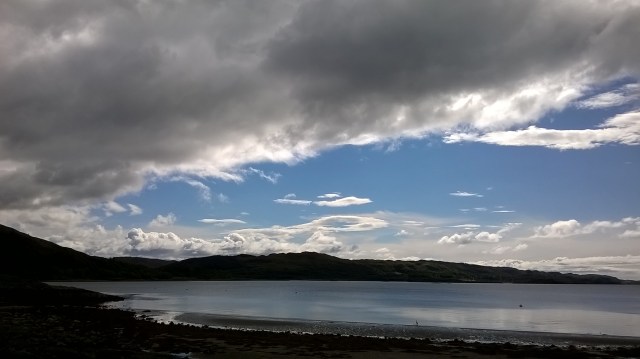 Having returned to Oban from four days on the Isle of Mull, our second ‘hop’ involved a drive down the Argyll coast line towards our next ferry which would take us across to Arran.
We had plenty of time, so I was on the lookout for somewhere to stop for lunch. Half an hour’s drive and we noticed a Scottish National Trust sign to a nearby garden- the perfect solution.
Arduaine Garden is a 20 acre tranquil green oasis on the south slope of the Arduaine peninsula which overlooks Loch Melfort. It is a coastal garden that rolls down towards the sea and is very reminiscent of many such gardens you find in Cornwall; another area blessed by the warming effects of the North Atlantic Drift.
‘a horticultural tour around the temperate world with a collection of rhododendrons, azaleas, magnolias, Blue Tibetan poppies, giant Himalayan lilies and Chatham Island forget-me-nots’


Though the weather was cloudy, we enjoyed our stroll (and lunch) through the wooded slopes and especially the wonderful water garden, with it’s range of habitats and some lovely ‘natural’ streams and ponds with ‘close up’ paths where you can see water lilies, primulas and other marginal plants.
The garden was begun on a bare promontory in 1898 by James Arthur Campbell and continued by two succeeding generations of his family. In 1965 Arduaine House was sold and became the Loch Melfort Motor Inn, later the Loch Melfort Hotel. The garden was sold in 1971 to Edmund and Harry Wright who in turn passed the garden on, as a gift, to the National Trust for Scotland in 1992.
As the headland is open to all the winds that blow, the garden hides behind a shelterbelt that keeps out the worst of the wind and salt spray and this (along with the North Atlantic Drift), allows many tender plants to be grown.
Arduaine is well-known in rhododendron circles for its wonderful collection of species and hybrids, many of which are considered tender elsewhere and grow largely under the canopy of mature Japanese larch. The garden has a great variety of flowering shrubs and trees, bamboos, ferns (including tree ferns), a large perennial collection in many mixed borders. So, the plants come from all over the world, but in particular from East Asia and South America, and in addition it has native mosses and ferns growing everywhere.


I was sorry to see that the gardens have been struck by an outbreak of the pathogen Phytophthora ramorum (‘Sudden Oak Death’). Found among the garden’s larch trees P. ramorum had previously been present in the garden at a low level in the shrub plantings and the Trust had been working with the Scottish Government over a number of years to control it. Unfortunately, despite these efforts, the fungus-like pathogen has now extended its range of host plants to include the garden’s larch trees.
Despite this setback, apparently there is no threat to the garden as a whole and the main areas of the garden are unaffected. However, in the longer-term, a new ‘vision’ for Arduaine Garden will be developed, which will set out objectives and planting regimes 20 years hence. These should be less susceptible to P. ramorum and better adapted to climate change, as well as carrying on Arduaine’s fine tradition as a ‘plant hunter’s garden’, which has continually evolved over the last century.
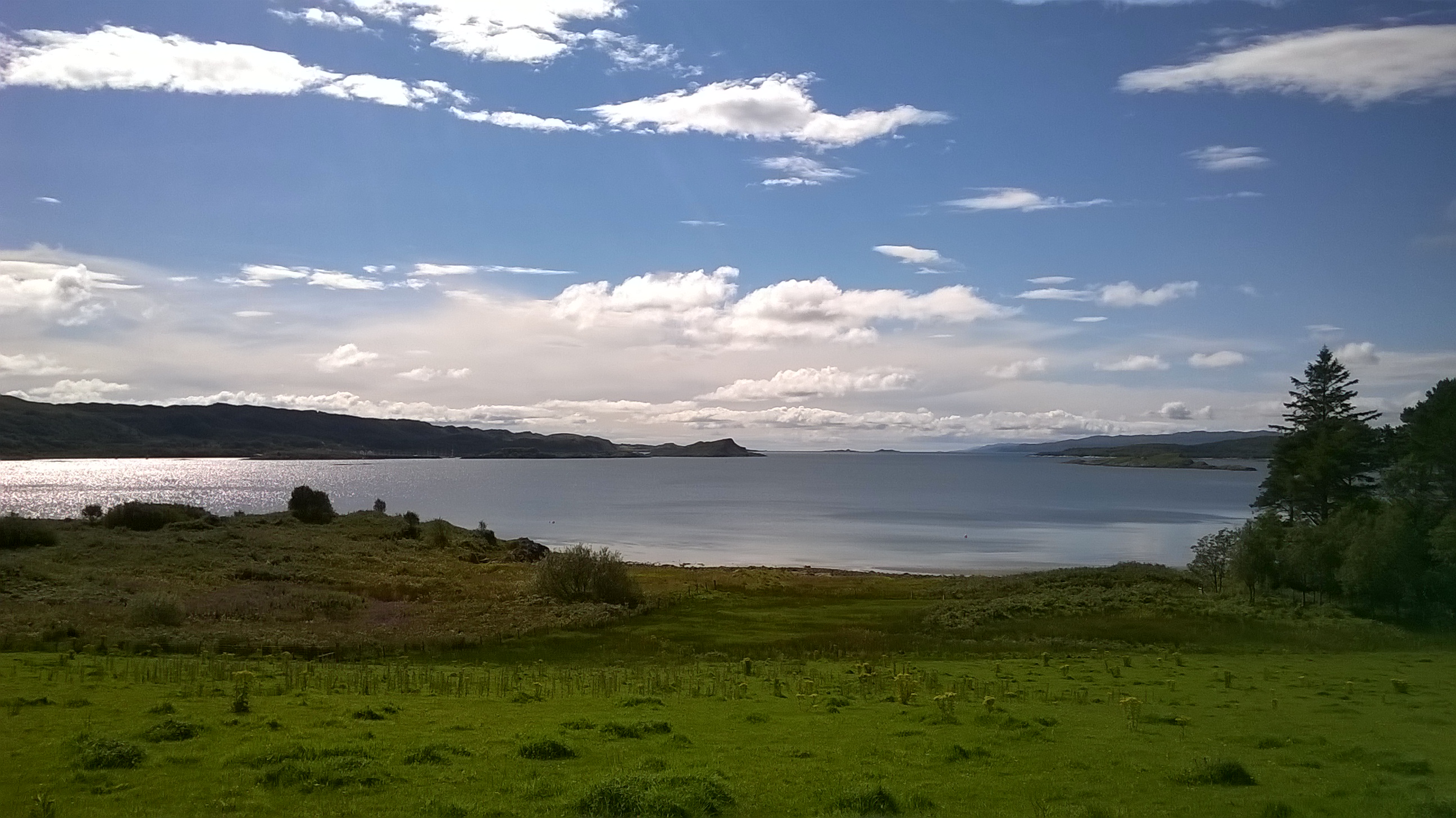
Old School Gardener
So, four days on and we needed to move onto stage two of our Hebridean Hop– the ferry back to Oban and the long drive along the Mull of Kintyre to catch our next ferry to the Isle of Arran. But not before stumbling across a lovely seaside garden en route- more of that in my next post.

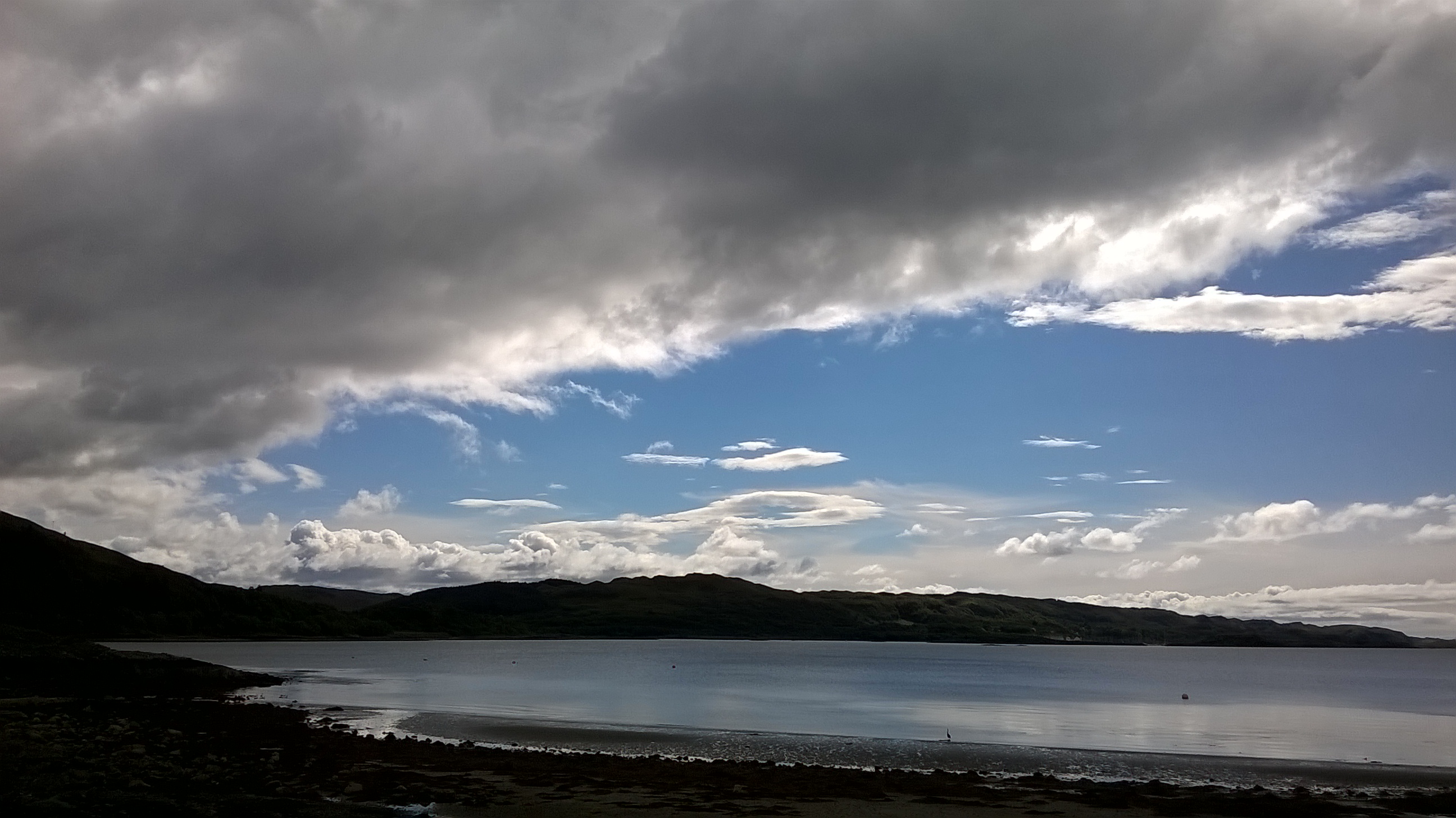
Looking across Loch Scridain from our second stop…

…dusk…and ducks…

tide coming in pretty quickly- we were nearly cut off

Some fellow travellers on the ferry back to Oban.
Old School Gardener
 We boarded the ‘Calmac’ Ferry at Oban on the first stage of our recent week-long break in the Hebrides, western Scotland. Neither of us had been to the area before and the view of the islands from the harbour was very inviting. We drove on board the ferry to Craignure on the Isle of Mull and had a smooth, serene crossing.

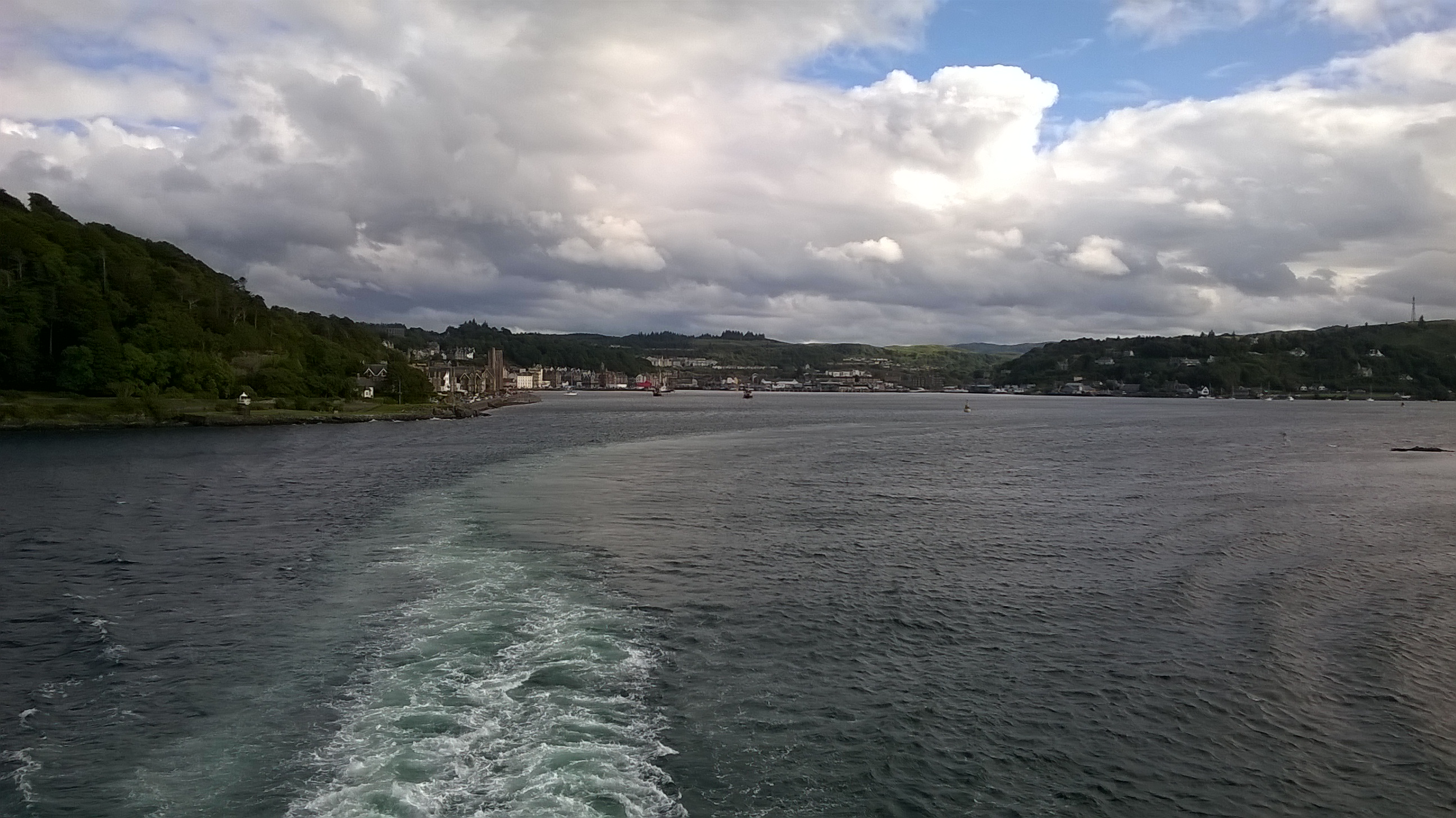
Leaving Oban…
We headed for Tobermory in the north of the island upon landing, along a narrow road (we were to discover much narrower and rougher tracks later in the stay). We had two great days here in the capital of the island famed for its colour washed harbour frontage and top notch fish restaurants (we sampled Cafe Fish– superb freshly caught fish).

Tobermory harbour front..

Cafe Fish…a top fish restaurant in what was once the harbour master’s office…

Otters alert! -a curious fundraising van for the Otter Trust was adorned with otters on the wing mirrors..

The distillery was a fascinating- and ‘warming’- visit!

Across the harbour

Lovely boat seat outside the local arts centre

A rather unusual combination of retail outlets!
On our first day- with a mixture of sunshine and showers- we made a road trip to the north west of the island to Calgary Bay (from where the Canadian city is named, I think). We parked up at an art gallery and walked down to the bay through a delightful ‘Art in Nature’ landscape, where artistic objects had been placed among the trees and hillside. the beach in the bay was a smooth, silky strand and as we retraced our steps the next heavy, windswept shower took it’s toll! Not before I’d found many interesting beach textures to photograph (more on these in a later post).
There wasn’t much else of gardening interest to report other than some pretty plots on the Isle of Iona which we visited later in the week when we moved to the south west of the island for a second stay in ‘B and B’. Having said this who needs gardens when you have such amazing scenery?
I was disappointed however to not visit one garden en route south called Lip na Cloiche. Our journey south was along narrow, winding roads and I hadn’t appreciated how slow the going was to be- in fact we travelled, around 46 miles in 2 hours! So, there was no time to stop, but the front entrance to this interesting garden was tantalising; I gather it is densely planted, tumbles down the coastline and uses ‘found’ objects imaginatively in the landscape. Ah well, if we return ( I think we shall) this will be a ‘must visit’.
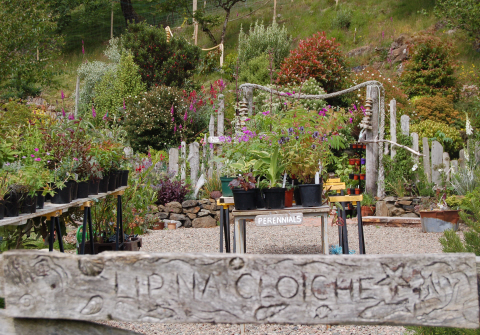
Looks interesting…must get there, next time
We made two boat trips whilst in the south of the island; one to Iona (the Holy Isle of St. Columba) and a visit to the staggering landscape and seascape of Staffa (from the old Norse for ‘staff’ or ‘pillar’ island), including the famous ‘Fingal’s Cave’ enclosed by towering cliffs of columnar basalt, many with a clear hexagonal profile.

Staffa looming large …

amazing hexagonal basalt…


the mouth of Fingal’s Cave…

…and within- awe inspiring.
Iona was a delight, especially as we had our bikes with us to get around- we dropped into the Abbey and its museum, walked up the highest hill to get super views of Mull and beyond and had a delicious lunch in a local hotel.
So, four days on and we needed to move onto stage two of our Hebridean Hop– the ferry back to Oban and the long drive along the Mull of Kintyre to catch our next ferry to the Isle of Arran. But not before stumbling across a lovely seaside garden en route- more of that in my next post.
Looking across Loch Scridain from our second stop…
…dusk…and ducks…
tide coming in pretty quickly- we were nearly cut off
Some fellow travellers on the ferry back to Oban.





 Old School Garden