Tag Archive: gardens


FB_20150426_18_30_24_Saved_Picture

WP_20160222_14_13_35_ProOld School Garden – 29th February 2016

Dear Walter,

This month has been one of acquisition. I mentioned my plans for a DIY shed (including shingle roof) at Blickling recently and one of the volunteers, Peter, said he thought his brother might have some shingles he wanted rid of. Well last week I collected  several boxes of cedar shingles and ridge caps from his home in nearby Taverham, and think I might have enough to do most if not all of the roof- for a bargain price of £20.
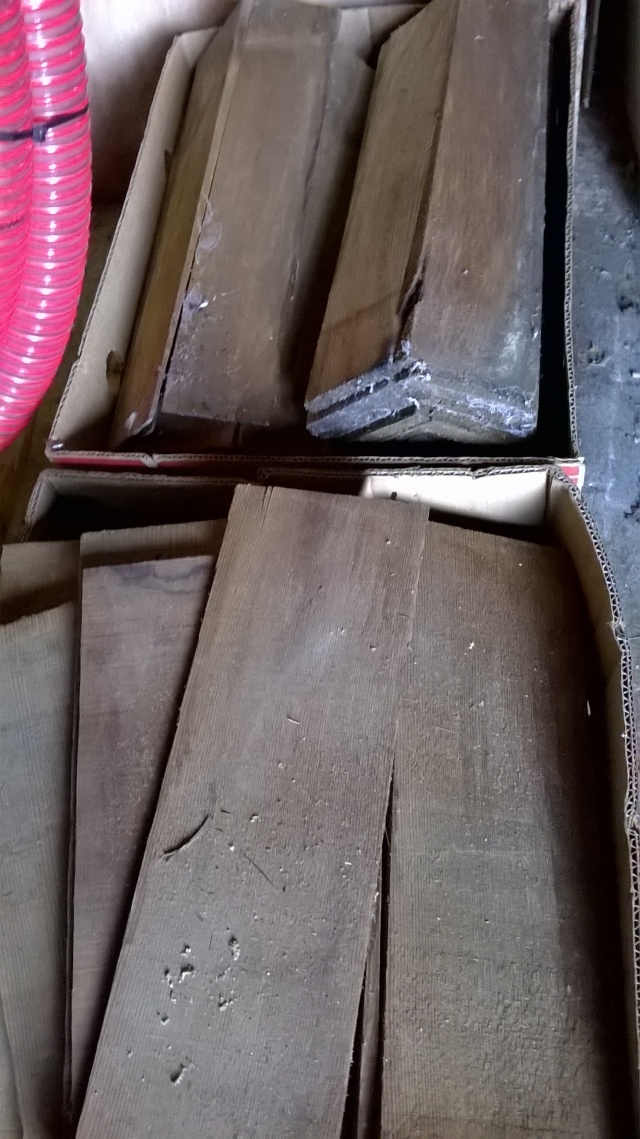
Shingles...I look forward to fixing these on the roof of my new shed

Shingles…I look forward to fixing these on the roof of my new shed

The shingles are old, but unused and have been stored under cover for several years. You may remember that I’m drawing up plans for this shed based on using the old floorboards taken up when we had some under floor insulation put in? The plans are firming up nicely, and I’m making the shed big enough and tall enough to comfortably store all my unpowered garden tools along with a potting bench and storage for trays, pots and all the other garden paraphernalia like string, plant labels and so on. I’ll need to buy a few extra slabs for the base, as well as the timber for the frame, but the result should be something that will last, be big enough, not cost the earth – and look attractive too (I hope).

The other big project for this year, the wildlife pond, has begun too. Having firmed up my sketch plan I decided to dig out the main boundaries and other features and put in some key shrubs from elsewhere in the garden. While I was at it I thought I’d tidy up and strengthen the planting in the two borders you pass between to get to the pond. These look much better, with one side featuring a relocated Spotted Laurel (which was nestling unseen behind soem holly and whose leaves now pick up the yellow flowers of the Kerria behind), Star Magnolia and  Viburnum along with white Forget – me – Nots, and Verbena bonariensis. The other side features the ornamental Japanese Maple I bought last year along with a Flowering Currant and Anemanthele lessoniana grass, all surrounded with Yellow Loosestrife and purple Geraniums.

I’ve also acquired- again from Peter and his wife Pam, some plants suitable for the pond area and I hope to get some rustic wooden poles and log slices for embanking and an arbour from Blickling when I’m next there – the acquisitions continue!

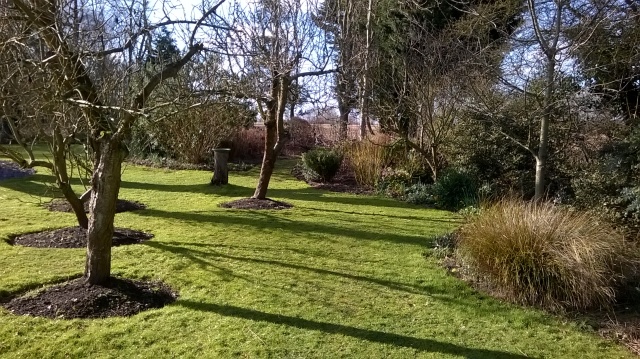
Elsewhere in the garden I’ve begun the great spring clear up- cutting spent stems and pruning shrubs and trees, raking off leaves from the borders and forking over the soil to remove weeds and aerate. I find this very satisfying work, though I’ve a lot to do. I also cut the grass in a few places a week or two ago (in February would you believe!), as it had grown considerably in the (to date) mild winter.
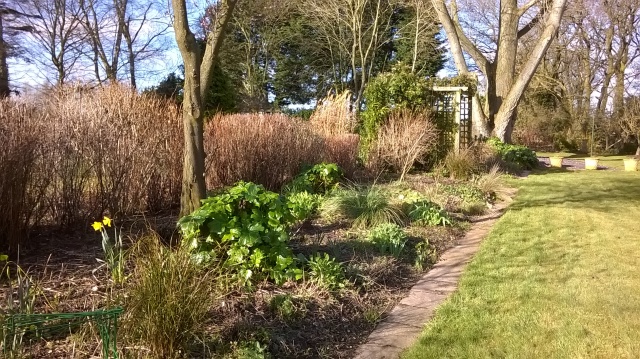
Borders cleared and ready for weeding and soil tickling...

Borders cleared and ready for weeding and soil tickling…

I’ve also finally got my seed potatoes chitting (‘Rocket’ as first earlies, ‘Charlotte’ as second), and my first seeds have been sown and are starting to germinate; Sweet peas, Scabious, Lettuce, Calabrese, cosmos etc. Some of these are a little spindly, showing the effect of low light levels, but hopefully they can be potted up shortly and placed in the greenhouse to continue their journey.

My garden design course at Blickling proceeds well, I think, with 6 participants keen to find out how best to improve their own plots, which range from small, urban settings to large country gardens. The second session involved a practical measured survey of the Secret Garden at Blickling, which I think they found very instructive, and in tomorrow’s session I plan to cover garden structure which will also involve a visit to the gardens at Blickling to observe the key structural elements of the different gardens there.

Oh, I mustn’t forget my other acquisition this month. Our neighbour Richard and I were chatting over the garden fence one day and he told me of his new mole repeller, and asked if I wanted to get one as he was going to order another. Having used this sort of thing in the past with mixed results I was skeptical, but went along and said I’d give one a try. Well, he duly came round the other day and presented me with this solar-powered device, which emits a regular sound which is supposed to disturb the moles and encourage them to move on. He didn’t want any payment either!
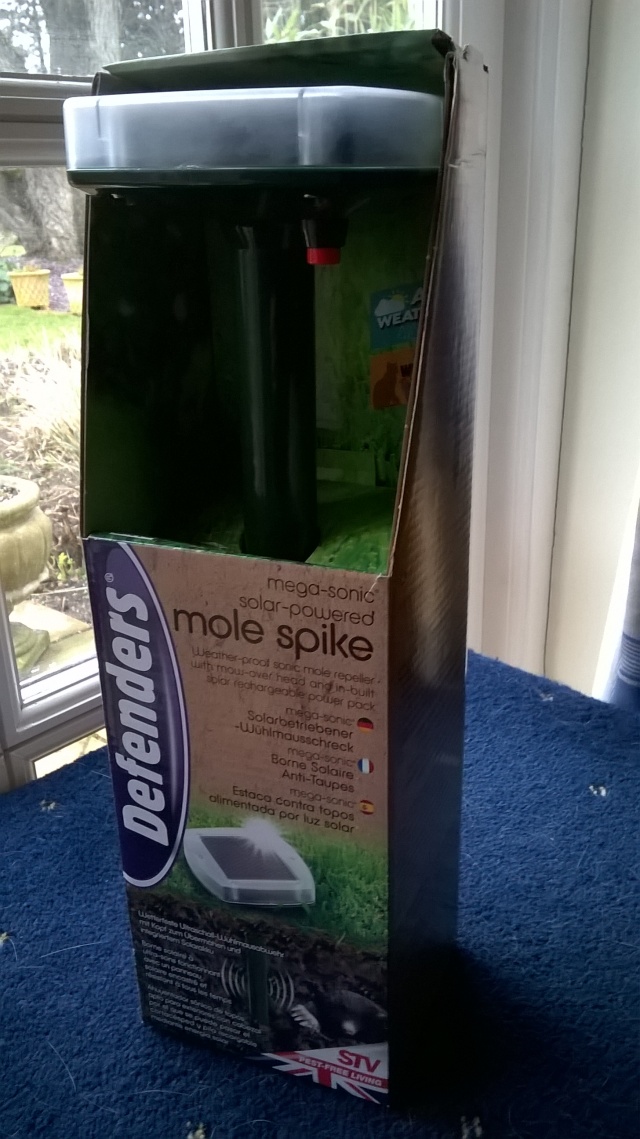
Will it work? My new attempt at mole control,courtesy of neighbour Richard

Will it work? My new attempt at mole control, courtesy of neighbour Richard

So, it is in the lawn where there was last evidence of mole activity (I’ve also come across lots of mole hills in the borders as I’ve been clearing up), so we’ll see what impact it has. I suspect it’s still a little early for mole activity on any scale, so I await the spring with a mixture of trepidation and a small element of hope that this new device might do the trick. Of course with us both having these things we could drive the moles to our third nearby neighbour’s garden! But this shouldn’t be too much of an issue as the chap there, Norman, seems to thrive on his mole catching ability; I think his tally to date is in the twenties!

Well, Walter, I hope this latest letter finds you and Lise in good health and looking forward to the lighter, warmer days of spring that are on the horizon- tomorrow is March after all!

best wishes,

Old School Gardener


FB_20160213_17_32_22_Saved_Picture

49bef9cfc989acf6a48a3670e7b1f02dNo garden is complete- in my view- without some plants you can eat. Even if it’s only the leaves of herbs or flower petals to garnish a ‘happy salad’, growing our own food has to be a part of the essence of gardening. So today’s object is a traditional garden trug, used to gather in the fruits (and veg) of your labours.

The traditional trug has an interesting history:

‘Way back in the heydays of the 1820’s, just before Queen Victoria ascended to the English Throne, a Man of Sussex, one Thomas Smith of Herstmonceux, made a decision about his life that was to have a profound effect on Sussex and the World.   He invented the Sussex Trug!   Taking an ancient idea dating back to Anglo Saxon times, Thomas redesigned the historic “trog” and in so doing he created a part of the English gardening scene that is now World famous!   

 The “trog” was a wooden vessel hewn from solid timber in the shape of the round coracle boat that the Anglo Saxons used for their daily business.   Because of the way these “trogs” were made they were very heavy.   They were used by Sussex farmers to measure grain and liquids and were made in several sizes for different measures.   They continued in use in this form until the mid-1600’s and we have been able to uncover an inventory from a farm in Newhaven, East Sussex at about that time where there were recorded “a dozen of trogs in the milking parlour”. 

 Thomas Smith re-invented the “trog” carefully designing a lightweight basket using Sweet Chestnut (Castanea Sativa) and Cricket Bat Willow (Salix Coerulea)….’

Thomas Smith- The Royal Sussex Trug

The traditional Sussex Trug

The traditional Sussex Trug

Thanks to a thoughtful birthday present from my wife, I now have two of these lovely baskets at Old School Garden. It is a joy taking them out into the garden, from early summer, to harvest  fresh produce and then use it as quickly as possible in the day’s main meal. Celebrity gardener Bob Flowerdew underlines the importance of getting your pickings as quickly as you can from plot to saucepan to maximise the sweetness; as soon as it’s picked a sweetcorn’s, or whatever’s natural sugars start to convert to starch.

I guess the trug is a good token for all the other containers we use in the garden (including the modern day plastic trug); whether it be to carry flowers, tools, weeds, compost and so on.

But most importantly, it is the symbol of all that’s good in ‘growing your own’ and the freshness and flavour that comes from this small contribution to world food production.

Further information:

History of the Sussex Trug

 Old School Gardener

image1My friends Jen and Dave paid a visit to the wonderful gardens at Nymans in Sussex, recently. Jen says:

‘On a cold (4 degrees),damp and very grey day we went to Nymans, a National Trust property, for a long muddy walk in their woods.
The gardens are well known for several different types of snowdrops but it was the variety of winter colour which shone through. The C
amellias have been coming out early and there were even a couple of Rhododendrons in flower.’

Thanks for the pictures, Jen!

Old School Gardener


‘Weather watching’, or rather using forecasts of it and then responding so as to maximise plant growth and health, is a central task for most gardeners, especially those growing food. So my next object (no it’s not a weather vane), marks the massive progress there’s been in forecasting over the last 50 or so years; it’s one of the first satellites to be launched with the aim of improving meteorological forecasting, the TIROS-1.

Artist's impression of the TIROS 1. Picture by NASA Kennedy Space Center

Artist’s impression of the TIROS 1. Picture by NASA Kennedy Space Center

Launched way back in 1960, the TIROS Program (Television Infrared Observation Satellite) was NASA’s first experimental step to determine if satellites could be useful in the study of the Earth. At that time, the effectiveness of satellite observations was still unproven. Since satellites were a new technology, the TIROS Program also tested various design issues for spacecraft: instruments, data and operational parameters. The goal was to improve satellite applications for Earth-bound decisions, such as “should we evacuate the coast because of the hurricane?”. The TIROS Program’s first priority was the development of a meteorological satellite information system. Weather forecasting was deemed the most promising application of space-based observations.

TIROS proved extremely successful, providing the first accurate weather forecasts based on data gathered from space. TIROS began continuous coverage of the Earth’s weather in 1962, and was used by meteorologists worldwide. The program’s success with many instrument types and orbital configurations lead to the development of more sophisticated meteorological observation satellites. Read more here.

We gardeners have benefitted enormously from improvements in both long and short-term weather forecasting; I especially like the three-day forecasts broadcast on the BBC here in the UK, which usually turn out to be pretty accurate. Of course, with climate change affecting weather patterns, leading, it seems, to ever-increasing ‘unusual’ weather events, the future challenges for gardeners and growers (as well as the general population) are perhaps greater than they were. The worst effects of extremes of wet, dry, wind, hot and cold can be ameliorated with physical changes to the layouts of our gardens to create ‘micro climates’ and we need to be ready to supply extra water and perhaps food for plants in times of drought.

And in these days of ‘big data’ it is also interesting to see how further technological developments could help to improve farming (and in due course gardening?) practices. So called ‘Cloud Farming’ is being trialled in Kenya, Africa to help small holders monitor and manage key elements of their plots in ‘real time’. As a recent blog post on ‘Can We feed the World?’ says:

‘Although a sophisticated technology relying on expensive high-tech equipment, and thus not practical for the average smallholder farmer, cloud farming is increasing our knowledge of what happens on a farm scale, knowledge which could be useful in providing technical assistance on a broader scale. IBM’s EZ-Farm project, which is currently being piloted in Kenya, aims to explore how advanced data collection and analytics can help farmers monitor farming conditions on their smallholdings. Around the farm, sensors and infra-red cameras are strategically placed to monitor water tank levels, the amount of moisture in the soil, the performance of irrigation equipment, and rates of photosynthesis. This data is then streamed wirelessly to the IBM Cloud and can be accessed by the farmer via a smartphone app. The hope is that with access to such information, farmers can modify their practices and make their farms more productive…’

6928926222_9304a04498_zSo, while a weather satellite might seem a bit removed from the essence of gardening, I think it symbolises both gardeners’ historic need to monitor and forecast the weather (perhaps with something as basic as a weather vane), and our continuing need to do this, using technology to arm us with the information we need in more unpredictable times.
 Old School Gardener

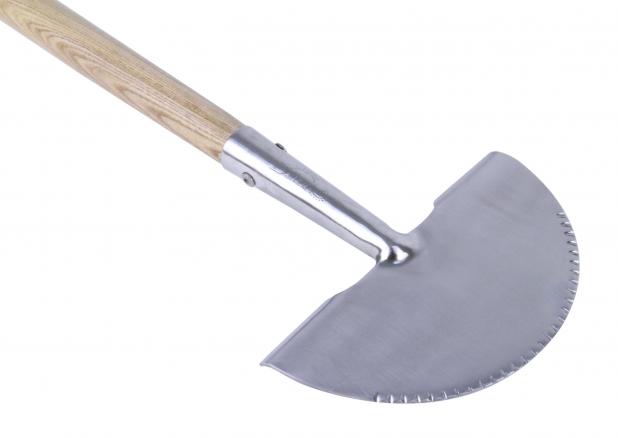
This object is all about constructing a garden or shaping the ground. I thought a good choice would be another tool, a ‘half moon’, used for creating edges to lawns or giving shape to borders.

half-moon-lawn-edger1It’s great thinking about and perhaps drawing up your garden design ideas, but even better putting them into action. Sometimes (perhaps more often than I care to admit), I find the design process is more satisfying by going out, looking at the garden, grabbing your tools and shaping or constructing things there and then. A bit risky sometimes if you don’t fully appreciate the impact of your ‘on the spot’ decisions on the rest of the garden. However, when using a half moon, perhaps in combination with a nicely curving hose pipe as a guide, it is really satisfying seeing the new, crisply flowing line of a border with its freshly dug soil, emerging from the adjoining grass.

Alas, my opportunities for this here in Old School Garden are getting fewer, as I move from an expansionist phase to one focused on creating a more manageable garden, and if anything, reducing the amount of planted space and to put back easier to maintain lawn and hard surfacing…but don’t mention this to my wife!

If you’ve been reading other posts in this series, you know that sometimes I’ve pushed the rules and included a couple of objects with the same name. Once more- by accident I hasten to add– I find myself toying with another sort of ‘half moon’. Yes, the astronomical variety, no less. That opens up a whole new area of ‘gardening essence’, well at least for some growers. Gardening according to the phases of the moon is a fascinating approach which you can use to guide when you plant different things for maximum health and vigour. As Lila Das Gupta says:

‘In a nutshell, people who garden by the phases of the moon believe that its gravitational pull on the earth’s water (i.e. tides), has a bearing on plant growth. They never plant anything when the moon is waning in the last quarter because it’s believed that the earth’s water table is receding. After the new moon, the water table rises again and planting can resume. Farmers on the continent have been using moon phases to guide them for years, as indeed have many gardeners in the UK.

You don’t need to spend money on any special equipment. My friend directed me towards lunarium.co.uk, from which you can print out universal lunar calendars for free….’

half moonSee more of her interesting article here.

 Old School Gardener

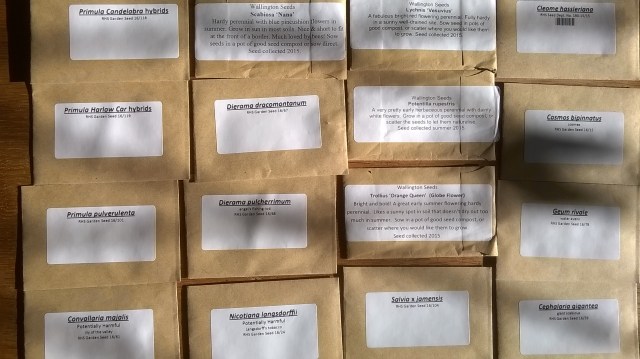
WP_20160130_13_10_48_ProI’ve now begun this year’s seed sowing; some early veg and some of the interesting varieties above, courtesy of my visit to Wallington Gardens last year and the RHS seed scheme…Looking at the germination requirements some of these are going to be a challenge!

Old School Gardener

Hellebores one of a few winter flowers currently on show...

Hellebores one of a few winter flowers currently on show…

Old School Garden – 29th January 2016

Dear Walter,

I looked back at the letter I wrote you this time last year, just out of interest. Even though that letter (written from a snowy landscape), painted a picture of relative inactivity, I did at least have potatoes chitting and the first seeds germinated. Alas, even though the weather has been mild (if a bit wet) I seem to be way behind this year.

I do NOT have potatoes chitting (I’m waiting on my friend who’s ordered the seed potatoes this year) and I do NOT have seeds sprouting (I brought the propagators in yesterday along with the seed box for sorting through).

I am looking forward to seed sowing though. Apart from some interesting perennials I bought at a National Trust Garden in the summer, I’m waiting on my selection of seeds from the RHS Seed scheme. These, with early vegetables (I planned out this year’s crops for the Kitchen Garden before Christmas) will give me a lot of seed sowing and seedling potting activity in the coming weeks….

Apart from NOT doing the things I needed to, I HAVE done a few other garden related things. As you know, I’ve been constructing some cupboards in two alcoves in our entrance hall. I’m rather pleased with the result. I bought some solid oak cupboard doors and sourced some oak framing and tops from a local timber merchant (the smell of freshly cut oak in the car on the way home was delightful). These are now finished and being repopulated with photo albums, sewing machines and other stuff… and I’m pleased with the result, and not a little surprised at my own skill level (YouTube ‘How to’ videos are a wonderful invention).

One of two new cupboards I've been building from solid oak...

One of two new cupboards I’ve been building from solid oak…

Well, I was left with a few pieces of spare wood, and had begun making a key cabinet to also go in the entrance hall, but upon putting this together using glued dowels I discovered my skill level wasn’t quite up to that challenge and also concluded that the thickness of the wood looked out of place for such a small item….So, having abandoned that project I had a lightbulb moment and decided to adapt the three sided box I had into a ‘bug hotel’, with a focus on nesting places for solitary bees and the like. Here’s the result…

One Bug Hotel!

One Bug Hotel!

It is rather heavy, but certainly solid. I’ve used a selection of old canes, some willow plant support and an old bamboo window blind, cut to fit and jammed together. I’ll now need to finalise where to put it up. I gather it needs to be in a warm sunny spot at least a metre off the ground. I may try to fix this to the fruit fence in the Kitchen Garden; this is the place where effective pollination is especially important.

Oh, and I nearly forgot that I’ve tied in the summer raspberries – at last! I’ve pruned the apple trees and vine. I’ve also finally dug up the dahlias and apart from a little tuber rot, these seem to be OK, so they are currently drying off in the greenhouse and will be put into slightly damp, second hand compost shortly, to stay under cover until they are ready to plant out later in the season. I also dug up two Osteospermums and put these in pots inside, as I think they might be prone to dying off before the end of the winter if left outside.

I’m pleased to say that my new Garden Design Course, ‘Get More From Your Garden’ looks like it will run as I have achieved the minimum number needed to make it viable, so I’m looking forward to meeting this new group of people and using the wonderful venue at Blickling Hall to explore and develop their own design projects.

Deborah and I have followed your lead and joined our newly established, local U3A (‘University of the Third Age’) group in Aylsham. We went along to a fascinating talk about ‘PAT’ (Pets As Therapy) dogs yesterday, the ones used in schools to help shy children learn to read, as companions for older or disabled people and so on. I’ve also joined a new gardening group and met the dozen or so other people in the group last week for an initial get together to discuss what we want to achieve. It looks like this could include visiting each other’s gardens to discuss problems and ideas, swapping plants, visiting open gardens etc.

An ahhhh moment...

An ahhhh moment…

So, I look back. And whilst I’m behind in some garden-related things, hopefully there’s still time to catch up (especially with the seed sowing). I’m pleased to hear that your new terrace has been laid and look forward to seeing it when we visit you and Lise at Easter. No doubt you’ll be planting up the pockets you left amongst the paving soon?

all the best for now,

Old School Gardener


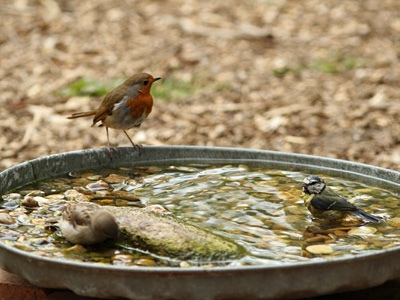
birdbath%20trio.jpg-550x0Birds will splash vigorously in an expensive ornamental birdbath – but just as readily in an upturned old dustbin lid. Prop it in place with bricks to ensure it is stable and put some gravel in the bottom to give the birds something to grip underfoot. change the water every few days and in the winter be sure to break any ice which forms. Give the lid a brisk scrub occasionally to keep it clear of algae.

Source: ‘Good Ideas for your Garden’- Reader’s Digest 1995

Old School Gardener

Finding Nature

Nature Connectedness Research Blog by Prof. Miles Richardson

Norfolk Green Care Network

Connecting People with Nature

Discover WordPress

A daily selection of the best content published on WordPress, collected for you by humans who love to read.

Susan Rushton

Celebrating gardens, photography and a creative life

Unlocking Landscapes

Writing, photography and more by Daniel Greenwood

Alphabet Ravine

Lydia Rae Bush Poetry

TIME GENTS

Australian Pub Project, Established 2013

Vanha Talo Suomi

The Journey from Finnish Rintamamiestalo to Arboretum & Gardens

Marigolds and Gin

Because even in chaos, there’s always gin and a good story …

Bits & Tidbits

RANDOM BITS & MORE TIDBITS

Rambling in the Garden

.....and nurturing my soul

The Interpretation Game

Cultural Heritage and the Digital Economy

pbmGarden

Sense of place, purpose, rejuvenation and joy

SISSINGHURST GARDEN

Notes from the Gardeners...

Deep Green Permaculture

Connecting People to Nature, Empowering People to Live Sustainably

BloominBootiful

A girl and her garden :)