Tag Archive: gardens


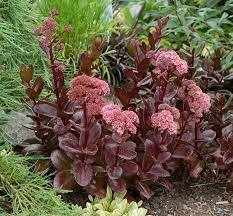
Sedum 'Chocolate Drop'- the foliage as attractive as the flower- and what a combination!

Sedum ‘Chocolate Drop’- the foliage as attractive as the flower- and what a combination!

We tend to think a lot – some of us almost entirely – about flower colour when we consider planting in the garden. Leaves last far longer than blooms, so why not go for a combination of flower and foliage that will add texture to flower colour and shape?

Some leaves are striped, others marbled or speckled, while others range from purple, silver and blue, to butter-yellow or lime-green. Geranium (Cranesbill) and succulent-leaved Sedum are good examples of plants that pack a punch with their leaves, as do Hostas and Lamium.

Stipa gigantea- wonderful

Stipa gigantea- wonderful

You can creat a soft, billowing effect with plants that have feathery foliage, such as Bronze Fennel, or those with masses of leaflets, such as Aquilegia and many of the ferns. Ornamental grasses can also be used to soften displays; many are particularly useful because they are drought tolerant. I grow several here at Old School Garden, and I love the variety they add to a herbaceous border with an evergreen structure of shrubs; Stipa gigantea is especially lovely when the late afternoon sunlight catches its stalks and waving awns.

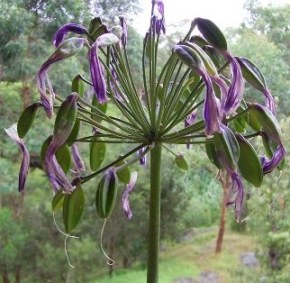
From flower to seedpod- Agapanthus

From flower to seedpod- Agapanthus

To sum up….

  • Blend foliage plants with flowering ones to keep the border looking at its best over the longest possible time.

  • Combine foliage and flowers that contrast with each other in colour,shape and texture.

  • Use plants with ornamental seed pods, such as Agapanthus, Feathery grass heads, such as Pampas grass and evergreen foliage.

  • Use plants with variegated leaves, such as striped, blotched and marbled, to their full advantage.

  • Choose flowering plants that have attractive foliage, such as Alchemilla mollis and geranium so that they add interest to the border over several months.

Hostas are usually grown for their foliage- which comes in all sorts of patterns and hues, but the flowers can also be very attractive

Hostas are usually grown for their foliage- which comes in all sorts of patterns and hues, but the flowers can also be very attractive

Source: ‘Short Cuts to Great Gardens’- Reader’s Digest, 1999

Old School Gardener


The 'Alderman' Pea- a heritage or heirloom variety

The ‘Alderman’ Pea- a heritage or heirloom variety

So, we made it to number 12. And what’s left to capture the essence of gardening? Well, I think I must put something in about legacy. So I’ve chosen an example of the humble pea, but not just any- an heirloom or heritage variety called ‘Alderman’.

In an interesting article about the heirloom or heritage varieties of pea held at the John Innes Centre in nearby Norwich, Mike Ambrose describes how the number of varieties of pea mentioned in seed catalogues increased over the 19th century, though in truth probably many were not ‘new’ varieties but thought to be such by their discoverers.

‘Peas were one of the most highly prized vegetables not just because of their nutritional qualities but also for their ease of cultivation and the range of varieties that ensured a succession of fresh produce over an extended season from May to October. Seed catalogues from the 1800’s contained many pages of descriptions of the varieties and in many, peas were placed at the front of the list. The Suttons catalogue of Vegetable seeds lists 53 varieties of peas compared to 14 broad beans whereas EW King & Co catalogue lists 49 peas to only 8 broad beans. Arthur Sutton in his paper on the progress of vegetable cultivation during Queen Victoria’s reign, interestingly also starts with peas which he refers to as the ‘Prince of Vegetables’.

The highly inbreeding nature of peas means that once fixed, particular variants or lines were particularly easy to maintain and it is clear from descriptions and illustrations as far back as the late 1500’s that peas such as parchmentless and fascinated types merited their own description and attributes (Gerard’s Herbal 1597). Prior to the rediscovery of Mendel’s work on the basis of inheritance in the early years of the 1900’s, there are clear references in the literature to selections being made from existing varieties as well as crossings between lines from which multiple forms were derived. In the absence of an understanding as to the underlying mechanism, the work was largely very largely empirical and selections in segregating populations resulting from crosses would have been only fixed for major characters leaving plenty of scope for further selection in subsequent generations.

Such was the clamour for improved varieties from growers in a market where there was no restriction in seed marketing and references can be found that openly refer to the prolific development of synonyms. Sherwood in 1898 noted the anomaly that, “while the number of listed varieties in catalogues was falling, the number of names of peas were ever increasing as more and more new varieties were being announced or shall I say old friends with new names”.

This was a brave statement of what was a widespread practise and he goes on to say “I need hardly say that they may easily be reduced to one fourth that number (150) as so many are only synonyms well known to those who test them each year: but it is not my intention to apply the pruning-knife, as I should most likely bring about my head a hornet’s nest of protests from those who do not agree with me.” This from someone who was involved with the growing of nearly 700 rows of different marketed peas for comparison in 1898 in his trial grounds in Essex…’

So my last object captures the way gardeners and breeders have taken natural processes of hybridisation among plants and developed varieties with new chracteristics- whether in foliage, flower, fruit or other ways. This legacy has added to nature’s own bounty and given us as gardeners ever more choice. But of course nature (and the growth in plant breeder’s rights) can also destroy or limit this variety. So it’s great to see initiatives like the conservation work of the NCCPG, Garden Organic’s Heritage Seed Library and the Svalbard Global Seed Vault- which both attempt to collect, and in Garden Organic’s case, promote the growing of, varieties that are in danger of being lost

…I leave to another place the debate over whether ever-increasing new varieties and the growing control of the varieties available commercially are ultimately ‘good’ things and of course the even more controversial topic of how genetic modification can even further extend our control of nature…

For us more modest gardeners, legacy may not be about breeding or discovering new varieties of plant and then finding a name for them (often of a cherished loved one, or for the more narcissistic, choosing one’s own name). Rather, it will be in leaving what we have created in our gardens and quite possibly what we pass on to sons, daughters and others (e.g. in school or community growing projects) by way of our skills and knowledge gained over many seasons.

I hope that you’ve enjoyed reading this and the previous posts in the series. You can access all of them via  ‘The Essence of Gardening in 12 Objects’ in the ‘My articles classified’ list on the right- but as a ready reference I’ll list out all 12 below:

1: Compost Heap– looking after our soil and feeding plants

2: Plant Label– propagation by seed and nurturing plants

3: Wardian Case– the expansion of plant choice through importation and creation of micro climates

4: Hand fork– weeding and soil care

5: Topiary– cutting plant stems to control shape and propagate

6: NGS Booklet– sharing our gardens and learning from them

7: Compass and compasses– positioning plants and design

8: Half Moon– constructing and shaping the garden and lunar phase gardening

9: Weather Satellite– watching and responding to the weather and further technological developments to aid the gardener

10: Trug– growing plants to eat

11: Garden Bench– sitting and enjoying the garden

12: Heirloom Pea – legacy through hybridisation and passing on our skills and knowledge to the next generation

Further information:

Garden Organic’s Heritage Seed Library

‘Seed Sense’- The Guardian

Svalbard Global Seed Vault

NCCPG Plant Heritage

EU Seed Law update and why grow Heritage seeds- Permaculture Magazine

 Old School Gardener

Hellebores coming to an end...

Hellebores coming to an end…

To Walter Degrasse

Dear Walter,

So, as usual, I’m feeling guilty at all the jobs that are lining up and my failure to make much of an impact on them. Still, I was heartened by Monty Don’s comment in last week’s ‘Gardeners’ World’, when he said: ‘Now’s the time to divide and move herbaceous and other perennials’; phew, at least I’m a little ahead of the game on that score!

However, I do seem to be behind in digging over the borders and getting seedlings going, amongst other things. I got round to planting out some (leggy) ‘cut and come again’ lettuce the other day (under cloches), and yesterday I potted up some other trays of early seedlings. At the same time I started to clear out the greenhouse- of trays of not very successfully overwintered pelargoniums, and the more tender exotics…hopefully a cover of fleece will see them through the remaining cold weather.

Potted up and ready to go- Scabious 'Nana', Geum rivale etc.

Potted up and ready to go- Scabious ‘Nana’, Geum rivale etc.

The little bit of digging I have done was very satisfying, having finished cutting back all the dead growth from last year and raked up the remaining fallen leaves from the borders. The daffodils are well into their stride – mine seem to have behaved much as normal as far as flowering time is concerned, unlike other parts of the country, where the abnormally mild winter has brought many species out earlier than ‘usual’. And the tulips are starting to show their colours. I also gave the grass its first real cut of the year at Easter Weekend and that always makes things look a little tidier.

I’ve continued to dig out the new Pond Garden and also- thanks to a gift from Blickling- set up a lowish rustic fence. in front of this I’ve planted a couple of lines of Yew cuttings (which will, I hope reach a reasonable height to form a hedge in a few years time). I’ve also slotted in an evergreen, variegated Jasmine (the variety escapes me), pink Clematis and a Belgian Honeysuckle; these three should nicely clothe this fence and leave some peep holes into the pond garden.

Grass has had its first real cut...

Grass has had its first real cut…

I’ve firmed up my plans for this new area and have decided to follow a ‘Crescent’ theme- you’ll recall that I cut out a crescent (or arc) along the top of the Laurel hedge that bounds this new garden? I plan to repeat this motif in other features; e.g. a crescent-shaped wall of rustic poles to hold up the embankment behind the rustic bench, and a series of rope swags which will form a nice rose and clematis-clad pergola feature over the bench. I’ve also got a rather fine arc of an oak trunk which will look good placed in the garden and have ideas for some ‘rustic arc sculpture’ to also pick up the theme. However, I’ve looked back at my letter to you about this time last year and was horrified to see that the pond excavation was underway then- so a whole year on and not much to show for it!

I’m using the spoil from the pond excavation to create a mound overlooking the fields and church beyond; where another bench can be placed as both a feature and somewhere different to sit- not that I seem to do much of this these days!

Mound under construction with the view across the field to the Church

Mound under construction with the view across the field to the Church

Along side this the woodland garden I set out last year is starting to fill out nicely, with several types of spring bulb beginning to form flowers. In due course I’l extend this to enclose the new bench mound.

The woodland garden starting to fill out..

The woodland garden starting to fill out..

As I write this the remnants of Storm ‘Katie’ have just passed and so I’ve been out with the pressure washer to try to clean up the paved areas of the terrace and around the house. It was hard work and a few hours later it looks better, but retains a lot of algae. I’ll give it a coating of patio cleaner and another go with the pressure washer tomorrow. I also divided up the two main patches of snowdrops the other day, but there is plenty of other plant moving and dividing to do. Along with digging over, mulching, preparing the ground for my ‘first early’ potatoes and so on…

Getting cleaner- the terrace after it's first pressure wash

Getting cleaner- the terrace after it’s first pressure wash

The other big digging job that I’ve just begun involves taking out some cotoneaster shrubs and the roots of the ivy that grew up the front gable wall of the house. I hope that once this is cleared we can get the old paint removed  to reveal the original flint facing and at the same time get the roof flashings repaired to, hopefully, overcome our water penetration problems.
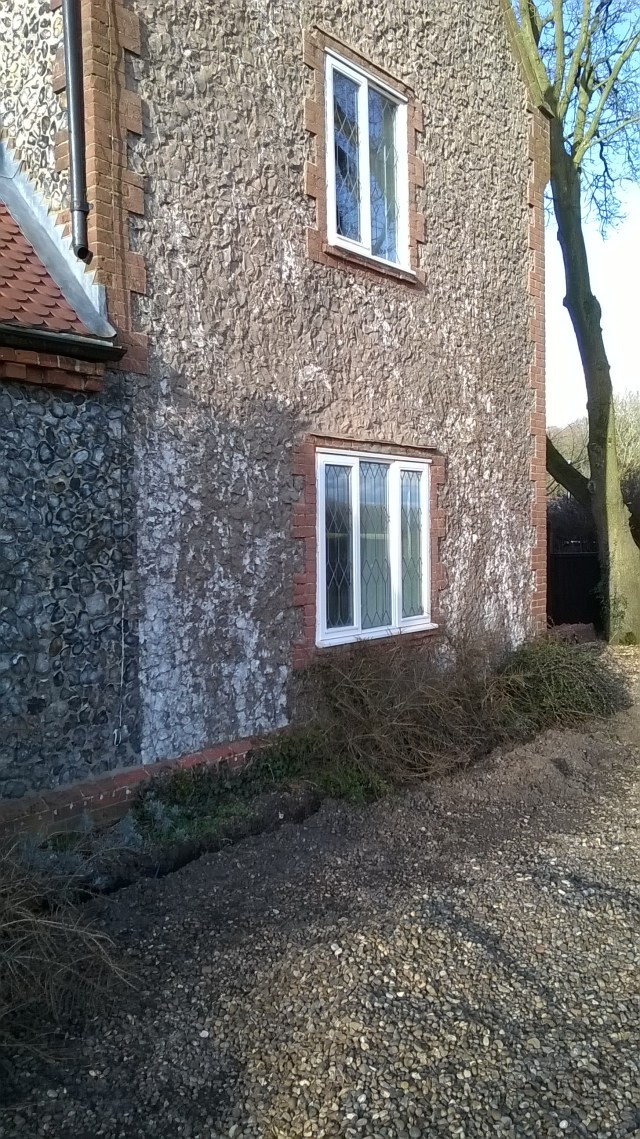
The front border is being dug out to remove ivy roots and a couple of old Cotoneaster plants- these will be relocated to the new pond garden

The front border is beign dug out to remove ivy roots and a couple of old Cotoneaster plants- these will be relocated to the new pond garden

This slideshow requires JavaScript.

I’m pleased to say that more time is now available as the Garden Design course I ran at Blickling has just ended. I think that this went pretty well, though some elements need to be tweaked. The last session involved the participants going into the Walled Garden at Blickling and doing a practical exercise in setting out and preparing the ground for planting etc. Though pressed for time, I think that they found this useful and I’m grateful for Project Manager Mike’s help in this.

Garden Design course participants getting to grips with a setting out exercise in the Walled Garden at Blickling

Garden Design course participants getting to grips with a setting out exercise in the Walled Garden at Blickling

This is the time of year that is full of promise in the garden- stems, flowers and foliage are sprouting, bringing back a welcome splash of fresh colour. My hope is that I manage to get all the preparation done before it’s too late to tread on the ground- and all this this alongside the other big projects in both house and garden!

All the best to you and Lise,

Old School Gardener

Royal Blue Clematis: picture by Virginia Mitchell-Pike

Royal Blue Clematis: picture by Virginia Mitchell-Pike

Our friends Jen and Dave visited us at the weekend and on the way they stopped off at the wonderful Anglesey Abbey in Cambridgeshire. This National Trust property has a spectacular display of Snowdrops (finished by the time of their visit), formal gardens, summer borders and also a winding Winter Garden which features a fantastic mixture of flower, leaf and stem colour. Here are Jen’s pictures from that Winter Garden; I expect it will soon be pruned- thanks Jen!

Further information: National Trust Website

Old School Gardener


coastal-garden-benchesSo, my penultimate object in this series symbolises our need (all too often neglected by the busiest gardeners) to sit and enjoy the fruits of our labours- the garden bench. And the one in the featured picture is made from reclaimed wood and, I think, looks rather inviting (especially with the addition of a couple of large cushions?).

Having said this, there are probably not that many garden benches that are frequently used for sitting. Here at Old School Garden, over the years  I’ve spread a number of these garden ‘must haves’ around (and have two more to restore/ assemble to place in key positions in my pond garden and to take advantage of the view across the fields to our local church). Apart from one or two used to take summer morning coffee (as an alternative to the rather more comfortable chairs on the terrace), these are not used for sitting. So, where should you position these essential garden objects?

One view is that it’s by a process of elimination, spotting the place where it looks right. However, what looks right, in practice might not feel right. Elizabeth West describes the difficulty in her book Hovel in the Hills:

“The right places to sit in a garden have to be discovered. They cannot be decided in advance. Alan [her husband] once erected a two-seat wooden bench beneath the laburnum tree because it was sheltered from the wind, caught the sun and looked out towards Moel Siabod [a mountain in Snowdonia].

On a few occasions we took out our cups of tea and sat there self-consciously, but it didn’t feel right. We would find ourselves drifting across to a patch on the drive about 10ft away, and we would stand there to finish our tea. So we moved the bench there. It caught all the sun, was not so sheltered and didn’t have quite the same view, but it felt right.”

The classic 'Lutyens Bench'- one to add a bit of class to your plot?

The classic ‘Lutyens Bench’- one to add a bit of class to your plot?

In a provocative article (see below for link), Antony Howard says:

“Discomfort remains the defining quality of outdoor seating. The goal of meeting the tripartite challenge of comfort, weatherproofing and looks continues to defy designers. Most seats make minimal concession to the fragility of the human frame. Sharp angles, hard edges and an absolute absence of ergonomics abound. Wooden seats promise a coating of green slime. Metal or stone ones freeze the buttocks. Grass or moss are obviously not to be taken seriously.”

He goes on to say that this discomfort doesn’t really matter, for garden benches are not, in general, intended to be sat on. ‘They are present to introduce the idea of repose’, he says, ‘which is perfectly justifiable in a place given over to the peace of mind, body and soul.’ Apart from this, they also have visual value in garden design- brightly painted to provide a focal point or attraction on a garden route, tucked in or under or around a tree to emphasise or frame it.

Either way, the garden bench- in all its manifestations- for me is an essential of gardening. Whether it be just the idea of rest and soaking up the surroundings, or actually sitting down (perhaps mid gardening session) to sip a drink, with clipped conversation tailored to the real wish to watch nature at work.

Hmm, the ultimate in benches designed not to be sat upon?

Hmm, the ultimate in benches designed not to be sat upon?

Further information:

‘The Art of Garden Furniture ‘- Antony Howard in the Daily Telegraph

‘A Short History of Benches’

‘The humble public bench becomes comfortable, inclusive and healthy’

 Old School Gardener

The Royal Botanic Gardens, Edinburgh saw an impressive increase in visitors last year.

The Royal Botanic Gardens, Edinburgh saw an impressive increase in visitors last year.

By Elizabeth Henry (from Horticulure Week 7th March 2016)

‘Visitors continue to flock to gardens around the country, according to figures released today by the Association of Leading Visitor Attractions (ALVA).

Among them, the Royal Botanic Gardens, Edinburgh saw a 10 per cent increase to 889,420, adding to a 19 per cent rise in 2014. RBGE credited their Lights programme in the winter months for the increase.

The Eden Project saw an 11 per cent increase to 960,029 visitors, compared to a 1 per cent increase in 2014.

All four RHS gardens had record visitor numbers in 2015, with RHS Garden Hyde Hall in particular up 12.1 per cent to 242,520 visitors. Rosemoor visitor numbers were up by 9.5 per cent, Wisley by 6.1 per cent and Harlow Carr by 5 per cent.

Kew Gardens saw a more modest increase of 3.5 per cent, but Wakehurst Place, which Kew leases from the National Trust, saw visitor figures climb by 14.9 per cent – a strong turnaround from 2014 when the introduction of carparking fees saw a 29 per cent fall in visitor numbers.

Many National Trust properties held steady or saw more modest gains. Standouts include a 15.2 per cent increase in numbers at Bodnant Garden in Wales, 10.3 per cent at Lanhydrock and 17 per cent at Mount Stewart in Northern Ireland.

The UK as a whole saw a 3.2 per cent increase in visitor numbers, while Scottish attractions proved particularly popular, gaining 5.48 per cent overall.

Chester Zoo was the most visited paid-for attraction in England outside London, mainly as a result of the opening ‘Islands’ in June – a recreation of the tropical environments of six South East Asian islands.

The British Museum continued to be the most popular visitor attraction overall for the ninth year running. But visits to many London attractions plummeted following the Paris attacks in November.

Bernard Donoghue, Director of ALVA, commented:

“2015 continued to be a record year mainly due to our members continuing to show how diverse the UK is to both domestic and overseas visitors….The current weakness of the pound to the dollar and Euro is making the UK a more affordable destination and 2016 is on target to be another memorable year for ALVA members.” ‘

FB_20160213_17_33_07_Saved_Picture

FB_20160213_17_31_24_Saved_Picture

FB_20160213_17_31_57_Saved_Picture

Finding Nature

Nature Connectedness Research Blog by Prof. Miles Richardson

Norfolk Green Care Network

Connecting People with Nature

Discover WordPress

A daily selection of the best content published on WordPress, collected for you by humans who love to read.

Susan Rushton

Celebrating gardens, photography and a creative life

Unlocking Landscapes

Writing, photography and more by Daniel Greenwood

Alphabet Ravine

Lydia Rae Bush Poetry

TIME GENTS

Australian Pub Project, Established 2013

Vanha Talo Suomi

The Journey from Finnish Rintamamiestalo to Arboretum & Gardens

Marigolds and Gin

Because even in chaos, there’s always gin and a good story …

Bits & Tidbits

RANDOM BITS & MORE TIDBITS

Rambling in the Garden

.....and nurturing my soul

The Interpretation Game

Cultural Heritage and the Digital Economy

pbmGarden

Sense of place, purpose, rejuvenation and joy

SISSINGHURST GARDEN

Notes from the Gardeners...

Deep Green Permaculture

Connecting People to Nature, Empowering People to Live Sustainably

BloominBootiful

A girl and her garden :)