
Hellebores one of a few winter flowers currently on show…
Old School Garden – 29th January 2016
Dear Walter,
I looked back at the letter I wrote you this time last year, just out of interest. Even though that letter (written from a snowy landscape), painted a picture of relative inactivity, I did at least have potatoes chitting and the first seeds germinated. Alas, even though the weather has been mild (if a bit wet) I seem to be way behind this year.
I do NOT have potatoes chitting (I’m waiting on my friend who’s ordered the seed potatoes this year) and I do NOT have seeds sprouting (I brought the propagators in yesterday along with the seed box for sorting through).
I am looking forward to seed sowing though. Apart from some interesting perennials I bought at a National Trust Garden in the summer, I’m waiting on my selection of seeds from the RHS Seed scheme. These, with early vegetables (I planned out this year’s crops for the Kitchen Garden before Christmas) will give me a lot of seed sowing and seedling potting activity in the coming weeks….

Spring promise…Purple sprouting broccolli on the way…

…Crocuses….

…Tulips…
Apart from NOT doing the things I needed to, I HAVE done a few other garden related things. As you know, I’ve been constructing some cupboards in two alcoves in our entrance hall. I’m rather pleased with the result. I bought some solid oak cupboard doors and sourced some oak framing and tops from a local timber merchant (the smell of freshly cut oak in the car on the way home was delightful). These are now finished and being repopulated with photo albums, sewing machines and other stuff… and I’m pleased with the result, and not a little surprised at my own skill level (YouTube ‘How to’ videos are a wonderful invention).

One of two new cupboards I’ve been building from solid oak…
Well, I was left with a few pieces of spare wood, and had begun making a key cabinet to also go in the entrance hall, but upon putting this together using glued dowels I discovered my skill level wasn’t quite up to that challenge and also concluded that the thickness of the wood looked out of place for such a small item….So, having abandoned that project I had a lightbulb moment and decided to adapt the three sided box I had into a ‘bug hotel’, with a focus on nesting places for solitary bees and the like. Here’s the result…

One Bug Hotel!
It is rather heavy, but certainly solid. I’ve used a selection of old canes, some willow plant support and an old bamboo window blind, cut to fit and jammed together. I’ll now need to finalise where to put it up. I gather it needs to be in a warm sunny spot at least a metre off the ground. I may try to fix this to the fruit fence in the Kitchen Garden; this is the place where effective pollination is especially important.

Apple trees pruned…

..and the vine in the courtyard.
Oh, and I nearly forgot that I’ve tied in the summer raspberries – at last! I’ve pruned the apple trees and vine. I’ve also finally dug up the dahlias and apart from a little tuber rot, these seem to be OK, so they are currently drying off in the greenhouse and will be put into slightly damp, second hand compost shortly, to stay under cover until they are ready to plant out later in the season. I also dug up two Osteospermums and put these in pots inside, as I think they might be prone to dying off before the end of the winter if left outside.

Winter colour…Hellebores…

…Snowdrops…

Winter Aconites….
I’m pleased to say that my new Garden Design Course, ‘Get More From Your Garden’ looks like it will run as I have achieved the minimum number needed to make it viable, so I’m looking forward to meeting this new group of people and using the wonderful venue at Blickling Hall to explore and develop their own design projects.
Deborah and I have followed your lead and joined our newly established, local U3A (‘University of the Third Age’) group in Aylsham. We went along to a fascinating talk about ‘PAT’ (Pets As Therapy) dogs yesterday, the ones used in schools to help shy children learn to read, as companions for older or disabled people and so on. I’ve also joined a new gardening group and met the dozen or so other people in the group last week for an initial get together to discuss what we want to achieve. It looks like this could include visiting each other’s gardens to discuss problems and ideas, swapping plants, visiting open gardens etc.

An ahhhh moment…
So, I look back. And whilst I’m behind in some garden-related things, hopefully there’s still time to catch up (especially with the seed sowing). I’m pleased to hear that your new terrace has been laid and look forward to seeing it when we visit you and Lise at Easter. No doubt you’ll be planting up the pockets you left amongst the paving soon?
all the best for now,
Old School Gardener


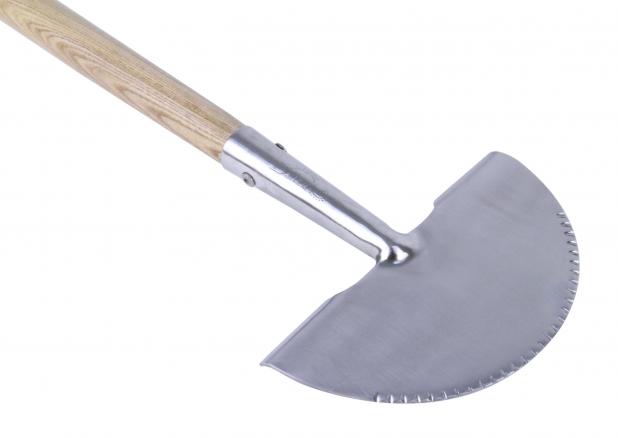 It’s great thinking about and perhaps drawing up your garden design ideas, but even better putting them into action. Sometimes (perhaps more often than I care to admit), I find the design process is more satisfying by going out, looking at the garden, grabbing your tools and shaping or constructing things there and then. A bit risky sometimes if you don’t fully appreciate the impact of your ‘on the spot’ decisions on the rest of the garden. However, when using a half moon, perhaps in combination with a nicely curving hose pipe as a guide, it is really satisfying seeing the new, crisply flowing line of a border with its freshly dug soil, emerging from the adjoining grass.
 See more of
 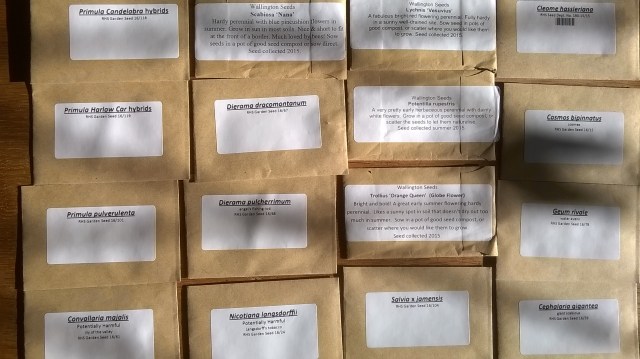 I’ve now begun this year’s seed sowing; some early veg and some of the interesting varieties above, courtesy of my visit to Wallington Gardens last year and the RHS seed scheme…Looking at the germination requirements some of these are going to be a challenge!
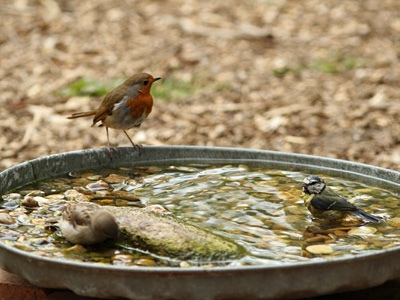 Birds will splash vigorously in an expensive ornamental birdbath – but just as readily in an upturned old dustbin lid. Prop it in place with bricks to ensure it is stable and put some gravel in the bottom to give the birds something to grip underfoot. change the water every few days and in the winter be sure to break any ice which forms. Give the lid a brisk scrub occasionally to keep it clear of algae.
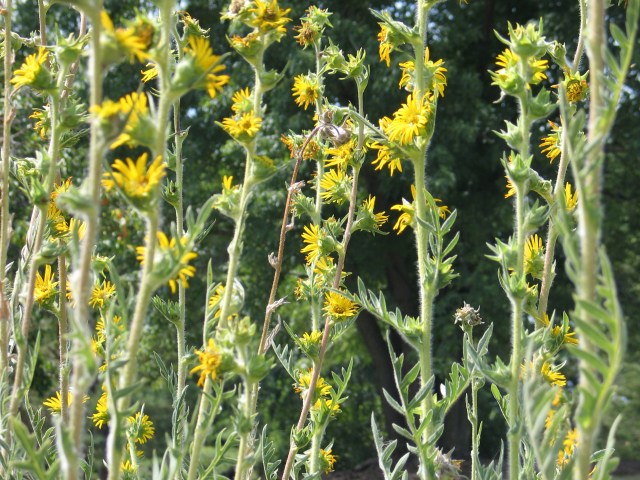
 Before starting to lay foundations for a paved area, decide on the position of plants around a terrace or patio and in planting pockets within the space and leave the areas free of foundation material and paving (wooden shuttering can be used for larger areas). Once the works are over, replace the topsoil of the planting areas with John Innes number 3 compost (and grit if you’re putting in things like Thymes). This will ensure a weed free growing medium with the right nutrients so plants establish quickly.
 As the
  We opened Old School Garden up to the public in 2013 for one day (not as part of the NGS, but with proceeds going to three local good causes), so I know how much hard work, excitement and enjoyment comes from doing that (we might have another go one day…). I’m also an enthusiastic visitor to other gardens, as you’ll have seen from many posts on this blog!
 Horticultural fleece laid over plants can bring earlier crops and other benefits.

 More and more garden plants are available from garden centres in flower. If bought in bud, potted bulbs, such as dwarf daffodils, crocuses, hyacinths and tulips, allow you to instantly transform an otherwise dull border into a colourful, early spring centrepiece. This is particularly useful for adding colour to prominent beds near to the house.




 Old School Garden