Tag Archive: garden


cornus alba sibirica and green yellow stems of C. flavirameaCornus is a genus of about 30- 60 species of woody trees and shrubs, commonly known as dogwoods. Most are deciduous, but a few are more like herbaceous perennials (subshrubs) and some are evergreen. Cornus is the latin word for ‘horn’ referring to the hardness of the wood.

The name “dog-tree” was recorded in 1548, and this had changed to “dogwood” by 1614. After this the plants soon became known as the Hound’s Tree, while the fruits came to be known as dogberries or houndberries (the latter is also the name given to the fruits of the black nightshade- alluding to Hecate’s hounds).

The plants may have become known as ‘dogwoods’ from the Old English word dagwood, which refers to the ways it’s slender stems of very hard wood were used to make “dags” (daggers, skewers, and arrows).

Another, earlier name of the dogwood in English is the whipple-tree. Chaucer refers to the “whippletree” in The Canterbury Tales (‘The Knight’s Tale- verse 2065). A whippletree is also a part of a horse – drawn cart; the link between the drawpole of the cart and the harnesses of the horses lined up behind one another, and commonly carved from the Whippletree or Dogwood.

Some of the Cornus species names are:

C. alba = white

C. canadensis = of Canada

C. candidissima = very white- the flowers

C. capitata = headed- the grouping of flowers

C. florida = flowering richly

C. fragifera = strawberry-like – the fruits

C. glabrata = glabrous

C. kousa = a japanese name

C. mas = male (mascula of Linnaeus)

C. nuttallii = after Nuttall

C. sanguinea = blood-red- the twigs

Cornus are either grown for their flowers, interesting leaves (some both of interest during summer and autumn) or for their colourful winter stems. These are just coming into their own in winter gardens around Britain – including Old School Garden. I have several groups of C. alba ‘Sibirica’, C. sanguinea ‘Midwinter Fire’ and C. sericea ‘Flaviramea’ (some grown easily from hardwood cuttings). I ‘stool’ these (i.e. cut the stems to the base) each spring to encourage new growth, which once the leaves have fallen (these are also very colourful in the autumn), reveals bright red, orange and yellow- green stems, which really glow in the winter sunshine..

Sources and further information:

Wikipedia

Seven Plants for Winter Wonder -article on Old School Garden

Cornus- RHS advice

Cornus- an essential winter shrub- Daily Telegraph

Old School Gardener

A few more examples of creative projects for childrens’ play, shelters, planters and other projects for the garden and open spaces. Most from the site 1001 pallets.

Old School Gardener

holly with berriesSo it’s coming up to Christmas and those traditional displays of greenery in the house like Mistletoe, Ivy and of course Holly are being assembled as I write. But someone in Cumbria has a problem. George Alloway in Cockermouth asks:

‘My holly bush never seems to have any berries, but my neighbour’s has loads. What’s wrong?’

George, it sounds like a classic case of ‘not the right holly’, or rather that you probably have a male bush and your neighbours a female- only the female will produce fruit (berries) and this plant is probably being pollinated by yours!

Formally clipped Hollies at Kew Gardens

Formally clipped Hollies at Kew Gardens

Hollies (Ilex) mainly come in male and female varieties and so you need both to ensure that you have berries. Hollies, apart from their decorative value around the house at Christmas, are a wonderful small tree or shrub to have in your garden, especially in a border that runs into woodland (as is the case in Old School Garden) – they are a classic ‘understorey’ or edge of woodland plant.

So, if you want berries, make sure you have a mix of male and female plants or go for a self fertile variety like ‘J.C. van Tol’ which is a regular fruiter, has oval-elliptical leaves and grows into a conical shape up to 6m. It also can be grown as a standard tree (i.e. having a bare stem of at least 1 metre length).

You could also buy a female variety to sit alongside your other, probably male, bush. A good variety is ‘Golden King’- despite the name, this is a female! Just to confuse matters further there’s a lovely male variety called ‘Silver Queen’ – variegated with broad and irregular white-yellowish margins and dark olive-green centres, this one grows to 4-6 metres high. It has the added feature of new leaves being tinged light pink.

I guess in these days of tolerance on sexual orientation, we shouldn’t get too het up about these naming confusions!

Old School Gardener

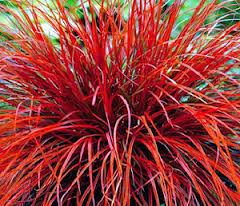
Uncinia rubra 'Firedance'

Uncinia rubra ‘Firedance’

Uncinia is a showy addition to any border or garden with its shiny red-bronze foliage.

Uncinia is a genus of about 35-45 species of tufted,evergreen perennials, known as hook-sedges (or hook grasses or bastard grasses in New Zealand. The plants develop hooks, which are used to attach it’s fruit to passing animals, especially birds. The name derives from the latin word uncinus, which means a hook or barb. Uncinia is a “satellite genus” of the very large genus Carex.  Most species are found in Australia, New Zealand and South America.

Uncinia flower
Uncinia flower

Some species are rhizomatous and most are native to damp, tussocky grassland, moist woodland or swamps. Grown for their colourful leaves, Uncinia are suitable for the front of borders, or gravel plantings. Though they are frost hardy to about -10 degrees C for short periods, longer term exposure to frost is best avoided for some species and so these should be grown in cool greenhouses. They prefer moderately fertile, humus-rich, moist but well-drained soil in full sun or light dappled shade. They are not troubled by any pests or diseases.

The most common Uncinia used in gardens are U. rubra (around 30 cms high, with greenish red to rich reddish brown stems and foliage and with dark brown to black flowers) and U. uncinata (25cms tall and with pale brown to red-brown leaves and dark brown flowers). Both bear flowers in mid to late summer. Foliage colour is best in late spring.

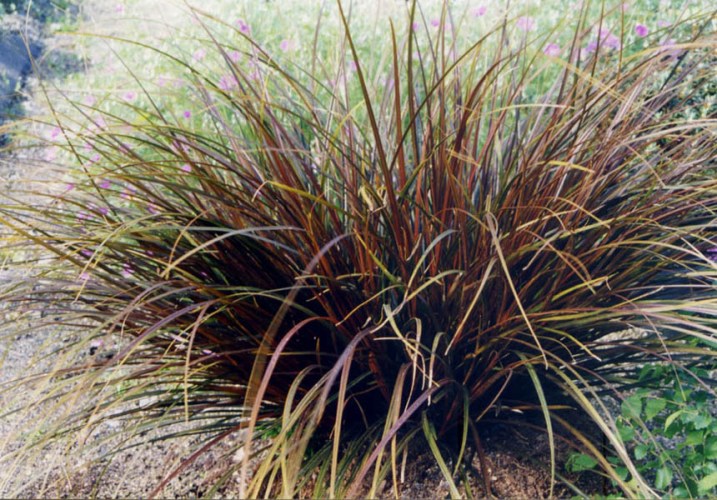
Uncinia ucinata 'Red'
Uncinia uncinata ‘Red’

The plants gradually form dense clumps of short, arching, grassy, evergreen foliage.  Slow growing, Uncinia look at their best in groups as leafy ground cover at the front of a sunny border. They can be combined with other perennial grasses that enjoy similar conditions; e.g.

  • Carex oshimensis ‘Evergold’

  • Phormium ‘Alison Blackman’

  • Ophiopogon planiscapus.

It will do well in soggy areas and around water features and ponds. U. rubra ‘Firedance’ will add a highlight to the rock garden as well as the mixed border, and it also looks great in containers. It’s advisable to avoid planting them next to vigorous plants that would smother them, as they need lots of sun to do well. Comb or rake off any old, tired or dead leaves and flowers in spring. If necessary they can be cut back (by up to half) at almost any time from April to July, but should not be cut back in autumn or winter.

Uncinia uncinata
Uncinia uncinata

You can raise Uncinia seeds in a cold frame for protection and hardiness. Seeds can be started in the late winter or early spring and should be sown in good quality, well-draining seed compost, pressing the seeds into the soil. Lower temperatures of less than 41°F are very effective. Constant moisture must be maintained and trays should not be left in direct sunlight. Once seedlings are large enough to handle, move them into a pot to grow on. Transplanting can be done in spring or summer after all frost danger has passed.

Old School Gardener

IMG_7887

Thanks for reading this, my 1000th post on Old School Garden. I’ll do a fuller review of my blogging experience on my first anniversary on 17th December. But for now I hope that you enjoy my review of an interesting garden in Portugal.

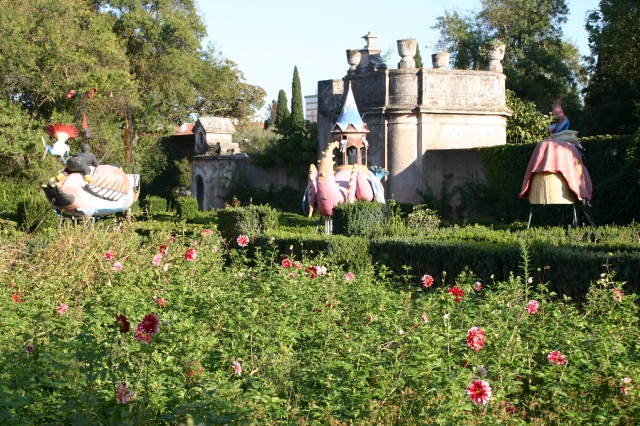
A little off the beaten track in one of Lisbon’s northern suburbs (Lumiar), sit the Gardens of Monteiro Mor (this translates as ‘the High Huntsman of the Royal House’ refering to one of the former grand residents).They come with not one, but two bonuses – small, but fascinating museums, one focusing on Portuguese Theatre and the other Costume.

The surrounding gardens are a very engaging mix of formal, botanical display and wilder woodland walks – all very pleasant on a warm autumn day. And there are a number of curious sculptures to see en route too, along meandering paths and steps which take you to a variety of water features and through glades of mixed, mature trees and shrubs.

Interestingly, a communal food growing area seems to have been created on the edge of the parkland, and we also were lucky enough to see a wide range of flowers on display when we visited.

The museums, housed in two former grand houses a few paces from each other, are very well laid out. The Theatre Museum comes stocked with a huge array of printed and pictorial material along with theatre models, sculpture and theatrical props (including some lovely puppets and larger costume displays).

No need for much in the way of interpretation here as the visual richness speaks for itself!

The Costume Museum is an altogether more restrained affair, with displays of clothes and accessories from different periods set off wonderfully in the elegantly decorated rooms of the former palace. Varied lighting levels and effects and a nicely uncluttered feel all contributed to a beautiful wander though time.

This became especially interesting when we reached the 1960’s and more recent displays, which brought back some long-lost memories!

This was a visit well worth the subway ride from central Lisbon, the ‘one for all’ ticket being very good value.

Old School Gardener

Depending on the shade amd soil conditions many plants can be grown under trees

This week’s question is one that affects many gardens- the impact of trees on other planting. Jenny Bough from Gateshead asks;

‘Part of my garden is in shade for most of the day because of trees in a neighbour’s garden. Since I cannot remove the trees, what can I do to improve the conditions for my plants? And what plants will grow well?’

If the trees grow close to your garden the shade will probably be dense, and the soil may well be permanently moist from overhead drip. If so, you can improve the drainage by adding coarse grit to the soil under the tree and plant moisture- and shade- loving plants such as hardy Ferns, Primula species, Violets and Periwinkles. If you have lighter or more dappled shade then there are plants which like these conditions: Lilies, hostas, Azaleas, Rhododendrons and Blue Poppy (Mecanopsis) for example.

Epimedium- a good choice for dry shade

If the tree is close to your boundary, or indeed within your garden, and its roots make the immediate area very dry and shady, then plants such as dwarf Cyclamen (C. hederifolium), small-leaved Ivies and Epimedium should do well. You could also try to dig out a few pockets where bulbs can be planted. If you can mix plenty of compost or other organic matter  into the soil then many more options are open to you as the soil will be relatively nutritious and will retain moisture better. The London Orchard Project have added a helpful piece of advice:

‘Wait until the tree has established before any underplanting is carried out. Then be sure to plant perennials,  as (these), including trees, prefer a fungally dominated soil, whereas annuals prefer bacterial domination. Also, disturbing the shallow feeder roots of the tree can be minimised by not having to replant/remove annuals.’

Some trees produce roots close to or above the soil surface, which then send up new shoots or ‘suckers’; e.g Poplars. If you want to grow grass over these root runs, once again the best approach is to ensure a good depth of topsoil above the roots and so give the grass a good layer of soil to grow on and reduce the chances of suckers appearing. Another approach- and one I’ve used in Old School Garden under a large Black Poplar tree- is to cover the immediate surrounds of the tree with landscaping fabric and then use a decorative aggregate or other material as a covering (I’ve used purple slate). This has reduced, but not entirely removed the problem of suckers appearing. Alternatively, there’s nothing else for it but to keep pruning/mowing off the shoots as they come up. This is best done in early summer after the tree has put on its initial growth spurt- doing it in the dormant season will only encourage more suckers to appear in the new season.

Some trees (in this case a Maple) will send out shallow or surface level roots from which new shoots or 'suckers' will grow
Some trees (in this case a Maple) will send out shallow or surface level roots from which new shoots or ‘suckers’ will grow

Further information: a useful guide to tree care

Old School Gardener

raspberriesAnother guest article by one of the participants in the ‘Grow Your Own Food’ course I ran recently in Foulsham, Norfolk.
Raspberries – A superfood that tastes better than spinach-what’s not to like?!

by Chris Richmond

Health

Antioxidant and anti-inflammatory phytonutrients in Raspberries may have anti-cancer benefits and assist in the management of obesity, though possibly not if eaten with oodles of cream.

However, raspberries are among a small number of foods that contain measurable amounts of oxalates. When oxalates become too concentrated in body fluids, they can crystallize and cause health problems. For this reason, individuals with already existing and untreated kidney or gallbladder problems may want to avoid eating raspberries.

So…everything in moderation, even raspberries- unfortunately.

Varieties

There are two types of raspberry available to the kitchen gardener. Summer-fruiting varieties will crop at any time from the beginning of July to early August on stems of last season’s growth; autumn-fruiters bear their berries over a longer period – from mid-August to the first frosts – on the current season’s growth. Both are similarly easy to care for but require slightly different pruning techniques. As long as you know how to wield your secateurs around them there is little mystery to growing these accommodating fruits and their length of service – up to 12 years – means they give a lot back in return.

‘Glen Ample’ AGM – Delicious, large fruit produced in mid-summer on this extremely heavy-yielding summer cultivar with vigorous, upright, spine-free canes. The berries are produced on long, upright stems, making picking easy.

‘Glen Moy’ AGM – This early summer raspberry bears heavy crops of medium to large berries, which have a good flavour. It may also produce a small crop on the new canes, in autumn. The spine-free canes are compact.

‘Leo’ AGM – This cultivar is one of the latest summer raspberries to ripen, producing large, firm fruits with an excellent flavour. The stems are very long, so harvesting is easy. Site in a sheltered position.

‘Malling Admiral’ – A summer raspberry bearing good yields in mid- to late summer on strong-growing, tall canes, which are best sited in a sheltered spot. The flavour is excellent, and the large berries ripen to deep red.

‘Autumn Bliss’ AGM – The short, sturdy canes of this popular autumn cultivar produce high yields from late summer to mid-autumn. The fruit is large and deep red with a firm texture and excellent flavour.

‘Polka’ – This new autumn cultivar ripens two weeks earlier than ‘Autumn Bliss’, bridging the gap between summer and autumn. It produces very high yields of large, well-flavoured fruit.

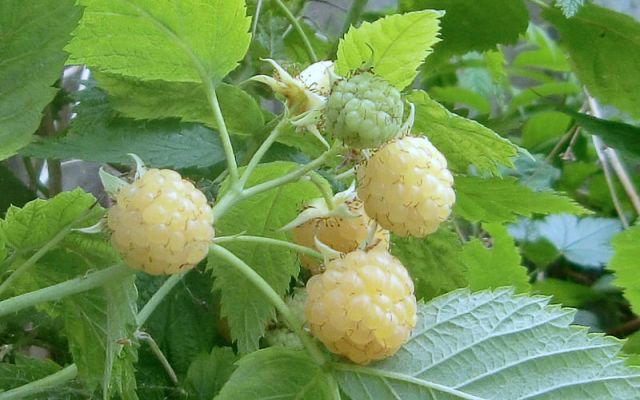
A Golden Raspberry Variety

Preparation

Like most edible crops, raspberries produce a better yield when grown in full sun. However, thanks to their woodland origins, they can be grown in a degree of shade too, as long as they receive at least a few hours of direct sunshine each day. They prefer slightly acidic soils, which is great news for gardeners who struggle to grow plants in these conditions. They like it to be moist as well, so be prepared to water the plants as they establish – but beware of waterlogged winter ground.

Be prepared to put in a bit of effort to get soil conditions just right before planting: thoroughly dig down to a spade’s depth along a row 90cm wide. Turn it over and remove any weeds, especially perennial types (such as bindweed and horsetail) and their roots.

Raspberries are shallow rooted, which means there won’t be much of an opportunity to weed as meticulously once the plants are in place, for fear of damaging their root system. They are also heavy feeders, so for every plant you intend to grow incorporate a bucketful of well-rotted manure or compost while digging, turning it all into the soil. Ideally soil preparation should be complete a month before planting; at the very least you should allow two weeks to give the earth time to settle.

They might play second fiddle to their Wimbledon-associated cousins on shop shelves but on the plot there should be no such bias – raspberry plants crop reliably year-after-year and ask for little in return. They even thrive in partially-shaded areas where few fruit or vegetables would grow. And such is their hardiness that they will produce a bumper crop of their sweet, mildly acidic fruits even in disappointing summers – a valuable trait given the last few we’ve experienced. They’re a great choice for those gardening in cooler, northern climates – as they flower late in the spring there is little danger of them being damaged by unexpected late frosts.

Planting

With a well-prepared growing area in place, planting shouldn’t present any difficulties. Buy in certified disease-free, one-year-old plants (usually called canes) from a reputable nursery or mail-order catalogue. They are usually acquired bare rooted, packaged up into bundles ready for planting. The best to time to plant them is in the autumn, from October through to early December, as the soil still retains a degree of warmth which will help the roots to grow and quickly settle the new introductions into place. If this isn’t possible they can, however, be planted any time up to March.

Position each cane into a shallow hole about 22cm wide and 7cm deep, spreading the roots evenly across the bottom. Backfill and firm in around them as you go, making sure that the soil mark on the canes is at least level with the surface and up to an inch beneath it – this will encourage extra root growth and quickly anchor the plants into place. Space them 45cm apart within the row, leaving 1.8m between further rows to allow room for the roots to spread sufficiently and enough space for picking.

The tall, gangly canes will need to be supported, so set up a suitable support system at planting time. The best system is a simple post-and-wire set-up – hammer in two sturdy, 2.4m-high posts at either end of the row, 60cm into the ground and 3m apart. Stretch three galvanised wires horizontally in-between them at heights of 75cm, 1m and 1.5m.

The top wire can be omitted if you’re growing an autumn-fruiting variety as they are much sturdier and require less support.

Grow your own tip- If you only intend to grow a few plants you can do away with a complete post and wire system and simply position up to two plants at the base of a single post for support. As the stems grow upwards, tie them loosely to the post using garden string.

Growing

Immediately after planting your canes, cut each one just above a bud so that they’re 30cm in height. By spring, new shoots will appear from the base of the old cane and these will need to be tied into the wires as they reach them. The original cane can be cut right down to about 3cm above ground level at this point, again just above a bud. Remove any weak shoots in this first summer and any appearing more than 20cm from the row. Be disciplined and remove any flowers that develop in the initial season too – the object of the first year is to establish a good base and allowing plants to channel energy into setting fruit will compromise this effort. In the following years pruning is simple, although it’s important to use the correct method depending on whether you’ve opted for summer- or autumn-fruiting varieties. The former should be cut right back to ground level as soon as they have finished cropping.

At this stage there will already be plenty of new growth at the base of the plant and these will be the fruiting stems for next year. Tie them into your support system using garden string, so that each stem is spaced around 10cm from the last. Cut down any spindly stems or those growing away from the row. Towards the end of the growing season, loop over and tie in place any really tall stems to prevent them falling over in the wind over winter. In early spring, before growth commences, cut them back to a bud about 15cm above the top wire so that they are uncluttered and in a good position when they start fruiting.

Pruning autumn-fruiters is much more straightforward – just cut back all of last year’s canes to ground level before growth starts in February. New shoots will appear from the base by spring and these should all produce fruit on the upper stem sections.

Crop care

Feeding and watering are pivotal to the success of a raspberry crop. Keep your canes moist and well-fed and, coupled with the correct pruning regime, you should be carrying away punnets full of berries. Watering is particularly important at flowering time, as the fruits swell, and during any dry spells.

Applying a thick layer of organic matter as a mulch in early spring will help to lock-in moisture (make sure the soil is moist beforehand) as well as feed the canes. Be generous – make it at least 5cm deep and more if you can spare it. Any well-rotted organic matter such as compost or manure will do but avoid mushroom compost – it is alkaline and therefore unsuited to the acid-loving plants. Mulches will also help to naturally nourish the soil and stifle weed growth. As raspberry roots are very shallow and can easily be damaged by hoeing, any weeds that make it through the mulch will need to be removed by hand.

New shoots that appear away from the main row or post are called suckers. It will be difficult to tie them in to the support system – instead, you should remove them by lifting them out of the soil, then use secateurs to sever them from the parent plant below ground level.

Raspberry curd quark dessert- one of many delicious sweets using raspberries

Raspberry curd quark dessert- one of many delicious sweets using raspberries

Stolen without permission from various websites including:

www.rhs.org.uk

www.growfruitandveg.co.uk

A few more wonderful garden furniture projects from 1001 pallets and other places.

What are you upcycling in your garden?

Old School Gardener

Califorinian Poppies- a possible addition to the new front border

To Walter Degrasse

Dear Walter,

I write this month about lots of gardening related activity, but not so much ‘direct action’ in Old School Garden. The past few weeks have remained relatively mild here in Norfolk, only the slightest of frosts having affected us to date. I think this weather has been one of the reasons I’ve felt able to leave off doing some of the garden jobs I might have gotten on with in other years; leaf raking, dahlia digging, plant moving, bulb planting etc.

Even though the greenhouse is more or less set up for winter with its bubble wrap insulation and electric heater, I haven’t yet hooked the latter up and certainly haven’t felt the need to get it going. The greenhouse now has our Pelargonums, Echeveria and tender pot plants all set out for their winter repose.

You remember the border of old English Lavender as you come into our drive? Well, I decided this has now got to be so ‘leggy’ and large that it was time to take it out and go for something fresh. I’m experimenting a little here, as I’ve transplanted a few Sedum plants  (some of a spectabile variety I salvaged from Peckover House, whilst working there), and these are fronted by some divided Nepeta (‘Catmint’) to mirror a similar edge on the other side of the drive. I’ve spread the Sedum around a bit and inter planted them with the four packs of tulip bulbs I bought in Amsterdam recently.

My hope, then is that the white, violet and blue heads of these will give a good spring show and once these are over I’ll put in some annuals to complement the violet flowers and glaucous foliage of the Nepeta- possibly some Californian Poppies as their shades of orange and red will give a real burst of interest in high summer. I migth also add some grasses (Stipa tennuissima for instance), and some Nerine bulbs that could do with replanting.  These should both work well with the Sedums for some late Autumn colour and interest. I’ll post some photos of this border as the season progresses so that you can see how the plan works out in practice!

Today looks like good plant moving weather, so I think I’ll try to tackle another area at the front of the house, by moving some Perovskia (Russian Sage) to a more suitable location fronting  our big laurel hedge (and with some further Sedums in front to help this rather lax performer stay upright), and possibly plant the remaining 40 bulbs we got from Holland, along with some more Sedum (‘Herbstfreude’) to the front of the house.

I won’t repeat all my other ‘garden related’ news here as you have probably been reading about this in other articles:

  • Trips to Portugal and Amsterdam including lots of interesting garden visits

  •  Completing the courses I’ve been running on ‘Grow Your Own Food’ and ‘Garden Design’, both of which seem to have gone down well with the participants. I hope to be running further courses in the New Year.

  • Doing a ‘mystery shopper’ inspection of a Country Park near here as part of the ‘Green Flag’ scheme.

  • Very satisfying reports on how some of the money raised at the opening of Old School Garden back in July has been used to fund food growing projects in Norfolk under the ‘Master Gardener’ programme.

The splendid ceiling of the bandstand in Estrela Gardens, Lisbon- a highlight of a recent visit

Come to think of it, I haven’t said much of late about my voluntary efforts at the local primary school and Gressenhall Farm and Workhouse. We’ve had some very productive sessions at the school,  with children planting three apple trees in the orchard , weeding and digging over the soil in preparation for next year, sowing broad beans, onion sets, garlic bulbs and some green manure (the latter doesn’t seem to have germinated, probably down to the age of the seed). I’ve been heartened by the children’s enthusiasm for gardening, and I’m getting to know some of the real characters at the school- it’s always a joy to be greeted so enthusuastically when I arrive at the school!

At the recent ‘open day’ one parent commented on how excited her child was when he brought home a runner bean seed in all its wonderful purply violet colours and one pupil who had sown some broad bean seeds in paper pots at this event, proudly presented me with one plant as ‘an early Christmas present’! A couple of ‘Garden Gang’ events have also resulted in the garden being tidied up, more progress being made on our plastic bottle greenhouse and the plumbing in of water butts from the garden shed to help with water supply. Parents are regular helpers at these sessions.

I’ve also had a sort through the school’s seed collection. This was an interesting exercise, there being many packets (and several of these unopened) dating from 3 or more years ago. I’m tempted to give some these a go next year, though there are many packets where I suspect the seed is just too old to bother with. Here’s a useful article about using old seeds.

Can you use old seeds?

At Gressenhall Museum the gardens are slowly fading into dormancy and time has been largely spent here managing the decline to keep the borders presentable, planting up some new entrance barrels with bulbs and pansies for spring interest, as well as helping with other routine tasks such as raking out leaves and excess plants from the wildlife pond, weeding, and mulching the extended front entrance border with compost to help improve a rather poor soil. I think I’ll put in one more session here to complete the tidy up and them things can be left until the spring.

Well, Walter, that’s about the sum of my efforts over the last month, and you’ll probably award me only 5 out of 10 for what I’ve actually done in Old School Garden!

Hopefully today I can make inroads to the remaining jobs and then spend some time working out my priorities for the next couple of months. I know this list will include reorganising the outside sheds, installing a barrier made out of pallets to support the border in which my fan – trained cherry and plum are starting to get established and ordering seeds for next year. The latter will involve paring down the current list from my excited first look at the catalogues! I must remember to check the seeds I already have, including some purchased on the trip to Ryton Gardens a few weeks ago.

I was pleased to hear that you’ve more or less managed to get your autumn garden tasks done, especially as you’ve had a few more frosty days than us. What are your plans for Christmas? Is there a chance that you could both drop in to see us for a weekend before the festivities really kick off? We’d love to see you both!

Old School Gardener

800px-Fuchsia_2008

With winter around the corner, this week’s question comes from Penny Rose in Hampshire:

‘I’ve moved house earlier this year and planted some fuchsias in the garden. I bought these from a local nursery and they are described as ‘hardy’. Can I leave them in the ground over winter and if so do I need to protect them in some way?’

Well, Penny, In the coldest parts of the UK you’ll have no option but to dig up your plants and put them in a conservatory or greenhouse. It’s also a good insurance policy to take cuttings (preferably in early autumn) to bring on new plants in case of a particularly severe frost or disease problems. In warmer areas you can leave plants in the ground but take steps to protect them by not cutting down the stems in Autumn, and by making some holes in the ground around each plant with a a border fork, to help water drain away- particularly important if you have heavy soil that retains water. Once this is done you should put a mulch of leaf mould, wood ashes or soil around the base of  the plant to protect it further. Some Fuchsia varieties are hardier than  others; the toughest are F. magellanica, F.’Riccartonii’ and F. ‘Mrs. Popple’ which can withstand temperatures down to between -5C and -15C.

So in somewhere like Hampshire, you’ll probably be OK  to leave your Fuchsias outside (but take the action suggested above). For me here in Norfolk, it’s a little more difficult to be sure, so I’ll leave some outside (in a pot in a warmish courtyard) and either bring others in or mulch my sandy loam soil (forming drainage holes isn’t as important).

Old School Gardener

Finding Nature

Nature Connectedness Research Blog by Prof. Miles Richardson

Norfolk Green Care Network

Connecting People with Nature

Discover WordPress

A daily selection of the best content published on WordPress, collected for you by humans who love to read.

Susan Rushton

Celebrating gardens, photography and a creative life

Unlocking Landscapes

Writing, photography and more by Daniel Greenwood

Alphabet Ravine

Lydia Rae Bush Poetry

TIME GENTS

Australian Pub Project, Established 2013

Vanha Talo Suomi

The Journey from Finnish Rintamamiestalo to Arboretum & Gardens

Marigolds and Gin

Because even in chaos, there’s always gin and a good story …

Bits & Tidbits

RANDOM BITS & MORE TIDBITS

Rambling in the Garden

.....and nurturing my soul

The Interpretation Game

Cultural Heritage and the Digital Economy

pbmGarden

Sense of place, purpose, rejuvenation and joy

SISSINGHURST GARDEN

Notes from the Gardeners...

Deep Green Permaculture

Connecting People to Nature, Empowering People to Live Sustainably

BloominBootiful

A girl and her garden :)