Tag Archive: garden


lily of the valley by Jill RaggetLily of the Valley among the paving

Old School Gardener

This is the life- our cat enjoying a bask in the sun...
This is the life- our cat enjoying a bask in the sun…

 To Walter Degrasse

28th May 2014

Dear Walter

It’s been a busy May, Walter- ‘as usual’ I suppose you  might say! The last couple of days have seen heavy rain, but thankfully I managed to get out for a full day in Old School Garden on Monday, anticipating the rain by planting out lots of seedlings. This stage of the year also coincides with the cleaning of the (now empty) greenhouse and getting in the 12 different varieties of tomato and chillies my friend Steve has given me – plus a cucumber.

Today, as the weather is clearing up I’ll be out putting in a cane framework up which to train them. Or rather, most of them, as this year Steve has given me two varieties of tomato which don’t require tying in and training as cordons. Roma is a ‘determinate’ variety so should be grown as a bush (it doesn’t need it’s side shoots pinching out), and Marmande is ‘semi determinate’ which means limited pinching out is required. He’s also given me a ‘ridge’ cucumber which I’m going to try to grow outside in a pot.

I’m also feeling quite pleased that I managed to find a good use for the old compost I removed from the greenhouse. I grow my tomatoes in bottomless pots sunk into the ground (the so-called ‘ring culture’ method), so a dozen holes need to be dug to make way for the pots which are then filled with growbag and other compost. I’ve used the old compost in a plastic bin that once ‘graced’  the courtyard – you may remember I’d bought some rather nice large terracotta pots to replace the utilitarian plastic dustbin and pots that previously contained the peach and an olive bush? Any way, I thought I’d have a go at growing some carrots in the dustbin and the old compost. This is very friable and lacks any stones, so seems the perfect medium for this. So the bin is full and I’ll hopefully get round to sowing the carrots later today – they’re a variety called ‘Nigel’ given to me at Christmas by Steve and his wife!

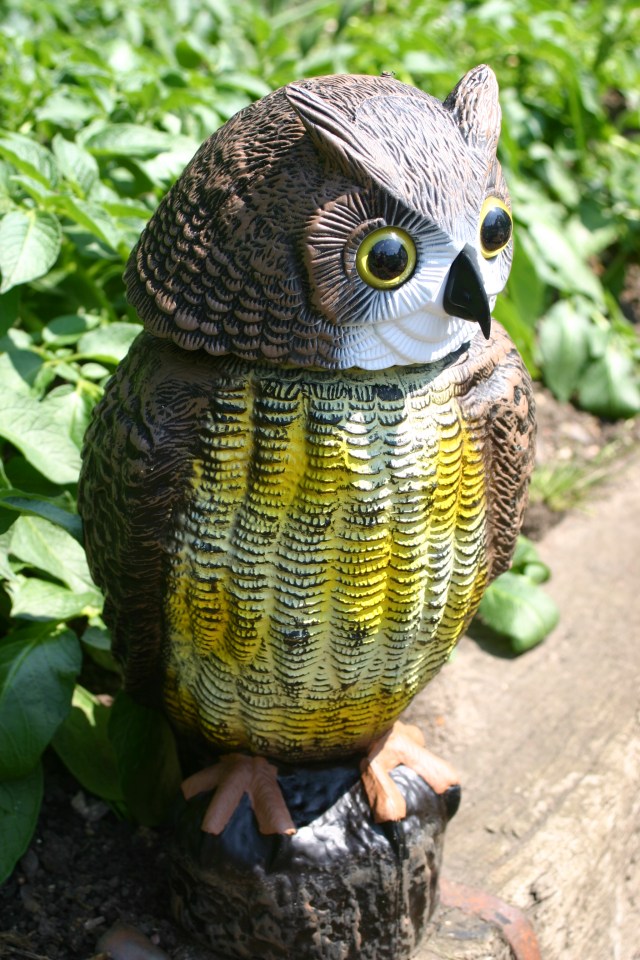
The rest of the kitchen garden is also looking pretty full- potatoes have been earthed up a couple of times and the first flowers are forming on the first earlies. The Brassica cage is also looking increasingly full with Cauliflowers, Calabrese, Spinach and Broccoli. Rainbow Chard and Leeks are bulking up and the first Broad Beans look like they’ll be ready to pick very soon. My sowings of Parsnip, Carrot and Beetroot are also coming along nicely. We’ve had plenty of Lettuce in the last couple of weeks. The Strawberry bed has been mulched with straw and as a bit of fun I’ve bought a plastic owl with a swiveling head to see if I can deter pigeons and other birds from the swelling fruit and other goodies in the garden (they usually go for my raspberries which are also looking promising this year)!

I’ve just about managed to catch up with the major weeding- just one area of the woodland edge to do and then I think I’ll mulch this with wood chippings to try to keep the weeds down. I’m hoping to do the same in the fruit cage once I’ve been through with the hoe later today. Oh, and some good news. You remember we had that extension put on about ten years ago that created Deborah’s Study? Well, I had to move a rather old Philadelphus bush and so put it in the main mixed border as a back drop to other things. It’s never flowered since, despite some careful successive pruning out of old wood, and encouragement of new growth. Well, it may be weather-related, but its covered with flower buds this year – I’ll post a pic when it comes out!

I’ve still got some half-hardy annuals coming through (I spent a couple of hours inside the shed potting these up while it poured down outside, yesterday). However,  I’ve managed to plant out most of these and especially the front bed which is my ‘homage’ to Victorian bedding and one or two other spots to add complementary colour or texture to perennials that will flower later- e.g. putting some golden-yellow looking Amaranthus in with the blue Agapanthus.

Several things are looking good here, including the rapidly filling mixed borders, so here’s a slide show of some of the highlights.

This slideshow requires JavaScript.

Unfortunately I didn’t manage to get the number of takers necessary to run the various gardening courses I’d planned for May and June, but I’ll try again the autumn, which seems the time most people do an evening class, especially if it’s garden -related. My work in other gardens has also been rather hectic. The sessions at Fakenham Academy have really begun to take off. The children seem more focused and interested and are starting to ‘own’ their plots, which are fast filling up with all sorts of food crops and some annual flowers to add colour and scent as well as attracting the pollinators of course. Unfortunately an assortment of pests is also posing a challenge- rabbits, mice and pigeons in the main. So remedial action has been necessary to try to prevent further damage- we had great fun last week trying to erect a pigeon-proof cage over the brassicas!

We’ve also got some tomatoes, cucumber and aubergines growing in the greenhouse. Also in Fakenham the project at the Community Centre to clear and plant a border next to the two hundred year old ‘crinkle crankle’ wall, has gone well. I, together with volunteers and children from the local primary school, planted this up last week. Now we wait for the plants – which I’ve positioned in repeating drifts of different colours, textures and forms to reflect the wave of the wall -to get hold and push on to do their stuff. I’ll post some pictures of this next week.

Another pest controller- I hope!

Another pest controller- I hope!

I was also pleased to be positively mentioned by one of the Inspectors at a recent Ofsted Inspection at the local primary school, where I was showing the children how to weed and earth up potatoes and explaining why we do this. This school (which now has level 5 of the RHS Campaign for School Gardening award), is shortly to host a training session for other local schools interested in school gardening activities. I’ll let you know how it goes.

How is your garden looking, Walter? I expect your orchard has  finished flowering by now, but I have fond memories of visiting you and Lise one spring and seeing all the beautiful blossom there. From my own garden, it looks like we’ll have another good year for fruit- there certainly seem to be a lot of plums forming on the tree and I can even seen some (and cherries) on the young fan- trained plants in the kitchen garden.

So, I think its getting to that time of year when we can take the foot off the accelerator a little and begin to enjoy the fruits of our labours! Hopefully that last major bit of weeding will be done by the end of the week and I can then get the remaining flowers planted out, as well as hoeing here and there to keep the weeds down. And maybe then a bit more sitting in the sun!

Having said that, I do think there’s something very satisfying about forking into a light, damp soil and pulling whole strands of Ground Elder root out (and of course trying not to breaking any of it off in the ground)!

Old School Gardener


vertical gdn pattern via urban gdns


Wall carpet via Urban Gardens– or maybe a plan of the wider garden? 😉

Old School Gardener

Bitton church, South Gloucestershire

‘A country parson without some knowledge of plants is surely as incomplete as a country parsonage without a garden.’

Canon  Ellacombe; ‘In a Gloucestershire Garden’ 1895

Old School Gardener

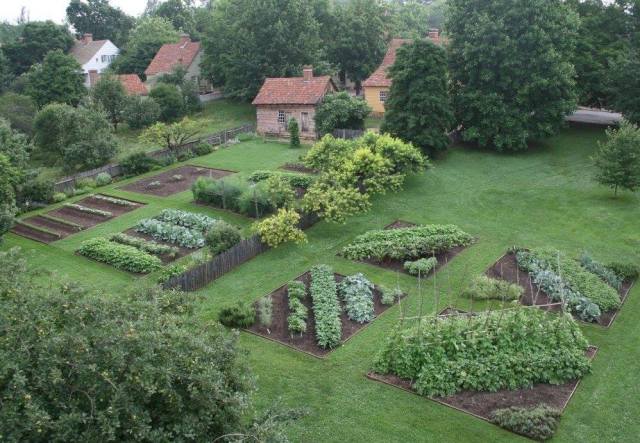
old salem museums and gardens via p.allen smith


‘Diagonal Veg’ at Old Salem Museums and Gardens via P. Allen Smith

Old School Gardener

PicPost: Stop Monkeying Around!

The Monkey Orchid

‘A number of images depicting a flower with the face of a monkey are currently circulating via social media posts and the blogosphere. Many commentators have suggested that the images have been “photoshopped”.

However, the images are genuine and depict a real flower. The botanical name of (one of) the pictured orchids (top right) is Dracula gigas. Another orchid species, Dracula simia, also has flowers that resemble monkey faces. The name pays homage to the “monkey” resemblance (simia) as well as to a resemblance to the flowing cape and long fangs of the Dracula character in popular fiction.

These orchid species grow in their natural state in Colombian, Ecuadorian and Peruvian forests at high elevations are thus not often encountered by people in the wild. However, collectors have cultivated the plants elsewhere.’ (extract from hoaxslayer.com)

Old School Gardener

ammunition canister garden via urban gdns


Surplus ammunition canisters used imaginatively as a vertical garden

Old School Gardener

Picture from 'Voice in the Garden Blogspot'
Picture from ‘Voice in the Garden Blogspot’

In researching this article I’ve solved a little mystery. A couple of years ago I ‘liberated’ some curious looking fruits from a tree in a grand garden in Cornwall I was visiting. It was autumn and the leaves were a beautiful muted rusty golden colour. I couldn’t identify it at the time and the three fruits have been sitting on my desk ever since both intruiging and annoying me!

Well it turns out that they are the fruits of Davidia involucrata, better known as the ‘Paper Handkerchief’  or ‘Dove Tree’ because of its large white bracts enclosing the flower (and followed by the fruit). It looks like it may be a long and fiddly business to grow from seed, but I think I’ll have a go!

Common name: ‘Paper Handkerchief’ or ‘Dove’ Tree

Native areas: originally from damp woods in south West China, it is extremely endangered in the wild and also rare in cultivation.

Historical notes: discovered by Pere David in 1869 and introduced in 1904. It first flowered in 1911 on Veitch’s Coombe Wood nursery.

Features: a broadly conical, very beautiful tree that is (eventually) fast growing and of medium to large height, growing to 10-15 metres at maturity. However, it is difficult to grow from a young age and seems to thrive once it gets beyond 2-3 metres tall. Foliage and habit are similar to the Lime.The sharply toothed leaves are heart shaped to around 15 cms long, are pinkish in spring turning bright green above, densely hairy beneath in summer, then turn to gold in the autumn. The flowers are tiny but it is the large white flower bracts up to about 15 cms long that put on a great show in late spring. The fruits are rounded and green, up to 1.5 inches across, later ripening to brown (like the 3  I have here!). The attractive bark is orange brown and peels vertically in flakes.

Uses:  very good in parkland or as a specimen and does best in a sheltered position. Sometimes the cultivar ‘Vilmoriana’ is specified, but it appears to be very similar to the parent species.

This slideshow requires JavaScript.

Growing conditions: Davidia grows best in a sheltered spot in deep fertile soil. It responds to light summer pruning. Growing tips can frost off if it is subjected to icy winds and invariably the best specimens are seen nestled away in a comfy sheltered spot. They also respond well to fertilizers with lots of potassium. They are best trained to a central leader when young with lower branches gradually removed. Propagation is from seed sown immediately upon ripening, germination can take up to 1.5 years but seedlings grow fast. It can also be grown from semi-ripe cuttings taken during late summer. Insect pest and disease problems rarely occur and are not serious.

Further information:

Wikipedia

RHS- Davidia involucrata

Barcham trees directory

Old School Gardener


A 'Land Print' using robotics to create a planting pattern- amazing

A ‘Land Print’ using robotics to create a planting pattern- amazing!

Old School Gardener

The glorious Passion Flower

The glorious Passion Flower

Today’s question concern climbers that won’t flower, specifically Passion flowers and Wisteria. Jimmy Jones of Brighton asks:

‘I’ve a problem with two of my climbers. I have a Passion Flower growing over my front door which grows very vigourously, but produces no flowers or fruit. Likewise I bought a Wisteria a good few years ago and it did not grow for a long time. I fed it and recently it has begun to grow, but still has not flowered. Can you help please?’

The Passion Flower (Passiflora) needs one thing above all else- sunshine. So a south facing wall is really the only place where it will succeed in most parts of the U.K.- it must be open to the sun all day. If your location is right the other issue might be an over rich soil- this can produce a mass of foliage and stems at the expense of flowers, so if you’ve been feeding it perhaps lay off for a while and then make sure you use a feed rich in potassium (e.g.dilute tomato feed), which will encourage flowering.

As for the Wisteria, this is one of those plants that takes a fair while to come into flower. to make the wait even more agonising, it often grows very little in its first year or two. Help to induce flowering by shortening any unwanted long stems in July or August, cutting them back to about 30 cms or to 5 or 6 buds, and prune again in January, shortening all side shoots back to two or three buds, so concentrating the plant’s energy into a limited number of flowering buds. Again, an occasional feed with diluted tomato feed (or another feed rich in potassium) can also coax flowers from reluctant plants.

My own experience from transplanting a Wisteria seedling to my arbour in my Kitchen Garden, is that it’s taken a good five years for it to flower in any profusion, but I think the mild winter and warmish spring have also played a part- below are some pictures of how it looks today. I’m gradually training it over the top and sides of the arbour. You might also find  this article about using climbers in the garden useful.

Coincidentally my younger daughter (who lives in a basement apartment in the outskirts of Lisbon,Portugal), has just bought a Wisteria to go alongside a very successful Trachelospermum jasminoides she and her husband planted about 3 years ago (I’m told the fragrance just now is wonderful). I’ve suggested they train it along wires fixed to the walls of their patio garden and as it’s in a container to give it a fortnightly feed of tomato food to encourage flowering. Fingers crossed!

If you have any questions you’d liked answered then email me and I’ll do my best to feature your question and hopefully provide an answer!

My email address: nbold@btinternet.com, and put ‘GQT question’ in the subject line, please.

Old School Gardener

If you’ve enjoyed reading this post and others on this blog, why not comment and also join some other people and sign up for automatic updates via email (see side bar, above right ) or through an RSS feed (see top of page)?

Finding Nature

Nature Connectedness Research Blog by Prof. Miles Richardson

Norfolk Green Care Network

Connecting People with Nature

Discover WordPress

A daily selection of the best content published on WordPress, collected for you by humans who love to read.

Susan Rushton

Celebrating gardens, photography and a creative life

Unlocking Landscapes

Writing, photography and more by Daniel Greenwood

Alphabet Ravine

Lydia Rae Bush Poetry

TIME GENTS

Australian Pub Project, Established 2013

Vanha Talo Suomi

The Journey from Finnish Rintamamiestalo to Arboretum & Gardens

Marigolds and Gin

Because even in chaos, there’s always gin and a good story …

Bits & Tidbits

RANDOM BITS & MORE TIDBITS

Rambling in the Garden

.....and nurturing my soul

The Interpretation Game

Cultural Heritage and the Digital Economy

pbmGarden

Sense of place, purpose, rejuvenation and joy

SISSINGHURST GARDEN

Notes from the Gardeners...

Deep Green Permaculture

Connecting People to Nature, Empowering People to Live Sustainably

BloominBootiful

A girl and her garden :)