 Occasionally I’m asked to review garden products and equipment. Recently I was approached about trialling one of a range of battery-powered garden tools made by the Chervon company under the brand ‘Ego’. They offer a lawnmower, strimmer, hedge trimmer, leaf blower and chainsaw. So what should I try out? Well I have a mains powered chainsaw that has done me good service over the years, but it is getting to the end of its life, so I plumped for the chainsaw. I wasn’t disappointed.

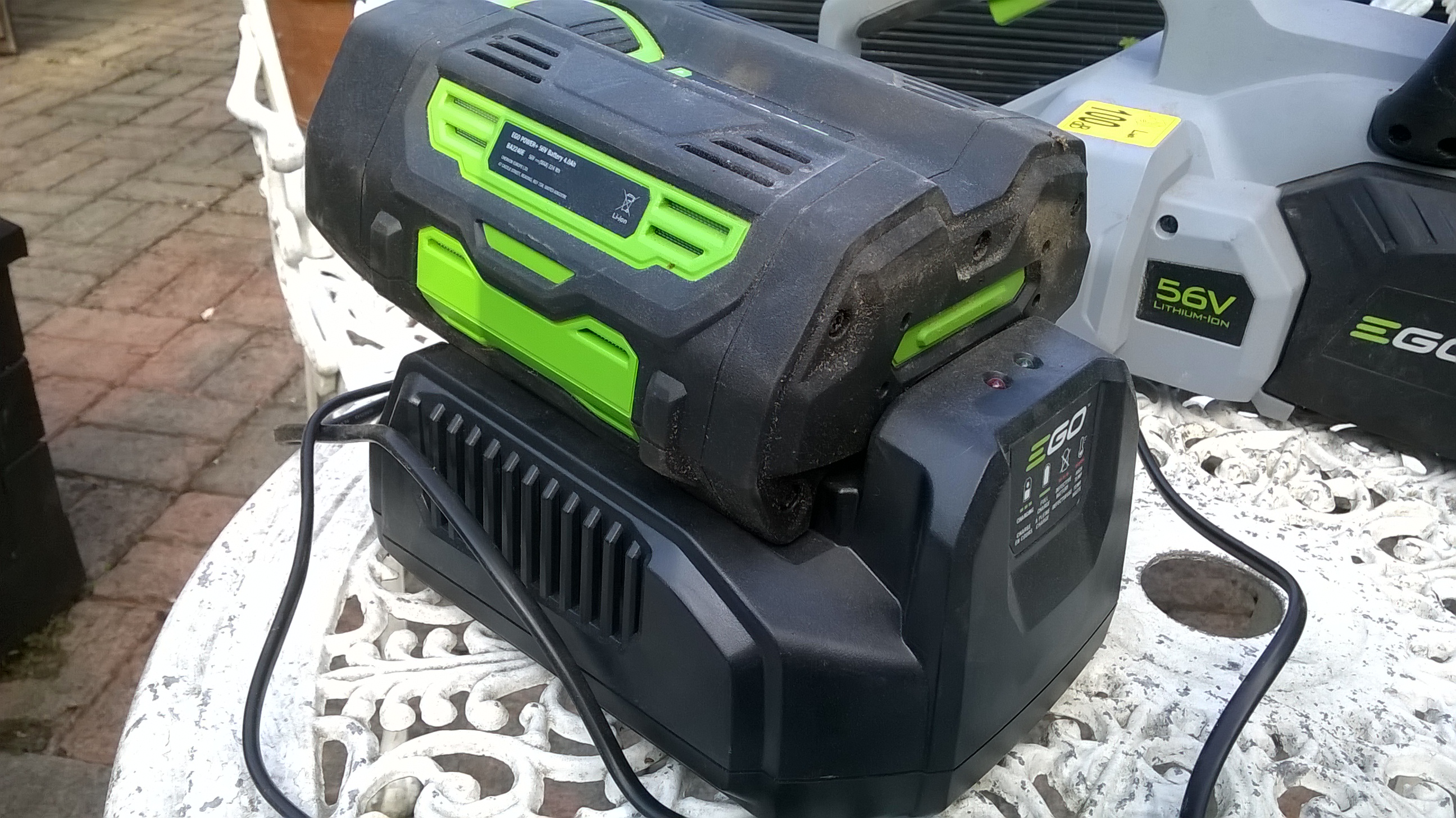
The battery in the standard charger
I must admit that the ‘revolution’ in battery-powered gadgets has rather crept up on me relatively unseen. I guess that I’m like most people and if your current tool kit is working well, you don’t think much about changing it, and when you do, the option of changing format/ power source isn’t on the radar. The Ego range comes with a choice of different powered batteries; 2, 4 or 6 amps. There’s also a choice of two chargers, a standard and a fast charger.
I’d been sent the 4 amp battery with a standard charger, which is what’s needed in the lawnmower, whereas the other items in the range can be powered by the 2 amp battery. The batteries offer different power levels and as you’d expect also vary in weight. The standard battery charger and 4 amp battery take about 80 minutes to fully charge and the charging unit- like the chainsaw itself, is nicely designed and easy to use. You just slide in the battery, switch on the power and an on/off button illuminates to tell you the state of the charge; so when it goes green you know you’re ready to rock.

Ready to go- the green light tells you the battery is fully charged
I was a little hesitant setting up the saw with its battery, mainly because the battery seemed to be weighthy and I wondered if the saw, once fully loaded, would be too heavy to use for any lengthy period. I needn’t have worried; the whole saw, complete with battery, weighs about the same as my corded saw and I found it’s weight nicely distributed so you can use it to help with the sawing process. I imagine, if you’re up at any height where it’s difficult to rest the machine, it could get a bit tiring, but I don’t envisage doing long periods of serious elevated lumberjacking with it, so for my purposes, it’s fine. The makers claim that the weight is also comparable to most petrol-powered machines.
In fact after trying it out (see more below), it seems very easy to set up and use, and perfect for the gardener with a few medium-sized trees or shrubs to cut back, firewood sawing and similar ‘around the garden’ jobs.
Turning to the saw itself, it comes with a 14″ chain and in many respects follows a well -worn path of chainsaw design. But there are some very nice, helpful design features that I found to be a big advantage:
-
the fact that it’s cord free of course makes for easy and safe use- none of that continuous checking on where the cord is and pulling it out of the way of the cutting area.
-
a couple of very neat knobs for opening the chain- fitting compartment and tensioning the chain; I always find dealing with chains that come off or loosen during a sawing session a pain with my corded saw, as you have to get out spanners and the like and over time the nuts lose their grip.
-
an easy to start safety button and trigger.
-
a chain brake (which stops the chain once powerered off) and hand guard that makes it easy to deactivate the saw when adjusting and which acts as a safety mechanism should the saw ‘kickback’ in use.
-
the powerful 56 volt, brushless motor, which should give longer motor life. It is also fairly quiet to use.

The easy to turn knob that gets you in and out of the chain fitting area

And a great little thumb turner to tension the chain, very useful during sawing sessions as it means you don’t have to fiddle around with screwdrivers or spanners

The chain brake, cut out and safety guard, with the oil filler cap and level indicator below.
So, how did it perform in my trial? I tested it on three little jobs: sawing up some seasoned logs for firewood (these were about 10″ diameter); cutting through some 3″x 2″ timbers on a pallet I’m adapting to store bags of wood pellets; and cutting through some trunks of a rampant ivy that is rapidly taking over my and my neighbour’s gardens.
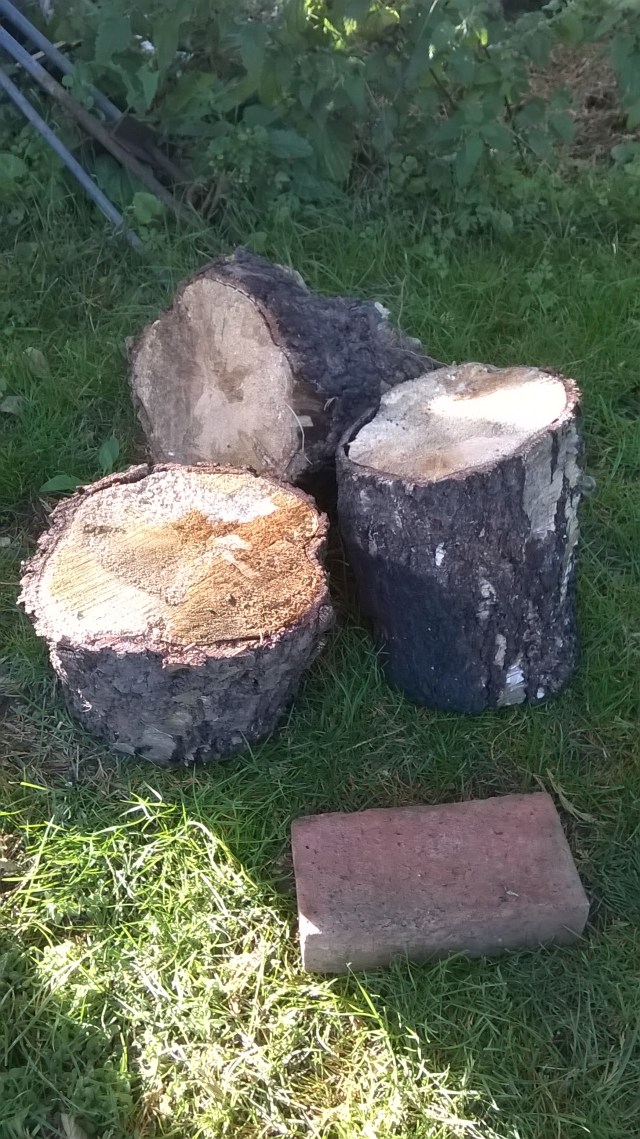
Sawing these well seasoned logs was pretty impressive
The saw cut through all of these items with ease, and though it worked hard on the logs, I didn’t need to force the pace, the weight of the saw and my gentle rocking motion completing the job in relatively short order. I haven’t checked on the run time on a single charge- this will vary on how hard you work the saw. But the makers claim the 2 amp battery will give up to 100 cuts on 4″ x 4″ timber, so my, more powerful battery should give more.

The pallet before…

and after cutting…perhaps a ready made fence?
So what next? Well, I’m encouraged by the results so far and plan in the autumn to do some serious ‘hedge shaping’ on a length of Laurel in Old School Garden. This hedge has grown to be about 15′ high and 6′ wide. It will provide a back drop to my planned pond area, but it needs reducing in scale to make it easier to keep in trim (avoiding precariously placed ladders and corded electric hedge trimmers) and at the same time let in more sunlight to the pond area. This will also be an opportunity to be creative. I hope to carve out a dipping curved top to the hedge that will be a nice feature from both sides, giving glimpses into adjoining garden spaces.
I’m now thinking positively about this major job, as my new chainsaw will be perfect for taking out those limbs and branches which are either too thick for loppers or are just too numerous for manual labour. In fact I can see myself as one of those ‘chainsaw artists’ you sometimes see at country fairs, sculpting amazing items from chunks of tree trunks. But in my case it’ll be more like ‘chainsaw topiary’.

Some of the ivy trunks prior to cutting

Some of the ivy which now takes up a good part of my and my neighbours’ gardens

And after- just some of the trunks I eventually found and cut
OK, so I wouldn’t alter anything? Well, perhaps just one thing. The rather opaque oil level indicator on the side of the saw. In theory this should allow you to check the lubricant level easily, but (maybe it’s my aging eyesight), I found this difficult to read.

The Laurel hedge I’ll be tackling in the autumn. The Ego will be a great help in getting out some of the larger bracnhes…

…like these
But to sum up, my first serious experience of battery-powered garden tools is a very positive one. I might even extend the range of options by getting hold of some of the other tools in the range, which now makes sense as I have the battery that fits them all. And of course there’s also the option of buying another battery so that I could do a continuous run of work- using one battery while the other is charging up.
I’ve left some links to the Ego website and a couple of reviews below, if you’d like more information. Currently the Ego chainsaw costs £199, the 4 amp battery £149 and standard charger a further £39.
Further information:
Old School Gardener















 Old School Garden