Tag Archive: garden


water path

Appalachian Red Oaks-picture Jason Hollinger

Appalachian Red Oaks-picture Jason Hollinger

There can’t be many trees with a botanical name beginning with Q, but the Oaks provide plenty of variety and what for the U.K. (or maybe just England?) is probably the ‘people’s choice’ as our national tree (Quercus robur).

I’ve chosen a rather large variety, which will not fit easily into smaller gardens, but I just love it, especially for its autumn foliage…

Common name: Red Oak, American Red Oak, Northern Red Oak or Champion Oak

Native areas: North America, in the eastern and central U.S. and southeast and south-central Canada.

Red Oak early in the year

Red Oak early in the year

Historical notes: The Red Oak is one of the most important oaks for timber production in North America. Quality red oak is of high value as lumber and veneer, while defective logs are used as firewood. It’s bark is also rich in tannin, making it valuable in tanning leather. It was introduced to the U.K. in 1724 and has won the R.H.S. Award of Garden Merit in 2002 (and before this in 1971). There are 3 well known, very old specimens in the U.S.:

  • Ashford Oak – A very large Northern Red Oak in Ashford, Connecticut. The tree has suffered falling limbs because of its great age. However, this tree is still a sight to behold; the trunk is 8 m (26 ft) in circumference and the root-knees are also particularly impressive.

  • Chase Creek Red Oak – This forest tree is located on a very rich steep slope in Anne Arundel County, Maryland. The circumference at breast height is 6.7 m (22 ft), the height 41.5 m (136 ft) and the spread 29.9 m (98 ft)

  • Shera-Blair Red Oak – This majestic red oak tree is located in the South Frankfort neighbourhood of Frankling County, Kentucky. The circumference at breast height is 6.4 m (21 ft), with the trunk reaching higher than 40 feet before the branches begin and an estimated height of 130 feet.

Red Oak specimen Tortorth Arboretum. Picture by Velela

Red Oak specimen Tortorth Arboretum. Picture by Velela

Features: A large, broadly oval tree which does best in deep fertile soils, but tolerates most others. Under optimal conditions, Red Oak is fast growing and a 10-year-old tree can be 5–6 m (16–20 ft) tall. Trees may live up to 500 years and a living example of 326 years was noted in 2001. Red oak is easy to recognize by its bark, which features bark ridges that appear to have shiny stripes down the centre.  Young growth emerges almost yellow in the spring befoe expanding into large, broad green and lobed leaves by May. It’s autumn foliage is a rich red, turning dark reddish grey brown before falling. The acorns mature in about 18 months after pollination. Its kernel is white and very bitter. Despite this bitterness, they are eaten by deer, squirrels and birds. It appears to tolerate polluted air well.

Uses:  As a large tree the Red Oak is best used in parks and large gardens as specimen tree.

Growing conditions:  Red Oak is not planted as often as the closely related Pin Oak as it develops a taproot and quickly becomes difficult to transplant. Acorns should either be sown in the location where the tree is intended to be planted or else moved to their permanent location within the seedling’s first year. As the tree gets older, the taproot gradually shrinks and the lateral root network expands. Red Oak is easy to start from seed, however the acorns must be protected from animal predation over the winter months. As with other oaks, germination takes place in late spring when all frost danger has passed. The seedling grows rapidly for its first month, then pauses for another month, and sends out more new shoots until September when growth stops for the year. If the weather stays favorable, a third burst of growth may occur.

Mature Red Oak, autumn foliage

Mature Red Oak, autumn foliage

Further information:

Wikipedia

RHS- Quercus rubra

Barcham trees directory- Quercus rubra

Old School Gardener

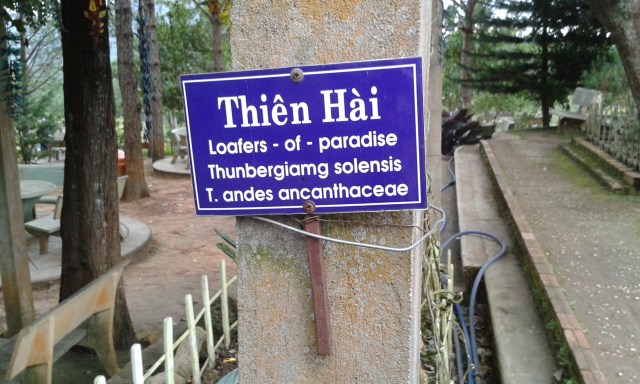
Friends Jen and Dave are having a great time in Vietnam, and Jen has been ‘plant spotting’. She’s sent me some exotic specimens to name and this began with a bit of a mystery. The picture below appears to show a sign with some plant names on it in English.

image2Jen assumed this related to the plant picture below, but was puzzled at the (misspelled) reference to Thuinbergia, so I set out to investigate further…

image1

Strongylodon macrobotrys

Jen mentioned that the plant and sign in question were at a monastery in De Lat, which helped me to search online. Here I found a picture of the same plant, but with its correct names of Jade Vine (sometimes also called Tigers’ Teeth); a native of the Philippines, but there are examples in the UK at Cambridge Botanic Garden, Kew and the Eden Project. Interestingly it’s propagated by bats! The botanical name is Strongylodon macrobotrys; and so, not a hint of Thunbergia!

Well, it turns out that another plant nearby (see below), apparently popular in De Lat, is Thunbergia mysorensis (again ‘lost in translation’ on the sign) or its common name of Mysore Trumpet Vine. So, a case of poor sign placement (it looks like its been strapped to a pillar after being in the ground), as well as incorrect botany (incidentally Thunbergia are part of the Acanthaceae family, so that might explain that bit of the sign- but once more, misspelled!).

Thunbergia mysorensis

Thunbergia mysorensis

Another of Jen’s pictures is of the Torch Ginger (Etlingera elatior), a plant used in cooking (especially fresh fish).

Etlingera elatior

Etlingera elatior

I’m still working on identifying the other six plants Jen sent me, but will hopefully crack the mystery in the next few days…look out for further episodes of a Select Vietnamese Flora!

Old School Gardener


12240067_1240555582626966_5779594606128298140_n

‘Carry, & spread dung & compost.’

John Evelyn 1686 (published 1932)

Old School Gardener

Lotus flower- picture by Ellen Zilin

Lotus flower- picture by Ellen Zilin

Sunflowers and Echinops

Sunflowers and Echinops

Some of this year's squash harvest- should keep us going for a few weeks.

Some of this year’s squash harvest- should keep us going for a few weeks.

Old School Garden – 29th November 2015

Dear Walter,

As we move towards winter, this month has been one of small steps forward, old friend. We had our first frost last week, and I managed to get the tenderest plants under cover in the greenhouse.

Tucked away from the frost...

Tucked away from the frost…

I’ve noticed that the leaves on the Cannas have started to brown so it won’t be long until they and the Dahlias are also brought in. I won’t be cutting down or removing much else as I like to see the grasses and many herbaceous stems stand over winter- I think this is also good for wildlife.

Cannas on the turn- soon to be dug up and replanted in the greenhouse

Cannas on the turn- soon to be dug up and replanted in the greenhouse

The piles of leaves continue to grow, and though many have fallen, there’s still a lot of oak to float down and then be gathered up. I’ve already cut back and placed most of the Pelargoniums into trays for over wintering and once the remaining pots on the terrace are empty, I’ll plant out the four or five packs of tulips I have in the shed.

Tulips ready to go in some of the other terrace containers and borders

Tulips ready to go in some of the other terrace containers and borders

In the kitchen garden I’ve pulled the remaining carrots- they are a well-sized and tasty crop. The parsnips and a few leeks are all that remains for winter vegetables, with the promise of Purple Sprouting Broccoli to come in spring. As I reported last month, I’ve used my latest batch of compost to mulch the fruit bushes, strawberries and raspberries and added some manure over the rhubarb and asparagus bed, which hopefully might give us a few spears next year.

I dug up one of the remaining two blackcurrant bushes the other day and took this in to the local Primary School, where I was helped by 7 pupils to divide it and plant it out in their developing fruit garden. It was fun to be back among some familiar (if older) faces and they were very responsive and involved in the hour we spent talking about roots, stems, water and so on.

Awaiitng a Redcurrant, to go alongside White and Black!

Awaiitng a Redcurrant, to go alongside White and Black!

So, here we’re left with one large blackcurrant bush (after having three for several years – the freezer is still bulging with the last few year’s crops). I’m now waiting on the arrival of some bare root red currant and raspberry canes at the local nursery, so that I can fill out the summer fruiting raspberries and replace the blackcurrant, which will give us one each of Red, White and Black currants.

Looking ahead, my friend Steve volunteered to order me some seed potatoes, so I’ve gone for some first and second earlies which should be here for ‘chitting’ in January. I also recently ordered some seeds from the RHS scheme for members, which is good value for money. With the seeds I purchased on my visit to Wallington Gardens in September (as well as some harvesting at other gardens we’ve visited), I can see that February will be a busy time (as usual), propagating a new range of interesting flowers for the borders; including one ‘long wanted’ variety,  Cephalaria gigantea.

My Pond garden project is moving ahead slowly, with the reclamation of some large York stone flags from one of our outside sheds (we’ve had a new concrete floor put in here to replace the stones) and the use of the stony soil from under these to build up the surrounds of the pond area. Before going much further outside on this I want to firm up my design on paper, so the drawing board is out again and I’m sketching out some ideas, including a stepping stone bridge (this is what some of the flagstones will be used for), boggy borders and a ‘beach’. My collection of plants for this area is growing nicely so I’m factoring these into the design too.


On a broader front, I went over to Gressenhall the other day and began to clear up for winter (including some overdue shearing of the lavender and leaf clearing) and planted out some Catmint I took out of the courtyard planters at Old School Garden. Together with the new plants I purchased recently these will make a good show in a number of half barrel planters we have there.

You’ll have also seen something of my regular visits to Blickling Hall, where the winter clear up and preparation for next season is well underway. Did I tell you that I’m hoping to run a new Garden Design course at Blickling? Based on the one I’ve run in the past at Reepham, it will be slightly extended but will still focus on helping participants to design their own garden or area. I hope for a good level of interest, especially as we shall be able to use the gardens at Blickling as a showcase for many of the ideas and concepts I’ll be covering. If I get the numbers I need this will begin in early February.

Having just replaced the broken glass in our wood burner I think its time to light it and get something to drink!

Very best wishes,

Old School Gardener


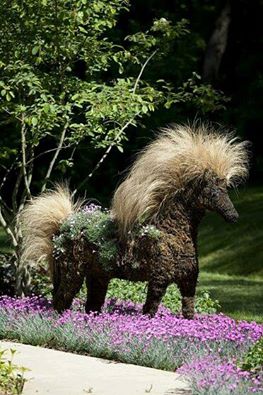
'Pony Tail' grass (Stipa tennuissima)

‘Pony Tail’ grass (Stipa tennuissima)

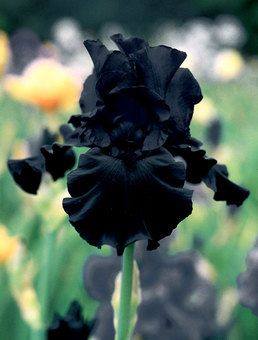
Iris 'Black Affair'

Iris ‘Black Affair’

Finding Nature

Nature Connectedness Research Blog by Prof. Miles Richardson

Norfolk Green Care Network

Connecting People with Nature

Discover WordPress

A daily selection of the best content published on WordPress, collected for you by humans who love to read.

Susan Rushton

Celebrating gardens, photography and a creative life

Unlocking Landscapes

Writing, photography and more by Daniel Greenwood

Alphabet Ravine

Lydia Rae Bush Poetry

TIME GENTS

Australian Pub Project, Established 2013

Vanha Talo Suomi

The Journey from Finnish Rintamamiestalo to Arboretum & Gardens

Marigolds and Gin

Because even in chaos, there’s always gin and a good story …

Bits & Tidbits

RANDOM BITS & MORE TIDBITS

Rambling in the Garden

.....and nurturing my soul

The Interpretation Game

Cultural Heritage and the Digital Economy

pbmGarden

Sense of place, purpose, rejuvenation and joy

SISSINGHURST GARDEN

Notes from the Gardeners...

Deep Green Permaculture

Connecting People to Nature, Empowering People to Live Sustainably

BloominBootiful

A girl and her garden :)