Tag Archive: garden


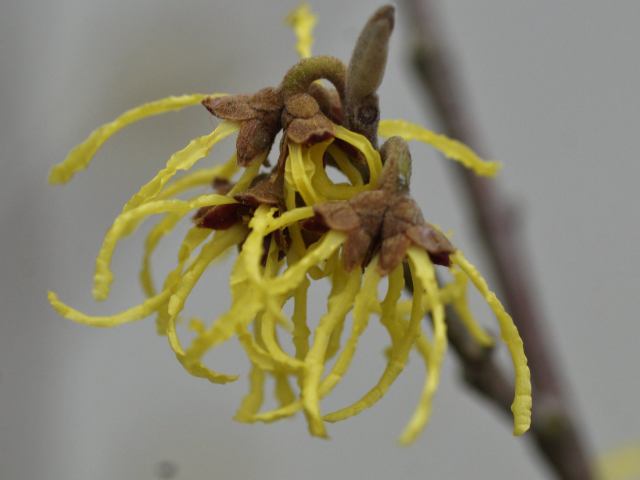
Hamamellis- pic by  Shirley Goodlife

Hamamellis- pic by Shirley Goodlife

WP_20160204_12_45_49_ProMore forking and levelling this week in the walled garden. It was good exercise and inspired me to begin excavating my new wildlife pond at Old School Garden the day afterwards.

You may recall that fellow volunteer, Peter and I had continued getting the grass cross paths ready for turfing or seeding? Well we carried on for another few hours this week, and I’m pleased to say that the majority of this prep is now done.

Nearly there...forking over and topping up the cross paths ready for grassing over

Nearly there…forking over and topping up the cross paths ready for grassing over

It was great to see some obvious progress in this regeneration project; Manager Mike and Gardener Rob carried on with the installation of the metal posts that will carry wires to support a wide range of trained fruit bushes and trees. I also noticed that the roof of the new Bothy (with shop and office) was virtually finished, complete with two squat chimneys. I gathered from Darren, the roofer, that we’d missed the traditional ‘topping out’ ceremony where the making of a building wind and weather tight is celebrated with a bottle of bubbly…just the day before!!

There is also a beautiful solid oak noticeboard by the entrance to the garden , which I understand from Mike is to have a lovely carved top fixed to it, like the one near the main entrance to the gardens. Mike is contemplating a ‘past, present, future’ display on the three boards. I like this idea; it will kindle visitor interest in the walled garden as an historic feature of the House and its surrounds and inform them about seasonal jobs and future projects.

The new notice board

The new notice board

The crocuses near the entrance to the Walled Garden were showing their colour, and there is now plenty of other floral interest in the gardens.

WP_20160204_10_41_47_ProFurther Information:

Blickling Hall website

Blickling Hall Facebook page

A 360 degree tour of Blickling Hall

Old School Gardener


Picture by Ellen Zillin

Picture by Ellen Zillin

Cyclamen -pic by Janina Sidlinskaite

Cyclamen -pic by Janina Sidlinskaite

1YC9C3UYXThis exotic looking palm is pretty tolerant of cold, and has lovely fan foliage – a good choice if you want to bring a touch of the ‘exotic’ to the garden.

Common name:  Chinese Windmill Palm, Windmill Palm or Chusan Palm

Native areas: Central China (Hubei southwards), southern Japan (Kyushu), south to northern Burma and northern India, growing at altitudes of 100–2,400 metres

Historical notes: Trachycarpus fortunei has been cultivated in China and Japan for thousands of years, for its coarse but very strong leaf sheath fibre, used for making rope, sacks, and other coarse cloth where great strength is important. The species was brought from Japan to Europe by the German physician Philipp Franz von Siebold in 1830. The common name refers to Chusan Island (now Zhousan Island), where Robert Fortune first saw cultivated specimens of the species. In 1849, Fortune smuggled Windmill palm plants from China to the Kew Horticultural Gardens and the Royal garden of Prince Albert. The Windmill Palm was later named Trachycarpus fortunei, after him. RHS Award of Garden Merit (AGM) in 2002.

Features: Trachycarpus fortunei is slow growing but can grow to 12–20 m tall on a single stem, the diameter of which is up to 15–30 centimetres. The trunk is very rough with the persistent leaf bases clasping the stem as layers of coarse fibrous material. It is a fan palm with the leaves with the long petiole bare except for two rows of small spines, terminating in a rounded fan of numerous leaflets; each leaf is 140–190 centimetres long, with the petiole 60–100 centimetres long, and the leaflets up to 90 centimetres long. It is a somewhat variable plant, especially as regards its general appearance and some specimens are to be seen with leaf segments having straight and others having drooping tips. The flowers are yellow (male) and greenish (female), about 2–4 millimetres across, borne in large branched panicles up to 1 metre long in spring; it is dioecious, with male and female flowers produced on separate trees. The fruit is a yellow to blue-black, kidney-shaped drupe 10–12 millimetres long, ripening in mid autumn.

Uses:   Trachycarpus fortunei is cultivated as a trunking palm in gardens and parks throughout the world in warm temperate and subtropical climates. Its tolerance of cool summers and cold winters makes it highly valued by palm enthusiasts, landscape designers and gardeners. Chusan Palms make attractive garden focal points, and look good alongside other exotic plants such as Cordyline australis, the New Zealand cabbage palm and the semi-hardy banana, Musa basjoo. Large-leafed plants such as cannas or bamboos also work well. Although usually grown as a solitary plant, the impact is greater with a clump of three or more.

Growing conditions:  It can be grown successfully in such cool and damp but relatively winter-mild locales as Scotland, Southern New England, Long Island, and British Columbia, Canada, as well as in warm temperate climates in parts of the United States, Europe (predominantly UK, France and Germany), New Zealand, and Asia. It does not grow well in very hot climates. It will grow in most soils as long as they are well drained and ideally needs a sheltered position, out of full sun.

Chusan Palms at Vancouver, Canada. Pic by Keepitsurreal

Chusan Palms at Vancouver, Canada. Pic by Keepitsurreal

Further information:

Wikipedia

RHS- Trachycarpus fortunei

How to Grow : Chusan Palm- Daily Telegraph

Barcham Trees Directory- Trachycarpus fortune

Trachycarpus fortunei in the Exotic Garden, Norwich

Choosing a Palm

Old School Gardener

Levelling up the new cross paths was this week's focus.

Levelling up the new cross paths was this week’s focus.

Having dug out channels for the oak edging to some paths in the Walled Garden in previous weeks, my colleague Peter and I had a day filling in the paths with soil in readiness for these to be put to grass.

It was hard work shifting sticky soil from a huge pile 100 yards away from the paths. These will form access ways across the four major quarters of the garden and will be grassed over- Project Manager Mike is yet to decide whether to turf or seed them.

In contrast to our previous session, today the weather was sunny and ‘crispy cold’ and the exercise (including arm extension from barrowing heavy loads!) was refreshing, if tiring. Two days on and I’m still feeling the effects on my shoulder muscles.  The first line of metal posts has been installed along one side of a quarter and with a nice dark mulch underneath starts to really define the shape of the garden.

Metal posts installed and mulched underneath in readiness for fruit planting

Metal posts installed and mulched underneath in readiness for fruit planting

It was also encouraging to see the progress on restoring the building in the corner of the walled garden which is to become a new ‘Gardeners’ Bothy, plus office and shop. This is expected to be finished by March, when a new crop of volunteers begins work; the recent ‘Volunteer Recruitment Day’, seems to have been a great success.

The roof well underway on the new 'bothy'- pic Blickling Estate

The roof well underway on the new ‘bothy’- pic Blickling Estate

Further Information:

Blickling Hall website

Blickling Hall Facebook page

A 360 degree tour of Blickling Hall

Old School Gardener


Tulip 'Harborlight'

Tulip ‘Harborlight’

Hellebores one of a few winter flowers currently on show...

Hellebores one of a few winter flowers currently on show…

Old School Garden – 29th January 2016

Dear Walter,

I looked back at the letter I wrote you this time last year, just out of interest. Even though that letter (written from a snowy landscape), painted a picture of relative inactivity, I did at least have potatoes chitting and the first seeds germinated. Alas, even though the weather has been mild (if a bit wet) I seem to be way behind this year.

I do NOT have potatoes chitting (I’m waiting on my friend who’s ordered the seed potatoes this year) and I do NOT have seeds sprouting (I brought the propagators in yesterday along with the seed box for sorting through).

I am looking forward to seed sowing though. Apart from some interesting perennials I bought at a National Trust Garden in the summer, I’m waiting on my selection of seeds from the RHS Seed scheme. These, with early vegetables (I planned out this year’s crops for the Kitchen Garden before Christmas) will give me a lot of seed sowing and seedling potting activity in the coming weeks….

Apart from NOT doing the things I needed to, I HAVE done a few other garden related things. As you know, I’ve been constructing some cupboards in two alcoves in our entrance hall. I’m rather pleased with the result. I bought some solid oak cupboard doors and sourced some oak framing and tops from a local timber merchant (the smell of freshly cut oak in the car on the way home was delightful). These are now finished and being repopulated with photo albums, sewing machines and other stuff… and I’m pleased with the result, and not a little surprised at my own skill level (YouTube ‘How to’ videos are a wonderful invention).

One of two new cupboards I've been building from solid oak...

One of two new cupboards I’ve been building from solid oak…

Well, I was left with a few pieces of spare wood, and had begun making a key cabinet to also go in the entrance hall, but upon putting this together using glued dowels I discovered my skill level wasn’t quite up to that challenge and also concluded that the thickness of the wood looked out of place for such a small item….So, having abandoned that project I had a lightbulb moment and decided to adapt the three sided box I had into a ‘bug hotel’, with a focus on nesting places for solitary bees and the like. Here’s the result…

One Bug Hotel!

One Bug Hotel!

It is rather heavy, but certainly solid. I’ve used a selection of old canes, some willow plant support and an old bamboo window blind, cut to fit and jammed together. I’ll now need to finalise where to put it up. I gather it needs to be in a warm sunny spot at least a metre off the ground. I may try to fix this to the fruit fence in the Kitchen Garden; this is the place where effective pollination is especially important.

Oh, and I nearly forgot that I’ve tied in the summer raspberries – at last! I’ve pruned the apple trees and vine. I’ve also finally dug up the dahlias and apart from a little tuber rot, these seem to be OK, so they are currently drying off in the greenhouse and will be put into slightly damp, second hand compost shortly, to stay under cover until they are ready to plant out later in the season. I also dug up two Osteospermums and put these in pots inside, as I think they might be prone to dying off before the end of the winter if left outside.

I’m pleased to say that my new Garden Design Course, ‘Get More From Your Garden’ looks like it will run as I have achieved the minimum number needed to make it viable, so I’m looking forward to meeting this new group of people and using the wonderful venue at Blickling Hall to explore and develop their own design projects.

Deborah and I have followed your lead and joined our newly established, local U3A (‘University of the Third Age’) group in Aylsham. We went along to a fascinating talk about ‘PAT’ (Pets As Therapy) dogs yesterday, the ones used in schools to help shy children learn to read, as companions for older or disabled people and so on. I’ve also joined a new gardening group and met the dozen or so other people in the group last week for an initial get together to discuss what we want to achieve. It looks like this could include visiting each other’s gardens to discuss problems and ideas, swapping plants, visiting open gardens etc.

An ahhhh moment...

An ahhhh moment…

So, I look back. And whilst I’m behind in some garden-related things, hopefully there’s still time to catch up (especially with the seed sowing). I’m pleased to hear that your new terrace has been laid and look forward to seeing it when we visit you and Lise at Easter. No doubt you’ll be planting up the pockets you left amongst the paving soon?

all the best for now,

Old School Gardener


Picture by Pockets1 on Flick

Picture by Pockets1 on Flick

WP_20160121_13_37_53_ProThis week’s gardening session focused on the avenues in the wilderness garden at Blickling. Gardener Ed led the volunteers to continue felling, gathering, shredding and stacking wood from the trees and overgrown shrubs alongside one of the routes radiating away from the House.
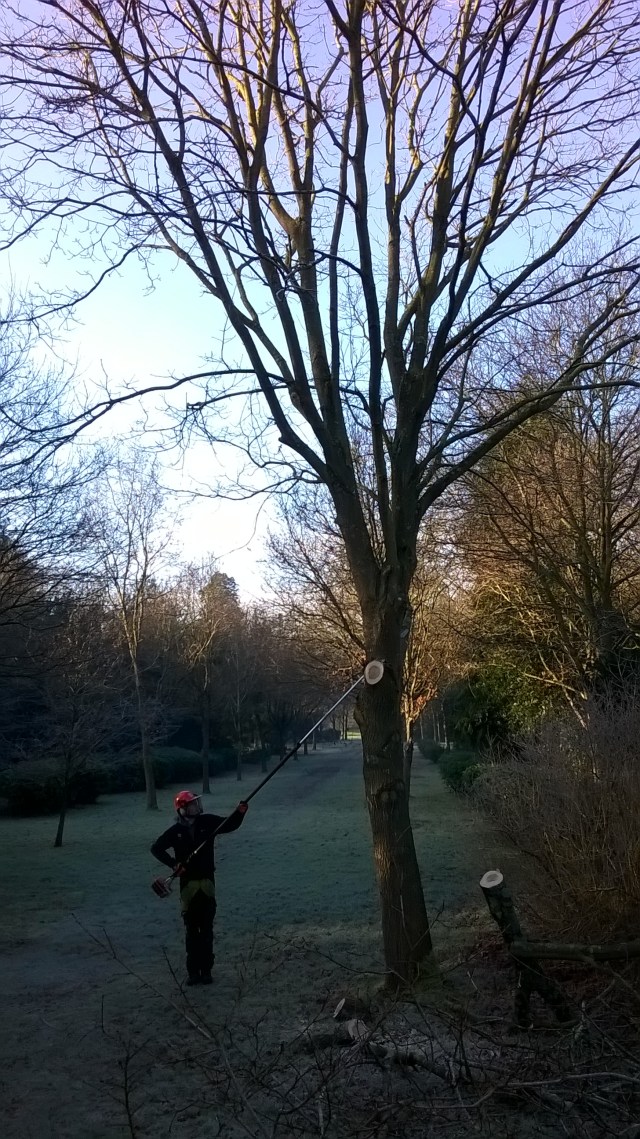
Having delivered two trays of birthday cakes (held over from last week), I made my way over to the Temple area where it was clear that some serious wood cutting was going on. You may recall in an earlier post, that the avenues have not received regular attention and so various trees have forced their way into what were once clear, straight lines of Oaks and similar trees. The main culprits are Yews and Hollies though some ‘rogue” Oaks have also found their way into these areas too.

WP_20160121_10_54_13_ProEd set to work with an impressive chainsaw attachment on an extended pole which made cutting off offending boughs look pretty easy. He later used a more conventional chainsaw to reduce some overgrown hollies to stools, form which bushes will re-sprout.

The shredder which managed to consume vast quantities of brashings from the trees was an impressive machine. ‘The Wolf’ gobbles up quite thick stems and so we were left with just a couple of piles of very thick cuttings that we later stacked in a wood pile for firewood. I imagine the shreddings are mixed in with other organic material to from compost.

I mentioned last week a talk to the Estate volunteers about the Walled Garden Project from Project Manager Mike. This was well attended and proved to be extremely interesting, with plenty of photographs of how the Walled Garden looked over the years since it’s birth in the 1600’s, when fruit was definitely the thing to grow. It was interesting to hear that the original garden was twice the size of the current one, and that the current garden formed the orchard area whereas the adjoining car park was once the area for soft fruit and vegetables etc. There are some fascinating old aerial photographs of Blickling taken in the 1930’s which you can see at this site .

Here’s one taken in 1928 and showing the walled garden in the foreground. About two thirds along from the left  and just up from the bottom there is a feature stretching away vertically on the picture, just to the right of a group of trees; this is thought to be the pineapple growing frames which were orientated to capture maximum sunlight. Apparently the Lost Gardens of Heligan in cornwall have grown pineapples in recreated frames and have calculated that it cost them some £10,000!

Further Information:

Blickling Hall website

Blickling Hall Facebook page

A 360 degree tour of Blickling Hall

Old School Gardener


Finding Nature

Nature Connectedness Research Blog by Prof. Miles Richardson

Norfolk Green Care Network

Connecting People with Nature

Discover WordPress

A daily selection of the best content published on WordPress, collected for you by humans who love to read.

Susan Rushton

Celebrating gardens, photography and a creative life

Unlocking Landscapes

Writing, photography and more by Daniel Greenwood

Alphabet Ravine

Lydia Rae Bush Poetry

TIME GENTS

Australian Pub Project, Established 2013

Vanha Talo Suomi

The Journey from Finnish Rintamamiestalo to Arboretum & Gardens

Marigolds and Gin

Because even in chaos, there’s always gin and a good story …

Bits & Tidbits

RANDOM BITS & MORE TIDBITS

Rambling in the Garden

.....and nurturing my soul

The Interpretation Game

Cultural Heritage and the Digital Economy

pbmGarden

Sense of place, purpose, rejuvenation and joy

SISSINGHURST GARDEN

Notes from the Gardeners...

Deep Green Permaculture

Connecting People to Nature, Empowering People to Live Sustainably

BloominBootiful

A girl and her garden :)