Tag Archive: garden


WP_20160224_15_46_02_Pro

En route to West Devon recently we had time for a brief afternoon stop at this wonderful National Trust property just outside Tiverton.

The house was built by Sir John Heathcoat Amory, the grandson of John Heathcoat, creator of the mechanised bobbin lace making machine and owner of a lace factory in Tiverton.

This slideshow requires JavaScript.

The foundation stone was laid in 1869, but it was not until 1873 that the elaborate interior designs were completed. William Burges, designer of Knightshayes, had a rocky relationship with the family and was fired half way through the project, leaving his imaginative vision incomplete.

Burges was replaced by another reputable designer, John Dibblee Crace, who turned out to be another ill-fated choice. Much of Crace’s work was covered up by the family, but later restored by the Trust.

We only had time to see the ‘Gothic Revival’ house and its colourful interiors (the Trust has imaginatively opened up some of the unrestored rooms too)  and quick tour of the formal gardens. These were originally designed by Edward Kemp (1817-1891), a reputable landscape gardener, but it fell into decline by the 1920s. Rescued by Sir John and Lady Heathcoat Amory, after the Second World War, the garden became one of the finest in England, winning the highest horticultural awards, with more than 1,200 species unique to Knightshayes. This garden has a very strong structure created by extensive Yew hedging and some amusing topiary animals scampering along the tops!

The restored Walled Garden was also an interesting spot, with its steeply sloping site being used to grow vines the ‘French Way’.

This slideshow requires JavaScript.

Knightshayes is certainly worth another, longer visit, when we can also explore the woodland garden… on the way out we stopped at a new ‘natural play’ site which cleverly uses three huge toppled oak trees to create a series of walkways, swing points, tunnels and other features.

Further information: Knightshayes National Trust website

Old School Gardener

Euphorbia myrsinites

Euphorbia myrsinites

WP_20160310_12_56_22_Pro

The final solution for the trained fruit trees along the central path?

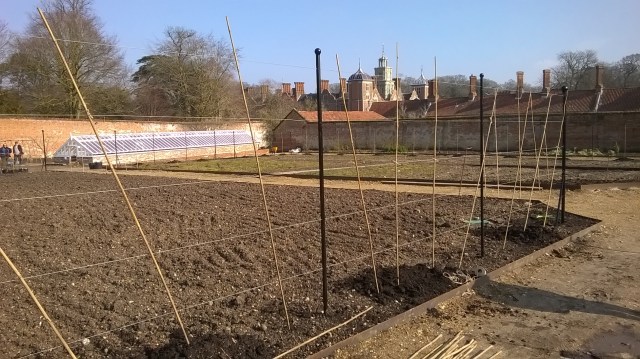
This week’s session at Blickling was easier- at least to begin with- than the previous few. Norfolk Peter and I were detailed to measure out the positions of the new trained fruit  around the edges and across the middle of the Walled Garden.

Placing and tying in canes to mark the planting positions was pretty straightforward around the perimeter- Mike plans for these to be vertically planted and then trained. Then we needed a bit of discussion about the central path, where Mike wants to put in some angled cordons for apples and pears. Putting them all in at 45 degrees and pointing the same way proved problematic; we ended up with plants placed too close to the concrete footings of the metal posts and some cordons would have to wrap around the corners or there would be gaps at the upper sections if we stuck rigidly to the spaces between each post…

After a bit of trial and error we came up with a combination of outwardly angled and a vertical espalier for each complete stretch of the wire and posts; this would mean some cordons growing over the intermediate metal posts and the angle would have to be steeper than 45 degrees. But overall it seemed to be a pleasing arrangement, and after they were in place I could see two other advantages; the design would visually slow you down as you proceeded along the path (rather than being hastened through if they had all be pointing in the same direction) and the angles nicely framed the other central path where these cross.

The rest of the volunteers were off digging over the parterre alongside the Hall, removing dead or dying Catmint and roses and replanting with new stock.

After lunch, having finished off the cane placing, Peter helped Mike measure up the splendid carved oak top trim for the new noticeboard and I barrowed in some soil and manure along the borders in the walled garden in preparation for the planting out of the many new plants that seem to be arriving in time for my next session… so next time it will be more gardening, less construction.

Further Information:

Blickling Hall website

Blickling Hall Facebook page

A 360 degree tour of Blickling Hall

Old School Gardener


PicPost: Artwork

Montreal, Canada

Montreal, Canada

Picture: Sally Smith

Picture: Sally Smith

Old School Gardener

WP_20160303_12_57_32_ProThe pace is quickening in the Walled Garden at Blickling. Having missed a session, I returned to discover the second Glasshouse restored and looking wonderful, with work to install the cold frames under way.

Cold Frames under contruction

Cold Frames under construction

I discovered that in my absence my fellow volunteers – ‘Aussie’ Pete and ‘Norfolk’ Pete – had been busy painting the metal posts that will carry wires for trained fruit.

Aussie Peter getting to grips with the painting

Aussie Peter getting to grips with the painting

In my latest session Aussie P continued with this, whilst Norfolk P and I finished off double digging between these posts in preparation for the fruit bush planting.

Project Manager Mike was well into asembling the wires, including the straining bolts that enable them to be tensioned.

And in the new bothy, work was underway to fit a new kitchen. In here I also saw a wonderful carved oak panel that will sit atop the oak noticeboard installed near the entrance, installed some weeks ago.

Sneak preview...part of the carved oak rail to be set atop the new noticeboard

Sneak preview…part of the carved oak rail to be set atop the new noticeboard

A new kitchen for the new bothy

A new kitchen for the new bothy

Whilst we three set to in the walled garden the remaining volunteers went about cutting back and tidying the borders around the moat to the house, which contain a bank of perennial Fuchsias.

After lunch it was a case of ‘all hands  to the wheel’.

As the house was due to open in a couple of days a big effort was needed to clear away the excavations that have been underway to install the Lake Source Heat  system I reported on a few weeks ago.

Along with a digger, tractor and trailer, which were used to remove some sloppy spoil, we loaded barrows and filled in a trench with crushed concrete, which was later smoothed nad compacted before having gravel spread to restore the pathway near the House.

Intense activity in a confined space...restoriung a path near the house

Intense activity in a confined space…restoriung a path near the house

Serious ‘Yakka’ once more, but a satisfying bit of work as the gardening staff and volunteers pulled together amidst the usual banter….

Further Information:

Blickling Hall website

Blickling Hall Facebook page

A 360 degree tour of Blickling Hall

Old School Gardener


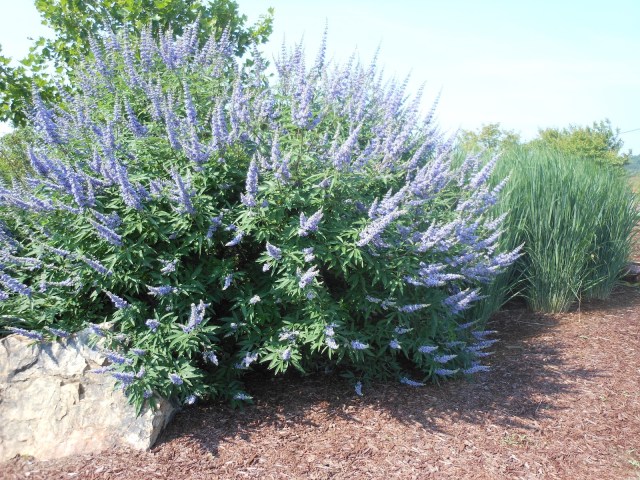
vitexI’m getting close to the end of the alphabet, and it doesn’t get any easier…so today’s feature tree (or large shrub), is the interestingly named Vitex agnus – castus…

Common name:  Vitex, Chaste Tree, chasteberry, Abraham’s balm, lilac chastetree, or monk’s pepper.

Native areas: Vitex agnus-castus is a native of the Mediterranean region and China. It is one of the few temperate-zone species of Vitex, which is on the whole a genus of tropical and sub-tropical flowering plants. It has a long history in the U.S.A. where it was first cultivated in 1670, and since that time it has become naturalized throughout the Southern part of the country. Many southerners use it as a replacement for lilacs, which don’t tolerate hot summers.

Historical notes: : Theophrastus mentioned Vitex as agnos (άγνος) in ‘Enquiry into Plants’. Vitex, its name in Pliny the Elder, is derived from the latin vieo, meaning to weave or to tie up, a reference to the use of Vitex agnus-castus in basketry. Its specific name repeats “chaste” in both Greek and Latin, and was considered to be sacred to the goddess Hestia/Vesta. In folk legends the tree is associated with Greek hagnos, ‘pure’, since it was strewn in bedchambers during Thesmophoria, the Greek religious festival when Athenian women left their husbands’ beds to remain ritually chaste-   “to cool the heat of lust”. At the end of the thirteenth century John Trevisa reports “the herbe agnus-castus is always grene, and the flowre therof is namly callyd Agnus Castus, for wyth smel and vse it maketh men chaste as a lombe”. More recently, this plant has been called monk’s pepper in the thought that it was used as anti-libido medicine by monks to aid their attempts to remain chaste. There are disputed accounts regarding its actual action on libido, with some claims that it is anaphrodisiac and others that it is aphrodisiac. Because of it’s  complex chemical action it can be probably be both, depending on the concentration of the extract and physiological variables. Today, Vitex agnus-castus is used to alleviate the symptoms of various gynaecological problems.

Features: Vitex blooms from late spring until early autumn with long, upright spikes of butterfly- attracting pink, lilac and white flowers (depending on variety) in late summer in cooler climates. It also has delicate-textured aromatic foliage. It develops small hard berries that ripen to a dark colour and look like peppercorns. It grows to a height of 1–5 metres.

Uses:   Whether left to grow as a large, multistemmed shrub, pruned to a standard tree or cut back annually for a more compact look, this selection is a winner. Fine, lacy leaves are glossy and green. Bright blue flower panicles begin to form in early summer and continue through the heat of the season and into autumn. This is a reasonably cold-hardy, deer-resistant woody plant. Vitex, also a traditional plant in Africa, is a little-known fruit plant that has potential to improve nutrition, boost food security, foster rural development and support sustainable landcare.

Growing conditions:   It requires full sun or partial shade along with well-drained soil. It’s best not to plant them in soil that is rich in organic matter because these soils hold too much moisture close to the roots. Chaste trees do very well in dry gardens. Under ideal conditions it is hardy to -10 degrees Fahrenheit and will grow in South West England (and possibly in suitable micro-climates and sheltered parts of gardens eleswhere) and the more temperate zones of north America. Wildlife shuns the seeds, and it’s just as well because you’ll have to remove the flower spikes before they go to seed to keep the plant flowering. You’ll need to prune annually to control the shape and size and encourage branching.

Further information:

Wikipedia

How to grow Vitex (U.S.A.)

Vitex agnus-castus- The British Gardener

Old School Gardener

A little out of control?!

A little out of control?!

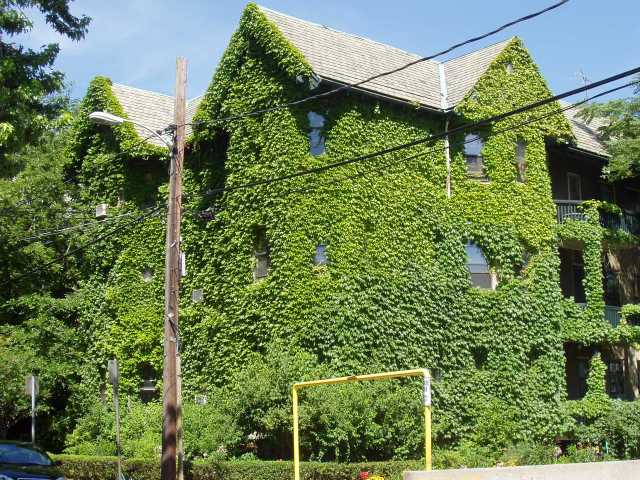
Swift action can prevent ivy from causing structural problems

Self-clinging climbers do not usually cause damage to wall surfaces but ivy supports itself by roots on the stems and where these penetrate cracks or joints they may cause structural damage. Its dense cover can also hide defects in the fabric of the building or hinder maintenance work.

At the Old School we have direct experience of this. The main gable end is of flint and brick construction and when we moved in (some 28 years ago) was painted white. This seemed strange, but we later discovered that we had a damp problem on the inner face of this wall. I took what I thought was the right action at the time and covered the wall with another coat of (this time brown) wall paint and for some years the damp problem seemed to wane. Then ivy got a hold and virtually covered the wall by last year, when we decided to remove this (it was a pain trying to keep it cut below the top of the roof) and try to remove the paint (there are, in fact three layers) and restore the original bare flint surface.

Having removed the ivy we’ve noticed how the roots from the stems have got behind a lot of the paintwork and whilst there’s no obvious major damage, we have seen our damp problems return; maybe a case of the ivy helping to prevent water coming in?! Well, we’re still waiting for quotes to do the paint removal work (and to repair some defective flashing on the adjacent roof which I think partly explains the damp problem), and I’m soon going to get into the border next to the wall to remove the roots of the ivy (I think this might be hard work).

In some situations Ivy up the wall may also provide handy access for intruders and harbour pests like mice. Where brickwork is sound, the main task is to keep growth away from gutters (and certainly from getting in under the roof slope) and paintwork.

Ivy under control, but it can be a pain getting up the ladders and trimming back annual growth...

Ivy under control, but it can be a pain getting up the ladders and trimming back annual growth…

Large climbers can pose a risk to house foundations. This is most likely with older buildings constructed on clay soils that are prone to shrinkage.

In the past, Ivy could be killed by cutting through the stem near ground level and treating the stump with ammonium sulphate, but this chemical is now banned so you have to resort to cutting the main stems and digging out the roots and any seedlings. Top growth may be treated with a brushwood killer or a weedkiller containing glyphosate, but ivy is not easily controlled in this way because the leaves are glossy and the spray simply runs off. Repeat applications may be necessary.

Dead foliage and stems are relatively easy to remove from walls (I used a crowbar to lever off quite large chunks, once these had died off), but aerial roots are persistent and can only be removed using a hard brush, wire brush or paint scraper. Here’s a useful video to summarise the basic approach to removing ivy (including from trees and shrubs).

Source: ‘RHS Wisley Experts- Gardeners’ Advice’ – Dorling Kindersley, 2004

Old School Gardener

WP_20160222_14_13_35_ProOld School Garden – 29th February 2016

Dear Walter,

This month has been one of acquisition. I mentioned my plans for a DIY shed (including shingle roof) at Blickling recently and one of the volunteers, Peter, said he thought his brother might have some shingles he wanted rid of. Well last week I collected  several boxes of cedar shingles and ridge caps from his home in nearby Taverham, and think I might have enough to do most if not all of the roof- for a bargain price of £20.
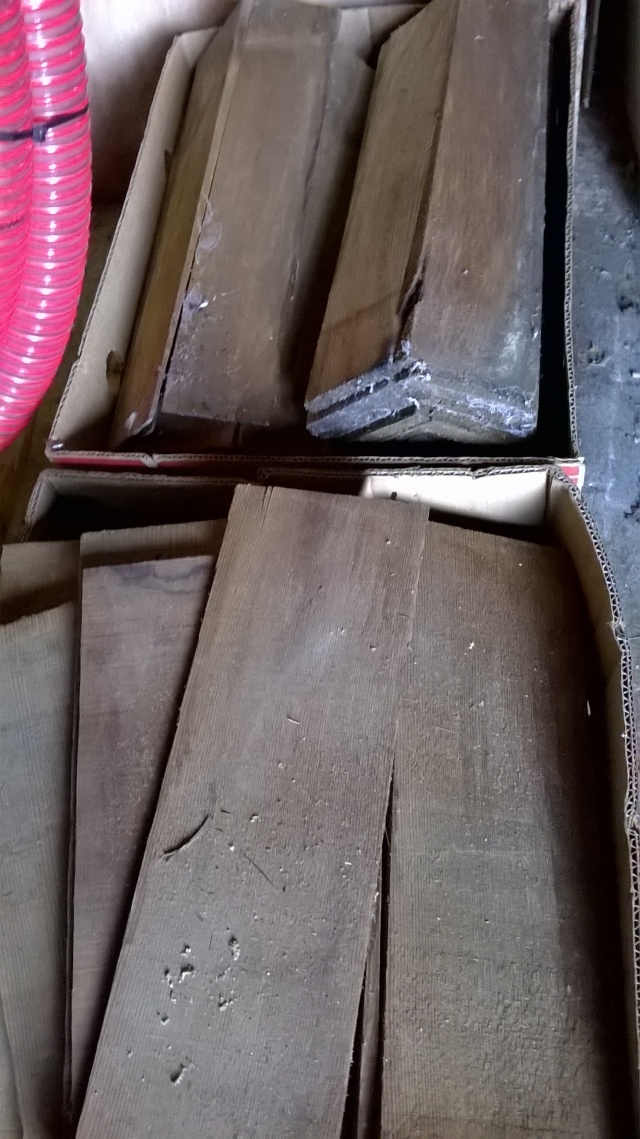
Shingles...I look forward to fixing these on the roof of my new shed

Shingles…I look forward to fixing these on the roof of my new shed

The shingles are old, but unused and have been stored under cover for several years. You may remember that I’m drawing up plans for this shed based on using the old floorboards taken up when we had some under floor insulation put in? The plans are firming up nicely, and I’m making the shed big enough and tall enough to comfortably store all my unpowered garden tools along with a potting bench and storage for trays, pots and all the other garden paraphernalia like string, plant labels and so on. I’ll need to buy a few extra slabs for the base, as well as the timber for the frame, but the result should be something that will last, be big enough, not cost the earth – and look attractive too (I hope).

The other big project for this year, the wildlife pond, has begun too. Having firmed up my sketch plan I decided to dig out the main boundaries and other features and put in some key shrubs from elsewhere in the garden. While I was at it I thought I’d tidy up and strengthen the planting in the two borders you pass between to get to the pond. These look much better, with one side featuring a relocated Spotted Laurel (which was nestling unseen behind soem holly and whose leaves now pick up the yellow flowers of the Kerria behind), Star Magnolia and  Viburnum along with white Forget – me – Nots, and Verbena bonariensis. The other side features the ornamental Japanese Maple I bought last year along with a Flowering Currant and Anemanthele lessoniana grass, all surrounded with Yellow Loosestrife and purple Geraniums.

I’ve also acquired- again from Peter and his wife Pam, some plants suitable for the pond area and I hope to get some rustic wooden poles and log slices for embanking and an arbour from Blickling when I’m next there – the acquisitions continue!

Elsewhere in the garden I’ve begun the great spring clear up- cutting spent stems and pruning shrubs and trees, raking off leaves from the borders and forking over the soil to remove weeds and aerate. I find this very satisfying work, though I’ve a lot to do. I also cut the grass in a few places a week or two ago (in February would you believe!), as it had grown considerably in the (to date) mild winter.
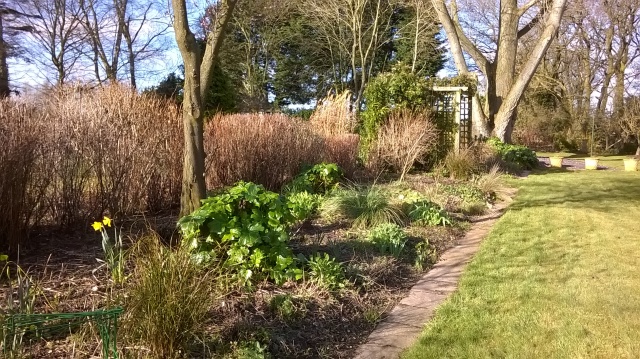
Borders cleared and ready for weeding and soil tickling...

Borders cleared and ready for weeding and soil tickling…

I’ve also finally got my seed potatoes chitting (‘Rocket’ as first earlies, ‘Charlotte’ as second), and my first seeds have been sown and are starting to germinate; Sweet peas, Scabious, Lettuce, Calabrese, cosmos etc. Some of these are a little spindly, showing the effect of low light levels, but hopefully they can be potted up shortly and placed in the greenhouse to continue their journey.

My garden design course at Blickling proceeds well, I think, with 6 participants keen to find out how best to improve their own plots, which range from small, urban settings to large country gardens. The second session involved a practical measured survey of the Secret Garden at Blickling, which I think they found very instructive, and in tomorrow’s session I plan to cover garden structure which will also involve a visit to the gardens at Blickling to observe the key structural elements of the different gardens there.

Oh, I mustn’t forget my other acquisition this month. Our neighbour Richard and I were chatting over the garden fence one day and he told me of his new mole repeller, and asked if I wanted to get one as he was going to order another. Having used this sort of thing in the past with mixed results I was skeptical, but went along and said I’d give one a try. Well, he duly came round the other day and presented me with this solar-powered device, which emits a regular sound which is supposed to disturb the moles and encourage them to move on. He didn’t want any payment either!
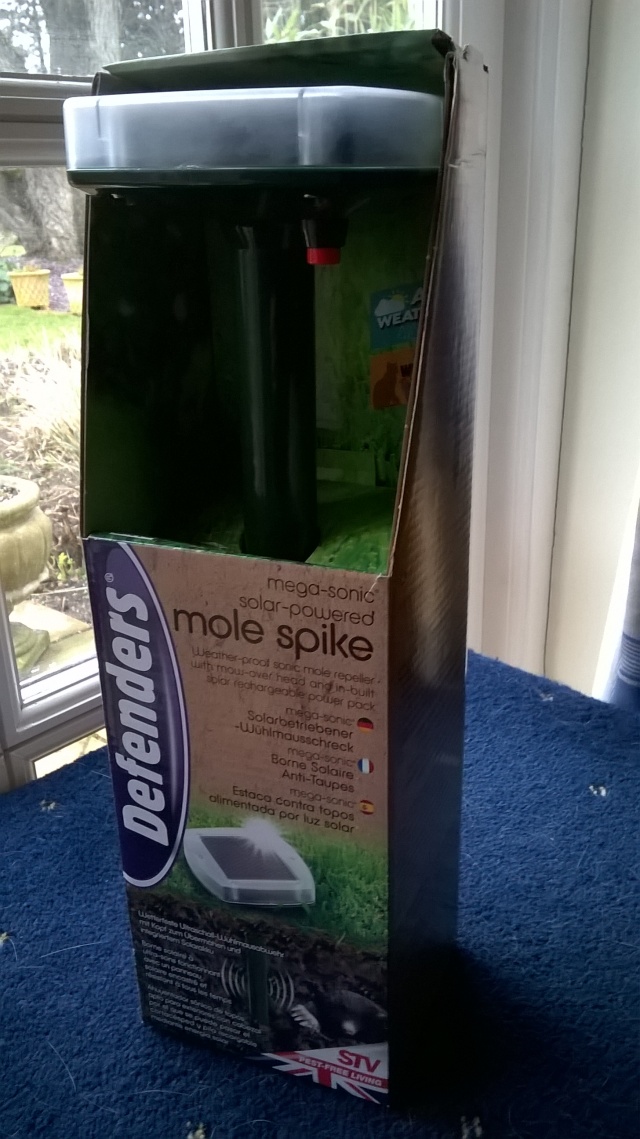
Will it work? My new attempt at mole control,courtesy of neighbour Richard

Will it work? My new attempt at mole control, courtesy of neighbour Richard

So, it is in the lawn where there was last evidence of mole activity (I’ve also come across lots of mole hills in the borders as I’ve been clearing up), so we’ll see what impact it has. I suspect it’s still a little early for mole activity on any scale, so I await the spring with a mixture of trepidation and a small element of hope that this new device might do the trick. Of course with us both having these things we could drive the moles to our third nearby neighbour’s garden! But this shouldn’t be too much of an issue as the chap there, Norman, seems to thrive on his mole catching ability; I think his tally to date is in the twenties!

Well, Walter, I hope this latest letter finds you and Lise in good health and looking forward to the lighter, warmer days of spring that are on the horizon- tomorrow is March after all!

best wishes,

Old School Gardener


Finding Nature

Nature Connectedness Research Blog by Prof. Miles Richardson

Norfolk Green Care Network

Connecting People with Nature

Discover WordPress

A daily selection of the best content published on WordPress, collected for you by humans who love to read.

Susan Rushton

Celebrating gardens, photography and a creative life

Unlocking Landscapes

Writing, photography and more by Daniel Greenwood

Alphabet Ravine

Lydia Rae Bush Poetry

TIME GENTS

Australian Pub Project, Established 2013

Vanha Talo Suomi

The Journey from Finnish Rintamamiestalo to Arboretum & Gardens

Marigolds and Gin

Because even in chaos, there’s always gin and a good story …

Bits & Tidbits

RANDOM BITS & MORE TIDBITS

Rambling in the Garden

.....and nurturing my soul

The Interpretation Game

Cultural Heritage and the Digital Economy

pbmGarden

Sense of place, purpose, rejuvenation and joy

SISSINGHURST GARDEN

Notes from the Gardeners...

Deep Green Permaculture

Connecting People to Nature, Empowering People to Live Sustainably

BloominBootiful

A girl and her garden :)