Tag Archive: flowers


PicPost: I'm ready for love

PicPost: Electric Fan

PicPost: Key planting

Picpost: I love my bed

No, not me, not Old School Garden!

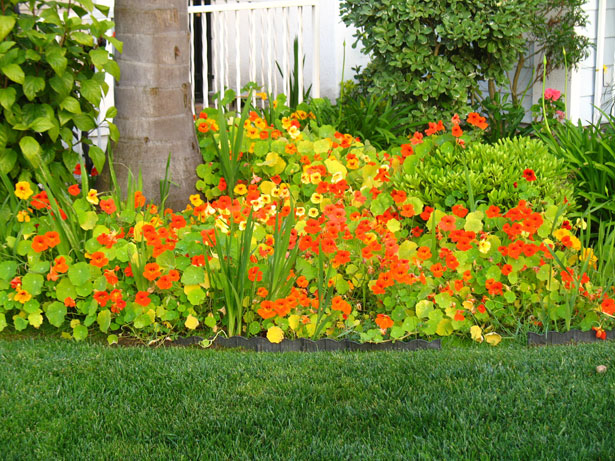
Tropaeolum majus

Tropaeolum majus

Tropaeolum is a genus of about 80 species of annuals and perennials native to South/Central America. The common Nasturtium (Tropaeolum majus) is the most frequently found member of the family. 

Nasturtium is from the latin words meaning literally “nose-twister” or “nose-tweaker” (referring to the pungent smell of some species!). The Tropaeolum Nasturtiums received their common name because they produce an oil that is similar to that produced by watercress (Nasturtium officinale).

Tropaeolum peregrinum

Tropaeolum peregrinum

Tropaeolum includes several very popular garden plants, the most commonly grown being T. majus T. peregrinum and T. speciosum The hardiest species is T. polyphyllum from Chile, the perennial roots of which can survive underground when air temperatures drop as low as −15 °C (5 °F).

Plants in this genus have showy, often intensely bright flowers (in reds, oranges and yellows), and rounded, shield- shaped leaves which vary in colour and include some attractive blue – green tones. Flowers have five petals (sometimes more) and a funnel-shaped nectar tube at the back. The name Tropaeolum is from the Latin tropaeum , meaning ‘trophy’ and was originally chosen by the swedish botanist Carl Linnaeus in the 18th century.

After victory in battle, the Romans used to set up a trophy pole called a tropaeum (from the Greek tropaion, source of the English word ‘trophy’). On this the armour and weapons of the vanquished foe were hung. Linnaeus was reminded of this by the plant as the round leaves resemble shields and the flowers, blood-stained helmets.

Tropaeolums in flower

Tropaeolums in a border

Species names of Tropaeolum include:

T. aduncum = hooked (the flowers)

T. canariense = canary – referring to the colour and shape of the flowers (the ‘Canary Creeper’)

T. lobbianum =  after Lobb the plant collector

T. majus = great (the Climbing Nasturtium)

T. minus = small (the Dwarf Nasturtium)

T. pentaphyllum = five leaved or divided into five

T. pergrinum = foreign or wandering, probably referring to its straggly growth

T. speciosum = showy

T. tuberosum = tuberous

'Canary Creeper' (T. canariense)

‘Canary Creeper’ (T. canariense)

Nasturtiums were also known as “Indian cress”. This derived from their use as a salad ingredient and because at that time South/Central America was referred to as ‘the Indies’. The 16th-century herbalist John Gerard called the plant “Lark’s Heel”, referring to the flower’s spur (and similar to Larkspur).

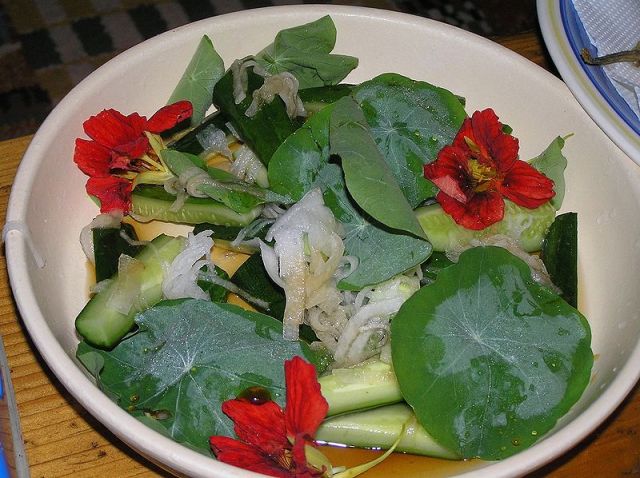
All parts of T. majus are edible. The flower is most often eaten as an ornamental salad ingredient or in a stir fry; it has a slightly peppery taste reminiscent of watercress. The flowers contain about 130 milligrams of Vitamin C per 100 grams or about the same amount as in Parsley. The unripe seed pods can be harvested and dropped into spiced vinegar to produce a condiment and garnish, sometimes used in place of capers.

Tropaeolum leaves and flowers as salad ingredients

Tropaeolum leaves and flowers as salad ingredients

Nasturtiums have been used in herbal medicines for their antiseptic and expectorant qualities. They are said to be good for a chest cold and to promote well being by the formation of new blood cells. The common Nasturtium has been used in herbal medicine for respiratory and urinary tract infections.

The bright, quaintly – shaped flowers are usually freely produced on long stalks, and the fast growth of many of the climbers makes the Tropaeolum a very useful, decorative plant. They will spill beautifully over walls and onto paths, when used as edging plants. They also hold up very well in containers. Climbing varieties, such as ‘Canary Creeper’ will amble up and through shrubs. Bushy, ground hugging plants will fill in gaps among complementary – coloured day lilies and roses.

You can use clusters of plants to brighten up the vegetable garden – and to act as ‘sacrificial’ ‘plants to attract caterpillars away from your brassicas!

Sources and further information:

Wikipedia

Tropaeolum speciosum

Growing Tropaeolum

Tropaeolum varieties

Quizzicals: two cryptic clues to flower, plant, veg or fruit names –

  • Bird swearing
  • Vasectomy for Dad

(thanks to Les Palmer, answers in the next Plantax!)

Old School Gardener

If you’ve enjoyed reading this post and others on this blog, why not comment and join others by signing up for automatic updates via email (see side bar, above right ) or through an RSS feed (see top of page)?

PicPost: Bearded Beauty

Bearded Iris drawn by Sue Walker White

PicPost: Fire Station

Photo from The Exotic Garden, Norwich

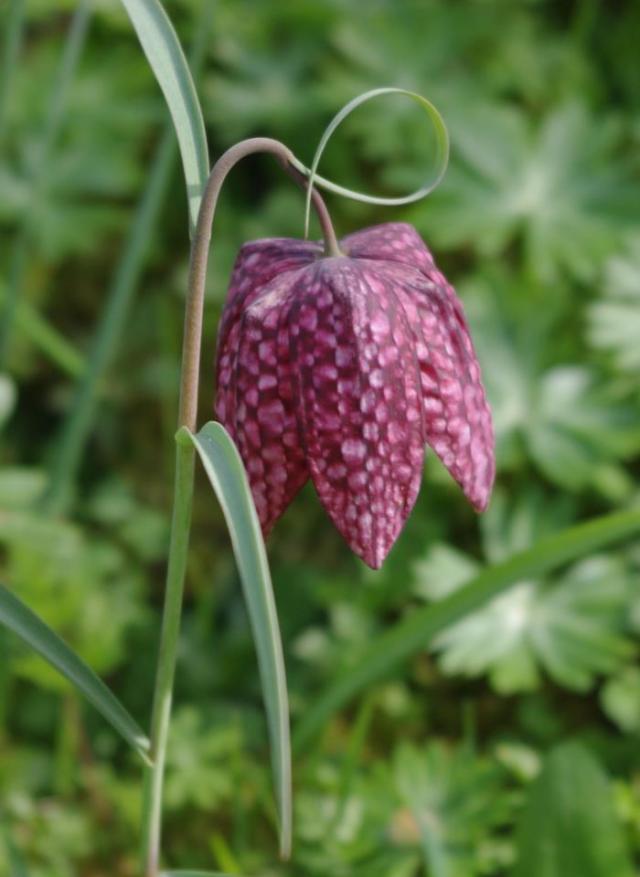
PicPost: Frittilary

‘Super talk last night by the Director of the Museum Christopher Woodward for the Friends of the Botanic Garden (Oxford). As with much trade, the railways enabled flowers to be sent to London and it was the wild Snakeshead Fritillary that grew on the wet Oxford meadows that yielded its flowers for admiration.’ from Richard Barrett, who was at the Garden Museum, London.

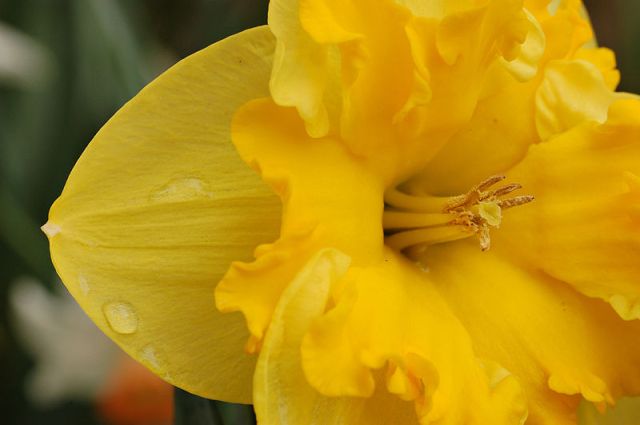
Daffodil flower close up

Narcissus is a genus of bulbous perennials in the Amaryllis family. They are in the  main hardy and most flower in the spring. There are various common names used to describe all or some of the genus – daffodil, narcissus, and jonquil. Narcissus are native to meadows and woods in Europe, North Africa and West Asia, centred in the Western Mediterranean.

There is disagreement about the number of distinct species (these range from 26 to more than 60 depending on who you ask) – as some are very similar and others have hybridised. All Narcissus cultivars are split into 13 divisions (using a combination of flower form and genetic background). New cultivars are registered by name and color with the Royal Horticultural Society, which is the international registration authority for the genus.

More than 27,000 names were registered as of 2008!

Narcissus flowers

Narcissus flowers

The name “daffodil” is derived from an earlier word  “affodell”, a variant of Asphodel (another group of Mediterranean plants). The reason for the addition of the  initial “d” is not known, although it could be a ‘slip of the dutch tongue’ – the merging of the main word with the Dutch article “de”, as in “De affodil”. Playful synonyms  “Daffadown Dilly”, “daffadown dilly”, and “daffydowndilly” appeared as early as the 16th century. Everyday use of the term Daffodil tends to refer to the wild daffodil (N. pseudonarcissus).

The name Narcissus comes from the same latin word, which in turn is based on an ancient greek word – but its meaning is unknown. It could be a word loaned from another language. The most common explanation is based on the Greek myth of Narcissus, a Thespian hunter renowned for his beauty. He became so obsessed with his own reflection in a pool of water that as he knelt and gazed into it, he fell into the water and drowned. Some variations of the myth say that he died of starvation and thirst. In both versions the Narcissus plant sprang from his remains. However, this is by no means a certain derivation and it could be the that the hunter’s name was derived from the flower rather than the other way round!

Another explanation for the name comes from Pliny who stated that the plant was named because of its narcotic properties (the greek word means ‘to grow numb’). There’s no evidence to support this idea and it seems to have fallen out of favour. However,  all Narcissus species do contain the poison lycorine (mostly in the bulb but also in the leaves). The bulbs can often be confused with onions, thereby leading to incidents of accidental poisoning.

On 1 May 2009 a number of schoolchildren fell ill at Gorseland Primary School in Martlesham Heath, Suffolk, England, after a daffodil bulb was added to soup during a cookery class.

Another problem is what florists call, “daffodil itch” – a skin problem often found on the hands after contact with the plant’s sap. Some cultivars seem more likely to cause this kind of dermatitis; eg  ‘Actaea’, ‘Camparelle’, ‘Gloriosa’, ‘Grande Monarque’, ‘Ornatus’, ‘Princeps’ and ‘Scilly White’.

Narcissus geranium

Narcissus geranium

The Narcissus is used quite widely as a symbol:

  • of unrequited love (after the Narcissus myth)
  • of vanity (the West)
  • of wealth and good fortune (the East).
  • of the new year (Kurdish and Chinese cultures).
  • of beautiful eyes (Persian culture)
  • of the nation (Wales – where the daffodil is known as ‘Peter’s Leek’)
  • of Easter (the German for daffodil is Osterglocke or ‘Easter Bell’)
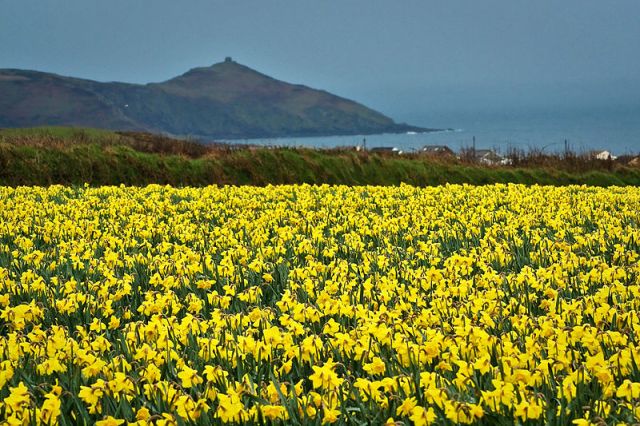
Cornwall daffodils- traditionally the place (along with the Scilly Isles and Channel Islands) where early supplies of cut flowers are sent out to the rest of Britain.

Cornwall Daffodils- traditionally the place (along with the Scilly Isles and Channel Islands) where early supplies of cut flowers are sent out to the rest of Britain.

Some of the species names are:

N. bulbocodium = probably greek for ‘bulb’ (bolbos) and ‘a little fleece’ (kodion) – referring to the covering of the bulb – the ‘Hoop Petticoat Daffodil’

N. cyclamineus = like a Cyclamen flower

N. incomparabilis = incomparable

N. jonquilla = probably from ‘juncus’ (a rush) – the leaves being rush-like. The ‘Jonquil’

N. juncifolia = like Jonquil, rush – leaved!

N. major = larger

N. maximus = largest

N. minor = smaller

N. odorus = sweet-scented

N. poeticus = poet’s – the ‘Poets’ Narcissus’

N. pseudonarcissus = the false Narcissus. The ‘English Daffodil’

N. tazetta = an old name for the ‘Polyanthus Narcissus’

N. triandrus = having three stamens
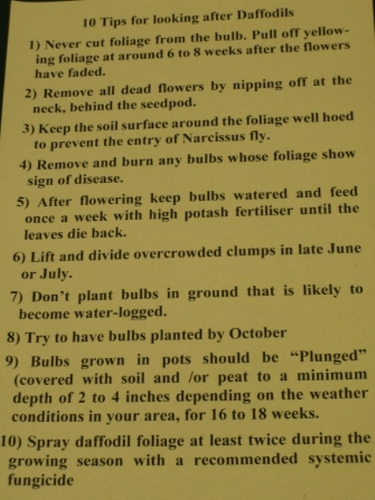
Daffodil growing tips

Daffodil growing tips

Both species and hybrids are used extensively in gardens and grounds, looking good planted in borders or in naturalized drifts at the base of deciduous trees. Propagation is mainly from bulbs which are very easy to grow. They require little maintenance, but with some minimum care they can be more vigorous and floriferous, and they’ll multiply much more quickly, improving the show they provide each year. (see ‘Ten tips for looking after Daffodils’ above). Narcissus grows almost anywhere, although it does prefer well-drained soils with a sunny or light shade environment. The Narcissus species types are more specific in their requirements.

Naturalised Daffodils

Naturalised Daffodils

Source and further information:

Wikipedia

Growing Narcissus

Kew Gardens- Narcissus pseudonarcissus

Daffodil classification

Old School Gardener

If you’ve enjoyed reading this post and others on this blog, why not comment and join others by signing up for automatic updates via email (see side bar, above right ) or through an RSS feed (see top of page)?

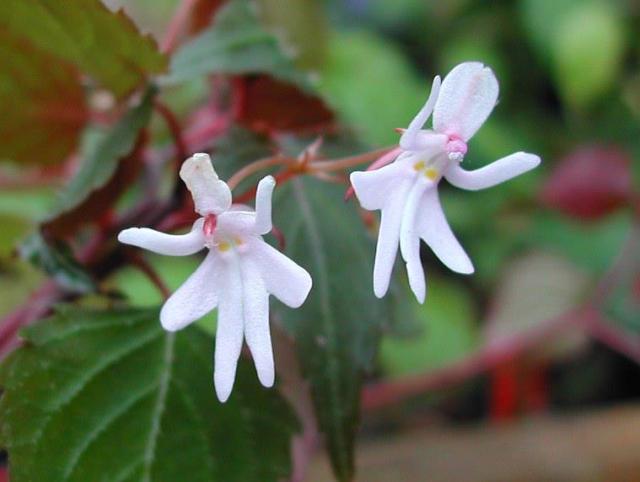
Picpost: Fairies

Impatiens bequaertii

Finding Nature

Nature Connectedness Research Blog by Prof. Miles Richardson

Norfolk Green Care Network

Connecting People with Nature

Discover WordPress

A daily selection of the best content published on WordPress, collected for you by humans who love to read.

Susan Rushton

Celebrating gardens, photography and a creative life

Unlocking Landscapes

Writing, photography and more by Daniel Greenwood

Alphabet Ravine

Lydia Rae Bush Poetry

TIME GENTS

Australian Pub Project, Established 2013

Vanha Talo Suomi

The Journey from Finnish Rintamamiestalo to Arboretum & Gardens

Marigolds and Gin

Because even in chaos, there’s always gin and a good story …

Bits & Tidbits

RANDOM BITS & MORE TIDBITS

Rambling in the Garden

.....and nurturing my soul

The Interpretation Game

Cultural Heritage and the Digital Economy

pbmGarden

Sense of place, purpose, rejuvenation and joy

SISSINGHURST GARDEN

Notes from the Gardeners...

Deep Green Permaculture

Connecting People to Nature, Empowering People to Live Sustainably

BloominBootiful

A girl and her garden :)