

Dahlia flowers at Anglesey Abbey, Cambridgeshire. Picture Madeleine Boldero-Rito
Dahlia flowers at Anglesey Abbey, Cambridgeshire. Picture Madeleine Boldero-Rito
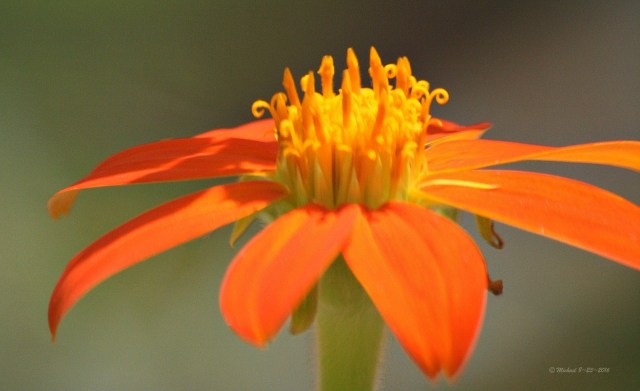
Picture by Mike Minnich

Picture by Eva Kovacs
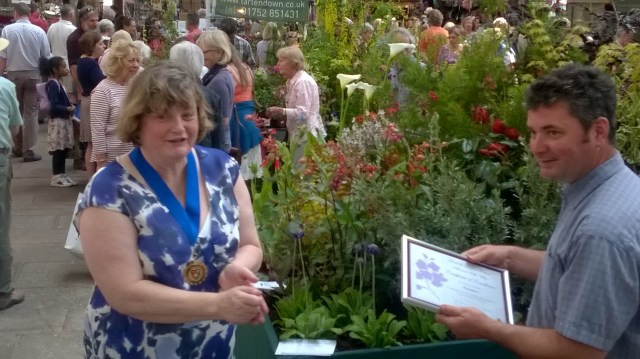 Whilst down in Devon recently, one sunny Sunday morning I wandered into Tavistock Pannier Market to the Tavistock Garden Festival. It was busy.
There was a lovely range of displays by local nurseries all vying for our trade, as well as some other trades people with garden ornaments and practical garden items. I was tempted…and succumbed, buying three rather unusual plants, all of which now adorn the pond garden here at the Old School: a beautiful white Camassia (I’ve already saved seed from this and hope to propagate further plants), a Sanguisorba with a mix of red flowers and nicely cut foliage and a rather nice Geum, with golden yellow flowers nestling on pinkish red bases.
 Our journey away from Skye featured a slow start- we got stuck behind a convoy of three huge trailers carrying the blades of a wind turbine! After a very good lunch en route we made our way alongside Loch Lomond (it’s rather long!) and eventually reached Helensburgh on the Clyde Estuary and specifically The Hill House. This gem of the National Trust for Scotland is one of the few houses designed by the renowned Art Nouveau Scottish Architect and designer Charles Rennie Mackintosh.


Built in 1902-3, to get close to some original Mackintosh design features- especially in the interior of the house- was a joy. Needless to say the attention to detail- somewhat typical of the ‘architecture for the rich’ at this time- was delightful. Unfortunately I wasn’t allowed to take photographs inside, but here are a few ‘culled’ from the ‘net…


And the gardens didn’t disappoint either, though these had rather less of the Mackintosh touch, the owner of the house probably playing a more important role in shaping its design, features and planting. The garden today is testament to a painstaking programme of restoration and whilst the layout is pretty typical for grand houses of this period- with formal, terraced lawns combined with a series of ‘garden rooms’- it nonetheless was a lovely experience strolling through these in the spring sunshine. It was also nice to be able to buy a few spare plants from the cottage garden, including ‘Jacob’s Ladder’.
 Our second garden trip whilst in Scotland this year involved a bit of a trek to the south-western coast of the Isle of Skye, from our base further north. The 20,000 acre estate of the Clan Donald is centred on an historic castle (now a ruin) and gardens, along with a rather interesting museum that guides you through 1500 years of history and culture of the ‘Kingdom of the Isles’.


Our visit, with friends Richard and Ann, was once again blessed with warm, sunny weather. After arriving and a light lunch at the Castle restaurant, we set off along Lord Macdonald’s Drive via a coast-side walk and viewpoint across the sound, towards the imposing shell of Armadale castle. As the Castle’s website explains:
‘The Clan Donald established itself on Skye in the 15th century, occupying castles at Dunscaith and Knock, both within a few miles of Armadale, and Duntulm Castle at the north end of the island.
From the 1650s, the MacDonald chiefs also began to stay at Armadale. From the 1700s onwards, the mansion house at Armadale was used as a dower house (a large home occupied by the widow of a late owner or chief) and then rented out to others.
A number of famous historical figures have visited Armadale over the years. Flora MacDonald, famed throughout the world for helping Bonnie Prince Charlie to flee Scotland after the Jacobites’ defeat at Culloden, was married here on 6 November 1750. Samuel Johnson and James Boswell visited in 1773.
Around 1790, a new mansion house was built at Armadale and this, combined with the start of the plantings you see around the gardens today, became a real demonstration of the wealth and lifestyle of the landed aristocracy.
In 1815, the mansion house was extended to form Armadale Castle, designed by the renowned architect James Gillespie Graham. In 1855, fire destroyed much of the original house, which was replaced by the current central section (designed by David Bryce). In 1925, the MacDonald family moved to a smaller house leaving the castle to the wind and rain.
Today, the Gillespie Graham section is a sculptured ruin and garden with the staircase and facade often used for wedding ceremonies. Housed in what remains of the original mansion, dating from around 1790, the Somerled Rooms offer a unique conference facility.’
From the castle we took in the formal gardens and woodland walks and eventually arrived at the Museum of the Isles, which was fascinating. Even more impressive were the linked pools outside where gardeners were preening the planting and the sun reflected beautifully off of the water surfaces.


Armadale Castle Gardens are testimony to years of patient restoration; the result is 40 acres of varied gardens and woodland, featuring some magnificent trees, some almost 200 years old. Through spring and summer there are carpets of bluebells, orchids and wildflowers and there is clear evidence of long-term thinking as below the giant trees are the young firs which will eventually replace them, as well as the growing collections of elegant birch and beech trees.
 I’ve finally got round to posting the first pictures from some gardens I saw on our recent trip to Scotland. Spending a week on the Isle of Skye (with amazing temperatures and bright sunshine) and then on to Glasgow for a couple of days, we visited some wonderful places. I’ll post more over the next week or two; the series begins with the ancient seat of the Clan MacLeod, Dunvegan Castle.
The oldest continuously inhabited castle in Scotland, this special place on the north west copast of Skye has been the home of the Chiefs of MacLeod for 800 years. We were given a warm welcome and lots of interesting information as we toured the castle. I was even more impressed with the gardens, which consist of a Woodland Garden, more formal ‘Round Garden’ a Walled Garden and a superb Water Garden.
The woodland garden features a hallmark of the gardening skills at play more generally here- very careful attention to planting in what can sometimes seem to be large, daunting spaces. There were some lovely touches; e.g. swathes of Shuttlecock Ferns glinting in the dappled sunlight.


From here we visited the ‘Round Garden’ which had some impressive displays of tulips, formed into a central array of beds, helping to define this circular space.


And then on to the Walled Garden where I chatted to one of thew gardeners abotu the vegetables under cultivation in raised beds, and visited an impressive glasshouse witha good show of various tender, exotic plants.


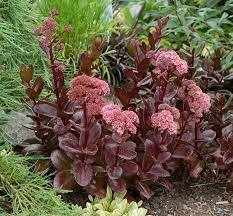
Sedum ‘Chocolate Drop’- the foliage as attractive as the flower- and what a combination!

Stipa gigantea- wonderful
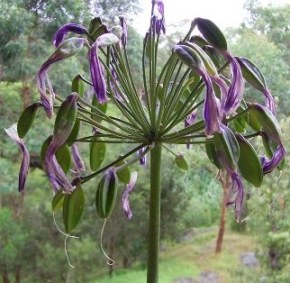
From flower to seedpod- Agapanthus
Blend foliage plants with flowering ones to keep the border looking at its best over the longest possible time.
Combine foliage and flowers that contrast with each other in colour,shape and texture.
Use plants with ornamental seed pods, such as Agapanthus, Feathery grass heads, such as Pampas grass and evergreen foliage.
Use plants with variegated leaves, such as striped, blotched and marbled, to their full advantage.
Choose flowering plants that have attractive foliage, such as Alchemilla mollis and geranium so that they add interest to the border over several months.

Hostas are usually grown for their foliage- which comes in all sorts of patterns and hues, but the flowers can also be very attractive

Picture: Janine Moorhouse- Lees
Nigel Boldero aka 'Old School Gardener'
 | Nigel Boldero on Fighting to Reduce Climate Cha… |
 | Anonymous on Fighting to Reduce Climate Cha… |
| Anonymous on PicPost: Carrot, my foot! |
| 18 Surprising Hydran… on Plantax 16: Hydrangea the wate… | |
| Nigel Boldero on Poppyland: A Victorian romance… |
| Anonymous on Poppyland: A Victorian romance… |
| Anonymous on Plants to die for… |
 | Isabella Childress on PicPost: Forest, but not as we… |
 | Happiness Factor on Is child-friendly planning a l… |
 | zidane on Top Tip: On a Pedestal- make m… |




Nature Connectedness Research Blog by Prof. Miles Richardson
Connecting People with Nature
A daily selection of the best content published on WordPress, collected for you by humans who love to read.
Celebrating gardens, photography and a creative life
Writing, photography and more by Daniel Greenwood
Lydia Rae Bush Poetry
Australian Pub Project, Established 2013
The Journey from Finnish Rintamamiestalo to Arboretum & Gardens
Because even in chaos, there’s always gin and a good story …
RANDOM BITS & MORE TIDBITS
.....and nurturing my soul
Cultural Heritage and the Digital Economy
Sense of place, purpose, rejuvenation and joy
Notes from the Gardeners...
Connecting People to Nature, Empowering People to Live Sustainably
A girl and her garden :)

 Old School Garden