Tag Archive: evergreen


KniphofiaA genus of 70 or so rhizomatous perennials from central and southern Africa, Kniphofia – or ‘red hot pokers’ – can often be found in moist places; alongside river banks, in grasslands or mountainsides. They are also called tritoma, torch lily, knofflers or poker plant. The Kniphofia genus is named after Johann Kniphof, an 18th-century German physician and botanist.

Kniphofia form clumps, with arching, strap-like leaves. They can be evergreen or deciduous, the leaves of the deciduous varieties tending to be narrower and shorter than the evergreens. They thrive in any soil as long as it is moisture retentive, prefer sun but will tolerate light shade and can vary from tender to fully hardy. Many tolerate coastal conditions. Coming from South Africa, they are not completely hardy, particularly in the far north. For safety grow the more hardy evergreen varieties, where you should tie up the leaves over the winter, so protecting each other from frost.  They are also susceptible to ‘wet feet’ – this is particularly bad in clay soils when they are also cold.

The flowers are cylindrical or tubular and usually hang down (‘pendent’), though in some varieties are upright. Flowers are borne well above the leaves in dense spike – like racemes. The flowers come in various colours, including green and toffee, but most of the commonly seen types open red and turn to yellow, giving  the characteristic, bicoloured flower spikes.

Red Hot Pokers make good cut flowers. The flowers produce copious nectar while blooming and are attractive to bees and butterflies. In the New World they may attract sap-suckers such as hummingbirds and New World orioles. They are low in allergens.
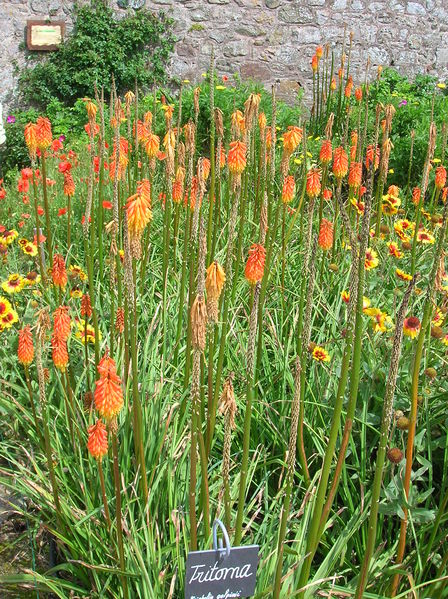
Tritoma group

A group of Kniphofia or ‘Tritoma’

Red hot pokers seem to have suffered a bad press over the years, stemming from Victorian times when one influential garden writer (Shirley Hibberd) thought they were vulgar and that their use required “a little extra care to avoid a violation of good taste”.

Cultivars range from 50cm to 2 metres in height, and the taller ones may need staking. Late-summer flowers such as Crocosmias look good with them, as do different sorts of marigolds; e.g. ‘Touch of Red’ and ‘Art Shades’ which are ideal for a showy look. Salvia uliginosa combined with yellow or coral-coloured pokers gives a more subtle effect. They mix well in the border with other tall plants such as Alliums and Echinops.  Sometimes a mixture of gaudy colours – Delphiniums, Alliums, Lilies and Knifophia – is quite attractive.
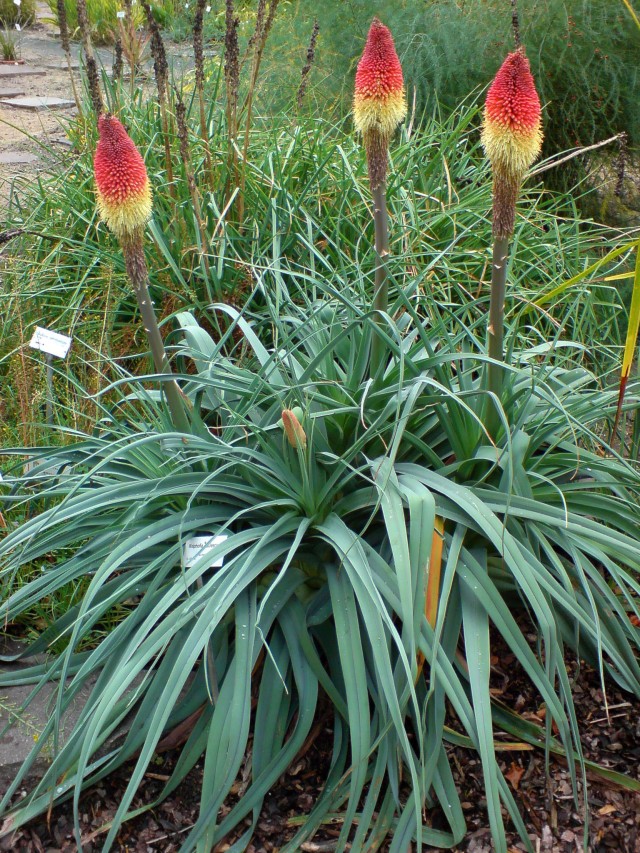
Kniphofia caulescens

Kniphofia caulescens

You can grow them from seed quite easily using ordinary seed compost – just push the seeds partially into the compost in April, water and they will be transplantable by summertime. Once mature, after a year of growth, the plant is dividable to increase stock. Do this in late September, into pots of 50% compost 50% grit. Dividing is easy enough, they pull apart quite easily and you can simply pot them up. Leave the divided plants in pots in a cool but frost-free greenhouse, and replant in May the next year. When transplanting your Kniphofia, dig a hole that is about 20cm deep by 10cm wide, and half fill with 50% compost, 50% grit mixture and then top up with compost and plant in this. Each spring give them a mulch with good rich compost. You can also give them a liquid feed in June when they start to show signs of flowering. I have some in my long borders at Old School Garden and they are just coming into flower.
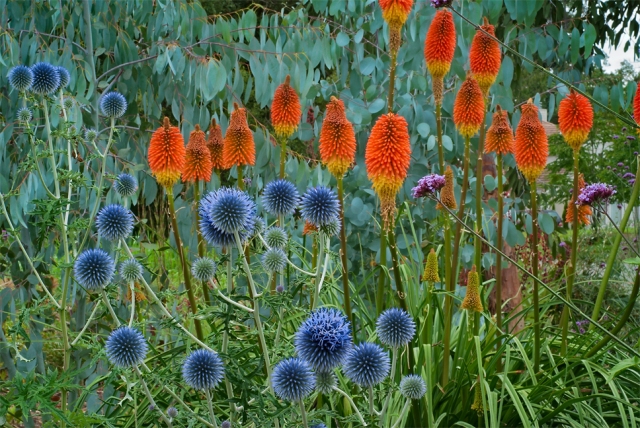
Kniphofia and Echinops. Photo- Jenny Cochran's garden

Kniphofia and Echinops. Photo- Jenny Cochran’s garden

Further information:

How to grow Kniphofias- Telegraph article

How to grow Kniphofias-Mirror article

RHS- Kniphofia ‘Bees Sunset’ and other links

RHS 2007/9 Kniphofia trials

Old School Gardener

If you’ve enjoyed reading this post and others on this blog, why not comment and join others by signing up for automatic updates via email (see side bar, above right ) or through an RSS feed (see top of page)?

hedge archwayThis week’s Gardeners’ Question Time looks at how and when to trim hedges. The question comes from Anne Elk who lives in West Devon:

‘I never seem to be able to get an even, level cut on my hedge when I give it its annual trim. How can I achieve a really neat appearance?’

Well Anne, first you need to check on whether in fact your hedge is of a variety that does just need only one clip, or whether it should have several (see below). If it’s the latter, it will be difficult with only one cut to keep it smooth and sharp as so much material will have to be removed, so you should perhaps be trimming it more frequently.

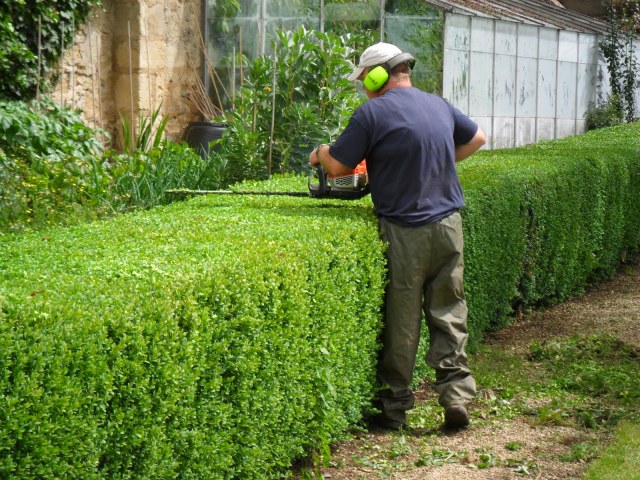
In general though, to get a sharp, level shape when cutting, stretch a string line tightly between two posts along the top, at the height you want the hedge to be, and clip exactly to this level – however, be prepared to repair any accidental cutting of the string! For the sides, put in canes vertically at intervals along the hedge, and sight along these as you cut. Alternatively some people can do this by eye and achieve a satisfactory result, especially if the hedge is fairly low.

Lowish hedges can eb trimmed by eye as long as a good original line has been established

Lowish hedges can be trimmed by eye as long as a good original line has been established

So how and when should you cut different types of hedge?

Established deciduous hedges that are moderately fast growing (e.g. Beech, Hornbeam, Hazel and Tamarisk) should be trimmed once in August – however, if they are growing particularly well, they might need two trims – one in late July the other (lighter trim) in early October.

Deciduous hedges which tend to be fast growing (e.g. Blackthorn, Myrobalan Plum, Hawthorn) will need about three clippings at about six weekly intervals during the summer- this also applies to some fast growing evergreen hedges such as Lonicera and Gorse.

Some slower growing evergeen hedges such as the various Laurels, Elaegnus and Sweet Bay require just one cut in early autumn, though faster growing evergreens such as confiers are best trimmed once in August – or possibly twice if particularly vigourous (once in July and then again in early October). For Yew, trim once a year in the summer.

For slow growing, smaller – leaved evergreen hedges such as Box, you should be cutting in early summer (June- July) and again in late summer/early autumn (including topiarised shapes).  Box hedges should be cut in overcast weather as if they are cut in the hot and dry their half cut leaves will desiccate and turn brown. For Privet (Ligustrum) you will need at least two and possibly more cuts in a season to maintain its shape.

Mazes are often created from Yew hedging - usually an annual cut will keep it looking trim

Mazes are often created from Yew hedging – usually an annual cut will keep it looking trim

If you have an informal flowering hedge, in general this should be pruned rather than generally cut over. This is best done in spring if it flowers in between mid summer and autumn and in mid summer if it flowers in the spring or early summer. In both cases take off the shoots which have flowered, thin out the growth if it is crowded and remove completely any old growth which is straggly and flowering badly.

For most hedges try to establish sloping sides with a taper inwards towards the top (known as a ‘batter’) – this encourages growth lower down the hedge which if the sides were vertical (or even worse sloping inwards towards the bottom), would result in thin growth at the base where less light reaches the leaves.

Not all hedges are meant to be level and straight- 'cloud pruned' forms such as this are more a work of art than a geometric challenge!

Not all hedges are meant to be level and straight- ‘cloud pruned’ forms such as this are more a work of art than a geometric challenge!

I hope that you find this of help, and if you have any gardening questions that you think I might help with, then please email me at nbold@btinternet.com

Old School Gardener

If you’ve enjoyed reading this post and others on this blog, why not comment and join others by signing up for automatic updates via email (see side bar, above right ) or through an RSS feed (see top of page)?

ChrysanthemumsI’ve received a question from a Nottinghamshire gardener about different kinds of cutting. Mr. R.Hood asks:

‘What is the difference between softwood and greenwood cuttings? I’ve read that chrysanthemums are propagated from greenwood.’

Well, Mr. Hood, the difference comes down to something quite smallsoftwood cuttings are taken from the first flush of new growth in spring, whereas greenwood cuttings are taken slightly later, when the wood at the base of the cutting is a little firmer – these cuttings do not root quite as quickly.  Greenwood cuttings are easier to handle than softwood, and they are less prone to wilting. Therefore, greenwood cuttings should be used to propagate plants that root readily, like Delphiniums, Pelargoniums and indeed Chrysanthemums. Chrysanthemum cuttings could not be easier and for every mother or grandmother plant, you can produce at least 10 of a new generation. For an easy guide on how look at this article.

Softwood cutting

Softwood cutting

And while we’re talking about propagating new plants from cuttings how about evergreen plants?

Cuttings from these plants are usually taken from ‘ripe or semi ripe wood’ (i.e. when stems are firmer and buds have developed) in early summer and autumn and rooted  in a cold frame. They can be anything from 50 -150cm long, depending on the size of the plant, and preferably with a ‘heel’ of older wood where the cutting stem has been pulled away from the main stem. You then strip off the lower leaves, and if there is no heel, make a wound about 13mm long at the base of the cutting. Apply a hormone rooting powder to the base of the cutting (just a light dusting) and insert the cutting to half their length in soil – you can probably put a number around the edge and in the centre of a pot. To help reduce water loss from the remaining leaf/leaves, cut these in half.

Semi ripe cutting

Semi ripe cutting

The pot should then be placed in a cold frame (you can also root the cuttings directly into the soil in a cold frame , but make sure it has been forked over and manured/composted a week or two beforehand).  Water them well and close the frame completely. Inspect and water them regularly and harden them off during the summer to prepare them for planting out the following autumn.

You can create your own 'mini cold frame' by using plastic covers or bags over pot-planted cuttings

You can create your own ‘mini cold frame’ by using plastic covers or bags over pot-planted cuttings

Another technique, if you don’t have a cold frame, is to put a plastic cover, or bag secured with an elastic band over the top of the pot – this helps to prevent the cuttings drying out, by maintaining a naturally humid atmosphere. These effectively become ‘mini cold frames’ themselves.

It seems you can grow some evergreen cuttings by placing them into a cut potato! - this one is Wisteria.

It seems you can grow shrub cuttings by placing them into a cut potato! – this one is Wisteria, see the link for further info

Further information:

Softwood and Greenwood cuttings – RHS

Semi ripe cuttings- RHS

Propagating shrubs in a potato

Old School Gardener

If you’ve enjoyed reading this post and others on this blog, why not comment and join others by signing up for automatic updates via email (see side bar, above right ) or through an RSS feed (see top of page)?

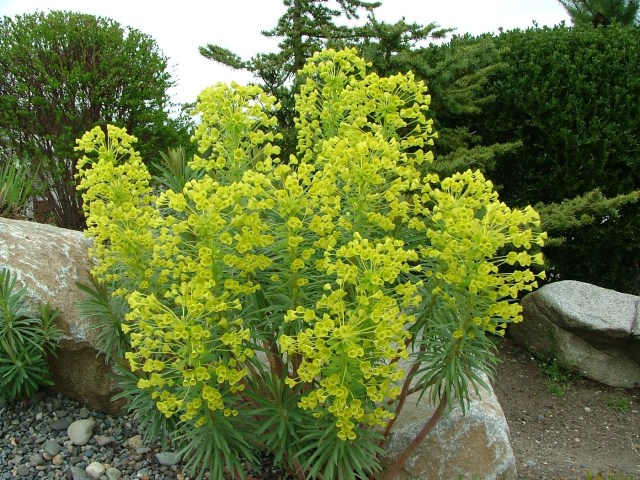
Euphorbia characias sub species 'Wulfenii'

Euphorbia characias sub species wulfenii

A bit like Marmite, gardeners  seem to either love or hate Euphorbia (Spurge) – I love them!

This is a large genus of over 2,000 species, including annuals,perennials as well as shrubs and succulents. They originate from many different parts of the world and as a result their growing requirements differ widely. They include the red-leaved species commonly seen at Christmas, Euphorbia pulcherrima (Poinsettia)

Euphorbia pulcherrima (Poinsettia)

Euphorbia pulcherrima (Poinsettia)

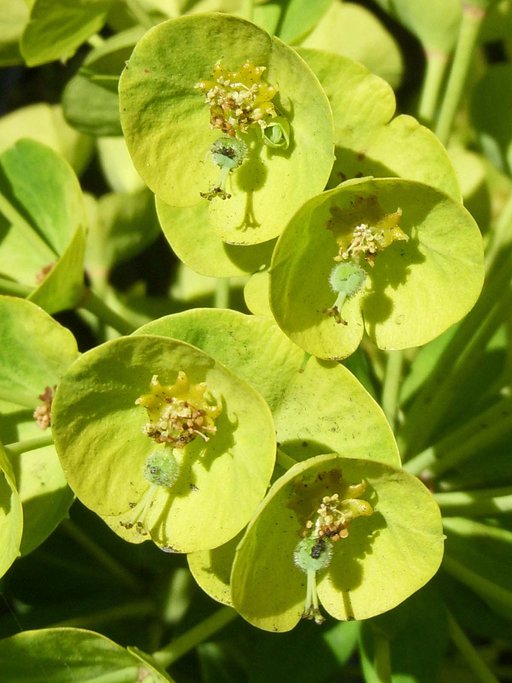
Some are evergreen and hardy, others are semi evergreen or deciduous. Nearly all species have distinctive ‘cyathia‘- small cups of long – lasting bracts that can be green, yellow, red, brown or purple. These are ‘cupping nectaries’ containing insignificant flowers with much reduced parts. In the perennials and shrubs these cyathia are carried in dense clusters. The leaves are very varied  and often are shed quite quickly.

Some species are very invasive and are not really suitable for the garden (e.g. E. cyparissias and E. pseudovirgata) others will self seed prolifically so need to be used with care (e.g. E. lathyris, E. hybernia,E.coralloides and E.wallichii). Some species can be invasive in some climates (e.g. E. myrsinites in parts of the USA) but are less problematic in milder, wetter places.

Euphorbia cyparissias (Cypress Spurge)

Euphorbia cyparissias (Cypress Spurge)

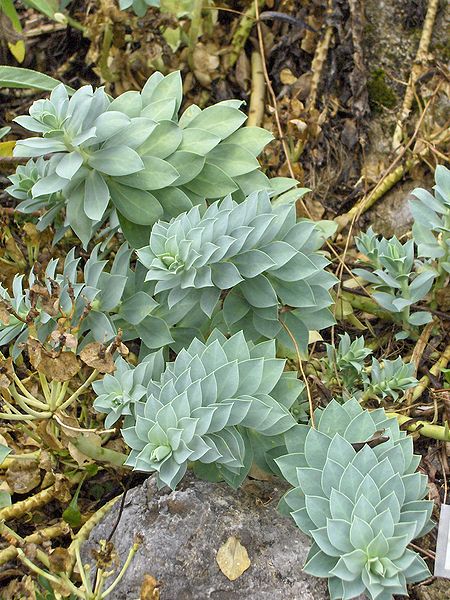
Euphorbia myrsinites

Euphorbia myrsinites

All Euphorbias resent disturbance, so siting them carefully from the start is important for long lasting plants. Euphorbia suit every situation from desert to bog, formal courtyard to wild woodland. With a couple of  exceptions Euphorbia are easy to grow. They are also look great in the garden, the colourful bracts lasting many weeks.

Euphorbia look best if allowed to sprawl at will, but if space is limited, you may need to support the floppier ones.

The evergreens require no routine pruning – simply tidy them up when they start to look untidy. Deciduous ones should be cut down to ground level in autumn. New shoots will emerge from the crown in spring. The biennial forms such as E. characias produce new shoots from the base each year. Cut out dead stems in winter. They are not fussy as to soil, but most prefer good drainage.

The bigger, more sculptural forms look good with architecture – against steps or walls, or in corners of courtyards. E. mellifera is a superb statement plant. E. myrsinites can be used in raised planters to sprawl over the sides. E. griffithii ‘Fireglow’ looks great beside water, with bronzy Rodgersias and red-flushed Astilbes, but will also look good in a hot border, while E. ‘Whistleberry Garnet’ associates well with ferns, Hostas and the dark-patterned leaves of Geranium phaeum.

All parts of Euphorbia are useful in flower arranging either in the fresh or dried state.

However all Euphorbia are poisonous and bleed a skin irritant milky sap, whereas the flowers are highly allergenic, so be careful when cutting or handling these wonderful plants.

Euphorbia polychroma

Euphorbia polychroma

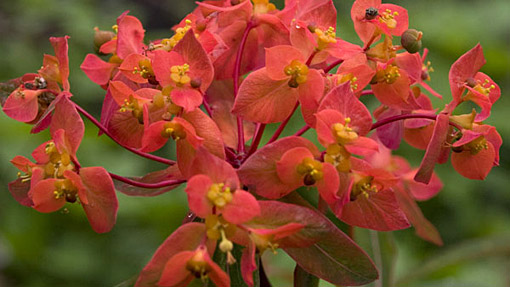
Euphorbia griffithii 'Fireglow'

Euphorbia griffithii ‘Fireglow’

Euphorbia characias sub species 'Wulfenii'

Euphorbia characias sub species wulfenii

Further information:

National Collection of hardy Euphorbias

Growing Euphorbias

Euphorbia pulcherrima (Poinsettia)

Common varieties

Wikipedia

Old School Gardener

If you’ve enjoyed reading this post and others on this blog, why not comment and join others by signing up for automatic updates via email (see side bar, above right ) or through an RSS feed (see top of page)?

Finding Nature

Nature Connectedness Research Blog by Prof. Miles Richardson

Norfolk Green Care Network

Connecting People with Nature

Discover WordPress

A daily selection of the best content published on WordPress, collected for you by humans who love to read.

Susan Rushton

Celebrating gardens, photography and a creative life

Unlocking Landscapes

Writing, photography and more by Daniel Greenwood

Alphabet Ravine

Lydia Rae Bush Poetry

TIME GENTS

Australian Pub Project, Established 2013

Vanha Talo Suomi

The Journey from Finnish Rintamamiestalo to Arboretum & Gardens

Marigolds and Gin

Because even in chaos, there’s always gin and a good story …

Bits & Tidbits

RANDOM BITS & MORE TIDBITS

Rambling in the Garden

.....and nurturing my soul

The Interpretation Game

Cultural Heritage and the Digital Economy

pbmGarden

Sense of place, purpose, rejuvenation and joy

SISSINGHURST GARDEN

Notes from the Gardeners...

Deep Green Permaculture

Connecting People to Nature, Empowering People to Live Sustainably

BloominBootiful

A girl and her garden :)