

Lonely Planet?
A few pictures from a recent visit to this beautiful Essex town.


Old School Gardener
Lonely Planet?


 Whilst visiting friends recently, we were fortunate to be given a guided tour of an historic garden and house in the course of renovation.
Copped Hall, close to Epping in Essex, is a substantial Georgian mansion which I remember visiting about 30 years ago.
At that time I can remember the house being a gutted shell, having no roof and pigs being kept in what remained of the ground floor!
There has been a grand house here since Norman times, with the current building dating from the middle of the 18th century. It has a fascinating history, culminating in the near destruction of the latest house by fire in 1917. Since then, various attempts have been made to redevelop the site, but local opposition has fought these off. The outcome was the formation of a charitable trust which raised funds to purchase the site with the aims of:
An active ‘Friends’ group supports the trust, including a small band of gardening volunteers, 2 of whom (Marion & John), kindly showed us around. The house itself has been made wind and weatherproof and some progress has been made in reinstating the interior structure. As anything portable and of value was stripped out of the buildings and grounds in the 1950’s, much of what remains are functional, structural features such as the brick piers supporting former stone steps and stairs. These tumbled down ruins are interesting in themselves, and with the still significant columns of clipped Yew give a gothic, romantic ruin feel to what was once a grand, formal, elevated approach to the house along with parterres and clipped hedges and bushes.


This space gives way to a wooded walk to the walled garden. There are some open archaelogical excavations in these grounds, adding further interest, and some more recent large scale landscaping projects in areas on the site of what was once the Tudor Manor house. Originally built in 1740, the 4 acre walled garden (one of the largest in Britain), is clothed on the approach to its outer wall with a glorious herbaceous border. Several metres deep, with excellent variation in height, this border also features large groupings of plants providing a strong structure and rhythm through their repetition, along the full 100 metres or so of its length.


 Herbaceous border at Copped Hall, Essex


The scale of the renovation task, especially here, is enormous, but the small band of volunteers is making steady progress, though could perhaps do with an overall ‘Conservation Plan’ to help to channel their efforts and encourage others along. We wish them well, and but for the distance from home, would offer to help them!
Further information:
If you’ve enjoyed reading this post and others on this blog, why not comment and join others by signing up for automatic updates via email (see side bar, above right ) or through an RSS feed (see top of page)?

The work involved the exterior pargetting, especially of two huge figures which, legend says, were the giants, Gog and Magog. Kent, however, has discovered that they were more likely to be taken from a novel by the 17th century owner and author, William Winstanley. ‘I knew they were in a parlous state but when we looked closely there were doubts they could be saved.’ New techniques and £30,000 have stabilised them – very important as the two figures are perhaps the most memorable feature of the town. Kent, who had no grants towards the work, has decided to paint them in a creamy off-white though they were probably buff coloured originally. He has also decided on three extra ‘Invitation to View’ opening days, Wednesday, June 26 at 2.30 pm; Thursday, August 1 at 11 am and Wednesday, September 4 also at 11 am. The winner of the award will be decided on May 1.’
Source: ‘Invitation to View’ Newsletter, April 2013
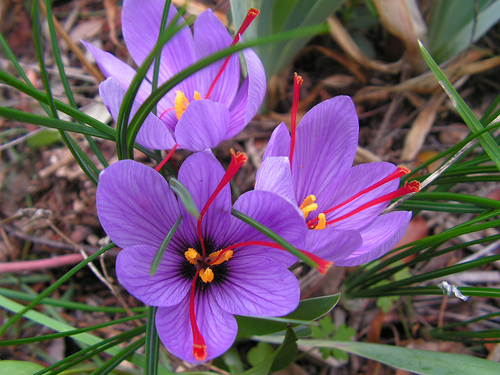
The Saffron Crocus (Crocus sativus)
We’d been here a long time ago and then only driving through so didn’t really have a chance to explore it thoroughly. Here’s a link to Wikipedia’s entry on the town if you’re interested in its history. In brief it’s of ancient standing, there having been a settlement here long before the Roman occupation of Britain 2 thousand years ago. Of particular interest is the derivation of the town’s name. In the medieval period the primary trade in Saffron Walden was in wool, but in the 16th and 17th centuries the Saffron Crocus (Crocus sativa) was grown in the area. Each saffron crocus grows to 20–30 cm and bears up to four flowers, each with three vivid crimson stigma. Together with the styles, or stalks that connect the stigmas to their host plant, the dried stigmas were used originally in medicines, as a condiment, a perfume, an aphrodisiac, and as an expensive yellow dye. This industry gave its name to the town and what used to be Chipping Walden became Saffron Walden. The town itself retains many old buildings, interesting spaces and features, as you’ll see in the gallery at the end of this article.
We began our visit in a fascinating garden – Bridge End Garden. This is actually a series of seven interlinked gardens laid out by the Gibson family (eminent bankers and brewers) in the nineteenth century. They are Grade II* listed (so protected), close to the town centre and church and are open to the public each day free of charge. Careful restoration has replicated gardening techniques and designs typical of the Victorian era and has brought the garden back to its full splendour.
Though there are signs around stating that it is ‘not a playground’ and ‘ball games are not allowed’, I can see it can be difficult to prevent its use for play by the town’s children, some of which might get a bit over exuberant at times…. While we were there I was delighted to see a group of teenage boys playing ‘It’ around the different spaces and the hedge maze was also an obvious draw for local kids. These features in an original 17th or 18th century setting must surely have been used in a similar, playful way – if not by children then by adults! The Dutch Garden with its complex parterre of box bushes also looks so like a ‘mini maze’ (in fact hedge mazes developed out of the complex parterres in France, Holland and elsewhere across Europe), so it wasn’t suprising to see another sign, perhaps rather desperately, announcing that it isn’t a maze!
The gardens are maintained by a team of paid staff (of the Town Council, which also maintains a number of other public gardens) and volunteers, and are in a very good condition. A long winding path flanked by well – kept mixed borders leads you past the formal Rose Garden with views to the parish church beyond (apparently the tallest church in Essex) to the walled garden with its fence and wall – trained fruit trees and two glasshouses with miniature orchard and citrus fruit trees, respectively, in pots that look as though they are brought outside in warmer weather.
All around are little curiosities to intrigue – statues of mock-snarling (or is it smiling) beasts, other classical statuary, some fine, mature trees such as a Cedar of Lebanon, a small summer house with a display of some curiosities from the garden (such as old gardener’s notes) and another gazebo called ‘Poets’ Corner’. The ‘Wilderness’, as it’s name suggests, was an area of more naturalistic planting (now with a developing Yew tunnel) and from the viewing platform at one end you can get a wonderful view of the Dutch Garden, with its swirling pattern of box hedging laid out to a design by Gertrude Jekyll, who visited the garden in the early 20th century.


Having seen a hedge maze, we went in search of one that is much older – and made of turf. At one edge of the town’s Common sits this wonderful example of a classical labyrinth (see my post on mazes and labyrinths for more information), of uncertain age, but several centuries at least as it was recut in the 17th century. This splendid feature is certainly a challenge to concentration and determination, being 1 kilometer long if you walk the full length of the winding brick path between the shallow turf mounding! Labyrinths are ancient features, adopted by Christianity as a way of encouraging meditation along the symbolic ‘journey of life’.
From here we passed by some of the medieval charm of central Saffron Walden, with their ‘pargetted’ walls (a technique that creates geometric patterns and pictures on the external render) and Market Square, and found a nice little Tea shop for our afternoon break. Unfortunately the west country ‘Saffron Cake’ appears not to be a local delicacy here, despite the town’s association with the spice! Instead portions of Strawberry Cheesecake and Millionaire’s Shortbread had to suffice! We finished our visit by looking round an old – estabslished Antique shop and the parish church of St. Mary- a superb example of a grand parish church built on wool – wealth (and latterly saffron – wealth). It has glorious glass, high painted wooden roof and stonework. Just as we were leaving this delightful town, the rain began to fall – great timing!


Further information:
Plantax 5: Crocus- spicy herald of Spring
Saffron Walden Town Council website
Bridge End Garden- Uttlesford District Council website
If you’ve enjoyed reading this post and others on this blog, why not comment and join others by signing up for automatic updates via email (see side bar, above right ) or through an RSS feed (see top of page)?

The garden has many aspects – formal lawns, flower beds, a brookside walk with a waterfall, a wild garden with a tangle of paths where children love to hide, a gazebo with a formal pond, an island fort to defend with a drawbridge onto it, an arboretum of young trees, and, at the end of a fascinating and memorable tour, a tearoom with mouth-watering cakes, ice creams and refreshments.
Nigel Boldero aka 'Old School Gardener'
 | Nigel Boldero on Fighting to Reduce Climate Cha… |
 | Anonymous on Fighting to Reduce Climate Cha… |
| Anonymous on PicPost: Carrot, my foot! |
| 18 Surprising Hydran… on Plantax 16: Hydrangea the wate… | |
| Nigel Boldero on Poppyland: A Victorian romance… |
| Anonymous on Poppyland: A Victorian romance… |
| Anonymous on Plants to die for… |
 | Isabella Childress on PicPost: Forest, but not as we… |
 | Happiness Factor on Is child-friendly planning a l… |
 | zidane on Top Tip: On a Pedestal- make m… |


Nature Connectedness Research Blog by Prof. Miles Richardson
Connecting People with Nature
A daily selection of the best content published on WordPress, collected for you by humans who love to read.
Celebrating gardens, photography and a creative life
Writing, photography and more by Daniel Greenwood
Lydia Rae Bush Poetry
Australian Pub Project, Established 2013
The Journey from Finnish Rintamamiestalo to Arboretum & Gardens
Because even in chaos, there’s always gin and a good story …
RANDOM BITS & MORE TIDBITS
.....and nurturing my soul
Cultural Heritage and the Digital Economy
Sense of place, purpose, rejuvenation and joy
Notes from the Gardeners...
Connecting People to Nature, Empowering People to Live Sustainably
A girl and her garden :)

 Old School Garden