
Tag Archive: drainage

With winter around the corner, this week’s question comes from Penny Rose in Hampshire:
‘I’ve moved house earlier this year and planted some fuchsias in the garden. I bought these from a local nursery and they are described as ‘hardy’. Can I leave them in the ground over winter and if so do I need to protect them in some way?’
Well, Penny, In the coldest parts of the UK you’ll have no option but to dig up your plants and put them in a conservatory or greenhouse. It’s also a good insurance policy to take cuttings (preferably in early autumn) to bring on new plants in case of a particularly severe frost or disease problems. In warmer areas you can leave plants in the ground but take steps to protect them by not cutting down the stems in Autumn, and by making some holes in the ground around each plant with a a border fork, to help water drain away- particularly important if you have heavy soil that retains water. Once this is done you should put a mulch of leaf mould, wood ashes or soil around the base of the plant to protect it further. Some Fuchsia varieties are hardier than others; the toughest are F. magellanica, F.’Riccartonii’ and F. ‘Mrs. Popple’ which can withstand temperatures down to between -5C and -15C.
So in somewhere like Hampshire, you’ll probably be OK to leave your Fuchsias outside (but take the action suggested above). For me here in Norfolk, it’s a little more difficult to be sure, so I’ll leave some outside (in a pot in a warmish courtyard) and either bring others in or mulch my sandy loam soil (forming drainage holes isn’t as important).
Old School Gardener

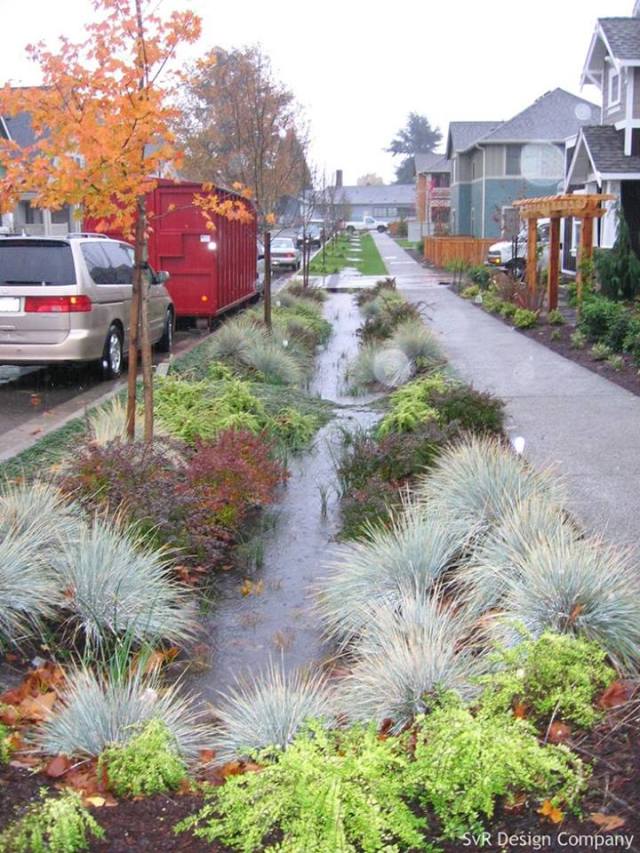
Rain Gardens
‘A rain garden is a planted depression or a hole that allows rainwater runoff from impervious urban areas, like roofs, driveways, walkways, parking lots, and compacted lawn areas, the opportunity to be absorbed. This reduces rain runoff by allowing stormwater to soak into the ground (as opposed to flowing into storm drains and surface waters which causes erosion, water pollution, flooding, and diminished groundwater). They can be designed for specific soils and climates. The purpose of a rain garden is to improve water quality in nearby bodies of water. Rain gardens can cut down on the amount of pollution reaching creeks and streams by up to 30%.’
Source: http://en.wikipedia.org/wiki/Rain_garden
Tutorial: seagrant
via Avantgardens
I thought I’d offer to (try to) answer any gardening queries you have as a regular blog feature on Old School Garden. In the comments on my recent review of the blog, several people mentioned the value of the gardening tips I include in some of my posts, so I thought I’d try out something a bit more focused and regular – a sort of ‘Gardeners’ Question Time’ (or GQT for the initiated!).
I was prompted to do this by a book I came across the other day, whilst rummaging in my local charity shop (a great place to pick up gardening books, I find). Though about 20 years old it still seems to ‘pack a punch’ so I’m going to use it to kick off the GQT series! It’s called ‘1000 Handy Gardening Hints’ and covers a wide range of topics, so hopefully it should be useful to someone out there in blogland!
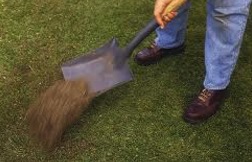 The first question, as you can see, concerns lawns and ‘top dressing’. Here’s my take on what the ‘Handy Hints’ book says, plus a few thoughts of my own:
Top dressing usually means applying a fertiliser, particularly a nitrogenous one, to the surface of soil bearing a crop, usually in concentrations of about 18 grams per square metre. In lawn management top-dressing means the application of suitable ‘bulky material’ to the surface of the lawn at the rate of 1 – 3.5 kg per square metre. The material should ideally be a made up or ready-made compost (of 6 parts medium grade, lime free sand to 1 part granulated peat or other organic material and 3 parts topsoil). This should be well worked into the lawn by means of a drag brush or ‘lute’ to make the surface smooth.
I remember my Dad (who was the Green Warden at our local Lawn Bowls Club around 50 years ago) spiking the grass surface before hand to provide some holes into which the top-dressing could be brushed (I also remember helping him to do this as an enthusiastic youngster!). Whilst this fed the grass it also helped to improve aeration and drainage. Top dressing can also help to even out dips in the surface. If you want to get the ‘Bowling Green ‘ effect, now is the ideal time to be applying top-dressing to your lawn!
Here’s a video that you might find helpful.
And you can find out how to make your lawn care more sustainable at Wild About Gardens
So that’s the first session of ‘GQT’ – what did you think?
I’ll try out a regular weekly session, so if you have any questions you’d liked answered then email me and I’ll do my best to feature your question and hopefully provide an answer!
My email address: nbold@btinternet.com, and put ‘GQT question’ in the subject line, please.
Old School Gardener
If you’ve enjoyed reading this post and others on this blog, why not comment and also join some other people and sign up for automatic updates via email (see side bar, above right ) or through an RSS feed (see top of page)?





 Old School Garden