Tag Archive: devon


IMG_8467

On our recent trip to Devon we visited a few National Trust houses and gardens. We’d been to Saltram, near Plymouth, before, but not in the spring. It was a beautiful sunny day and the photos below show the house and gardens at their best, with deep, sharp shadows adding to the atmosphere.

‘Saltram overlooks the River Plym and is set in a rolling landscape park that provides precious green space on the outskirts of Plymouth. Strolling along the riverside or through the woodland, you can almost forget that the city lies so close. Saltram was home to the Parker family from 1743, when an earlier mansion was remodelled to reflect the family’s increasingly prominent position. It’s magnificently decorated, with original contents including Chinese wallpapers and an exceptional collection of paintings (several by Sir Joshua Reynolds). It also has a superb country house library and Robert Adam’s Neo-classical Saloon…The garden is mostly 19th century, with a working 18th-century orangery and follies, beautiful shrubberies and imposing specimen trees providing year-round interest.’

 Further information: National Trust website

Old School Gardener

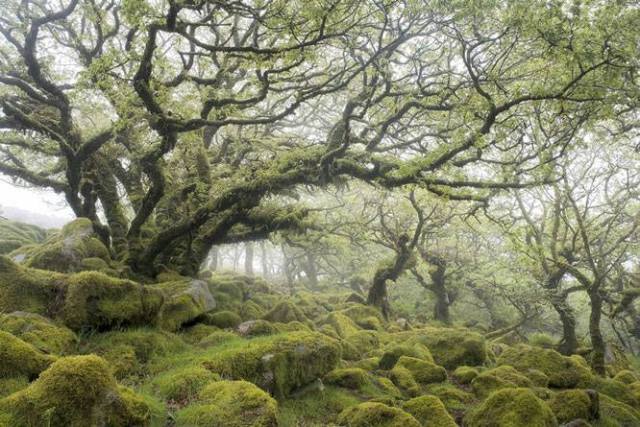
My wife and I spent a few days in Devon recently, visiting my Mother – in – Law. We had superb weather – unusual on the edge of Dartmoor – so were able to get out and about to see some beautiful places. I’ll feature a few of the great gardens we saw over the next few weeks, but almost our first outing was to a famous Dartmoor nature reserve and ancient copse, called ‘Wistman’s Wood’. Some of the trees are at least 400 years old – gnarled and almost dwarf oaks – and I managed to get some photographs to capture our afternoon visit in the sun. It’s such a mysterious and peaceful place I was moved (not been that for a while) to try my hand at some ‘poetry’ to accompany the pictures, so here goes….

‘In Wistman’s Wood

In Wistman’s Wood
A tumbled dwarf in valley ‘scape,
Rising with a greying ghostly hue.
Ancient Oaks clinging to life, entombed in rocks.
All engulfed in mossy fernery and silver beards,
Branch and trunk home to more lowly life,
In Wistman’s Wood.

In Wistman’s Wood
Strong sun casts a net of shade
Not yet filled by new young leaves.
And what of night or winter time?
Moonlight, mist and chattering cold-
Apt setting for moorland fairy tales,
In Wistman’s Wood.

In Wistman’s Wood
Sounds gentle on a spring day;
Rushing of the young Dart and
Bathed by the soft breeze,
Cut with children’s shout and ‘copter whirr.
Lone sheep a munching on meagre growth,
In Wistman’s Wood.

In Wistman’s Wood
Hear still and little life;
See nature stretched;
Smell moorland peaty damp;
Touch stone and twisted, mossy wood.
Taste sweet water
In Wistman’s Wood’

And here is a series of photos just in case that was all a bit too vague…


This slideshow requires JavaScript.

Old School Gardener

Ancient Woodland

Wistman’s Wood – Dartmoor, Devon, England; via Nature is Awesome

Old School Gardener

IMG_6950

Our last, late summer visit to a west country garden, Killerton, did not disappoint. We enjoyed a very informative tour in a golf buggy and strolled around the grounds on a sunny afternoon. Lying just outside Exeter, Killerton is a massive estate and we had a little trouble actually finding the entrance (road signs and sat nav conspired against us!). Nevertheless we had a warm welcome.

Killerton is notable as the ‘home given away’. It’s last private owner,  Sir Richard Acland did just this with the whole estate of over 2,500 hectares (including 20 farms and 200-plus cottages), one of the largest acquired by the National Trust. Acland held a strong belief in the common ownership of land and was a founder member of the British Common Wealth Party, formed in 1942 to oppose the wartime coalition and to advocate a co-operative form of socialism, in contrast to the state-led approach of the Labour Party. However, the group never achieved an electoral break through and Acland joined the Labour Party in 1945. He was also one of the founders of the Campaign for Nuclear Disarmament (CND).

The original gardens at Killerton were designed in the late 18th century by John Veitch, one of the leading landscape designers of the time. It features rhododendrons, magnolias, herbaceous borders and rare trees surrounded by rolling Devon countryside. Many of the trees and the views of the surrounding countryside are very impressive – here are some pictures.

The grounds also house – typically for the 19th century – an Ice House and a curious Summer House which is of a rather gothic design and features a strange assortment of decorative materials – including animal bones, hides and fir cones! Here’s a second set of pictures.

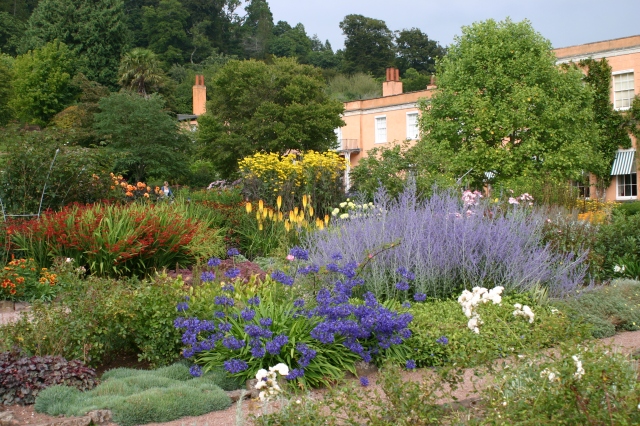
However, the ‘parterres’ or mixed herbaceous borders, full of late summer colour when we visited, stand out as my most significant memory of Killerton. These were designed by the late 19th century gardener, garden writer and designer William Robinson. They have some classic plant combinations and bold drifts, typical of the mixed herbaceous borders coming into vogue around this time, and which have been influential in English garden design up to the present day. This area features a central path and secondary paths with Coade stone urns as focal points. The layout of the borders is perhaps curious given Robinson’s advocacy of  ‘wild gardens’ – a more naturalistic approach to garden design. But even these semi formal designs, with their ‘loose planting’, were seen as revolutionary.  Apparently, Killerton’s head gardener at the time said:

‘it of course spoilt the park, starting as it does and ending nowhere, I got into bad odour condemning it’.

Robinson’s ideas about ‘wild gardening’ spurred the movement that evolved into the English cottage garden, a parallel to the search for honest simplicity and vernacular style of the British Arts and Crafts movement. Robinson is credited as an early practitioner of the mixed herbaceous border of hardy perennial plants, a ‘naturalistic’ look in stark contrast to the high Victorian ‘pattern garden’ of planted-out bedding schemes. Here is a gallery that, hopefully captures the best of these glorious borders.

Further information:

National Trust website

William Robinson- Wikipedia

Old School Gardener

IMG_6926

I’m back from two weeks away in Devon and Cornwall and I definitely visited more gardens in that time than ever before! I’ll do articles with photos on each of these over the coming weeks, but I thought I’d ease my way back into the blogosphere with a little feature on the town of Moretonhampstead, Devon.

Located in the middle of Dartmoor, this lovely little town is a convenient stopping off point for those negotiating the narrow, winding lanes and open vistas of the Moor, and that’s just what we did on our way to visit Killerton Gardens, near Exeter.

It was a glorious sunny day and the drive over the moor from Tavistock was breathtaking. As we approached Moretonhampstead I was struck by the beautiful display of hanging baskets outside one of the pubs and then realised there were a lot more colourful floral displays around the town, so took out a few minutes to capture them. I must say the town residents, shopkeepers, local council, hoteliers etc. all seem to put an effort into beautifying the place, so congratulations to them for what was a very enjoyable mooch around, snapping as I went.

This is definitely the place to ‘hang out’ if you’re travelling the Moor and there were plenty of cyclists, motorcyclists and other tourers taking a breather here when we visited.

This slideshow requires JavaScript.

Old School Gardener

The afternoon sun in late winter falls across one of the gardens at Buckland Abbey

The afternoon sun in late winter falls across the Elisabethan Garden at Buckland Abbey

‘700-year-old home of Elizabethan seafarers Drake and Grenville

In the 13th century, Buckland Abbey was home to the Cistercian monks who built the abbey and the incredible Great Barn and farmed the then vast estate.

The Abbey, now a house with a combination of furnished rooms and interactive museum galleries, tells the story of how two seafaring adventurers – Sir Richard Grenville and Sir Francis Drake – changed the shape of the house and the fate of the country….

Our Abbey garden is mainly a 1950s design. The main border includes hydrangeas, camellias, eucryphias, azaleas, rhododendrons and our two magnificent magnolia trees: a delavayi species and a grandiflora.

The monks cultivated the walled kitchen garden behind our Cider House and it’s still as prolific as ever. Meander through the espaliered fruit trees and vegetables and admire the Abbey towering above.

Our beloved herb garden next to the Great Barn has had a tough time. It was once home to 50 different culinary and medicinal herbs but box blight wiped it out. We’re currently refurbishing it.

In 2001 we purchased the Cider House, which was turned into a private residence in the 1940s. This acquisition has brought the monastic estate back together and has allowed us to invite the public to visit the beautiful gardens, passionately created by former owners Michael and Sarah Stone. It includes mixed planted borders, roses and a large amount of trees and shrubs

We created our Elizabethan garden in 2001. It shows you what the garden may have been like when Sir Richard Grenville and Sir Francis Drake lived in the Abbey. There’s a wild flowery mead, cultivated hedges, changing flower displays and even a hidden garden just perfect for contemplating your next voyage, just like Drake.’

Source and further information:

The gardens at Buckland Abbey, Devon – National Trust web site

Old School Gardener

PicPost: Great Garden @ The Garden House

‘The Garden House is the elegant former home of the vicars of Buckland Monachorum..(near Tavistock, Devon)…

The present building dates from the early 19th century and now accommodates the tearooms and conference centre. The history of this 8-acre garden is closely entwined with that of Buckland Abbey and the local church. In 1305 the Bishop instructed the Abbot to build a house for the parish priest and this site was chosen. At the dissolution of the monasteries, the abbot became the vicar of Buckland Monachorum and by the early 1700s, the vicarage consisted of a substantial 3-storey dwelling. The remains of this building, a tower with spiral staircase and a thatched barn, formerly the kitchen, are now the romantic ruins in the Walled Garden.

A modern vicarage was built in the 1920s and The Garden House was sold as a private dwelling. The house came onto the market again just after the Second World War and was purchased and given its present name by Lionel Fortescue, a retiring master at Eton, and his wife Katharine. Lionel was the son of a Newlyn school painter and had a good eye for colour as well as being an exacting plantsman. Lionel and Katharine immediately set about renovating and developing their garden whilst running a thriving market garden business, providing stock plants for growers in the Tamar Valley, and managing a herd of Jersey dairy cattle.

Over nearly 40 years, the Fortescues created a garden viewed as one of the finest in Britain. By 1961, they had established the Fortescue Garden Trust, an independent registered charity to which they bequeathed the house and garden to ensure the survival of this beautiful place for future generations. After their deaths in the early 1980s, ownership passed to the charity which to this day maintains the Fortescue’s lovely legacy.

The second phase of development took place under Keith Wiley who was appointed by Lionel and spent 25 years as Head Gardener. Keith took the 6 acres of paddocks to the far side of the road into cultivation from 1990, creating a series of gardens that take their inspiration from the natural world. Keith left in 2003 to concentrate on writing and creating his own nursery, Wildside Plants.

Matt Bishop is the present Head Gardener and he is particularly well-known for his expertise on snowdrops and bulbs. Matt’s brief is to care for and respect the legacies of his predecessors whilst ensuring, just as they did, that The Garden House remains a crucible of new ideas and new plants, at the cutting edge of horticultural excellence and innovation. He has undertaken a major refurbishment of the original Fortescue garden as well as ongoing maintenance in other areas to ensure a long opening season of glorious colour and variety. This has been an excellent opportunity to introduce many new plants whilst continuing Lionel’s principle of using only the best forms and cultivars avaialble.

Matt has two horticultural students under training here and a small team of dedicated staff and volunteers who care for the garden.’

Source: The Garden House website

Old School Gardener

Finding Nature

Nature Connectedness Research Blog by Prof. Miles Richardson

Norfolk Green Care Network

Connecting People with Nature

Discover WordPress

A daily selection of the best content published on WordPress, collected for you by humans who love to read.

Susan Rushton

Celebrating gardens, photography and a creative life

Unlocking Landscapes

Writing, photography and more by Daniel Greenwood

Alphabet Ravine

Lydia Rae Bush Poetry

TIME GENTS

Australian Pub Project, Established 2013

Vanha Talo Suomi

The Journey from Finnish Rintamamiestalo to Arboretum & Gardens

Marigolds and Gin

Because even in chaos, there’s always gin and a good story …

Bits & Tidbits

RANDOM BITS & MORE TIDBITS

Rambling in the Garden

.....and nurturing my soul

The Interpretation Game

Cultural Heritage and the Digital Economy

pbmGarden

Sense of place, purpose, rejuvenation and joy

SISSINGHURST GARDEN

Notes from the Gardeners...

Deep Green Permaculture

Connecting People to Nature, Empowering People to Live Sustainably

BloominBootiful

A girl and her garden :)