Our final walk. We returned to an old favourite, Pew Tor, just a short drive from Tavistock. It has a wonderful rock formation, remiding me of a dog’s head (see the picture above). It’s an old favourite because this walk has become bit of an institution in our family. We have done it many times with our children at various times in the past. Perhaps the most memorable occasion was when our, then young, son raced back down the slope with the call ‘running down the mountain, with some shouting!’
This slideshow requires JavaScript.
The walk today, another sunny afternoon, was easy. On previous occasions it has been a bit of a puff, but I guess our training on the previous five days was enough to make it a breeze. But this time something else was different. On previous occasions I’d looked around at the views and not known many, if any of the other tors and land in view.
But today, this felt like my space– I don’t know if it was the euphoria of having walked 20 tors in six days, or more the fact that I could look around, name the tors we could see, and more significantly, say we went there on…..
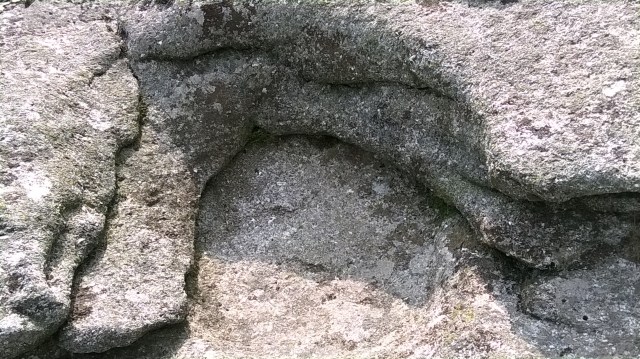
Water action has created a pool in one of the Tor’s top stones
We’ll be back- maybe for another 20 of the 160 plus tors, so that we can gradually come to know this wonderful moor even better.
Day five on our Tor Challenge involved heading out towards Princetown once more. Our start point was a small car park near to one of the tors we would be visiting and which is also home to a tall TV mast- north Hessary. A little cloudier than previous days but still dry and warm, so it looked like it was going to be a pleasant afternoon walk. and what’s more, we were aiming to cover 6 tors, which would bring us within reach of a total of 20 for the week.
As we set off we noticed an elderly couple just heading off in the same direction as us – towards Hollow Tor, and from here to the fairly indistinct Rundlestone Tor.
Hollow Tor
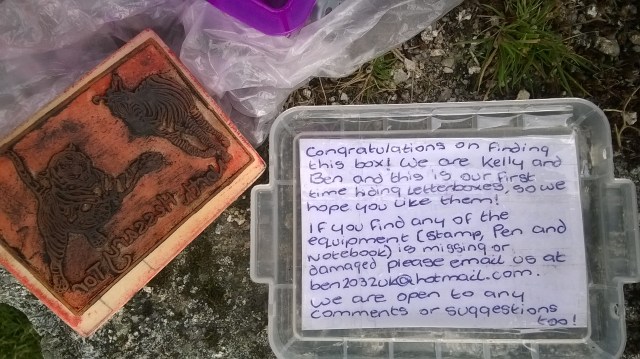
From there it was short walk long a road to the TV station and tor at north Hessary, the mast of which you can see for miles around, but which despite many years visiting the area I had never got close to. The mast is an impressive, albeit man- made intrusion in the landscape. The tor itself is rather tangled with the mast and surrounding walls and fencing, but is nevertheless and distinctive shape. I also found a small plastic box containing a stamp and notebook (see picture at the head of this article), an effort by a couple of local youngsters to place a ‘post box’ for visitors to leave a message and read those put by earlier visitors. It was a modern-day example of the Dartmoor Post Boxes, I suppose an earlier form of ‘Geocaching’:
‘A small pot (the letterbox) containing a stamp and visitors’ book is hidden on the moor, and a clue is written to lead others to its position. Clues may be as simple as a map reference and list of compass bearings, or may be more cryptic.
When a letterbox is found, the letterboxer takes a copy of the stamp, as well as leaving their own personal print in the visitors’ book.
Letterboxing began on Dartmoor but is now popular in areas all over the world.’ (source: Dartmoor letterboxing.org)
North Hessary Tor
Travellers from Muenster, Germany logged into the ‘post box’ on north Hessary
Taking a bearing to our next tor, ‘Foggintor’, we set off, but a little wary, because we had a walk guide which suggested that Foggintor was in fact an old quarry and one which you come across suddenly – beware 100 foot drops! We trudged down and then up bracken-strewn valley sides, heading for a group of rocks on the horizon which the bearing suggested was our target. We reached the edge of what looked like an old quarry but somehow the map and what we saw weren’t the same; where were we?
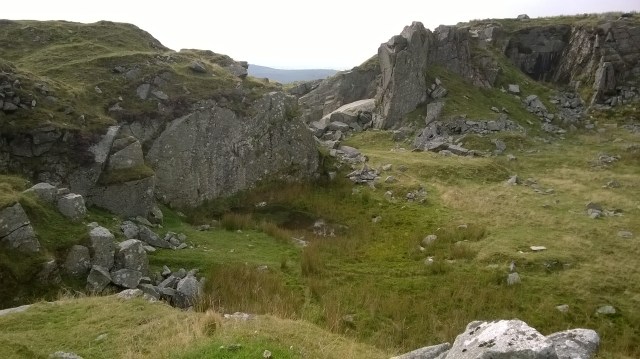
We pressed on thinking the rocks in front were what we were looking for and then looked back – in the distance and to the left of the route we’d taken, was an obvious old quarry with some apparently deep sides. We’d obviously not been accurate in our bearings and missed the quarry (I was sort of relieved, given the look of it). This is a ‘tor no more’, as the quarrying seems to have removed all evidence of the sort of rocks or peak that we’d come to expect.
Foggintor- quarry has removed what was there?
So, we were actually standing next to our fourth tor target of the walk, Swelltor, also an old quarry, but with a more discernible peak and tor like appearance.
Swelltor- more quarrying
From here it was a simple, fairly level walk across moor to our final target of the day, King’s Tor, which had some remarkable rock piles- see the pictures below.
This slideshow requires JavaScript.
The views from King’s Tor were also good, though a mist lay over the horizon so we couldn’t see as far as had been possible earlier in the week. We looked across the valley to Yellowmeade Farm, which gave us our target for the return walk to the car. This looked to be straight, fairly short walk, but the map and walk guide advised that it would be marshy ground, so wer were prepared for wet feet! But apart from a few soggy areas, the lack of any heavy rain for a week seemed to dry out the peaty conditions underfoot, so it was more a case of hopping form grassy clump to grassy clump than wading through water!
So that was it, we got back to the car only to arrive at the exact moment the elderly coupe we’d seen early did too! They were over for the weekend from Somerset and were looking for letterboxes and had apparently found quite a few.
The day had brought 6 more tors (well nearly if you count our skirting of the tor no more) and we looked forwards to our last day, when we would climb an old favourite and bring our tally up to 20 tors.
This was the big one. Day three of our Tor Challenge was billed as an all dayer, packed lunch required. Travelling to the northern edge of Dartmoor at Meldon, near Okehampton, we headed for the reservoir, a beautiful site in itself and the starting point for our day’s walk.
Meldon Reservoir
The Dam
Longstone Hill
It was a long trudge around Longstone Hill and then across valleys and into the (today quiet) firing range, towards Black Down. From here we followed increasingly rugged and harder-to- see paths to the foot of West Mill Tor. A short, steep ascent was rewarded with a tremendous view on another beautifully sunny day. From here we could see our ultimate objectives- High Willhays (the highest point in Devon and southern England) and Yes Tor, slightly lower. It was also from here that we made our first spotting of…….a nude walker! At least that’s what it looked like as a well-tanned male torso was seen stepping out boldly towards the slopes of Yes Tor. Having got over the ‘shock’ of this sight we made our way down to a wide, well trodden path that would take us up to the ridge between the two tors we were left with.
This slideshow requires JavaScript.
This was steady walking, remembering to pick up a stone or two en route to add to the cairn atop High Willhays. It was here that we saw our nude friend once more, striding out but also rather aimlessly- was he looking for someone to show off to? (we didn’t get close enough to see if he had reason to show off…). Or was he following us? He seemed to be close to our route across to Yes Tor and even waved at me and said ‘Hi’ just after I snapped a picture to prove our point….
Adding a stone to the cairn at High Willhays
The Triangulation point on Yes Tor
View back to West Mill Tor from Yes Tor
Back to Nature- 1
Back to Nature- 2….
After a packed lunch atop Yes Tor, admiring the distant views and chatting to fellow walkers, we saw some low clouds forming to the south and so decided to pick our way back to Black Down the quick route down the slopes, but also a rather wetter one through boggy ground. So, that’s nine Tors done, how many more could we add?
The view in the morning – looking towards Tavistock from the car park near Merrivale
Having seen off the rain and mist on the first day of our ‘Tor Challenge’, we started day two with bright sunshine- you could see across the moor for miles. Today’s plan was to do two walks with a break for lunch at a well-known pub (the ‘Dartmoor Inn’ at Merrivale). The morning began with a couple of hours walk close to where we were on day one, but the contrast in weather couldn’t have been starker.
Having parked up at the pub we set off following the road back towards Tavistock and then headed inland (having taken a bearing first) ascending and crossing the rounded crest of Barn hill to the first of the targets, Feather Tor, an unassuming tor from it’s approach, but with some interesting rock formations (and a rare Dartmoor tree!).
Stone cross on Grimstone and Storridge Leat, which we crossed to ascend Heckwood Tor
Feather Tor
Heckwood Tor from Feather Tor- it looked a steep climb
From here it was a short, but steep walk up to a much more expansive tor, Heckwood. It affords a view that is truly breathtaking and I think this, on reflection, was one of my favourite tors on our challenge. The walk back to the pub involved finding a stream and following this past Vixen tor (which is a striking formation, but unfortunately not accessible to the public), and involved some boggy ground, but nothing too uncomfortable despite the previous day’s rain.
This slideshow requires JavaScript.
Lunch was a perfect combination of ‘Pannini and Pint’, after which we drove to our afternoon walk- north of Tavisotck, near Lydford this time and involving one tor I’d walked a good few years back, Brat Tor with the famous stone Widgery Cross at its summit. This was quite a climb, but again, a combination of walking poles, good boots and light clothing made it only partly puffing!
The cross was erected to commemorate the Golden Jubilee of Queen Victoria in 1887.It measures 12 feet 8 inches (3.86 metres) tall and 4 feet 4 inches (1.32 metres) across the arms. The shaft is 2 feet 1 inch (0.64 metres) square and is made of 10 layers of roughly cut granite blocks, topped off with a pointed rock. The blocks are of differing sizes, which interlock with each other to make the structure more secure. It was erected at the expense of William Widgery, the well-known local artist, and bears the inscription:‘W. Widgery, Fecit, Jubilee, V.R.’
This slideshow requires JavaScript.
From here we walked across a valley to Arms Tor (not sure if it’s called that because it has two distinctive blocks that look like arms?), which stands about 6 metres higher than Brat Tor at 457 metres.
Arms Tor…
Left Arm…
and Rght Arm?
View back to Brat Tor from Arms Tor
From here, in the warm afternoon sunshine, we made our way back to the bridge and stepping stones over the River Lyd where I recorded a short video to capture the magical sound of the rippling water…..
The end of a marvellous second day and meanign we had already completed 6 tors in our Tor Challenge! Day three was to prove a bit of an eye opener in several ways…..
We’re just back from a week in Dartmoor, Devon, walking between some of the well-known, usually prominent rocky features of this beautiful landscape, known as tors.
The Challenge
The tors (there are over 160 of them) are the focus of an annual event known as the Ten Tors Challenge, when around 2400 people aged between 14 and 19 (in over four hundred teams of six), face hikes of 35, 45 or 55 miles (56, 72 or 88km) visiting ten nominated tors over two days. The teams must be self-sufficient, carrying all that they need to complete their route safely despite the terrain and the weather. The latter can be very changeable and at times quite extreme, and success or failure can depend very much on the extent to which a team has been trained for all eventualities.
Not having completed this in her youth, my partner ( a local lass), was keen to do her own ‘Ten Tors Challenge’, but at a more leisurely pace. In the event, extremely good weather meant that we were able to visit double the target number of tors spread over six days, and including excellent overnight accommodation at my mother – in – law’s house in Tavistock! Over a series of posts in the next few days, I hope to give an interesting account of our adventures along with a few pictures. For starters here’s a ‘primer’ on Dartmoor and the tors in question….
The Moor
Covering an area of 954 sq km (368 sq miles), Dartmoor contains the largest and wildest area of open country in the south of England. By virtue of its outstanding natural beauty it is one of the National Parks of England and Wales. Unlike many National Parks in other countries, for example the USA, the National Parks in England, Wales and Scotland are not owned by the state. The term ‘National’ means that they have been identified as being of importance to our national heritage and as such are worthy of special protection and attention. Within each National Park there are many landowners, including public bodies and private individuals. National Parks are places where people live and work.
Geology
A large part of Dartmoor (65%) is made up of granite, an igneous rock which was intruded some 295 million years ago. This great granite core is surrounded by sedimentary rocks including limestones, shales and sandstones belonging to the Carboniferous and Devonian periods. Those nearest the granite intrusion were altered (metamorphosed) by intense heat and pressure and chemical reactions.
Tors
Dartmoor is known for its tors – hills topped with outcrops of bedrock, which in granite country such as this are usually rounded boulder-like formations. More than 160 of the hills of Dartmoor have the word tor in their name but quite a number do not. However this does not appear to relate to whether or not there is an outcrop of rock on their summit.
The processes resulting in the formation of the Dartmoor tors started about 280 million years ago as the granite forming Dartmoor cooled and solidified from molten rock at a temperature of 900 – 1000˚C. The minerals which make up granite crystallised as closely interlocking grains forming the hard rock. Granite is formed of three main minerals: Quartz – appearing in the granite as translucent slightly greyish looking grains; Feldspar – white grains, sometimes stained yellowish or pink (in parts of the granite feldspar forms large white crystals); and Biotite – dark brown glistening flakes.
Varying climatic conditions occurring over millions of years, along with the cooling of the molten and other materials were the first, mainly chemical factors in the formation of the tors. Most recently, cold conditions in the Ice Age (between 2 million to 10,000 years ago), have caused major mechanical forces to shape the landscape we see today. Of these the most important is the expansion of freezing water. The deeply weathered granite was forced apart and broken up into blocks by being subjected to frequent freezing and thawing during the cold periods of the Ice Age, and gravity was also important, moving the loose material downhill.
The principal tors are:
Tor
Height above sea level
High Willhays
621m (2,039ft)
Yes Tor
619m (2,030ft)
Great Links Tor
586m (1,924ft)
Fur Tor
572m (1,876ft)
Great Mis Tor
539m (1,768ft)
Great Staple Tor
455m (1,493ft)
Haytor
454m (1,490ft)
Hound Tor
448m (1,469ft)
Sharpitor
402m (1,320ft)
Sheeps Tor
320m (1,050ft)
Vixen Tor
320m (1,050ft)
Well that’s the basics….except you might be interested in a TV programme that is showing this evening (Tuesday 9th September) on ITV 1 (7.30pm). The first in a new series of ‘Wilderness Walks’ by bushcraft expert Ray Mears focuses on Dartmoor. I’ll certainly be watching….
…so now for an article on the first stage of our trip – and it’s a mysterious beginning to our adventure that awaits…..(I’ll explain more about the nudist along the way too).
Another trip out whilst in Devon recently, involved a rather tortuous journey (and the need to pre book parking) at the former home of Agatha Christie, Greenway, near Brixham. We were a little limited in what we could see of the gardens, and we didn’t get to some of the feature areas like the walled garden and rhododendrons. Another day perhaps….What we did see was a fascinating house (and contents too) and some beautiful riverside sloping gardens full of interesting plants, typical of so many ‘sub tropical’ gardens along this south west coastline.
‘…The beloved holiday home of the famous and much-loved author Agatha Christie and her family. This relaxed and atmospheric house is set in the 1950s, when Agatha and her family would spend summers and Christmases here with friends, relaxing by the river, playing croquet and clock golf, and reading her latest mystery to their guests. The family were great collectors, and the house is filled with archaeology, Tunbridgeware, silver, botanical china and books.
In the garden don’t miss the large and romantic woodland which drifts down the hillside towards the sparkling Dart estuary. The walled gardens are home to the restored peach house and vinery, as well as an allotment cared for by local school children. A visit to Greenway isn’t complete without seeing the Boathouse, scene of the crime in Dead Man’s Folly, and the battery complete with cannon….’






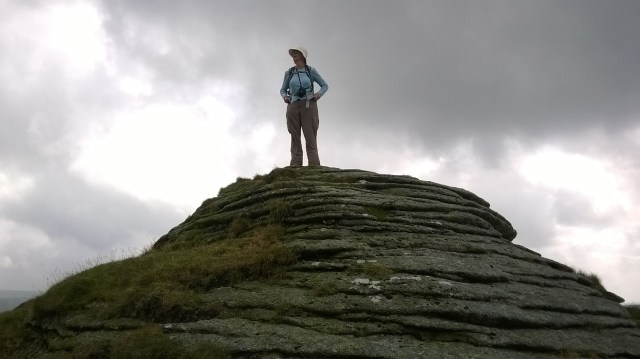


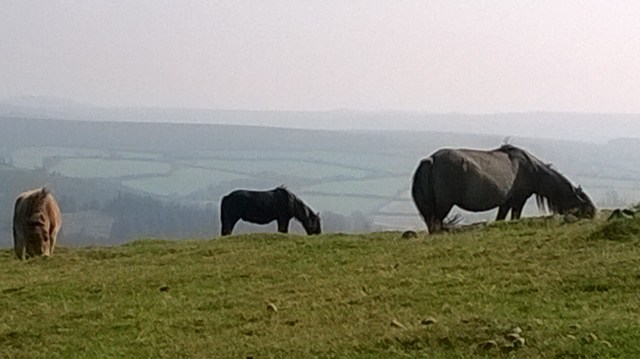


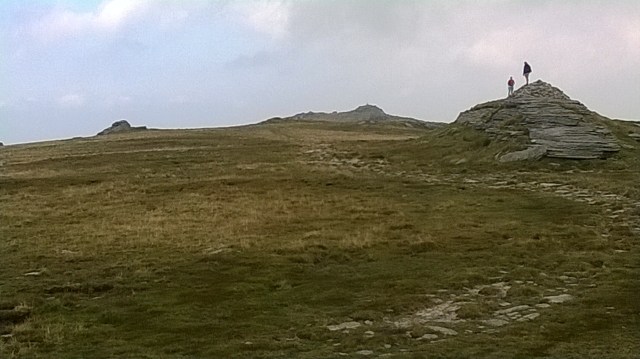 We’re just back from a week in Dartmoor, Devon, walking between some of the well-known, usually prominent rocky features of this beautiful landscape, known as tors.
 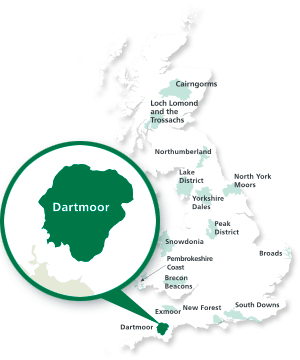 The Moor
 Varying climatic conditions occurring over millions of years, along with the cooling of the molten and other materials were the first, mainly chemical factors in the formation of the tors. Most recently, cold conditions in the Ice Age (between 2 million to 10,000 years ago), have caused major mechanical forces to shape the landscape we see today. Of these the most important is the expansion of freezing water. The deeply weathered granite was forced apart and broken up into blocks by being subjected to frequent freezing and thawing during the cold periods of the Ice Age, and gravity was also important, moving the loose material downhill.
 Another trip out whilst in Devon recently, involved a rather tortuous journey (and the need to pre book parking) at the former home of Agatha Christie, Greenway, near Brixham. We were a little limited in what we could see of the gardens, and we didn’t get to some of the feature areas like the walled garden and rhododendrons. Another day perhaps….What we did see was a fascinating house (and contents too) and some beautiful riverside sloping gardens full of interesting plants, typical of so many ‘sub tropical’ gardens along this south west coastline.






 Old School Garden