Tag Archive: dartmoor


What a pile- some amazing granite on Great Mis tor

What a pile- some amazing granite on Great Mis tor

So, the first day of our recent ‘Tor Challenge’  began. It wasn’t promising- showers and low cloud hung over Tavistock for most of the morning and into early afternoon. But, as forecast, it lifted and was dry enough to venture out by about 4pm.

My wife had spent a lot of time researching our various walks and calculating distances, heights, grid references and bearings. we were well equipped with some new waterproofs, boots, walking pole and downloaded app for my phone (which gives a grid reference for your position and, if needed, a marker on a base map). We had looked into buying a GPS device for walking, but on balance, we felt this wouldn’t be necessary for the lengths and routes we’d gone for and with my new phone app (alongside other useful apps).

We’re not the sort of people to accept new things without question, and when it comes to clothing we’re definitely favour ‘natural’ materials over man made. However, I couldn’t resist buying a synthetic ‘base layer’ shirt in a sale we’d seen a week or two before and today was it’s first outing , under my new ‘waterproof and breathable’ jacket. I was im pressed with both, as you’ll see.

Any way, we set out for what promised to be a short walk to twowell-known tors – Great and Little Mis tors, lying just to the north-east of Princetown (of Dartmoor Prison fame) and within the Merrivale firing range (we’d checked and no firing was planned). According to Philip Henry Gosse (in his book ‘Land and Sea’, 1865), the name ‘Mis’ may derive from the tors’ druidical connections, being named after Misor the British moon goddess!

The way up- and the cloud/mist descends....

The way up- and the cloud/mist descends….

The ascent was long and reasonably steep from the car park (170 metres in fact to the summit of Great Mis tor, which is 538 metres above sea level). As we ascended we saw the low cloud covering the top of the climb and were prepared for our first taste of ‘blind walking’. We needn’t have worried. a well- worn path took us most of the way to Little Mis tor, and after a quick check on my new phone app, we knew we must have been just a few steps away from  Little Mis Tor- which we couldn’t see for all the cloud/mist. sure enough stepping out in what we thought to be the right direction, it suddenly loomed up before us- I thought it was a tree at first but it’s rocky outline was soon clear.

From here, once climbing the short route to its summit, it was short walk across open ground (following the pre-plotted bearing) to the tor’s bigger brother (or sister), Great Mis tor. this has been called ‘one of the grandest hills in Devon’ and is one of the largest tors in the southern moor, but today our view to it and form it was a complete fog, so we’ll have to return another day to appreciate the glorious view.

Great Mis Tor- the fortress looms up...

Great Mis Tor- the fortress looms up…

As we approached the tor (or so we thought) two walkers emerged from the mist walking towards us and we confirmed that we were on the right track. And a few steps further on there it was, certainly a more impressive ‘pile’ than its little sibling, and standing rather like some medieval fortress awaiting an attack- especially with its flagpole which is used to indicate if the firing raneg is beign used. We scaled it without a problem and peered around the immediate area as far as the mist would allow- not very far at all. Having climbed our first two tors, there wasn’t much else to do, so we returned.

Following my fortress analogy, coming down a different route still, at first, covered in mist and so focused on our immediate terrain (a large area of fallen granite boulders), felt rather like stepping on and over the bodies of fallen warriors, whose attack on the citadel above had obviously failed. It was eerily quiet and still with no hint of a breeze, and the clammy wetness stuck to our faces and clothes.

Reaching the bottom – and a clear sky once more- was a minor relief and boosted our confidence about our preparedness for the more challenging tors to come. A good start then. and I must say a comfortable experience too, as my new ‘base layer’ and waterproof had kept me warm and dry (inside as well as out) and my new boots were proving to be the dream footwear I had expected. We may not have given this new stuff much of a test, but it was the perfect primer for the days to come, which the weather forecast predicted would be dry, and mostly clear and warm.

The forecast turned out to be correct and the rest of our week enabled us to not only experience the climbing and walking to our tor targets for the day, but to soak up the scale and beauty of the Dartmoor landscape…as you’ll see if you join me for my next instalment of our tor challenge!

Day 2 beckons….

Old School Gardener
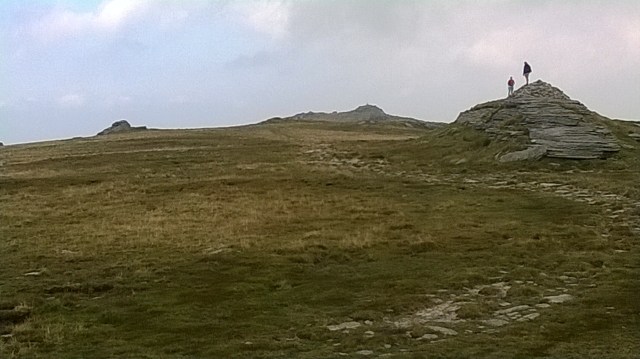


WP_20140903_020We’re just back from a week in Dartmoor, Devon, walking between some of the well-known, usually prominent rocky features of this beautiful landscape, known as tors

The Challenge

The tors (there are over 160 of them) are the focus of an annual event known as the Ten Tors Challenge, when around 2400 people aged between 14 and 19 (in over four hundred teams of six), face hikes of 35, 45 or 55 miles (56, 72 or 88km) visiting ten nominated tors over two days.  The teams must be self-sufficient, carrying all that they need to complete their route safely despite the terrain and the weather.  The latter can be very changeable and at times quite extreme, and success or failure can depend very much on the extent to which a team has been trained for all eventualities.

Not having completed this in her youth, my partner ( a local lass), was keen to do her own ‘Ten Tors Challenge’, but at a more leisurely pace. In the event, extremely good weather meant that we were able to visit double the target number of tors spread over six days, and including excellent overnight accommodation at my mother – in – law’s house in Tavistock! Over a series of posts in the next few days, I hope to give an interesting account of our adventures along with a few pictures. For starters here’s a ‘primer’ on Dartmoor and the tors in question….

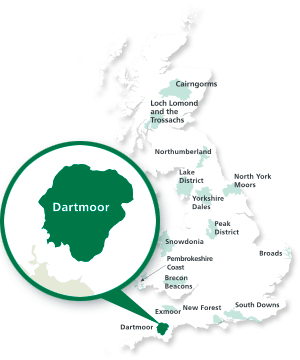
dartmoor locationThe Moor

Covering an area of 954 sq km (368 sq miles), Dartmoor contains the largest and wildest area of open country in the south of England. By virtue of its outstanding natural beauty it is one of the National Parks of England and Wales. Unlike many National Parks in other countries, for example the USA, the National Parks in England, Wales and Scotland are not owned by the state.  The term ‘National’ means that they have been identified as being of importance to our national heritage and as such are worthy of special protection and attention.  Within each National Park there are many landowners, including public bodies and private individuals. National Parks are places where people live and work.

Geology

A large part of Dartmoor (65%) is made up of granite, an igneous rock which was intruded some 295 million years ago.  This great granite core is surrounded by sedimentary rocks including limestones, shales and sandstones belonging to the Carboniferous and Devonian periods.  Those nearest the granite intrusion were altered (metamorphosed) by intense heat and pressure and chemical reactions.

Tors

Dartmoor is known for its tors – hills topped with outcrops of bedrock, which in granite country such as this are usually rounded boulder-like formations. More than 160 of the hills of Dartmoor have the word tor in their name but quite a number do not.   However this does not appear to relate to whether or not there is an outcrop of rock on their summit.

The processes resulting in the formation of the Dartmoor tors started about 280 million years ago as the granite forming Dartmoor cooled and solidified from molten rock at a temperature of 900 – 1000˚C. The minerals which make up granite crystallised as closely interlocking grains forming the hard rock. Granite is formed of three main minerals: Quartz – appearing in the granite as translucent slightly greyish looking grains; Feldspar – white grains, sometimes stained yellowish or pink (in parts of the granite feldspar forms large white crystals); and Biotite – dark brown glistening flakes.

dartmoorVarying climatic conditions occurring over millions of years, along with the cooling of the molten and other materials were the first, mainly chemical factors in the formation of the tors. Most recently, cold conditions in the Ice Age (between 2 million to 10,000 years ago), have caused major mechanical forces to shape the landscape we see today. Of these the most important is the expansion of freezing water. The deeply weathered granite was forced apart and broken up into blocks by being subjected to frequent freezing and thawing during the cold periods of the Ice Age, and gravity was also important, moving the loose material downhill.
 The principal tors are:

Tor Height above sea level
High Willhays 621m (2,039ft)
Yes Tor 619m (2,030ft)
Great Links Tor 586m (1,924ft)
Fur Tor 572m (1,876ft)
Great Mis Tor 539m (1,768ft)
Great Staple Tor 455m (1,493ft)
Haytor 454m (1,490ft)
Hound Tor 448m (1,469ft)
Sharpitor 402m (1,320ft)
Sheeps Tor 320m (1,050ft)
Vixen Tor 320m (1,050ft)

Well that’s the basics….except you might be interested in a TV programme that is showing this evening (Tuesday 9th September) on ITV 1 (7.30pm). The first in a new series of ‘Wilderness Walks’ by bushcraft expert Ray Mears focuses on Dartmoor. I’ll certainly be watching….

…so now for an article on the first stage of our trip – and it’s a mysterious beginning to our adventure that awaits…..(I’ll explain more about the nudist along the way too).

Further Information:  Dartmoor National Park

Old School Gardener

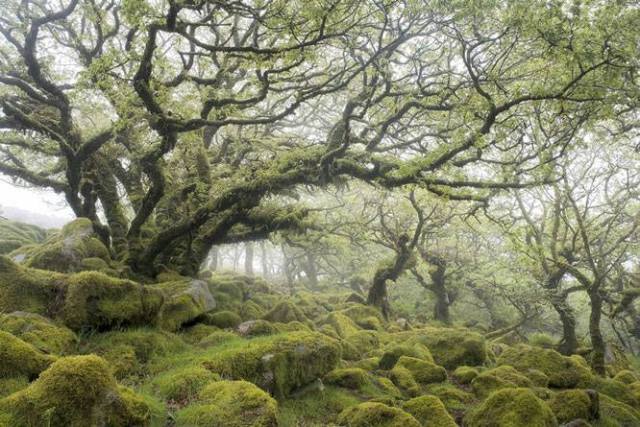
My wife and I spent a few days in Devon recently, visiting my Mother – in – Law. We had superb weather – unusual on the edge of Dartmoor – so were able to get out and about to see some beautiful places. I’ll feature a few of the great gardens we saw over the next few weeks, but almost our first outing was to a famous Dartmoor nature reserve and ancient copse, called ‘Wistman’s Wood’. Some of the trees are at least 400 years old – gnarled and almost dwarf oaks – and I managed to get some photographs to capture our afternoon visit in the sun. It’s such a mysterious and peaceful place I was moved (not been that for a while) to try my hand at some ‘poetry’ to accompany the pictures, so here goes….

‘In Wistman’s Wood

In Wistman’s Wood
A tumbled dwarf in valley ‘scape,
Rising with a greying ghostly hue.
Ancient Oaks clinging to life, entombed in rocks.
All engulfed in mossy fernery and silver beards,
Branch and trunk home to more lowly life,
In Wistman’s Wood.

In Wistman’s Wood
Strong sun casts a net of shade
Not yet filled by new young leaves.
And what of night or winter time?
Moonlight, mist and chattering cold-
Apt setting for moorland fairy tales,
In Wistman’s Wood.

In Wistman’s Wood
Sounds gentle on a spring day;
Rushing of the young Dart and
Bathed by the soft breeze,
Cut with children’s shout and ‘copter whirr.
Lone sheep a munching on meagre growth,
In Wistman’s Wood.

In Wistman’s Wood
Hear still and little life;
See nature stretched;
Smell moorland peaty damp;
Touch stone and twisted, mossy wood.
Taste sweet water
In Wistman’s Wood’

And here is a series of photos just in case that was all a bit too vague…


This slideshow requires JavaScript.

Old School Gardener

Ancient Woodland

Wistman’s Wood – Dartmoor, Devon, England; via Nature is Awesome

Old School Gardener

IMG_6926

I’m back from two weeks away in Devon and Cornwall and I definitely visited more gardens in that time than ever before! I’ll do articles with photos on each of these over the coming weeks, but I thought I’d ease my way back into the blogosphere with a little feature on the town of Moretonhampstead, Devon.

Located in the middle of Dartmoor, this lovely little town is a convenient stopping off point for those negotiating the narrow, winding lanes and open vistas of the Moor, and that’s just what we did on our way to visit Killerton Gardens, near Exeter.

It was a glorious sunny day and the drive over the moor from Tavistock was breathtaking. As we approached Moretonhampstead I was struck by the beautiful display of hanging baskets outside one of the pubs and then realised there were a lot more colourful floral displays around the town, so took out a few minutes to capture them. I must say the town residents, shopkeepers, local council, hoteliers etc. all seem to put an effort into beautifying the place, so congratulations to them for what was a very enjoyable mooch around, snapping as I went.

This is definitely the place to ‘hang out’ if you’re travelling the Moor and there were plenty of cyclists, motorcyclists and other tourers taking a breather here when we visited.

This slideshow requires JavaScript.

Old School Gardener

Finding Nature

Nature Connectedness Research Blog by Prof. Miles Richardson

Norfolk Green Care Network

Connecting People with Nature

Discover WordPress

A daily selection of the best content published on WordPress, collected for you by humans who love to read.

Susan Rushton

Celebrating gardens, photography and a creative life

Unlocking Landscapes

Writing, photography and more by Daniel Greenwood

Alphabet Ravine

Lydia Rae Bush Poetry

TIME GENTS

Australian Pub Project, Established 2013

Vanha Talo Suomi

The Journey from Finnish Rintamamiestalo to Arboretum & Gardens

Marigolds and Gin

Because even in chaos, there’s always gin and a good story …

Bits & Tidbits

RANDOM BITS & MORE TIDBITS

Rambling in the Garden

.....and nurturing my soul

The Interpretation Game

Cultural Heritage and the Digital Economy

pbmGarden

Sense of place, purpose, rejuvenation and joy

SISSINGHURST GARDEN

Notes from the Gardeners...

Deep Green Permaculture

Connecting People to Nature, Empowering People to Live Sustainably

BloominBootiful

A girl and her garden :)