Tag Archive: climbing


nWh
A pond is a fantastic resource for wildlife

A pond is a fantastic resource for wildlife

Most gardens play an important part in promoting biodiversity and maintaining ecosystems – vital if we are to have a sustainable planet. You might want to further enhance your garden’s ecological value, or perhaps promote wildlife to help pollinate plants (important if you want to gather your own seed and/or are growing your own food) and to help control unwanted pests.

Promoting wildlife is also a way or enriching the garden experience – just think about birdsong, the buzzing and gentle flitting of bees from flower to flower, the colourful displays of butterflies and the fascinating movements of the myriad insects and other ‘critters’ out there! So how can you ‘design’ wildlife into your garden and gardening activities?

Plant nectar- rich flowers to attract pollinators

Plant nectar- rich flowers to attract pollinators

First it’s important to recognise that you and your friends and family are also going to use the garden, so there’s no need to ‘go completely wild’ and make it unpleasant or difficult for humans to use the garden. In fact the best designed and managed gardens (and often the most beautiful) can also be the best for wildlife. These are the places where nature has not been allowed to take over.

You can ‘tip the balance in favour of wildlife’ in a number of ways. If you have a large garden you can adopt a ‘conservation’ approach and set out separate areas to attract and support different types of wildlife. If your garden is smaller, you can provide a range of features for the wildlife species you want to encourage. This approach is especially important if you want to actively harness nature to control pests.

Bird feeders need to be out of the reach of cats!

Bird feeders need to be out of the reach of cats!

So what can you do?

  • Create habitats that mimic those in nature and complement the local range outside the garden

  • Provide natural shelter, nesting, food and drink –  important as ‘stopping off’ points for temporary visitors to your garden as well as for longer term residents

  • Aim to increase diversity- and recognise that this is going to be a gradual process

  • Build in some key features, such as…..
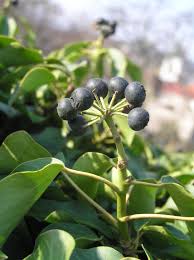
Climbign planst like Ivy provide a valuable food source for wildlife

Climbing plants like Ivy provide a valuable food source for wildlife

  1. Native plants- these act as a host to many more species than non native plants

  2. Wildflowers, grasses, weeds- these attract butterflies and many other insects. Nettles are important hosts for species that aid a healthy garden; butterflies and ladybirds. Maybe you can grow these in a container if you don’t have the space to leave patch in the garden?

  3. Nectar and pollen rich flowering plants- these  feed butterflies, bees, hoverflies etc.- which in turn attract birds

  4. Trees, flowering and fruiting shrubs- these provide food and shelter for birds

  5. Climbing plants- they provide food and cover for birds and food for insects and butterflies. Examples include Ivy, honeysuckle, quince, wisteria, clematis..

  6. Hedges- these give food and shelter for wildlife (e.g hedgehogs, voles and shrews), food and nesting for birds- where it’s practical choose to install a hedge rather than a fence

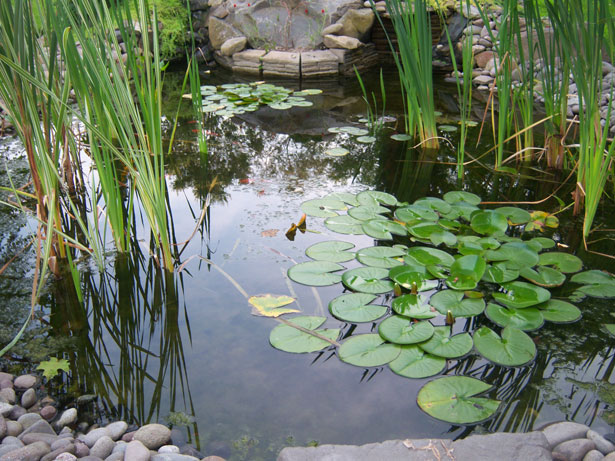
  7. Water- a pond brings masses of creatures to drink as well as attracting resident pond life

  8. Wood piles – insects colonise the decaying wood, attracting spiders and birds; beetles lay grubs; toads and hedgehogs hibernate underneath; slow worms use it as home (and these prey on slugs)

  9. Compost heap – provides both food for the soil and home for minute insects and other ‘mini beasts’ which feed birds, hedgehogs, toads. It also acts as a possible nesting place for hedgehogs, toads and slow worms.

  10. Bird and Bat boxes, tables, feeders and baths- put these up in secluded and sheltered spots out of full sun – and out of the reach of cats! Birds need extra food in winter. provide a range of foods according to the species you want to attract. Birds need to drink and bathe to keep their plumage in good order- even in winter, so keep birdbaths unfrozen

  11. Stones and walls- toads, newts and female frogs usually spend winter on land, under rockery stones (or in a log pile). Beetles, spiders, insects live in nooks and crannies

  12. Bug hotels’ can provide a ‘man made’ substitute for the above, and are good fun to make with children.
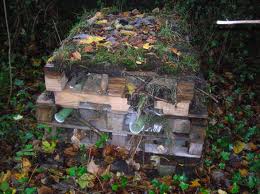
'Bug Hotels' can provide a 'Des Res' for many insects and other critters

‘Bug Hotels’ can provide a ‘Des Res’ for many insects and other critters
Further information: A range of useful wildlife gardening guides

Old School Gardener

WP_20130805_021It’s ‘Play Day’ in England today, so I thought it would be appropriate to report on my recent visit to the new Olympic Park Play Area in Stratford, London.

The ‘Tumbling Bay’ play space has just opened in the north of Queen Elizabeth Olympic Park. Designed by LUC and Erect Architecture, the space is the core social area for this part of the Park, which opens fully next April. It aims to provide a facility of use to both visitors to the area as well as the growing new residential community in the area and local workers.

The naturalistic play space is based on ecological concepts of succession and life cycles and is laid out along a newly created valley, with a new ‘Timber Lodge’ café and community hub at one end. I must say that I was impressed with what I saw.

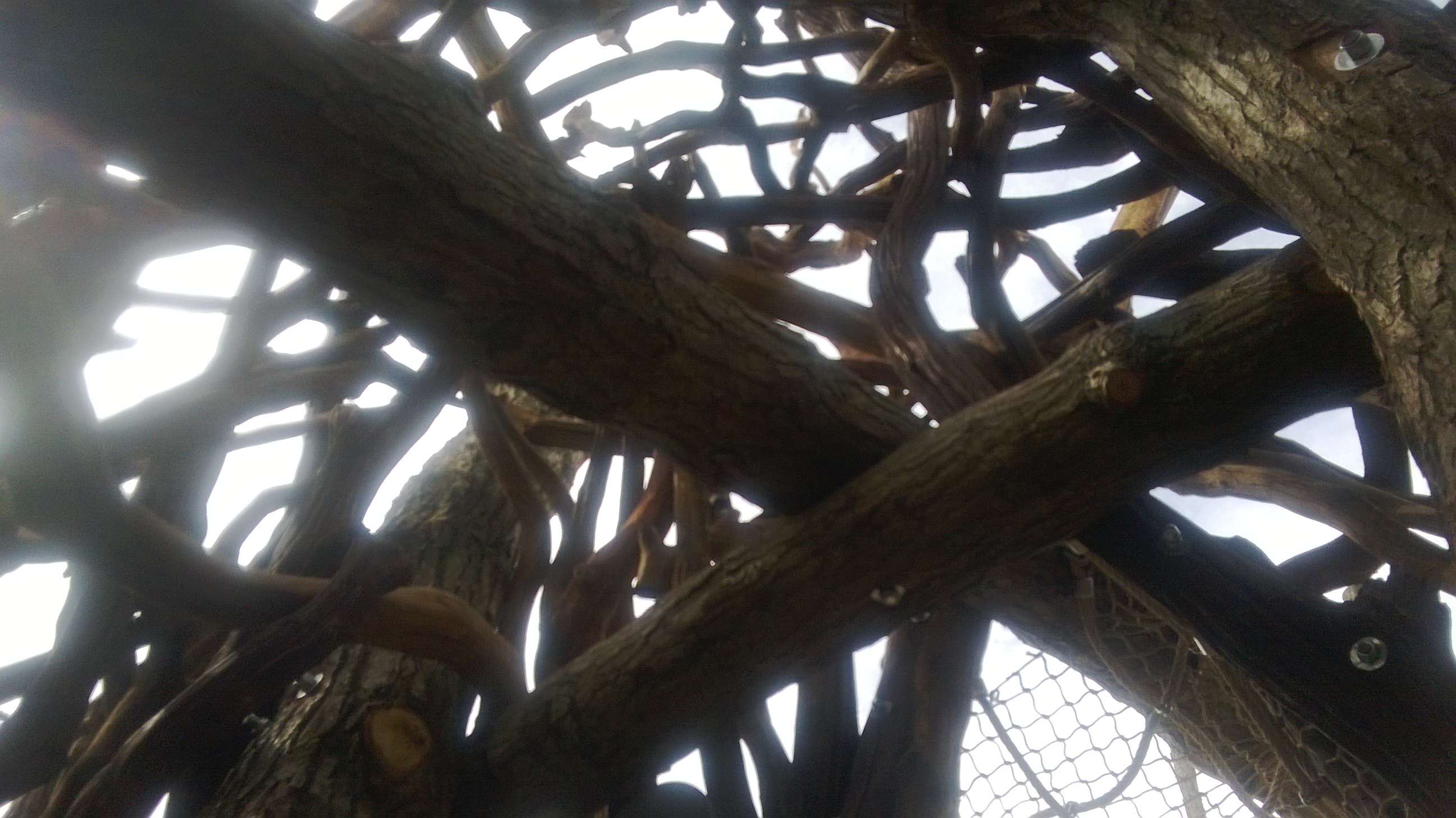
Given the heavy use this area is likely to see and that it is unsupervised, the designers and builders have done a great job at maximising natural play opportunities in an urban setting. I think children of all ages will be able to get something from it. At one end a climbing structure consisting of natural, rough finish timber bridges, ascents ,plus net walkways and other nooks and crannies is an exciting physical circuit for mainly physical play. The structures here are not so much designed on the drawing board as created on the spot – at least that’s how they look, with rough-hewn timber providing a wonderful variety of opportunities for climbing, clambering, crawling, walking and just sitting around.

This wood- strewn area gives way to an area dominated by a river delta – ilke landscape of gullies, pools and waterways. These are fed by a number of hand pumps and can be dammed at various points. And there are also spots offering a mix of sand and water play. The use of what seems to be blocks of natural (sand?) stone and sculpted landforms (made of composite materials?) conveys a natural look that could have been here for decades. Apparently the sand and water play area was inspired by the history of the River Lea and its industrial past. The arrangement of pumps and dams encourages children to experiment with water flows, work in groups and pump sufficient water to dam and divert water through the natural rock pools, rivulets and channels, filling a series of shallow pools and sand boxes along the way.

Finally, and running up to the cafe, is an area where water gives way to sand – dominated play, featuring a hanging conveyor system using sections of tyre and allowing children to move quantities of sand around the area. There are also a number of chunky wooden and gabion structures that are at different times seats, walkways or climbing features. I particularly liked the use of simple planed timber planking set around in odd places in the floorscape with grooves cut at right angles. I guess these are to provide a varied, grippy surface, but can also be a great little place for the very young to experiment with sand and water and other loose materials.

There are also some young hazel woodland copses where, in due course, children will be able to explore and build dens, hunt for bugs and get their hands dirty. The copses adjoin some ‘pine forest’ areas which run up against the timber play area. The curving form of the play area and its use of planting makes it blend in beautifully with the adjoining parkland landscape, avoiding the problem of all too many play spaces that stand out as colourful, metal-dominated, jarring places amidst surrounding greenery. The lack of fencing, but use of planting, land form and a variety of different log slice/trunk footways to provide barriers and create entrance and exit channels should also encourage children to play in the surrounding grassy and planted areas.

It is free to visit the parklands, cafe and playground. We enjoyed a lovely cup of coffee served by smiling staff at the new social enterprise – run cafe and events centre, which seemed to be doing a steady trade in these early days. I was interested to see that local primary schools have already contributed to displays in the Centre and this sign of community involvement is an early indicator of it becoming a successful community hub.  As you can see from the photographs, we were there early in the day, so only a few children were around. On our way home we passed lots of families with children who looked as though they were on their way to the park and play area.

If you get the chance it’s well worth a visit!

Old School Gardener

If you’ve enjoyed reading this post and others on this blog, why not comment and join others by signing up for automatic updates via email (see side bar, above right ) or through an RSS feed (see top of page)?

Tropaeolum majus

Tropaeolum majus

Tropaeolum is a genus of about 80 species of annuals and perennials native to South/Central America. The common Nasturtium (Tropaeolum majus) is the most frequently found member of the family. 

Nasturtium is from the latin words meaning literally “nose-twister” or “nose-tweaker” (referring to the pungent smell of some species!). The Tropaeolum Nasturtiums received their common name because they produce an oil that is similar to that produced by watercress (Nasturtium officinale).

Tropaeolum peregrinum

Tropaeolum peregrinum

Tropaeolum includes several very popular garden plants, the most commonly grown being T. majus T. peregrinum and T. speciosum The hardiest species is T. polyphyllum from Chile, the perennial roots of which can survive underground when air temperatures drop as low as −15 °C (5 °F).

Plants in this genus have showy, often intensely bright flowers (in reds, oranges and yellows), and rounded, shield- shaped leaves which vary in colour and include some attractive blue – green tones. Flowers have five petals (sometimes more) and a funnel-shaped nectar tube at the back. The name Tropaeolum is from the Latin tropaeum , meaning ‘trophy’ and was originally chosen by the swedish botanist Carl Linnaeus in the 18th century.

After victory in battle, the Romans used to set up a trophy pole called a tropaeum (from the Greek tropaion, source of the English word ‘trophy’). On this the armour and weapons of the vanquished foe were hung. Linnaeus was reminded of this by the plant as the round leaves resemble shields and the flowers, blood-stained helmets.

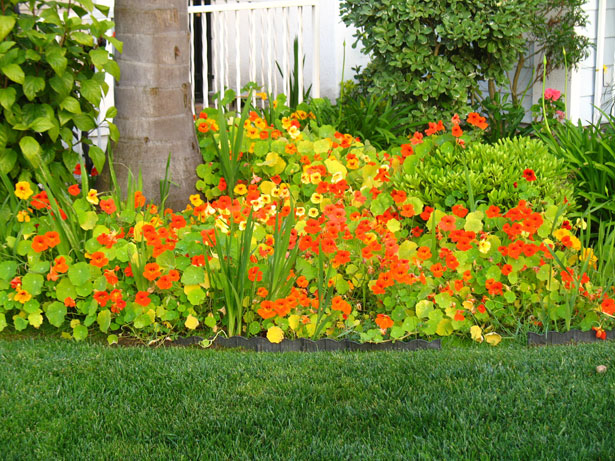
Tropaeolums in flower

Tropaeolums in a border

Species names of Tropaeolum include:

T. aduncum = hooked (the flowers)

T. canariense = canary – referring to the colour and shape of the flowers (the ‘Canary Creeper’)

T. lobbianum =  after Lobb the plant collector

T. majus = great (the Climbing Nasturtium)

T. minus = small (the Dwarf Nasturtium)

T. pentaphyllum = five leaved or divided into five

T. pergrinum = foreign or wandering, probably referring to its straggly growth

T. speciosum = showy

T. tuberosum = tuberous

'Canary Creeper' (T. canariense)

‘Canary Creeper’ (T. canariense)

Nasturtiums were also known as “Indian cress”. This derived from their use as a salad ingredient and because at that time South/Central America was referred to as ‘the Indies’. The 16th-century herbalist John Gerard called the plant “Lark’s Heel”, referring to the flower’s spur (and similar to Larkspur).

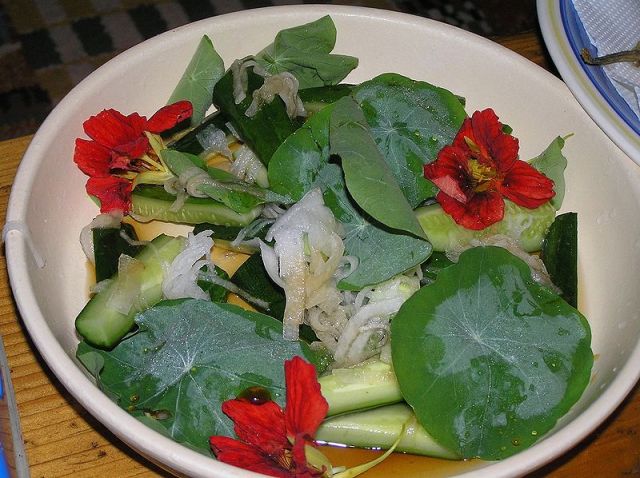
All parts of T. majus are edible. The flower is most often eaten as an ornamental salad ingredient or in a stir fry; it has a slightly peppery taste reminiscent of watercress. The flowers contain about 130 milligrams of Vitamin C per 100 grams or about the same amount as in Parsley. The unripe seed pods can be harvested and dropped into spiced vinegar to produce a condiment and garnish, sometimes used in place of capers.

Tropaeolum leaves and flowers as salad ingredients

Tropaeolum leaves and flowers as salad ingredients

Nasturtiums have been used in herbal medicines for their antiseptic and expectorant qualities. They are said to be good for a chest cold and to promote well being by the formation of new blood cells. The common Nasturtium has been used in herbal medicine for respiratory and urinary tract infections.

The bright, quaintly – shaped flowers are usually freely produced on long stalks, and the fast growth of many of the climbers makes the Tropaeolum a very useful, decorative plant. They will spill beautifully over walls and onto paths, when used as edging plants. They also hold up very well in containers. Climbing varieties, such as ‘Canary Creeper’ will amble up and through shrubs. Bushy, ground hugging plants will fill in gaps among complementary – coloured day lilies and roses.

You can use clusters of plants to brighten up the vegetable garden – and to act as ‘sacrificial’ ‘plants to attract caterpillars away from your brassicas!

Sources and further information:

Wikipedia

Tropaeolum speciosum

Growing Tropaeolum

Tropaeolum varieties

Quizzicals: two cryptic clues to flower, plant, veg or fruit names –

  • Bird swearing
  • Vasectomy for Dad

(thanks to Les Palmer, answers in the next Plantax!)

Old School Gardener

If you’ve enjoyed reading this post and others on this blog, why not comment and join others by signing up for automatic updates via email (see side bar, above right ) or through an RSS feed (see top of page)?

A metal arbour with a rambling rose

A metal arbour with a rambling rose

Arbours and pergolas can be important elements in a garden, adding visual interest, especially height, and functional value as shading or seating.

Arbour used to refer to an orchard, garden or lawn, but today its use tends to be limited to  a leafy glade or bower shaded by trees, vines, shrubs, etc. – especially when trained about a trellis. More precisely ‘a shady garden alcove with the sides and roof formed by trees or climbing plants trained over a framework’ (Oxford English Dictionary).This alcove may often contain a seat.

Pergola  is the term given to a horizontal trellis or framework, supported on posts, that carries climbing plants and may form a covered walk, though sometimes it is also used to describe the same sort of structure as an arbour. Today pergolas are also used to provide an overhanging structure for an entertaining/ dining area such as a patio or terrace.

So why have these structures? 

  • Provide privacy and shade

  • Divide up areas of the garden or/and provide an interesting route along a pathway or focal point

  • Provide support for plants

  • Provide a decorative structure 

A flower-covered pergola in the Canary Islands

A flower-covered pergola in the Canary Islands

A painted wooden arbour

A painted wooden arbour

Here are seven tips to make the best use of these structures in your garden:

1. Right design the design of the structure needs to complement the overall style of the garden, whether ‘cottage’, contemporary or classical etc. The use of curves or straight lines in the design can be especially important here, with curves flowing more easily in a romantic, informal style and straight lines often better in more formal settings.

2. Right materials whether wood, metal, brick or stone or a combination of these, it is again important to complement other materials in the garden/house and reinforce and harmonise with the overall style.

3. Right construction – a solid installation as well as overall design is important to ensure the structure is stable in winds etc. Once the structure becomes laden with foliage it can act as a significant wind barrier so needs to withstand the forces this will bring.

4. Right plants – again the choice of plants to climb over your arbour or pergola is important both as a way of reinforcing the garden’s style and because of the implications for ongoing maintenance – a vigorous rambling rose like ‘Kiftsgate’ could become a night mare unless you are prepared to prune and tie it in at the right time of the year. Choose plants with the ultimate height/length that is suitable for the structure or you could find that the structure looks under planted or alternatively is overwhelmed with foliage.

A modern metal pergola

A modern metal pergola

5. Right position these structures need to be placed within the garden – possibly to provide a focal point and informal seating area away from the house (arbour), an interesting tunnel through which to walk within the garden, so ‘framing the journey’ or alternatively close to the house over a patio (pergola). They also need to be positioned to gain the right level of light and shelter for the plants you envisage growing up them. And if you have an arbour with a seat think about what view you want to be looking at from it.

Pergola- the Old Vicarage, East Ruston

Pergola- the Old Vicarage, East Ruston

6. Right flooring–  again think about the material you use underneath the structure. It should be durable and harmonise with the path/terrace/patio materials in the wider garden, though it can contrast with these to help define the space covered by the arbour or pergola.

7. Right maintenance – keep an eye on your garden structures and look after them – re-coat painted wood regularly, check screws,nuts and bolts for rust, loosening or weakening joints.

Further information:

Great Designs for a garden party

Better Homes & Gardens examples of pergolas

Pergola plans for Free

58,779 garden pergola Home Design Photos

Old School Gardener

If you’ve enjoyed reading this post and others on this blog, why not comment and join others by signing up for automatic updates via email (see side bar, above right ) or through an RSS feed (see top of page)?

Finding Nature

Nature Connectedness Research Blog by Prof. Miles Richardson

Norfolk Green Care Network

Connecting People with Nature

Discover WordPress

A daily selection of the best content published on WordPress, collected for you by humans who love to read.

Susan Rushton

Celebrating gardens, photography and a creative life

Unlocking Landscapes

Writing, photography and more by Daniel Greenwood

Alphabet Ravine

Lydia Rae Bush Poetry

TIME GENTS

Australian Pub Project, Established 2013

Vanha Talo Suomi

The Journey from Finnish Rintamamiestalo to Arboretum & Gardens

Marigolds and Gin

Because even in chaos, there’s always gin and a good story …

Bits & Tidbits

RANDOM BITS & MORE TIDBITS

Rambling in the Garden

.....and nurturing my soul

The Interpretation Game

Cultural Heritage and the Digital Economy

pbmGarden

Sense of place, purpose, rejuvenation and joy

SISSINGHURST GARDEN

Notes from the Gardeners...

Deep Green Permaculture

Connecting People to Nature, Empowering People to Live Sustainably

BloominBootiful

A girl and her garden :)