
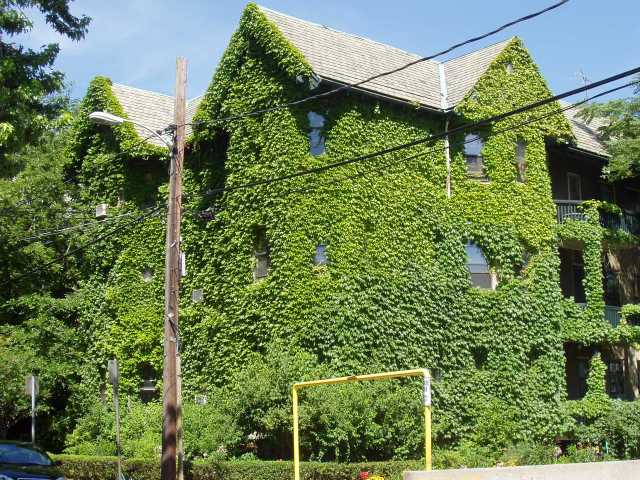
A little out of control?!
Swift action can prevent ivy from causing structural problems
Self-clinging climbers do not usually cause damage to wall surfaces but ivy supports itself by roots on the stems and where these penetrate cracks or joints they may cause structural damage. Its dense cover can also hide defects in the fabric of the building or hinder maintenance work.
At the Old School we have direct experience of this. The main gable end is of flint and brick construction and when we moved in (some 28 years ago) was painted white. This seemed strange, but we later discovered that we had a damp problem on the inner face of this wall. I took what I thought was the right action at the time and covered the wall with another coat of (this time brown) wall paint and for some years the damp problem seemed to wane. Then ivy got a hold and virtually covered the wall by last year, when we decided to remove this (it was a pain trying to keep it cut below the top of the roof) and try to remove the paint (there are, in fact three layers) and restore the original bare flint surface.

The wall at Old School after cutting through the main stems of the ivy- the dead foliage and stems remain…

after removing the dead ivy, revealing underlying pain…

and in detail with the original flint surface on the left
Having removed the ivy we’ve noticed how the roots from the stems have got behind a lot of the paintwork and whilst there’s no obvious major damage, we have seen our damp problems return; maybe a case of the ivy helping to prevent water coming in?! Well, we’re still waiting for quotes to do the paint removal work (and to repair some defective flashing on the adjacent roof which I think partly explains the damp problem), and I’m soon going to get into the border next to the wall to remove the roots of the ivy (I think this might be hard work).
In some situations Ivy up the wall may also provide handy access for intruders and harbour pests like mice. Where brickwork is sound, the main task is to keep growth away from gutters (and certainly from getting in under the roof slope) and paintwork.
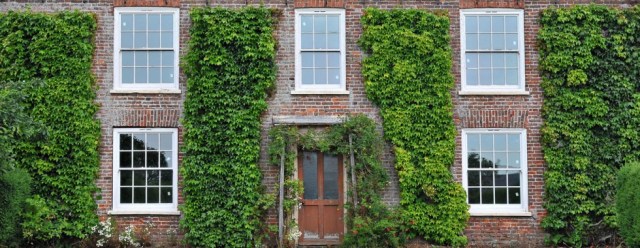
Ivy under control, but it can be a pain getting up the ladders and trimming back annual growth…
Large climbers can pose a risk to house foundations. This is most likely with older buildings constructed on clay soils that are prone to shrinkage.
In the past, Ivy could be killed by cutting through the stem near ground level and treating the stump with ammonium sulphate, but this chemical is now banned so you have to resort to cutting the main stems and digging out the roots and any seedlings. Top growth may be treated with a brushwood killer or a weedkiller containing glyphosate, but ivy is not easily controlled in this way because the leaves are glossy and the spray simply runs off. Repeat applications may be necessary.
Dead foliage and stems are relatively easy to remove from walls (I used a crowbar to lever off quite large chunks, once these had died off), but aerial roots are persistent and can only be removed using a hard brush, wire brush or paint scraper. Here’s a useful video to summarise the basic approach to removing ivy (including from trees and shrubs).


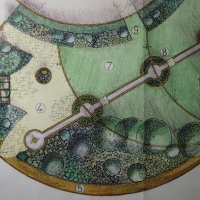


 Old School Garden