
A short, easy to understand video from the UK Meteorological Office
A short, easy to understand video from the UK Meteorological Office
 A grass -free ‘Floral Lawn’ has been opened today in Avondale Park, West London. It’s plants, which include daisies, red-flowering clover, thyme, chamomile, pennyroyal and Corsican mint, create a “pollinator-friendly patchwork” – with 25% more insect life than that found in “traditionally managed grass lawns”.
The Royal Borough of Kensington and Chelsea commissioned the biodiverse floral lawn from Lionel Smith, a Royal Horticultural Society (RHS) sponsored PhD student, and RBKC’s gardening team. It is the first time that a public park has featured this new form of lawn.
Planting a public space with specially selected and researched plants will give Lionel a valuable insight into how the public will react to this non-traditional lawn. Previously all his research has been on experimental plots at Reading University. The idea has prompted questions about ‘just what makes a lawn a lawn’. Lionel says:
“Lawns are normally associated with closely trimmed grass but mine are, I believe, entitled to be called that too. They are not only beautiful and easy to maintain but also environmentally friendly. It will be interesting to see how visitors to Avondale Park, where this public trial sward is to be being planted, will react. I hope to get some feedback as part of my research.”
Traditional grass lawns, if regularly mown, might look good, but have you thought about:
What do you think about this? Have you got a traditional grass lawn in your garden or have you turned it (or some of it) over to wild flowers or other uses? Should we turn over more areas of traditional grass lawn in public parks and spaces into grass- free or more diverse habitats? I’d love to hear your views!
Further information:
‘Rethinking the traditional grass lawn’ -blog article by Lionel Smith
If you’ve enjoyed reading this post and others on this blog, why not comment and join others by signing up for automatic updates via email (see side bar, above right ) or through an RSS feed (see top of page)?
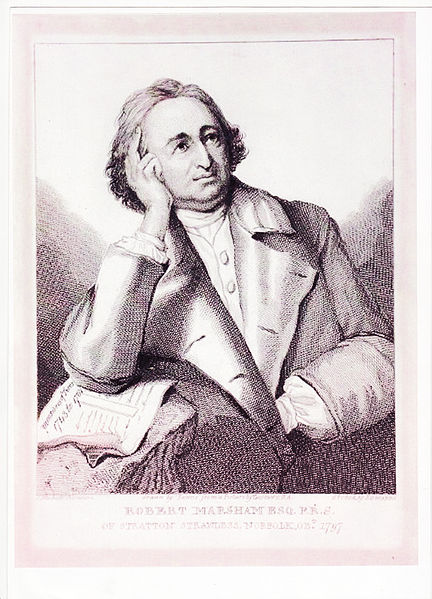
Robert Marsham – portrait by Zofany
Stratton Strawless Church contains some outstanding tombs and memorials to the Marshams. The Marshams lived at Stratton Strawless Hall (just off the A140 Norwich to Cromer Road) which was completed early in the 19th Century and had extensive landscaped grounds. Humphry Repton, the famous landscape gardener and great admirer of Robert Marsham’s tree planting work, described the estate as: “a gem made out of a common by Robert Marsham”. Apart from this large scale landscaping and an avid interest in trees, Marsham is best known as the ‘father of phenology’.


Stratton Strawless Hall
Phenology is the study of the times of recurring natural phenomena, especially in relation to climate. Robert Marsham was a meticulous recorder and he was the first to log the effects of nature and seasonal change. In 1736, Robert Marsham commenced this series of records that eventually developed into his 27 ‘Indications of Spring’. These included:
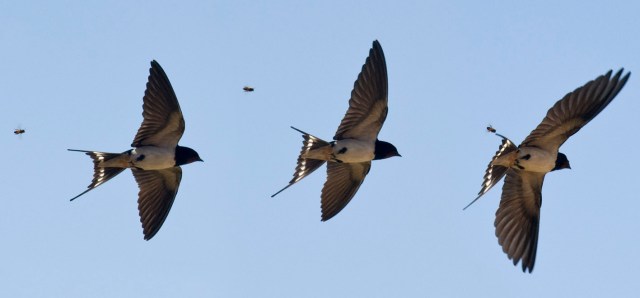
The first Swallow an indicator of spring
Historically, in Japan and China the time of cherry and peach trees blossoming is associated with ancient festivals and some of these dates can be traced back to the eighth century. In the UK the first individual records that have been found date back to 1684. Robert Marsham was Britain’s first systematic recorder of seasonal events and recorded his ‘Indications of Spring’ until his death in 1798. His vast database was reported to the Royal Society in 1789, the same year Gilbert White published his Natural History of Selborne. In 1875 British phenology took a major leap forward when the Royal Meteorological Society established a national recorder network. Annual reports were published up until 1948.
Marsham provided a fascinating insight into the winter of 1739/40, the coldest year on record, when the contents of his chamber pot frequently froze overnight and the turnip crop was completely destroyed! Turnips, a Norfolk speciality, were also monitored by Marsham. He regularly recorded turnip flowering dates (needed when turnips were to produce seed) and he noted one year:
Marsham’s great interest in trees resulted in him being elected a Fellow of the Royal Society in 1780. Most of his tree plantings were felled for much needed timber in the First and Second World Wars and other parts of the estate were ploughed over. What is left are a few ancient trees, the remains of his avenue of oaks, and particularly his Giant Cedar (planted in 1747).This Cedrus atlantica was planted as an 18 inch sapling. It stands to the east of Stratton Strawless Hall and when measured in 2000 it measured 102 feet high and had a circumference of 23 feet.


Most of Marsham’s writings haven’t survived. However, there are articles he published in journals, some of his letters to others, and some Victorian transcriptions from his diaries. These present a picture of a man of science with an obsession with trees. James Grigor described him as “an individual who excelled all his contemporaries, in this quarter, in the work of planting, of whom his oaks form the most fitting of all memorials”. His views on planting had a wider impact as they were very influential on Humphry Repton’s landscape designs. He was also one of the first to experiment with root cutting, trenching and bark-scrubbing. He was preoccupied with improving tree growth and continually tested unorthodox methods of pruning and thinning in his forest plantations.
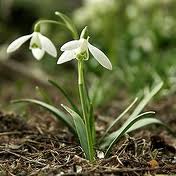
The first snowdrop flower an indicator of spring
Following his death in 1797 successive generations of his family continued to record the signs of spring right up to 1958. At the time nobody realised how important these records would become. Today, with concern over climate change and its impact on wildlife and the natural world, these records have become of global importance as one of the longest and best sets of records linking climate and the natural world. A friend and fellow gardener of mine, Mary Manning, has maintained her own set of spring flowering records in Norfolk since the 1960’s.
Marsham’s records can now be compared to temperature records and provide strong evidence of how global warming is leading to earlier springs. His records for Hawthorn show how for each 1°C of temperature rise, leafing can occur up to ten days earlier. Today, a website – ‘Natures Calendar’ – operated by the Woodland Trust, enables everyone to record their own ‘indications of spring’ data. This website also contains lots of useful information about recent seasonal indications and educational resources.

Sources and links:
US National Wildlife Federation- phenology
If you’ve enjoyed reading this post and others on this blog, why not comment and join others by signing up for automatic updates via email (see side bar, above right ) or through an RSS feed (see top of page)?

Picture: BBC
The report, hailed as a ‘wake up call’ to conservation policy and practice in the UK, says that current approaches are not halting these declines. The data – collected by dedicated volunteer enthusiasts through many surveys – are impressive, but they only cover 5% of the UK’s estimated 59,000 native species.
One of the report authors, Dr Mark Eaton of the RSPB, said: “These declines are happening across all countries and UK Overseas Territories, habitats and species groups, although it is probably greatest amongst insects, such as our moths, butterflies and beetles. Other once common species like the kittiwakes, Scottish wildcat and arable wildflowers are vanishing before our eyes”.
The elusive Corncrake is one of the bird species which the report cites as a positive example of what can be achieved by conservation projects. In Scotland, schemes which support changes in the timing and methods of mowing hay and silage during the breeding season are said to have secured a three-fold increase in the number of singing males.
The ‘State of Nature’ report offers clues to the fate of the UK’s 59,000 species. Some of the species seeing the largest falls in numbers are turtle doves, water voles, red squirrels and hedgehogs.The reasons for the decline are said to be “many and varied” but include rising temperatures and habitat degradation through development or agricultural practices such as pesticide use. Species requiring specific habitats have fared particularly poorly compared to the ‘generalists’ who are able to adapt to the country’s changing environment more easily.
“This report shows that our species are in trouble, with many declining at a worrying rate,”
said Sir David Attenborough. He commented in a radio interview today – ‘There is no single answer – what we have to do varies from species to species.” He points to the many expert organisations that can advise on how to provide or encourage habitat creation; e.g. the Wildlife Trusts network plus a number of specialist bodies for particular species.
Links:
BBC report on ‘State of Nature’
Rewilding our children – article by George Monbiot
Other relevant articles:
Four Seasons in One Day (1): Climate change and the garden
Moths- unsung victim of climate change and habitat loss
Mistle Thrush missing…Big Garden Watch this weekend
Winners and losers in latest butterfly survey- 7 tips for gardeners
If you’ve enjoyed reading this post and others on this blog, why not comment and also join some other people and sign up for automatic updates via email (see side bar, above right ) or through an RSS feed (see top of page)?

‘
Article from the Met Office


 A new report charting the numbers of moths in Britain over forty years makes grim reading. Climate change and habitat loss are driving some to extinction – especially in southern Britain.
Moths are perhaps not as popular as butterflies. But they are an important ‘indicator’ of how our native ecology is faring, a significant pollinator and source of food for birds, bats etc. Whilst many are subtly coloured, others are as eye-catching as their cousins.
The Butterfly Conservation report says that two-thirds of common and widespread larger species of moth (macro-moths) declined in the last 40 years, most seriously in southern Britain. The report suggests that the decline in habitats through development and agricultural practices are the factors behind the decline in the south, whereas it sees climate change (a gradual warming) as a key factor in the broadly neutral results in the north – declines in some species have been matched by increases in others.
And climate change is also the explanation behind the growth in new species in the country. More than 100 species have been recorded for the first time in Britain this century and 27 species have colonised Britain from the year 2000 onwards. However, the report says that three species have become extinct in the last 10 years and three more are at serious risk of extinction, having already declined by more than 90% in the last forty years.

Garden Tiger Moth caterpillar
‘Avoid using pesticides to give their caterpillars free rein on your plants (which will mostly only be nibbled a bit – so don’t worry).’
The website Mothscount says we also need to tolerate some untidiness in our gardens:
‘Moths and their caterpillars need fallen leaves, old stems and other plant debris to help them hide from predators, and especially to provide suitable places to spend the winter. It’s very helpful to delay cutting back old plants until the spring, rather than doing it in the autumn, and just generally be less tidy. If you want your garden to look tidy in the summer, try leaving some old plant material behind the back of borders or in other places out of sight…..’

All green form of the Red – Green Carpet Moth
Further information:
Winners and losers in latest butterfly survey – 7 tips for gardeners
If you’ve enjoyed reading this post and others on this blog, why not comment and also join some other people and sign up for automatic updates via email (see side bar, above right ) or through an RSS feed (see top of page)?
Nigel Boldero aka 'Old School Gardener'
 | Nigel Boldero on Fighting to Reduce Climate Cha… |
 | Anonymous on Fighting to Reduce Climate Cha… |
| Anonymous on PicPost: Carrot, my foot! |
| 18 Surprising Hydran… on Plantax 16: Hydrangea the wate… | |
| Nigel Boldero on Poppyland: A Victorian romance… |
| Anonymous on Poppyland: A Victorian romance… |
| Anonymous on Plants to die for… |
 | Isabella Childress on PicPost: Forest, but not as we… |
 | Happiness Factor on Is child-friendly planning a l… |
 | zidane on Top Tip: On a Pedestal- make m… |





Nature Connectedness Research Blog by Prof. Miles Richardson
Connecting People with Nature
A daily selection of the best content published on WordPress, collected for you by humans who love to read.
Celebrating gardens, photography and a creative life
Writing, photography and more by Daniel Greenwood
Lydia Rae Bush Poetry
Australian Pub Project, Established 2013
The Journey from Finnish Rintamamiestalo to Arboretum & Gardens
Because even in chaos, there’s always gin and a good story …
RANDOM BITS & MORE TIDBITS
.....and nurturing my soul
Cultural Heritage and the Digital Economy
Sense of place, purpose, rejuvenation and joy
Notes from the Gardeners...
Connecting People to Nature, Empowering People to Live Sustainably
A girl and her garden :)

 Old School Garden