Tag Archive: blickling


WP_20150122_12_03_53_ProMy latest session as a volunteer gardener with the National Trust at Blickling Hall involved working in another area of the gardens- the Winter Garden, which I think was planted up a few years ago as an area to feature colourful stems, fragrance and flowers at this quiet time of the year in the garden.

Work in the Walled Garden has been continuing, however, and with a few frosty nights it has been possible to move and spread the rest of the farmyard manure over the beds. As you can see below, this has helped to give definition to these planting areas…

Muck spreading in the Walled Garden- get to work worms! Picture: Michael Owers

Muck spreading in the Walled Garden- get to work worms! Picture: Michael Owers

For gardener Rebecca, me and the other ‘Thursday volunteers’, this week involved raking off a thick quilt of Sweet Chestnut and other leaves, tidying up spent stems and foliage and sprucing up the Hellebores…. as well as uncovering the first snowdrops. When I say ‘quilt’ I’m not joking – I just hope the plants underneath haven’t been as shocked as I have been, recently, emerging from under my own quilt in the frosty mornings!

So, for me the day that was spent almost entirely raking and loading leaves into trailers to be carried away for turning into leaf mould. Definitely one that required a ‘Radox Bath’ on my return home!

Even though it was repetitive work, it was also very satisfying, showing off this lovely garden with its over-arching trees and understory of shrubs and winter perennials- and hopefully giving some of the plants a good chance to ‘pick up’ as the seasons move on.

Further information:

Blickling Hall website

Blickling Hall Facebook page

A 360 degree tour of Blickling Hall

Old School Gardener


Volunteers tidying the kitchen garden beds at Blickling Hall

Volunteers tidying the kitchen garden beds at Blickling Hall

My second day as a volunteer gardener with the National Trust at Blickling Hall involved cleaning up the recently used kitchen garden, and along the way meeting some of the other garden volunteers… oh, and uncovering some plant mysteries…

You may recall that last week I helped Project Manager Mike and gardener Rebecca to make a start in preparing the ground in the main walled garden. With lots of rain since then there had been little chance of doing much more- in fact there were sections that were reminiscent of a World War I trench system, complete with mud and puddles!

‘Ooh, there’s a row of something…’

So, today we turned our attention to the long bed along the south-facing wall, an area that in recent years had been cultivated as a kitchen garden and nursery bed. There were clearly areas of bare soil, some  a bit weedy, whilst other areas still had the remains of last season’s plantings, including Chard, Penstemons, Dahlias and some less obvious herbaceous perennials.

At the start it looked like I might need to weed and then use a spade to dig over the soil, but it turned out that the soil is quite workable and so a border fork proved up to the job. I was soon joined by a platoon of other garden volunteers who turned their attention to other sections of the bed; uncovering rows of planting here and there (and trying to identify and label these as we went), tidying away spent stems and foliage and generally giving the soil its first ‘breath’ of the new year.

I think the plan is to use this bed in due course as a place for demonstrating different approaches to vegetable growing, but for this year Mike is focusing on a holding operation, working around existing groups of plants that can be left and no doubt seeing what other surprises might appear along the way; for example I think I uncovered an area of Rhubarb crowns towards the end of my stint.

Part of the team, proud of the day's work

Part of the team, proud of the day’s work

It was a satisfying day. There’s something ‘optimistic’ about seeing a newly dug border, the dark, rich soil contrasting with the brighter colours of surrounding plants, and looking forward to creating a progressively finer tilth as the days lengthen and temperatures.

My reward at the end of the day- sunset over mid Norfolk

My reward at the end of the day- sunset over mid Norfolk

Further information:

Blickling Hall website

Blickling Hall Facebook page

A 360 degree tour of Blickling Hall

Old School Gardener


SONY DSCI’ve mentioned recently that I’m commencing a stint as a volunteer gardener with the National Trust at Blickling Hall, a wonderful Jacobean House and estate just outside Aylsham, about 8 miles from home.

I’m particularly interested in helping with a project to regenerate a two acre walled garden that once supplied the household with an array of vegetables and fruit. Like many walled gardens of its time this was domestic food growing on a huge scale- almost like operating a mini farm.

I was reminded of this near agricultural scale of operation on my first day as the whole space has been deep ploughed (using an implement called a ‘sub soiler’ pulled behind a conventional tractor) to try to break up the compacted soil.

One of my first jobs involved marking out the main pathway structure using canes, so that plentiful supplies of farmyard manure can be tipped and spread on the growing areas and not wasted on areas which will soon be hard-surfaced. Fortunately the Project Manager, Mike Owers, had already set out some marker pegs around  the periphery of the garden from which we could run lines and so get our bearings over the rough terrain. Other members of the gardening team then trailered in what seemed like a never-ending stream of manure  (it was still being delivered as I left at dusk). Mike, Rebecca (one of the gardeners) and I then started the task of spreading this lovely stuff over the ground so that the worms can get to work incorporating it into the newly turned soil- a Rotatator may be used in due course to fully integrate this material.

My other main job on my first day was to work out the materials needed to restore the walled fruit support system around three walls (the fourth side of the garden is hedged). Many old espalier trained fruit bushes remain, though over the years, as the garden was not in commission, these have not been regularly pruned, so some careful renovation is called for. In some cases, the bushes may be beyond recovery, but a good basic structure exists on two out of three walls. Mike had been researching different ways of supporting these bushes and come up with a system used at another of the Trust’s properties, Scotney Castle in Kent. Here oak battens provide vertical supports for stretched wires which run along a series of vine eyes (and incorporate straining bolts at the ends of each run to ensure the wires are kept taut).

This avoids screwing the vine eyes themselves into the ancient walls, which I must say, as you’d expect, look a little fragile in places. The battens will be placed at roughly 4 metre intervals, which more or less corresponds to the spaces between the existing bushes. I did a quick sketch diagram of each wall showing the rough placement of the battens, straining bolts etc. and finished off with some basic calculations of the materials required- interestingly my estimate on the wire (which will be in 7 rows spaced around each 5 brick courses) at 1324 metres was close to Mike’s early estimate, so hopefully the figure is more or less on target!

I’m due back at the Gardens this week and will post a brief update as this work unfolds. The next few months are promising to be especially interesting as the basic structure of the garden- paths, irrigation, greenhouses etc – are put in place and the garden is readied for its first season of growth for many years.

Further information:

Blickling Hall website

Blickling Hall Facebook page

Old School Gardener


WP_20141117_15_07_28_Pro

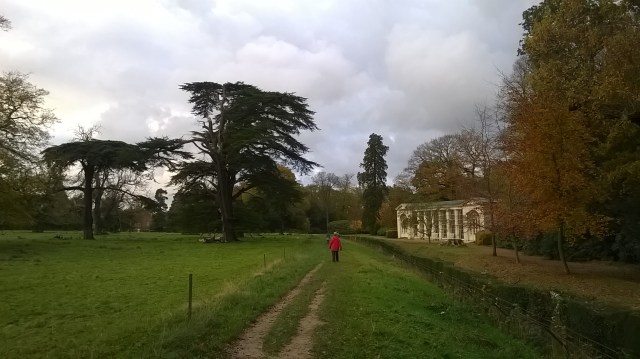
Cedars and the Orangery at Blickling Hall, Norfolk this week

Old School Gardener

IMG_8624The second and final stop on our trip home from Devon recently, was Montacute House, Somerset. Surrounded by beautiful, formally laid out gardens, the warm, honey-coloured stone of the house glowed in the spring sunshine. There was a splendid display of tulips and wallflowers and a magnificent ‘cloud’ yew hedge reminiscent of those at Blickling House, near our home in Norfolk. We were fortunate to meet  a gardener in the ”orangery’, which, she explained, was not really in the best spot for this and had in the past been more of a shady water feature, with its tufa – clad grotto. This and it’s surrounds are gradually being replanted with ferns and other suitable species. Pots of standard Bay trees line the terrace outside where once orange and lemon trees would have been placed in summer.

‘Montacute is a masterpiece of Elizabethan Renaissance architecture and design. With its towering walls of glass, glow of ham stone, and its surrounding gardens it is a place of beauty and wonder.

Sir Edward Phelips, was the visionary force and money behind the creation of this masterpiece, which was completed in 1601. Built by skilled craftsman using local ham stone under the instruction of William Arnold, master mason, the house was a statement of wealth, ambition and showmanship.

Come face to face with the past in the Long Gallery, which is the longest of its kind in England. The gallery houses over 60 Tudor and Elizabethan portraits on loan from the National Portrait Gallery.

Beautiful gardens surround Montacute, constantly changing, filling the house with scent in summer and providing an atmospheric backdrop for a winter walk…’

This slideshow requires JavaScript.

Further information: National Trust website

Old School Gardener

IMG_7088I frequently visit this wonderful Jacobean Mansion and more particularly it’s gardens and parkland. After all it is just 7 miles from home. A  walk around the park after a Christmas Day ‘brunch’ has become something of a family institution, often complete with festive headwear!

I try to visit the gardens at different times of the year as they offer something for every season, and back in September I was keen to experience the late summer colour festival of its herbaceous and other plantings. At this time of year it’s mix of formal and informal styles is most evident.

Coincidentally, there was a splendid event going on to celebrate the role of the Hall in the Second World War, including people dressed in military uniforms and plenty of vehicles and ‘kit’ from the time. This is my photo record of my most recent visit along with a very good summary of the gardens’ history and features from Wikipedia:

‘A house and garden existed at Blickling before the estate was purchased by the Boleyn family in the 1450s, but no records survive to give an indication of their appearance. After Sir Henry Hobart acquired the estate in 1616, he remodelled the gardens to include ponds, wilderness and a parterre. A garden mount– an artificial hill in Blickling’s flat landscape, was made to provide views of the new garden. With the accession of Sir John Hobart (later the 1st Earl of Buckingham) in 1698 the garden was expanded to add a new wilderness and the temple was constructed.

In the latter half of the 18th century John Hobart, 2nd Earl of Buckingham, embarked on works that would radically change the appearance of the gardens. All traces of formality were removed, and naturally arranged clumps of trees were planted to create a landscape garden. By the 1780s an orangery had been built to overwinter tender citrus trees. Following the 2nd Earl’s death in 1793, his youngest daughter Caroline, Lady Suffield, employed landscape gardener Humphry Repton and his son John Adey Repton to advise on garden matters. John Adey Repton would go on to provide designs for many garden features.


The estate was inherited by nine-year-old William Schomberg Robert Kerr, 8th Marquess of Lothian in 1840. He later re-introduced the formality and colour schemes of the parterre. After his death at the age of 38, responsibility for the gardens rested with Lady Lothian and her head gardener Mr Lyon. Philip Henry Kerr, 11th Marquis of Lothian, inherited the estate in 1930. After disparaging comments in a publication of Country Life, Lothian engaged socialite gardener Norah Lindsay to remodel the gardens. In the parterre she replaced the jumble of minuscule flower beds with four large square beds planted with a mixture of herbaceous plants in graduated and harmonious colours. Other improvements included removal of a line of conifers in the Temple walk, which were replaced with plantings of azaleas.

The garden today

The garden at Blickling covers 55 acres (22 ha) and contains formal and informal gardens, Grade II listed buildings and structures, woodland, specimen trees, Victorian garden ornaments, topiary, the kitchen garden .. and 18th century yew hedges.

The lawns which frame the main approach to the hall are bounded by yew hedges which were first recorded by William Freeman of Hamels in 1745. Surrounding the hall on three sides is the dry Moat. The plantings in the moist, sheltered conditions of the moat were considerably revised by Lindsay who introduced hosta, species of hydrangea, buddleja and rosemary.

To the rear of the hall is the noted Parterre garden which is located on the east lawn. Originally created as a Victorian sunken garden it was remodelled by Lindsay in the early 1930s. Set around an 18th-century listed stone fountain, she divided the garden into four large, colourful herbaceous beds surrounded by L shaped borders stocked with roses and catmint with an acorn shaped yew marking each corner.


In the terraces above the parterre there are plantings of peony, seasonal beds and the Double Borders created in 2006, contain a wide variety of perennials, shrubs and grasses with colours ranging from hot to cool. Close by, are the White and Black Borders which were established in 2009, together with a collection of eleagnus.

The western side of the garden features the lawned Acre which is fringed by a spreading oriental plane tree. Outdoor sports such as croquet are played here in the summer months. Further highlights are a collection of magnolia underplanted with autumn cyclamen, the shell fountain and the kitchen garden. To the north of the parterre is the Wilderness garden which is bisected by radial grassed avenues flanked with turkey oak, lime and beech trees and naturalised bulbs. The wilderness hides a Secret Garden with a summerhouse, scented plants and a central sundial.

Nearby is the listed 18th century orangery which houses a collection of citrus trees. Adjacent, to the building is the steep sided Dell which is home to many woodland plants including a selection of hellebore and foxglove. In 2009, an area of woodland was cleared close to the orangery to create a new garden. Stocked with a wide range of woodland plants including camellia and varieties of mahonia. Opened in 2010, it will be known as the Orangery Garden.

The Grade II listed Temple is approached by the Temple walk which is lined with azalea planted by Lindsay in her original 1930s design. Scattered throughout the garden are many garden ornaments including thirty pieces supplied to Lady Lothian in 1877 by Austin & Seeley of Euston Road, London.

Future projects include the creation of a philadelphus and rose garden. Both of which will be located in the Wilderness and open to the public in the near future .’ (Note – these have now been established and are open to the public- see pics below).

Further information:

National Trust Website

Wikipedia

Old School Gardener

PicPost: Blickling at Christmas

We’ve just returned from a seasonal trip to our local ‘stately home’ – Blickling Hall. The gardens are all wrapped up for the winter, but the Jacobean house and immediate grounds were magical- Christmas trees alight, beautiful flower arrangements, volunteers in period costume, crafts for sale and bands playing carols. December it is and the Christmas mood begins….

Old School Gardener

Finding Nature

Nature Connectedness Research Blog by Prof. Miles Richardson

Norfolk Green Care Network

Connecting People with Nature

Discover WordPress

A daily selection of the best content published on WordPress, collected for you by humans who love to read.

Susan Rushton

Celebrating gardens, photography and a creative life

Unlocking Landscapes

Writing, photography and more by Daniel Greenwood

Alphabet Ravine

Lydia Rae Bush Poetry

TIME GENTS

Australian Pub Project, Established 2013

Vanha Talo Suomi

The Journey from Finnish Rintamamiestalo to Arboretum & Gardens

Marigolds and Gin

Because even in chaos, there’s always gin and a good story …

Bits & Tidbits

RANDOM BITS & MORE TIDBITS

Rambling in the Garden

.....and nurturing my soul

The Interpretation Game

Cultural Heritage and the Digital Economy

pbmGarden

Sense of place, purpose, rejuvenation and joy

SISSINGHURST GARDEN

Notes from the Gardeners...

Deep Green Permaculture

Connecting People to Nature, Empowering People to Live Sustainably

BloominBootiful

A girl and her garden :)