Tag Archive: bedding


Trefoil - good for under sowing sweet corn and will fix nitrogen in the soil

Trefoil – good for under sowing sweet corn and will fix nitrogen in the soil

My first article in this series covered the 7 reasons to use green manures – any plants that are grown to benefit the soil. Today I’ll cover where and when to use them.

Vegetable Garden

Green manures can be grown as a ‘catch crop’ – something to fill a gap in the growing plan for any particular border, bed or growing area. For example, after lifting potatoes don’t leave the soil bare but pop in something like Grazing Rye or Winter Tares which can be sown quite late and will keep the soil covered in the winter months.

You can also sow fast growing green manures in areas where you plan to plant frost tender crops such as courgettes or runner beans, while you’re waiting for the weather to warm up. Some green manures will germinate in early spring and will keep the ground free of weeds. A few weeks before you’re ready to put in your frost tender plants dig in the green manure (leaves and roots) and this will be a good source of organic matter for greedy, moisture-loving crops like runner beans. However, don’t do this if you’re planning to sow any small seeded crops like carrots or parsnips as the green manure will inhibit seed germination.

Where you have a tall growing crop such as sweetcorn, you can sow a green manure between the plants to help reduce weed problems. A low growing plant such as Trefoil will keep the ground covered and this can be left to grow over winter once the sweetcorn has been harvested.

If you know your soil has been ‘over worked’ by previous gardeners (say in an allotment) and little bulky organic material has been added, it’s a good idea to grow a green manure in the first season.
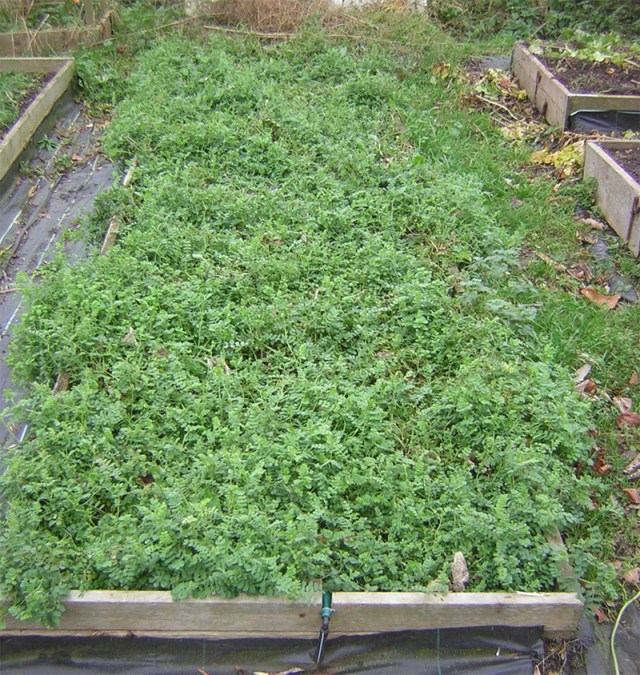
Tares

Tares – great for releasing nitrogen quickly in the spring after digging in

Ornamental Garden

A fast maturing green manure can be used to fill bare patches as spring flowers die down but before summer bedding can be planted. Green manures can also be used to revitalise tired soils where old shrubs or roses have been removed and a new planting scheme is planned. The area can be left to recuperate under a green manure for a few months or a year. Attractive green manures can be used to fill gaps around summer bedding or other plants – a low growing variety will help to smother weeds and retain moisture.

Fruit garden

Blackcurrants are ‘greedy feeders’ and can benefit from a green manure which helps to take nitrogen from the air and fixes this in the soil for plants to use. A green manure such as Tares can be grown around the fruit bushes after fruiting and then incorporated into the soil just before the next growing season – just hoeing off the tops in the spring and leaving these to decompose on the surface should do the job.

Winter – hardy green manures can be grown around the bases of fruit trees in the autumn. Helping to keep down weeds these can be cut down and left to decompose in the spring which will once again provide a valuable source of organic material for the tree. A long-term green manure, such as Clover, could also be grown around the tree – this will provide weed cover and also be a rich haven for pest – eating wildlife.

Hungarian Grazing Rye - the best gareen manure for soil improvement, especially on clay soils

Hungarian Grazing Rye – the best green manure for soil improvement, especially on clay soils

My next ‘Green Gold’ article will give some examples of different green manures and their strengths and weaknesses.

Source: ‘Green Manures’- Garden Organic Guide. September 2010

Other articles in this series: Green Gold- 7 reasons to use green manures

Old School Gardener

If you’ve enjoyed reading this post and others on this blog, why not comment and join others by signing up for automatic updates via email (see side bar, above right ) or through an RSS feed (see top of page)?

My mother – in – law is currently on a two week visit to us. A keen gardener (she was until a year ago Chair of the Tavistock Ladies Gardening club), she is not as mobile as she once was (she celebrated her 83rd birthday last week). However, she still enjoys looking at gardens so this is a great excuse (as if I needed one) to get out and about to see some interesting local gardens. The weather has also been kind so we’ve been to a few places that I haven’t been before, or haven’t seen for a good number of  years. Two of them are in Norwich, our local cathedral city, and they are fine examples of gardens developed for very different reasons; the one out of  the passion of a Victorian entrepreneur, the other based on a medieval religious garden.

The Plantation Garden

The Garden in 1897

In 1856, a prosperous upholsterer and cabinet maker living in Norwich, took a long lease on an industrial site just outside the old City walls. His name was Henry Trevor, and for the next forty years, he spent considerable sums of money and much effort transforming a chalk quarry into a magical garden.

Henry Trevor

In many ways, Henry Trevor’s garden was typical of Victorian taste and technology. He built a fountain, terraces with balustrades, rockworks, a Palm House, and a rustic bridge. He planted elaborate carpet beds, woodlands and shrubberies. He designed serpentine paths to conduct the visitor along circular routes, and he built and heated several greenhouses with boilers and hot water pipes.

Henry Trevor, however, was also a man of strong personal tastes. His “Gothic” fountain is unique, and he displayed great enterprise in using the fancy bricks from a local manufacturer to create medieval style walls, ruins and follies. Within less than 3 acres, he established a gentleman’s residence and garden that reflected in miniature the grand country houses of the Victorian period. Visitors were frequently welcomed in the garden by Henry Trevor, for he was always ready to allow his garden to be used for charitable causes.

The Garden in Victorian times- the Palm House no longer exists.

After the 1939-45 war, the garden was virtually abandoned. Fortunately, much of the structure has survived, and is gradually being restored by the The Plantation Garden Preservation Trust. The first task of its members was to clear a forest of sycamores and a blanket of ivy to reveal what had become hidden during the past 40 years. Since then, they have restored the flowerbeds, fountain, balustrading, Italian terrace, rustic bridge and in 2007, the Gothic alcove.

Trevor’s original passion has been matched by this band of volunteers and our visit, on a beautifully sunny afternoon, showed considerable progress in the restoration programme since my last visit some years ago. I was particularly impressed with the enormous amount of work done to stabilise, weed – proof and replant the steeply sloping sides of the garden, which remain topped off with a range of majestic Beech and other trees.

The Bishop’s Garden

Our second visit, on one of it’s open days in aid of local charities, was to the Bishop’s Garden, a four acre green oasis in the centre of Norwich, sitting in the shadow of the Gothic cathedral.

There has been a garden of sorts since around 1100 AD when Bishop de Losinga began to build the cathedral and palace. From the existing garden one can still marvel at the original detailing of Norman stonework on the North Transept of the cathedral which is only visible from the Bishop’s Garden.

In the early 14th century, Bishop John Salmon greatly increased the size of the garden by compulsory purchase of additional land. The general form of the garden was laid down at least 300 years ago. The lower end was cultivated and separated by a wall running straight across the garden. The colossal Old Bishops Palace which still stands was completed in around 1860. In 1959 a major change took place when a new Bishops House built and the Old Palace came to be used by Norwich School. The garden was reduced from 6 and half acres down to the present 4 acres. Records show that in the 1940s up to 15 gardeners were employed reducing to 9 in the 1950’s and today the garden is looked after by 1 fulltime and 1 part time gardener, plus a team of volunteers.

The garden has a range of features typical of many grand gardens developed over the last hundred plus years – large herbaceous borders (which have a persistent ground elder problem and are to be successively dug up and weeds systematically removed in the coming couple of years), a small woodland walk and box – edged rose beds. There is a long shade border with Hostas, Meconopsis and tree ferns, all but the latter looking splendid on our visit. There is also a large wild grass labyrinth, very popular with children (I walked it and contemplated my life as I went…). This is of a size where it can be easily mown using a ride on mower, the gardener told me that he cuts it all down in the autumn and then the path edges are left for the various wild flowers and other species to grow up over the growing season.

There are also extensive shrubberies containing many rare and unusual plants, among these being a Hebe planted from a sprig taken from Queen Victoria’s wedding bouquet in 1840. There is an organic kitchen garden and  ‘bambooserie’. The garden continues to evolve with new plants and features being introduced year by year. The Bishop’s Garden has developed links with Easton College, helping horticulture students gain valuable experience.

Though busy on our visit, including delightful music from a local Youth Orchestra and Choir, one can imagine the garden creating a peaceful mood – one where a succession of Norwich Bishops, stretching back 1000 years, paused to reflect, pray and secure spiritual renewal.

Sources and Links:

The Plantation Garden

The Bishop’s Garden

Old School Gardener

If you’ve enjoyed reading this post and others on this blog, why not comment and join others by signing up for automatic updates via email (see side bar, above right ) or through an RSS feed (see top of page)?

PicPost: Bedding scheme

Picpost: I love my bed

No, not me, not Old School Garden!

PicPost: Great Garden @ Cragside

The Formal Garden, Cragside

‘Enter the world of Lord Armstrong – Victorian inventor, innovator and landscape genius. Cragside house was truly a wonder of its age.Discover the first house in the world to be lit by hydroelectricity. It is crammed full of ingenious gadgets – most of them still working. The gardens are incredible. One of the largest rock gardens in Europe leads down to the Iron Bridge, which in turn leads to the formal garden. Children will love our adventure play area and exploring Nelly’s Labyrinth, a network of paths and tunnels cut out of a vast area of rhododendron forest.’ (National Trust website)

Old School Gardener

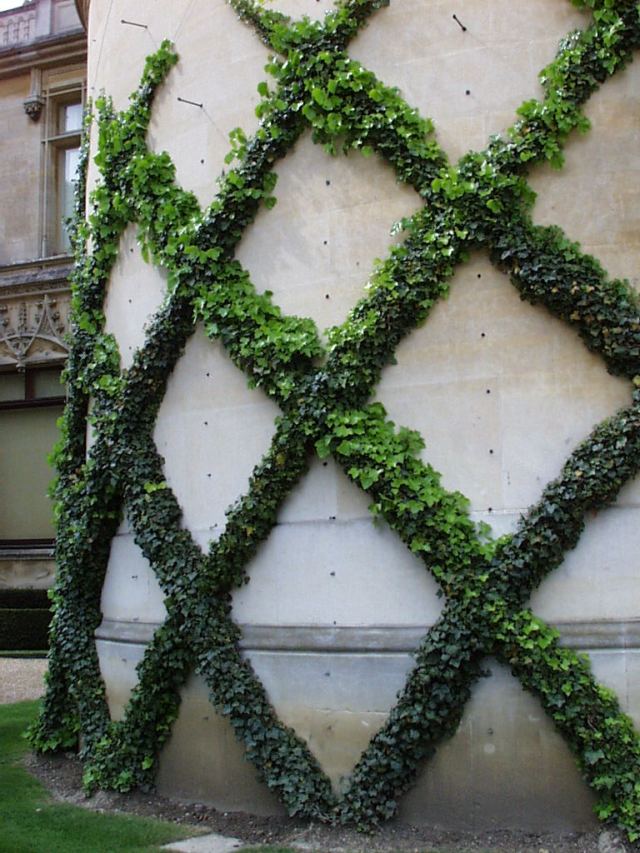
ivy

Waddesdon Manor was built by Baron Ferdinand de Rothschild in 1874 to display his outstanding collection of art treasures and to entertain the fashionable world.The 45 rooms on view combine the highest quality French furniture and decorative arts from the 18th century with superb English portraits and Dutch Old Masters. The Victorian garden is considered one of the finest in Britain with its parterre, seasonal displays, fountains and statuary. At its heart lies the aviary, stocked with species once part of Baron Ferdinand’s collection.’

Source and further information:

National Trust Website

Wikipedia

Waddesdon Manor Website

Old School Gardener

Finding Nature

Nature Connectedness Research Blog by Prof. Miles Richardson

Norfolk Green Care Network

Connecting People with Nature

Discover WordPress

A daily selection of the best content published on WordPress, collected for you by humans who love to read.

Susan Rushton

Celebrating gardens, photography and a creative life

Unlocking Landscapes

Writing, photography and more by Daniel Greenwood

Alphabet Ravine

Lydia Rae Bush Poetry

TIME GENTS

Australian Pub Project, Established 2013

Vanha Talo Suomi

The Journey from Finnish Rintamamiestalo to Arboretum & Gardens

Marigolds and Gin

Because even in chaos, there’s always gin and a good story …

Bits & Tidbits

RANDOM BITS & MORE TIDBITS

Rambling in the Garden

.....and nurturing my soul

The Interpretation Game

Cultural Heritage and the Digital Economy

pbmGarden

Sense of place, purpose, rejuvenation and joy

SISSINGHURST GARDEN

Notes from the Gardeners...

Deep Green Permaculture

Connecting People to Nature, Empowering People to Live Sustainably

BloominBootiful

A girl and her garden :)