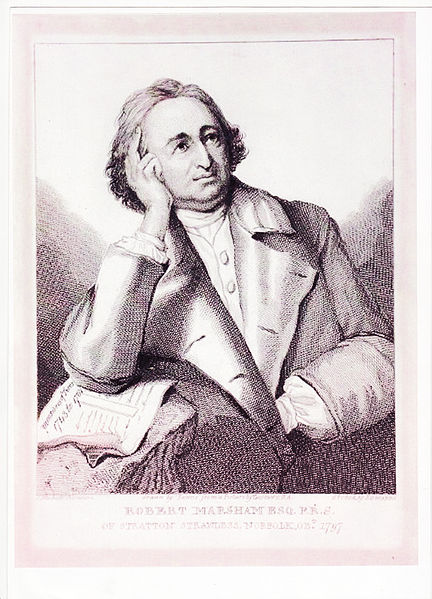
Robert Marsham – portrait by Zofany
On a recent walk around my neighbouring village of Stratton Strawless, I visited the church and the exhibition to its most famous inhabitant, Rober Marsham. One of the oldest families in Norfolk, the Marshams held substantial estates in and around Stratton Strawless for about four centuries.
Stratton Strawless Church contains some outstanding tombs and memorials to the Marshams. The Marshams lived at Stratton Strawless Hall (just off the A140 Norwich to Cromer Road) which was completed early in the 19th Century and had extensive landscaped grounds. Humphry Repton, the famous landscape gardener and great admirer of Robert Marsham’s tree planting work, described the estate as: “a gem made out of a common by Robert Marsham”. Apart from this large scale landscaping and an avid interest in trees, Marsham is best known as the ‘father of phenology’.

Stratton Strawless Church- roof and candelabra

Wall hanging- ‘Tree of Life’

Marsham family tomb

Stratton Strawless Hall
What is phenology?
Phenology is the study of the times of recurring natural phenomena, especially in relation to climate. Robert Marsham was a meticulous recorder and he was the first to log the effects of nature and seasonal change. In 1736, Robert Marsham commenced this series of records that eventually developed into his 27 ‘Indications of Spring’. These included:
- The first snowdrops
- The first swallows seen
- The first songs of migrant birds
- The first butterflies in Spring
- The first cuckoo call
- Leafing dates of trees
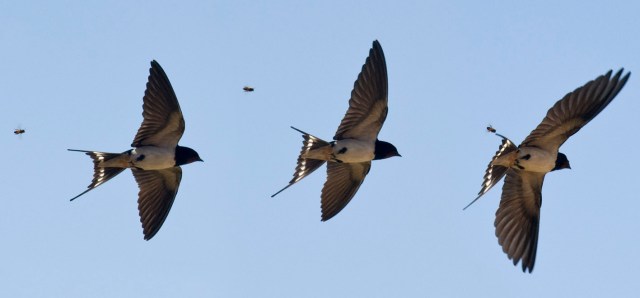
The first Swallow an indicator of spring
Historically, in Japan and China the time of cherry and peach trees blossoming is associated with ancient festivals and some of these dates can be traced back to the eighth century. In the UK the first individual records that have been found date back to 1684. Robert Marsham was Britain’s first systematic recorder of seasonal events and recorded his ‘Indications of Spring’ until his death in 1798. His vast database was reported to the Royal Society in 1789, the same year Gilbert White published his Natural History of Selborne. In 1875 British phenology took a major leap forward when the Royal Meteorological Society established a national recorder network. Annual reports were published up until 1948.
Marsham provided a fascinating insight into the winter of 1739/40, the coldest year on record, when the contents of his chamber pot frequently froze overnight and the turnip crop was completely destroyed! Turnips, a Norfolk speciality, were also monitored by Marsham. He regularly recorded turnip flowering dates (needed when turnips were to produce seed) and he noted one year:
‘My farm produced me a turnip that was 19lbs and 2 oz and 39 and a half inches round.’
Marsham’s great interest in trees resulted in him being elected a Fellow of the Royal Society in 1780. Most of his tree plantings were felled for much needed timber in the First and Second World Wars and other parts of the estate were ploughed over. What is left are a few ancient trees, the remains of his avenue of oaks, and particularly his Giant Cedar (planted in 1747).This Cedrus atlantica was planted as an 18 inch sapling. It stands to the east of Stratton Strawless Hall and when measured in 2000 it measured 102 feet high and had a circumference of 23 feet.

The Giant Cedar standing above surrounding woodland
Most of Marsham’s writings haven’t survived. However, there are articles he published in journals, some of his letters to others, and some Victorian transcriptions from his diaries. These present a picture of a man of science with an obsession with trees. James Grigor described him as “an individual who excelled all his contemporaries, in this quarter, in the work of planting, of whom his oaks form the most fitting of all memorials”. His views on planting had a wider impact as they were very influential on Humphry Repton’s landscape designs. He was also one of the first to experiment with root cutting, trenching and bark-scrubbing. He was preoccupied with improving tree growth and continually tested unorthodox methods of pruning and thinning in his forest plantations.
The first snowdrop flower an indicator of spring
Following his death in 1797 successive generations of his family continued to record the signs of spring right up to 1958. At the time nobody realised how important these records would become. Today, with concern over climate change and its impact on wildlife and the natural world, these records have become of global importance as one of the longest and best sets of records linking climate and the natural world. A friend and fellow gardener of mine, Mary Manning, has maintained her own set of spring flowering records in Norfolk since the 1960’s.
Marsham’s records can now be compared to temperature records and provide strong evidence of how global warming is leading to earlier springs. His records for Hawthorn show how for each 1°C of temperature rise, leafing can occur up to ten days earlier. Today, a website – ‘Natures Calendar’ – operated by the Woodland Trust, enables everyone to record their own ‘indications of spring’ data. This website also contains lots of useful information about recent seasonal indications and educational resources.
Another legacy of the Marsham family is the Marsham Arms Pub just a couple of miles from my home and a favourite ‘watering hole’ of mine! It was founded by Robert’s grandson, also named Robert, in 1832, as a hostel for homeless farm labourers.
Sources and links:
Wikipedia
Norfolk Wildlife Trust
Robert Marsham tricentenerary
Nature’s Calendar
Woodland Trust
Phenology Wheels
US National Wildlife Federation- phenology
Old School Gardener
If you’ve enjoyed reading this post and others on this blog, why not comment and join others by signing up for automatic updates via email (see side bar, above right ) or through an RSS feed (see top of page)?

 A grass -free ‘Floral Lawn’ has been opened today in Avondale Park, West London. It’s plants, which include daisies, red-flowering clover, thyme, chamomile, pennyroyal and Corsican mint, create a “pollinator-friendly patchwork” – with 25% more insect life than that found in “traditionally managed grass lawns”.
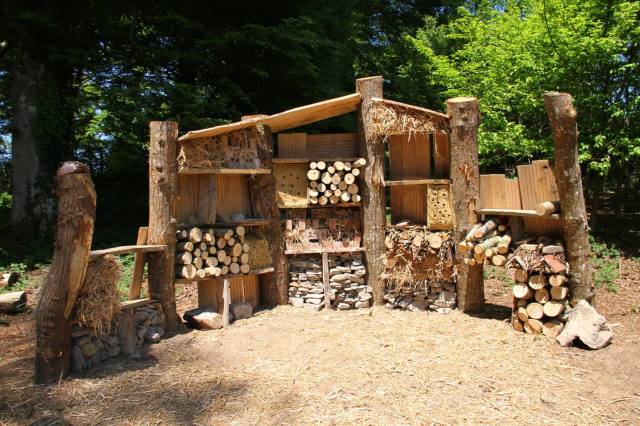






 Old School Garden