Category: This and that


Brigid Jackson's avatararistonorganic

ESSENTIAL OIL NATURAL PEST REPELLENTS
Insect Essential Oil
Ants – peppermint, garlic, citronella
Aphids – peppermint, cedarwood, hyssop
Black Fly – lavender, tagetes
Caterpillars – peppermint
Fleas – lemongrass, citronella, lavender
Flies – lavender, citronella, peppermint, basil
Gnats – citronella, patchouli
Lice – peppermint, cedarwood
Mosquitoes – lavender, citronella, lemongrass
Slugs – garlic, cedar wood, pine
Snails – cedarwood, pine, garlic, hyssop
Ticks – thyme, citronella, sage
Weevils – sandalwood, citronella, sage

OLYMPUS DIGITAL CAMERA

GOOD COMPANIONS
Vegetable Essential Oil
Asparagus basil
Green beans lavender, basil
Beetroot marjoram
Broccoli basil, thyme
Cabbage peppermint, sage, thyme
Cauliflower thyme
Celery geranium
Cucumber sage
Leeks hyssop
Lettuce tagetes
Onions chamomile
Peas geranium
Potatoes basil, sage
Tomatoes basil

View original post

Tim Gill's avatarRethinking Childhood

I am pleased to say that I will be returning to Australia this July and August for another series of talks and workshops, visiting Melbourne, Perth, Adelaide and Brisbane. There is a full itinerary at the end of this post. My diary on this trip is very full, so I will have limited opportunities for additional visits and meetings. However, I will try to share some of my thoughts and experiences here, as on previous trips. One question has been on my mind for a while: are Aussies more well-disposed towards children as a group than we are in the UK? Does Australia as a nation care more about the freedoms it allows its children than we do here in the old country?

View original post 669 more words

IMG_6053” ‘T was a hot afternoon, the last day of June and the sun was a demon….”

Remember the tune? I’ll give you the title and artist at the end of this article….

Well Sunday afternoon was certainly hot (the hottest day of the year so far) and whilst some may have headed for the beach, hundreds found their way to Gressenhall Farm & Workhouse Museum, Norfolk.

One of the Museum’s ‘Days with a difference’, the event saw a range of stalls selling, advising and demonstrating garden – related topics. I was there for the afternoon as a Master Gardener, offering advice on growing your own food, composting and just enjoying a chat or two with some seasoned garden folk. I particularly liked the ornamental ironwork display with some large pieces that would look good as eye catchers in the garden. And there was a very interesting vegetable stall selling plug plants of some unusual varieties – if I had more space in my kitchen garden I’d have bought some! Here’s a gallery of some of the stalls and their offerings.

And the gardens at the museum (you may recall that I’m a volunteer gardener here), also drew many positive comments and questions about the plans looking good at present – especially the ranks of Salvia sylvestris ‘Mainacht’ fronted by a low hedge of Lavandula angustifolia ‘Little Lady’ just coming into flower. The other gardens also looked good – the ‘Rambling Rector’ rose a colleague and I carefully pruned and tied in earlier in the year is particularly floriferous , tumbling over the metal arbour in the Wildlife Garden as well as draping one of the museum’s walls. Anmd the veg in cherry tree Cottage is starting to fill up the beds well. The Cafe Garden, looked after by volunteer Sue, is superb this year with a varied display of shrubs and perennials witha good mixtures of height, form and colour. Here are some pictures of some of the gardens and the newly reopenend ‘Seed Merchant’s Shop’ on the day.

…and the song?  ‘Summer (the first time)’ by Bobby Goldsboro (1973) – a classic summer song!

Relive it here:

Old School Gardener

If you’ve enjoyed reading this post and others on this blog, why not comment and join others by signing up for automatic updates via email (see side bar, above right ) or through an RSS feed (see top of page)?

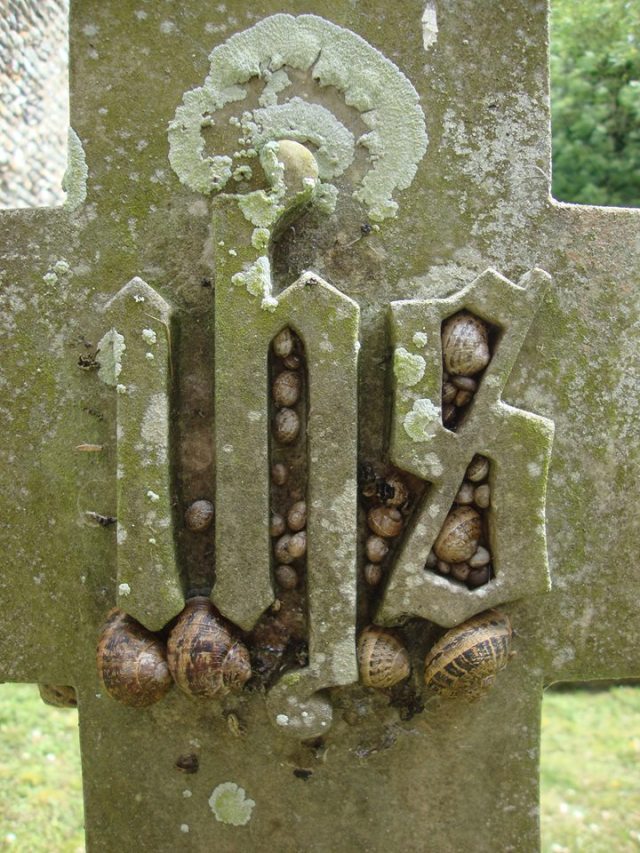
PicPost: Dodman's Rest

Tombstone at Weybourne, Norfolk via http://www.ournorfolk.org.uk

‘A dodman (plural “dodmen”) or a hoddyman dod is a local English vernacular word for a land snail. The word is used in some of the counties of England. This word is found in the Norfolk dialect, according to the Oxford English Dictionary. Fairfax, in his Bulk and Selvedge (1674), speaks of “a snayl or dodman.”

Hodimadod is a similar word for snail that is more commonly used in the Buckinghamshire dialect.

Alternatively (and apparently now more commonly used in the Norfolk dialect) are the closely related words Dodderman or Doddiman. In everyday folklore, these words are popularly said to be derived from the surname of a traveling cloth seller called Dudman, who supposedly had a bent back and carried a large roll of cloth on his back. The words to dodder, doddery, doddering, meaning to progress in an unsteady manner, are popularly said to have the same derivation.

A traditional Norfolk rhyme goes as follows:

“Doddiman, doddiman, put out your horn,
Here comes a thief to steal your corn.”

Source: Dictionary of Phrase and Fable, E. Cobham Brewer, 1894

The ‘inventor’ of ley lines, Alfred Watkins, thought that in the words “dodman” and the builder’s “hod” there was a survival of an ancient British term for a surveyor. Watkins felt that the name came about because the snail’s two horns resembled a surveyor’s two surveying rods. Watkins also supported this idea with an etymology from ‘doddering ‘ along and ‘dodge’ (akin, in his mind, to the series of actions a surveyor would carry out in moving his rod back and forth until it accurately lined up with another one as a backsight or foresight) and the Welsh verb ‘dodi’ meaning to lay or place. He thus decided that The Long Man of Wilmington was an image of an ancient surveyor.’

Source: Wikipedia

IMG_6025

‘Iron Man’ Gorilla outside the County Council tent- one of many hand painted gorillas that have just been put on display around Norwich in aid of a local children’s charity.

Yesterday I spent an enjoyable day at the Royal Norfolk Show, the County’s long established ‘agriculture plus’ event that has its own show ground at Easton near Norwich. My main reason for being there was to help man the ‘Master Gardener’ and ‘Master Composter’ stand, offering information and advice about growing food at home and, of course, how to compost effectively.

Before this afternoon stint I was able to stroll around, camera in hand, and soak up the atmosphere on this first of the two day show. Over both days the organisers are expecting around 90,000 people to attend, and they are aiming to ‘break even’ financially. It’s interesting that the show has managed to survive the tough financial times as some other county shows have folded completely due to dwindling attendances, not moving with the times or a lack of facilities to cope with poor weather. No signs of that at Easton, where there was a busy, joyful atmosphere, especially as the weather (until the very end of the afternoon) was warm and sunny.


As expected the crowds were a curious mix of ‘old and new’, or perhaps more accurately, different social groups  – the well dressed ‘County Setters’ in their blazers, shirts and ties, flowery hats and summer dresses (most involved in farming in some way), alongside groups of school children and more casually dressed families, teenagers and older couples. A microcosm of the local community in what remains predominantly a rural, agricultural County. Of course an agricultural show wouldn’t be the same without the ranks of huge and intricate machinery, some old, some brand spanking new as well as age-old crafts like horse shoeing and sheep shearing – including an impressive display by the Gressenhall Fam Manager, Richard Dalton, using a set of 100 hundred year old hand cranked clippers!


It’s always impressive to see some of the ‘beasts’ entered for the various cattle, horse, pigs and other animal competitions and the efforts put into their grooming and presentation for the judges. On the horticultural front there was an impressive floral display in one marquee, including some delightful orchids, chrysanthemums and looser mixed arrangements of garden plants nicely in flower and leaf. There were also some amazing floristry displays and the usual competitions for different types of home grown fruit and veg- some impressive Gooseberries caught my eye in particular. I managed to come away from the Norwich and Norfolk Horticultrual Society ‘plant tombola’ with a hand full of very nice seed packets, so I now have a supply of purple Pansies, Amaranthus, Morning Glory and Carrots to add to my seed bank!


And the varieties of food on offer reinforced the summery feel too – tumblers full of freshly cut fruit, strawberries and cream and of course ice cream a plenty. And not wasting food was one of the key messages of the Norfolk Waste Reduction Team’s display, which also hosted the Master Composter/Gardener stalls, along with some fascinating crabs illustrating the work of the Fisheries Conservation Agency. This was a great draw for the children who continually asked ‘which one is the most dangerous?’- in truth none of them really, as despite their fierce looking claws, the staff were able to pick them up to show the to the crowds without any apparent fear – or nipping!


My afternoon was spent talking to show goers about growing their own food and composting. I had some very interesting chats including a teacher from a local High School who teaches horticulture there and sounds to have a splendid school garden, several couples about starting or improving their compost, helping children to make paper pots and sow seeds to take home (along with all the other ‘trophies’ they collected from the stalls at the show), and other show goers clearly just enjoying growing their own food and with whom I shared tales of the late spring, compared potato growth rates and discussed rhubarb diseases.  The next door County Council tent with which we were associated also put on a splendid carousel of displays and activities (including live music) illustrating the array of ways in which the Council serves Norfolk – in fact it (and we) were so good that the whole stand won the Show’s top prize for ‘trade’ stands, so congratulations all round!

So, as you can tell, I had both a very pleasant day out – and one that boosted my energy, interest and optimism for gardening!

Old School Gardener

If you’ve enjoyed reading this post and others on this blog, why not comment and join others by signing up for automatic updates via email (see side bar, above right ) or through an RSS feed (see top of page)?

PicPost: Echeveria

iLandscape.com

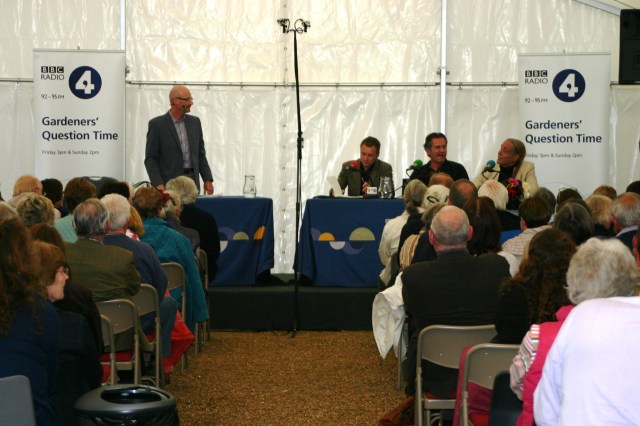
The GQT Panel doing their stuff

The GQT Panel doing their stuff

200 eager gardeners packed the marquee at Gressenhall Farm & Workhouse Museum, Norfolk yesterday. Rather than post my own article answering gardeners’ questions I thought I’d devote this week’s GQT to a report on the real thing!

Well, it turned out to be a fascinating event, especially watching the ‘well oiled machine’ that is GQT in operation. Celebrating its 65th year of broadcasting this year the programme, as chairman Peter Gibbs said, ‘has become a national institution’ attracting some 2.5 million listeners a week. Pleading with the audience not to blame him for the recent weather (for non Brits he’s a well-known TV and Radio weather forecaster as well as a keen gardener), he recalled his time in Norfolk and visiting the Museum with a young family about 15 years ago. He went on to chair not one but two editions of the programme (I’ll give you broadcast dates later). And we were not disappointed with either the range and quality of the questions or the depth and humour of the Panel’s answers.

Earlier I had been involved in a ‘pre recording’ session with some fellow gardeners and the original Museum curator, Bridget Yates. Matthew Wilson and Bob Flowerdew, two of the panelists quizzed us on the history of the place and some of the more recent developments in the gardens. I was mightily impressed with the professionalism of the production team and the two panelists who seemed to conjure an interesting and relevant discussion from the barest of facts – you’ll have to listen in for the full version!

The GQT Team at Gressenhall- from left: Matthew Wilson, Chris Beardshaw, Peter Gibbs, James Wong and Bob Flowerdew

The GQT Team at Gressenhall- from left: Matthew Wilson, Chris Beardshaw, Peter Gibbs, James Wong and Bob Flowerdew

After this I was pleased to have the opportunity of interviewing Matthew Wilson myself, for the online newspaper ‘The Breckland View’. A well known Garden Designer and Director of an historic plant nursery in London, Matthew talked about his (positive) impressions of the Museum gardens and we went on to talk about growing food at home. Matthew believes this is important, not only for the freshness and flavour of the home-grown produce, but as a way for people to ‘reconnect’ with nature in an increasingly ‘virtual’ world. Though his own garden is small, he tries to ensure that his young children are able to experience nature and growing things close up. He seems to be undecided on the ‘GM or not GM’ debate, as frustrated as me on the apparent lack of ‘hard’ evidence to help us decide how to proceed with the urgent business of ‘feeding the world’, though he feels we can still achieve improvements in crops from some of the older techniques of selection and breeding.

The Question time proper featured a dazzling array of questions. The panelists – serial Chelsea gold – winning medallist Chris Beardshaw and ‘new wave’ botanist James Wong  joined Matthew on stage for the first session  – seemed effortless in their answers to questions as diverse as:

  • whether the museum’s collection of historic gardening books and other material is still relevant (a resounding ‘yes’ from all to that one),
  • trying to explain why one poor gardener could only produce some ‘micro rhubarb’ (pencil thin stalks 10 centimetres long) – the ‘answer lies in the soil’ it would seem, specifically the lack of rich, organic matter and the right position, according to Matthew
  • what kinds of veg could be grown in a wet and dismal summer – James came up with some interesting oriental varieties that in a normal hot dry summer would bolt, but in a more dim and damp period would turn out just right
  • selecting some ‘exotic’ but hardy plants for a patio. Chris initially shocked his audience with a suggestion of ‘black negligee and stockings’, but quickly added that these were references to some interesting plants – sorry, the names have eluded me after the initial image he created…!

And I can confirm that, as the programme repeatedly states, the panel were not privy to the questions before they were asked! The audience was very receptive to the ongoing banter and humour between the panelists and seemed to maintain their enthusiasm right through a second session (where James was substituted by well-known Norfolk organic gardener Bob Flowerdew). Chairman Gibbs praised our fortitude and two hours later it was all over! It had been an enjoyable evening and one where gardening colleagues were welcomed from far and wide the gardening Team from Peckover House, Wisbech and Master Gardeners from King’s Lynn being some of the furthest travelled.

The first programme should be broadcast at 3pm on Friday 5th July (repeated Sunday 7th July 2pm) and the second (from a more anonymous ‘Norfolk’ location this one) on the 23rd/25th August. So, tune in to BBC Radio 4 at these times (or try it online via www.bbc.co.uk, on their ‘i player’ or ‘listen again’ facility if you can’t listen ‘live’).

And for anyone within striking distance of Gressenhall this weekend, the Museum has a special interest day on Sunday focused on gardens and gardening, so why not pop along and meet me at the Master Gardener stall, visit the many other attractions on offer and see the gardens, which I must say are looking splendid (but then again I would say that)!

Thanks to Kings Lynn Community Allotment for the photographs

Old School Gardener

If you’ve enjoyed reading this post and others on this blog, why not comment and join others by signing up for automatic updates via email (see side bar, above right ) or through an RSS feed (see top of page)?

shinealightproject's avatarShine A Light

By Dayna Woolbright

“If you want a golden rule that will fit everything, this is it: Have nothing in your houses that you do not know to be useful or believe to be beautiful.” William Morris

The words of William Morris seemed to be an appropriate introduction to a blog focusing on the Arts and Crafts movement. My inspiration for this topic came from crates 17 and 18 which contained a beautiful collection of Arts and Crafts furniture which came into the Norwich social history collection in 1995 as a bequest from a Mr D.W ­­Harvey of Norwich. The collection contained 22 objects and records state that much of the furniture was made by the donor’s father in the early 1900’s when the Arts and Crafts movement was at the height of its popularity.

Beginning in Britain around 1870 the Arts and crafts movement was the result of a reaction to…

View original post 1,509 more words

deltagardener's avatarThat Bloomin' Garden

I love growing vegetables but sometimes it can be especially challenging. I garden organically so that means I don’t use synthetic fertilizers or any type of pesticides on my garden. When growing organically you have to learn how to use some simple techniques to ward off pests in the garden. Some pests don’t do very much damage and certain levels can be tolerated. For example, if you have some chewed leaves on your radishes it’s not such a big deal as you probably don’t eat the leaves. It’s important to note that just noticing chewed leaves could mean this is a sign for a potential problem and you should keep a close eye out for pests. The one I will be covering today is hidden among the leaves as its green and blends in so well.

cabbage moth larva


The larva of the cabbage moth is a voracious eater. Here is a…

View original post 464 more words

sethsnap's avatarsethsnap

Red hearts lined with yellow tips, thoughts of distance and alien places, and smells of sweet goodness entered my mind and made a dream.  Purple towers that stretch far into the heavens followed.  Most find these beautiful and relaxing.  To me, these are reminders of all the work I still have left to do in my short life.  Long live the queen.

View original post

Finding Nature

Nature Connectedness Research Blog by Prof. Miles Richardson

Norfolk Green Care Network

Connecting People with Nature

Discover WordPress

A daily selection of the best content published on WordPress, collected for you by humans who love to read.

Susan Rushton

Celebrating gardens, photography and a creative life

Unlocking Landscapes

Writing, photography and more by Daniel Greenwood

Alphabet Ravine

Lydia Rae Bush Poetry

TIME GENTS

Australian Pub Project, Established 2013

Vanha Talo Suomi

The Journey from Finnish Rintamamiestalo to Arboretum & Gardens

Marigolds and Gin

Because even in chaos, there’s always gin and a good story …

Bits & Tidbits

RANDOM BITS & MORE TIDBITS

Rambling in the Garden

.....and nurturing my soul

The Interpretation Game

Cultural Heritage and the Digital Economy

pbmGarden

Sense of place, purpose, rejuvenation and joy

SISSINGHURST GARDEN

Notes from the Gardeners...

Deep Green Permaculture

Connecting People to Nature, Empowering People to Live Sustainably

BloominBootiful

A girl and her garden :)