Category: This and that


canwefeedtheworld's avatarOne Billion Hungry: Can We Feed the World?

mpg-with-text A major challenge for those working in international development is being able to understand the lives and needs of people in developing countries and being able to understand the challenges facing global decision makers. More and more online games are being developed by the international development community to help us gain insight into global development challenges and increase engagement around these issues, albeit in a virtual world. Here’s a list of some of these online games.
  1. Cyber Nations – Allows you to create and rule a nation, choosing a government type, a national religion, tax rate and more. You can choose and purchase infrastructure, land to expand your borders, technology to increase your effectiveness, and military to defend your national interests. You can build trading ports to enhance your ability to trade with other nations, build clinics and hospitals to increase your total population, invest in schools and universities to…

View original post 448 more words

canwefeedtheworld's avatarOne Billion Hungry: Can We Feed the World?

ID-10013909 Land use change, while most often associated with the loss of natural habitat, could be a cost-effective method of reducing greenhouse gas emissions and conserving threatened species. A new study in Nature entitled, Cheap carbon and biodiversity co-benefits from forest regeneration in a hotspot of endemism , investigated carbon stocks, biodiversity and economic values in the western Andes of Colombia, a threatened ecosystem rich in endemic species where land is predominantly used for cattle farming.

Results of the study found that if farmers were to allow forest to regenerate on their land, foregoing cattle farming, they would match or increase their current incomes through receiving payments for carbon. Under current carbon markets the price per tonne of carbon dioxide trees remove from the atmosphere is $1.99. Farmers’ land would be leased for 30 years and they would be paid for the carbon grown.

Aside from the benefits for climate change…

View original post 305 more words

Gardening-Boots2Two new rounds of my courses on Garden Design and Grow Your Own Food for Beginners start soon, and I’m also offering a new, one day course on Wildlife Gardening. I ran the last Garden Design course earlier this year and had great feedback on it (I even had a thank you present from the students!). All the courses feature a lot of group discussion and some practical tasks as well as useful tips and tricks to help particpants apply what they learn to their own plots.

The Garden Design course takes students through a customised design process, prompting a fresh look at participants’ own gardens, giving them the opportunity to develop their own ideas in a systematic way and benefitting from ideas generated in the whole group. I support participants to draw up their own scale plan design for their garden and supply plenty of useful background information and links to helpful web sources as well as the opportunity to borrow from my own garden book library. The course can also feature a visit to a well known garden to look at design ideas in practice.

The ‘GYO’ course is aimed at food-growing beginners or novices and gets off to a flying start with making paper pots and sowing broad bean seeds. It also prompts students to look at what they want to eat/grow and how they might do this most effectively in their own plots – this can include growing in containers for those with little or no garden.The course includes a visit to Old School Garden to look at my own approach to food growing, and covers topics like soils and soil improvement, growing under glass, encouraging beneficial wildlife into your garden and how to effectively control pests and diseases.

Narrow beds in the Kitchen Garden at Old School GardenNarrow beds in the Kitchen Garden at Old School Garden

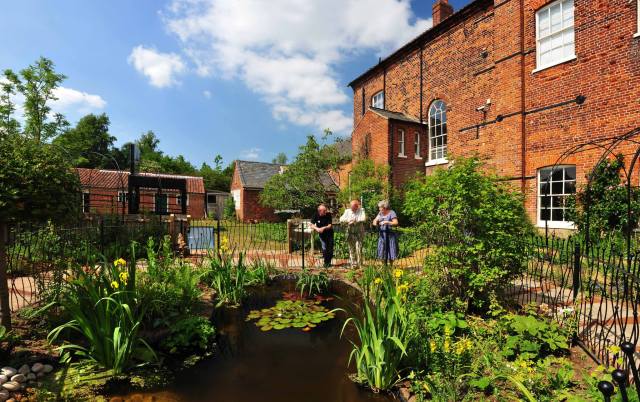
The one day Wildlife Gardening course, taking place at Gressenhall Farm and Workhouse Museum, makes use of the Wildlife Garden at the Museum and includes some practical work to help develop the wildlife -friendly features there as well as helping participants to focus on their own gardens and gardening practices. The aim is for them to develop  their own action plans for the future.

The Wild life Garden at Gressenhall Farm and Museum

The Wild life Garden at Gressenhall Farm and Museum

The courses are fast filling up but there are some places still available if you’re quick!

They are running as follows:

Garden Design–  6 Monday evenings, 7pm-9pm at Reepham High School & College, commencing on 12th May.

Grow Your Own Food for Beginners – 6 Wednesday evenings, 7pm-9pm at Reepham High School and College, commencing 14th May.

Get more details and how to enrol at www.reephamlearningcommunity.co.uk

Wildlife Gardening- Sunday 18th May, 10am-4pm at Gressenhall Farm and Workhouse Museum, near Dereham.

For more information on this and other short courses at the Museum see www.museums.norfolk.gov.uk

Old School Gardener

canwefeedtheworld's avatarOne Billion Hungry: Can We Feed the World?

ID-10083575 In Africa over 200 million people are aged between 15 and 24, the youngest population in the world. This age group according to the African Economic Outlooks is expected to double in number by 2045. Low profitability, poor security of land tenure, and high risks are just some of the reasons Africa’s youth are leaving rural areas to seek jobs in cities, a migration that could see Africa with a shortage of farmers in the future. Given that agriculture is one of the continent’s biggest economic sectors, generating broad economic development and providing much of the population with food, this poses a serious threat to the future of farming and to meeting the demands of a rapidly growing urban population. Growing youth unemployment, ageing farmers and declining crop yields under traditional farming systems mean engaging youth in agriculture should be a priority.

Recent articles highlight this key challenge and suggest…

View original post 853 more words

canwefeedtheworld's avatarOne Billion Hungry: Can We Feed the World?

ID-10064167“For all things come from earth, and all things end by becoming earth.” Xenophanes, 580 B.C. You could, in reading this quote, be mistaken in thinking that the soil is a regenerating, renewable resource. Soil is formed from slowly decomposing rocks, sediment and organic matter. This process is so slow in fact that it takes 2,000 years to build 10cm of topsoil, such an unhurried rate of growth that soil should be thought of as finite, non-renewable and a resource that needs to be protected.

Healthy soils provide a variety of ecosystem services such as nutrient cycling, water regulation, flood protection, habitats for biodiversity and food production. For approximately 1 to 1.5 billion people in the world land degradation is reducing some of these services, negatively impacting their quality of life and livelihoods.

So far we haven’t been doing a very good job of protecting the soil. We overuse and…

View original post 496 more words

My wife and I spent a few days in Devon recently, visiting my Mother – in – Law. We had superb weather – unusual on the edge of Dartmoor – so were able to get out and about to see some beautiful places. I’ll feature a few of the great gardens we saw over the next few weeks, but almost our first outing was to a famous Dartmoor nature reserve and ancient copse, called ‘Wistman’s Wood’. Some of the trees are at least 400 years old – gnarled and almost dwarf oaks – and I managed to get some photographs to capture our afternoon visit in the sun. It’s such a mysterious and peaceful place I was moved (not been that for a while) to try my hand at some ‘poetry’ to accompany the pictures, so here goes….

‘In Wistman’s Wood

In Wistman’s Wood
A tumbled dwarf in valley ‘scape,
Rising with a greying ghostly hue.
Ancient Oaks clinging to life, entombed in rocks.
All engulfed in mossy fernery and silver beards,
Branch and trunk home to more lowly life,
In Wistman’s Wood.

In Wistman’s Wood
Strong sun casts a net of shade
Not yet filled by new young leaves.
And what of night or winter time?
Moonlight, mist and chattering cold-
Apt setting for moorland fairy tales,
In Wistman’s Wood.

In Wistman’s Wood
Sounds gentle on a spring day;
Rushing of the young Dart and
Bathed by the soft breeze,
Cut with children’s shout and ‘copter whirr.
Lone sheep a munching on meagre growth,
In Wistman’s Wood.

In Wistman’s Wood
Hear still and little life;
See nature stretched;
Smell moorland peaty damp;
Touch stone and twisted, mossy wood.
Taste sweet water
In Wistman’s Wood’

And here is a series of photos just in case that was all a bit too vague…


This slideshow requires JavaScript.

Old School Gardener

Lancelot Capability Brown's avatarLancelot Capability Brown

It’s William Shakespeare’s 450th Birthday celebration, and therefore another golden opportunity to talk about Lancelot ‘Capability’ Brown. But what is the connection you may ask? Brown was born a clear century after Shakespeare passed away!

View original post 611 more words

canwefeedtheworld's avatarOne Billion Hungry: Can We Feed the World?

ID-100236071 Hailed as the latest technological advance that could revolutionise development and agriculture (along with other sectors), “big data” has been the focus of several recent articles, most notably a series of articles published by SciDev.Net. In June 2013 a UN High level panel called for a “data revolution” emphasising the need for better data to track progress towards development goals. But what is big data and how can it aid poverty and hunger eradication?

Big data is not just large amounts of information but rather it’s about integrating infrastructure to collect data at every step of the development process and designing new data collection methods that can track development goals effectively. In particular, big data is being hailed as the big fix for the lack of reliable official statistics in developing countries. But there is no clear (agreed upon) definition of big data, one article stating “it is data…

View original post 1,071 more words

Finding Nature

Nature Connectedness Research Blog by Prof. Miles Richardson

Norfolk Green Care Network

Connecting People with Nature

Discover WordPress

A daily selection of the best content published on WordPress, collected for you by humans who love to read.

Susan Rushton

Celebrating gardens, photography and a creative life

Unlocking Landscapes

Writing, photography and more by Daniel Greenwood

Alphabet Ravine

Lydia Rae Bush Poetry

TIME GENTS

Australian Pub Project, Established 2013

Vanha Talo Suomi

The Journey from Finnish Rintamamiestalo to Arboretum & Gardens

Marigolds and Gin

Because even in chaos, there’s always gin and a good story …

Bits & Tidbits

RANDOM BITS & MORE TIDBITS

Rambling in the Garden

.....and nurturing my soul

The Interpretation Game

Cultural Heritage and the Digital Economy

pbmGarden

Sense of place, purpose, rejuvenation and joy

SISSINGHURST GARDEN

Notes from the Gardeners...

Deep Green Permaculture

Connecting People to Nature, Empowering People to Live Sustainably

BloominBootiful

A girl and her garden :)