
Category: This and that
 ‘Of composts shall the Muse descend to sing,
 Following on from a previous post giving an overview of the Ouse Washes Landscape Partnership’s 25 projects which the OWLP partnership aims to deliver between now and 2017, we can now also proudly present our Landscape Conservation Action Plan!
The Landscape Conservation Plan (or LCAP) is the Ouse Washes LP partnership’s main document that was sent to the Heritage Lottery Fund, together with other paperwork for our stage 2 grant submission, back in November 2013; in short, it contains:
- A summary of the varied heritage of the OWLP landscape, explaining what is important and why;
- An overview of the issues facing the landscape, its heritage and its communities, together with an outline of the opportunities to address these issues;
- A detailed understanding of how the OWLP scheme will be addressing the needs of the landscape and communities, together with details of the projects it will carry out in order to do so…
View original post 392 more words

At Gressenhall we have over 50,000 objects. From trinkets to tractors, each one of these objects has a past, a present and, if we do our job well, a future. To look after these objects we need to know what they are and where they are. Put simply this is ‘collections management’ but what does that really entail?
Imagine for a moment if you will standing in the queue at Argos. You’re after a kettle. You would like a colour to match your kitchen and you know that it needs to be small enough to fit under your taps.
Luckily, Argos have an extensive catalogue that you can flip through to find just the thing you are looking for. The description gives you its measurements, a photograph and the code you need to purchase it. Importantly, Argos also know where it is and how to get it to you.
The…
View original post 828 more words

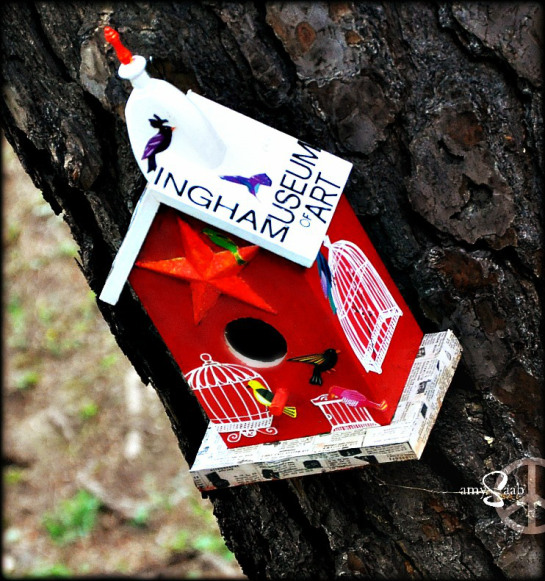
with my kids home for summer vacation, we’ve turned to making crafts in the art studio. i decoupaged the cages & the sign onto an ugly birdhouse. i do have instructions for doing so…in this blog (i think the post is titled 2me4art project birdhouses). the Birmingham Museum of Art’s gift shops bags are clear with just the name of the museum, an easy thing to cut up & use to decorate the bird house. this birdhouse is located beside my deck. easily within view of any upcoming residents.

Yesterday brought more news of a looming public health crisis. Over one in three English adults has pre-diabetes (blood glucose levels that place them at significant risk of full-blown type 2 diabetes) according to a new academic study. What is more, the proportion has more than tripled between 2003 and 2011.
Diabetes is already a huge public health problem. According to Diabetes UK, nearly one-tenth of the NHS budget (£12 billion a year) is spent on treating type 2 diabetes: lest we forget, a largely preventable illness.
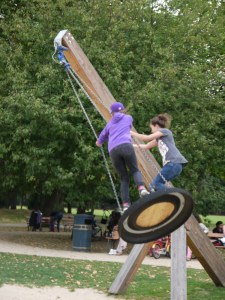 Being more physically active cuts the risk of type 2 diabetes. Physically active children are more likely to grow up to be physically active adults. And there is robust evidence that improving outdoor play opportunities boosts children’s physical activity levels. (I will say more on this when my evidence report is published shortly.) All of which adds up to a compelling…
View original post 801 more words

There were those who looked askance at the London County Council’s new Dover House Estate in 1919. Well-heeled local people in the big houses nearby expressed concern that transport links were poor for the area’s new residents. And then there was another ‘element for consideration’ – ‘that its conversion into a working-class district must enormously depreciate the rateable value of property in the vicinity’. (1)
 Dover House Road
In fact, worries that the Estate would blight the neighbourhood and would be filled by ‘very, very poor people from the bad areas of the East End’ were illusory. The Dover House Estate, initially known as the Roehampton Estate, would become a ‘show place in its day…visited by many from all over the world.’ (2) And it would house an overwhelmingly ‘respectable’ working class. Many of these worked in the public services – in public transport, as police officers or postal workers – and they…
View original post 1,927 more words

 Photo Credit: Joint Staff Public Affairs via CC Flickr
I recently read an article written by Kim Willsher on TheGuardian,com in which she told many stories of servicemen that participated in D-Day and World War 2. I thought that it would be a great share with all of you. I hope that you would take the time to remember these people and the things that they experienced during this awful time of war.
————
They stood to attention as straight as their creaking backs would allow and saluted briskly as a lone bugler high up on the old Pegasus Bridge played the Last Post. A minute’s silence followed; the men bowed their heads, dabbed their eyes and remembered the fallen.
Some made one last heroic effort to rise from their wheelchairs, others leaned on sticks or the arms of relatives and friends. Medals glinted in the morning sunshine; rows and…
View original post 1,470 more words

 Yesterday’s World Environment Day, the United Nations’ principal vehicle for encouraging worldwide awareness and action for the environment, focused on tackling climate change. This year’s theme is Raise your voice, not the sea level. First established in 1972, every year on 5th June countries around the world host seminars, events and environmental projects from cleaning up Kosovo to solar electric roofs in Barbados to plastic purges on the beaches of Sri Lanka. And there are the WED challenges.
This year is also the UN International Year of Small Island Developing States (SIDS) and part of the activities of WED were to raise awareness about the challenges SIDS face, their vulnerability to climate change and sea level rise and the urgent need to help protect the islands.
The message of WED is that our individual actions will aggregate into collective action with the power to transform, in this…
View original post 512 more words
If a single estate can be taken to encapsulate the social, political and planning history of council housing in this country it is probably Knowle West in Bristol. You’ll find in it all the hopes and dreams, all the good intentions and unintended consequences, that have marked the complex story of council housing over the last hundred years or so. And you’ll find families and communities that have lived this story in all its complexity.
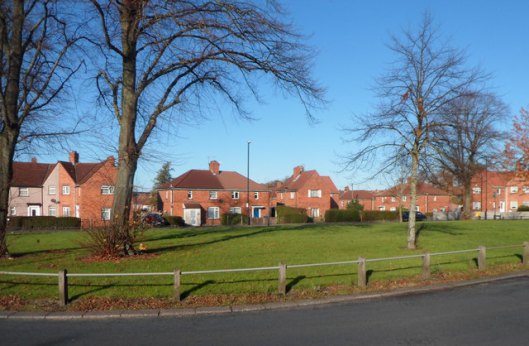 Broad Walk, Knowle © Phil Jaggery and made available under a Creative Commons licence
To begin with, let’s cast our eyes a little wider. In the interwar period, the Bedminster and Knowle Estate was the largest of Bristol’s interwar council schemes. Building began in 1920. By 1939 the estate as a whole comprised over 6000 council homes and a population of some 28,000.
As we saw in last week’s post, this was the product of three…
View original post 2,594 more words





 Old School Garden