Category: This and that


Awesome Autumn!

nymansgardenblognt's avatarnymansgardenblognt

Acer + Hydrangea = Nymans in Autumn Acer + Hydrangea = Nymans in Autumn

Nymans is often referred to as a garden for all seasons, but for many of our vistors and indeed members of the garden team, Autumn is perhaps the favourite of them all. The showy blooms of Summer may well have faded into memory but the kaleidoscope of colour at this time of year never ceases to dazzle and excite. Whether it’s the fiery foliage tones or the beautiful fruits that adorn the trees that you’re after, Nymans should certainly be top of your list of places to visit soon. In this week’s blog we’ll take you through some of the highlights that await you…

The view from the formal gardens to the Arboretum The view from the formal gardens to the Arboretum

And here it is in some more detail And here it is in some more detail

Perhaps the most obvious place to start looking for turning leaf colour is in our Arboretum and even if you can’t make…

View original post 1,360 more words

greenbenchramblings's avatargreenbenchramblings

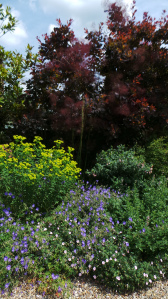
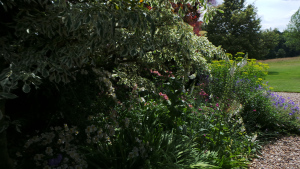
As promised for the third in my week’s posts celebrating my 500th post we go down to Hertfordshire to explore Tom Stuart-Smith’s garden designs at his own home and the home of his sister. The family home at Serge Hill is surrounded by mature planting. The new gardens  designed by T S-S are within its grounds. When these gardens open they are very popular with thousands of visitors making an appearance. It looks very busy and taking photos is difficult as the gardens are only open for one day each year as part of the National Garden Scheme, so people find it in the famous Yellow Book. The friendly herd of Guernsey calves greeted every visitor. We wandered through the gardens around the house which had been there a long time but the influence of T S-S can be seen.

2014 06 22_0703-1 2014 06 22_0671-12014 06 22_0668-1 2014 06 22_0599-12014 06 22_0600-1   2014 06 22_0604-12014 06 22_0601-12014 06 22_0609-12014 06 22_0614-12014 06 22_0612-12014 06 22_0611-12014 06 22_0610-1

In the gardens at Tom’s and his…

View original post 203 more words

canwefeedtheworld's avatarOne Billion Hungry: Can We Feed the World?

event141016-familyfarmingA series of international days as observed by the United Nations has and is taking place over several days this month.

Yesterday

Yesterday was International Day of Rural Women, the first of which occurred in 2008. The day is about recognising “the critical role and contribution of rural women, including indigenous women, in enhancing agricultural and rural development, improving food security and eradicating rural poverty.”

Rural women are crucial in attaining sustainable rural development but they often face inequalities in terms of access to productive resources, finance, health care and education. Women and girls are also more likely to be undernourished and to go without food despite the central roles they play in a household’s wealth and health. Gender equality and women’s empowerment are not only central to household welfare though but to rural communities, national economic growth and global food security. UN Women Executive Director Phumzile Mlambo-Ngcuka, in…

View original post 774 more words

Municipal Dreams's avatarMunicipal Dreams

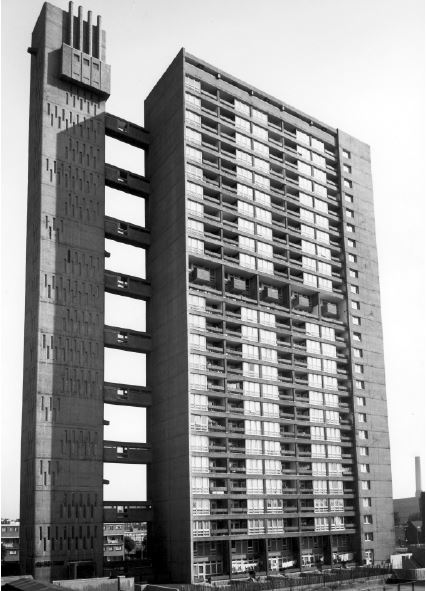
Balfron Tower is now one of the stately homes of England – a National Trust attraction no less.  Recently it’s hosted an arts season, a Shakespeare play, and it’s provided live-work accommodation for twenty-five artists since 2008.  And all that, to be honest, makes me sad because once Balfron was simply housing for the local people who needed it – although its size and style and big name architect did always get it special attention.

Photograph taken in 1969 showing original concrete chimneys to service tower boilers (from Brownfield Estate, Poplar Conservation Management Plan) Photograph taken in 1969 showing original concrete chimneys to service tower boilers (from LBTH, Brownfield Estate, Poplar Conservation Management Plan)

The site for what is currently the Brownfield Estate, in which Balfron is located, had been identified as early as 1951.  The now truncated St Leonard’s Road was one of Poplar’s principal streets; the area as a whole comprised a dense grid of old and substandard terraced housing.  The land was acquired in 1959 just as…

View original post 1,118 more words

IMG_0182

It was our second full day. We left home along mountain tracks and soon found our way onto one of the very good motorways here. I guess it took us a little over an hour to reach our destination for the day, Granada. Deborah and I had been here before, some 9 years ago, visiting our daughter who was studying at the University. I was excited about returning, especially to see the Alhambra, which was one of the experiences that turned me on to garden design.

We spent the morning and early afternoon walking the streets. Oh, and took a rather disappointing open-topped bus ride of the city, which we’d done before, but this time it seemed to be a stagger from one traffic light to the next, amidst heavy traffic and which, I guess, lacked the novelty of that first trip. Still, a nice coffee in the precincts of the cathedral and a wander around the moorish quarter, including a wonderful lunch in a restaurant overlooking the Alhambra, all made for a good start to the day.

The afternoon began with the ascent to the main entrance to the Alhambra, where pre booked tickets are essential as the place gets very busy and you need to have a time slot for the most famous bit, the Nasrid Palace. Ours was for late afternoon so we had a few hours to take in the Generalife (the adjacent palace) and the rest of the Alhambra before the real treat. I seem to remember we didn’t get much of a look around the Generalife 9 years before, so today we began there and it was well worth spending more time amongst its wonderful gardens. Here are a few pictures…

This slideshow requires JavaScript.

We wove our way through crowds towards the Alhambra and made it up to the castellated viewpoint of the Alcazaba, just in time to get to our allotted spot at the nearby Nasrid Palace. This consists of a series of interlocking rooms, chambers and courtyards or patios. It was worth the preamble.

As you enter the Palace you plunge into a room of near darkness, only to emerge into the dazzling light of the outside space. I’d forgotten how simple, peaceful and mystical the Patio of the Myrtles was, with its sheet of water and simple structural planting. I sat and took in the scene, which was rather like an outdoor cathedral- you know, even though there are people around and making noise, the space seems to dissipate and soften that so that it forms a sort of background murmur, almost of reverence?

The slow trickle of water from a fountain added to the ambience, quite a contrast to the rushing of the arched fountains in the Generalife (I’ll post a couple of videos comparing them in the next day or two). Here are some pictures of the outer Alhambra and the Nasrid Palace…

This slideshow requires JavaScript.

The moorish ornamentation of the rooms and external walls is breathtaking in its complexity, but there is an overall harmony. The light is used cleverly to provide alternating experiences of rich, internal splendour and simpler, but equally impressive outside spaces. The Patio of the Lions was altogether grander and more ornamental in style, the sort of space you can imagine political deals being concluded under the loggia, perhaps having spent time meditating on these in the previous patio? From there we gradually ‘came down’ through simple, lush outside spaces which are more expansive, but still attractive; blocks of colourful planting beginning to re-engage you with the outside world of colour and noise.

Well, I got my ‘fix’. Our drive home was a little more eventful than our outward one, as we had both darkness and rain to contend with. But we rolled safely into the Cortijo and managed a late night supper (I think it must have been 11pm before we ate) round the pool. A quieter day tomorrow, perhaps?

Further information: Granada- Wikipedia

Old School Gardener

Congratulations to Malc on his 500th post!

greenbenchramblings's avatargreenbenchramblings

To celebrate reaching 500 posts in my Greenbenchramblings adventures I thought I would create a week of posts about my favourite garden designers, Piet Oudolf and Tom Stuart-Smith. I have featured examples of their gardens several times already but these are special gardens. The Piet Oudolf garden here is his latest creation in Somerset and the Tom Stuart-Smith gardens are his own garden and the one he designed for his sister who lives just yards away.

The garden, called the Oudolf Field sits within the grounds of the Hauser and Wirth Gallery in the Somerset village of Bruton. This 1.5 acre garden was only planted this year so we visited in its very early stages. The garden is better described as a perennial meadow than his usual tall prairie. The plants are generally shorter so that more of each border and the garden as a whole can be seen at…

View original post 243 more words
PlayGroundology's avatarPlayGroundology

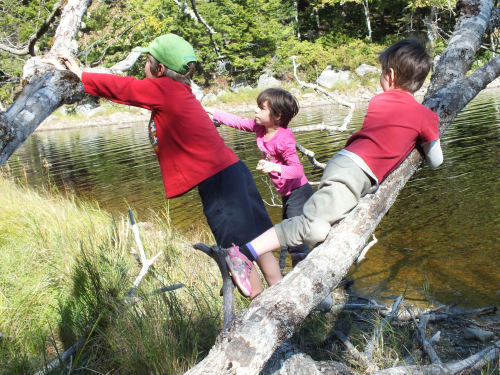
Each summer we trek a couple of hundred kilometres to camp at Kejimkujik one of Canada’s east coast national parks. For the kids it’s an unparalleled play ecosystem – woods, water, wildlife, wonder. They always have something close at hand in the natural environment that is readily transformed into adventure.

This trip, we are tucked away in the far corner of a walk in area. The cozy comfort of familiarity is all around us. We’ve tented here several times over the years on solo family excursions and with friends. A small inlet is just down the path where rocks, a mighty old tree and gently rippling water beckon.

DSCF9583Gathering moss and lichen from old man tree

Since our last stay, old man tree is no longer reaching skyward. Cracked at the trunk and toppled, its growing days are over. But like the tree in Shel Silverstein’s story (original animation video)…

View original post 463 more words

WP_20140916_13_06_39_Pro

It was late September and we had travelled to Spain for a week’s break in a farmhouse home in a remote mountainous region of innner Andalucia. Having settled in, done our first food shop and enjoyed our first evening meal by the pool we decided to make a short trip out on our first full day to the nearby village and lake of Iznajar.

Felicty enjoying our lunchtime view
Felicity enjoying our lunchtime view

Andalucia.com describes the village and area:

‘This small town of some six thousand inhabitants was transformed some years ago by the creation of an ’embalse’, or reservoir, below the promontory on which Iznajar sits in the River Genil valley. Today, to all intents and purposes, Iznajar now has a waterfront, overlooking an inland sea some thirty kilometres long, and containing an estimated 900 million cubic metres of water destined for domestic consumption…

Iznajar itself escaped the submersion that often visits towns and villages in the region of Andalucía’s controversial programme to construct more and more dams and reservoirs to serve this increasingly thirsty region. If anything, the lake below has given further resonance to its unofficial title as the Mirador (viewpoint) del Genil. Surrounding countryside and communications have been radically altered, not least by a bridge built across the reservoir near Iznajar in order to continue to carry traffic on the Archidona/Priego de Córdoba road…

The village was originally a prehistoric Iberian settlement, but flourished in the eighth century when Arab settlers, in the wake of the 711AD invasion by Tariq ibn Zayid and his Moorish armies, built a castle on the promontory and called it ‘Hins Ashar’ (hence the modern Spanish name). It became the focus of battles between various north African factions, finally being taken by the army of Abderramán III. After the fall of the Caliphate of Córdoba, then the capital of Al-Andalus, it fell under the rule of the dependency of Granada. In 1431, in the reign of Catholic monarch Juan II, it was taken back by the Christian rulers, some sixty years before Granada was to fall in 1492. Iznajar gained brief notoriety in 1861 when the town supported an uprising against the monarchy, led by Rafael Perez del Alamo, with grimly predictable consequences…

The ruins of the 1,200-year-old castle are the obvious key attraction for the visitor… Parts of the fortified town walls can also be seen in the upper reaches of the town. Inside the town walls, a small square called the Patio de las Comedias suggests that, despite its defensive position, Iznajar once had a theatre culture that probably tracks back millennia… the Iglesia de Santiago church, (was) built over time during the fifteenth and sixteenth centuries, with a remarkable late addition in the form of a Baroque altar piece. The cemetery next to the church only dates back to 1806…

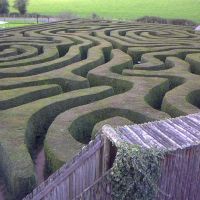
The most interesting barrio, district, of Iznajar is the Barrio del Coso, a labyrinth of typical whitewashed Andalucían houses dotted around a labyrinth of narrow lanes that criss-cross the promontory. As if often the case in these hill towns, the ‘lower’ part is also the newer part of town…..’

This slideshow requires JavaScript.

I loved the majestic setting of this lovely village and the obvious care the residents take in looking after their private and public spaces. Having ‘mooched’ around the village in the morning and had a light tapas lunch with a splendid balcony view across the village, we moved off to the nearby ‘beach’, where we had the place almost to ourselves (that’s wife Deborah and friends Nick and Felicity). The beautiful setting, warm sunshine and water (I actually swam!) made for a relaxing beginning to our week’s adventure…

Old School Gardener

Gardening With Children's avatarGardening with Children

I love Autumn; the crisp, frosty mornings when spiders webs appear to have been decorated with crystals, the misty mornings when the fields are cloaked in white and the rich, damp, earthy smells as you walk through the woods. At this time of year most of the plants in the garden have started to die back, the stars of Autumn to my mind are the trees, many of which are dazzling in their ‘coats’ of many colours and heavily laden with masses of fruits and seeds of varying colours, shapes and sizes just waiting for the perfect time and opportunity to break free and become the next generation of trees.

There are many varieties of trees where I live, I just cannot resist the temptation to collect their seeds, my favourites are conkers from the Horse Chestnut Tree and the Spinning Jennies from the Maples, Sycamores and Ashes it is lovely…

View original post 331 more words

shinealightproject's avatarShine A Light

By Sophie Towne

Over the last couple of months here at the Norfolk Museums Collection Centre we have largely been reorganising and giving a bit of TLC to our collection of fireplaces, fire screens, chimney cranes and roasting spits.

Each fireplace in our collection has its own character and personality; from grandiose and ostentatiously decorative to modestly useful.

Here are a couple of my favourite fire surrounds from our collection, polar opposites but both equally lovely:

A typical fireplace from the 1850s with pillars decorated with acanthus leaves and Prince of Wales feathers in relief A typical fireplace from the 1850s with pillars decorated with acanthus leaves and Prince of Wales feathers in relief

Cast iron fireplace with polychrome tiled floral surround and marble mantelpiece dated 1910 from 72 St Mary's Road in Lowestoft Cast iron fireplace with polychrome tiled floral surround dated 1910 from 72 St Mary’s Road in Lowestoft

This is just a taster of our amazing collection, check back soon for more updates on our fabulous array of all things fiery.

View original post

Finding Nature

Nature Connectedness Research Blog by Prof. Miles Richardson

Norfolk Green Care Network

Connecting People with Nature

Discover WordPress

A daily selection of the best content published on WordPress, collected for you by humans who love to read.

Susan Rushton

Celebrating gardens, photography and a creative life

Unlocking Landscapes

Writing, photography and more by Daniel Greenwood

Alphabet Ravine

Lydia Rae Bush Poetry

TIME GENTS

Australian Pub Project, Established 2013

Vanha Talo Suomi

The Journey from Finnish Rintamamiestalo to Arboretum & Gardens

Marigolds and Gin

Because even in chaos, there’s always gin and a good story …

Bits & Tidbits

RANDOM BITS & MORE TIDBITS

Rambling in the Garden

.....and nurturing my soul

The Interpretation Game

Cultural Heritage and the Digital Economy

pbmGarden

Sense of place, purpose, rejuvenation and joy

SISSINGHURST GARDEN

Notes from the Gardeners...

Deep Green Permaculture

Connecting People to Nature, Empowering People to Live Sustainably

BloominBootiful

A girl and her garden :)