
Category: Soils and soil improvement
 Guest article by Master Composter, Jill Wragg
• find a suitable container, purpose built or out of scrap wood, old carpet or chicken wire and newspaper,
 Garden waste is not the only thing that you can put in your compost bin.
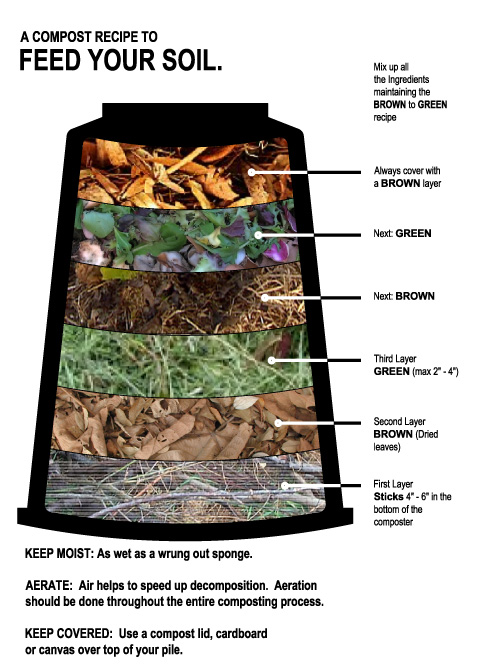 Then just leave it…
This week’s little jaunt at Blickling was a revisit to the Winter Garden, which I helped to start clearing of leaves and generally tidying up, last week.
The crisp cold day began with more leaf clearing and I was soon joined by half a dozen other volunteers who were kind enough to start clearing and loading the various leaf piles I made as I went across the borders. Fortunately I’d finished raking by lunchtime and could begin ‘tickling’ the matted soil surface with a border fork; generally perking up the look of the borders, including revealing many more clumps of snow drops and hellebores and doing the odd bit of pruning to Dogwoods that were starting to layer.
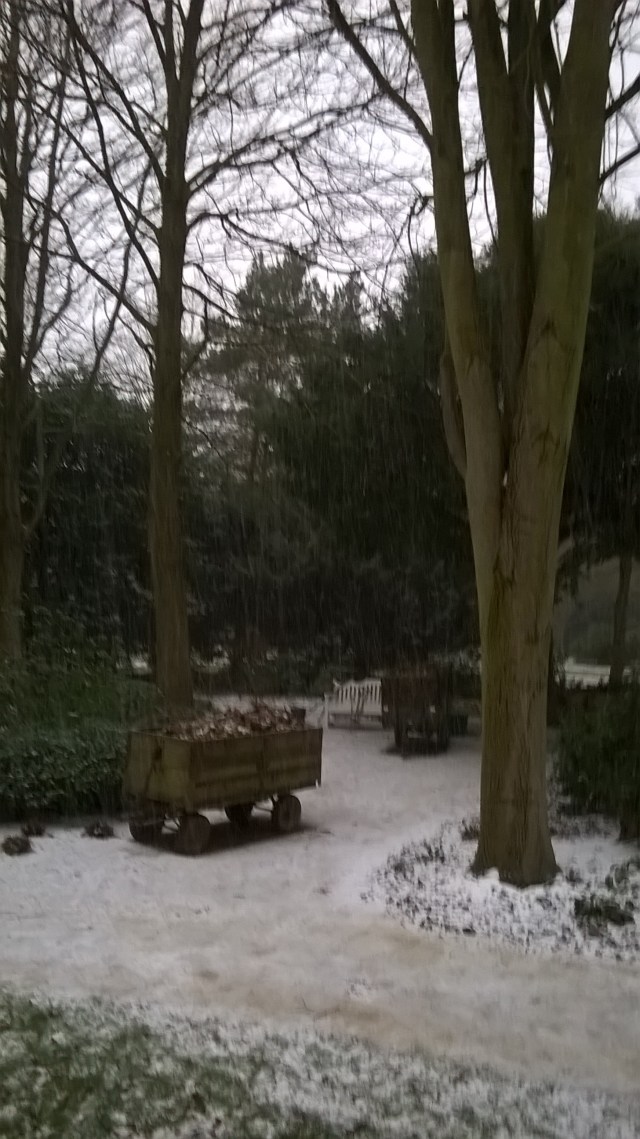
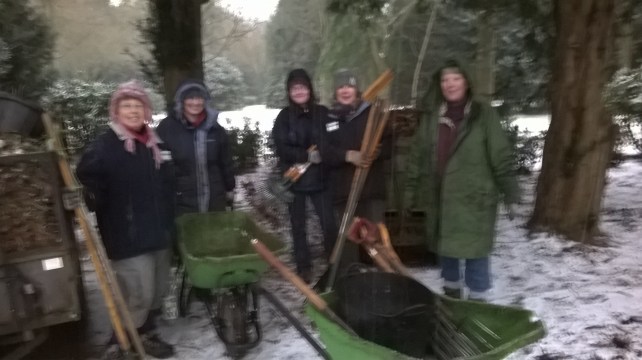
After and hour the heavens opened- thunder, lightning and a heavy snow shower made the going rather more challenging. We continued for a while, but it was soon clear that the snow was settling and we couldn’t see the earth for turning, so ‘an early bath’ was in order. Thanks to the ‘Leaf Maidens’ who diligently gathered in next year’s leaf mould and worked with me to improve the appearance of this garden.
Sorry about the poor quality photographs- a combination of wet screen, poor light and shaking hands (in the cold) made for a bit of ‘shake’ on the ‘phone camera!
 Further information:
Blickling Hall website
Blickling Hall Facebook page
A 360 degree tour of Blickling Hall
Old School Gardener
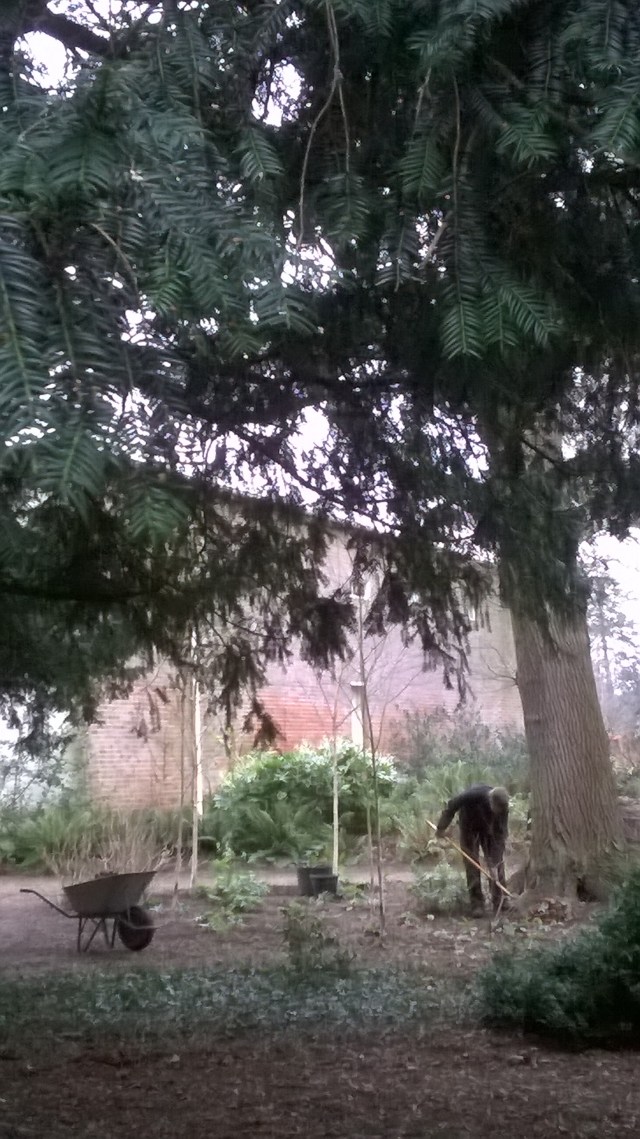 My latest session as a volunteer gardener with the National Trust at Blickling Hall involved working in another area of the gardens- the Winter Garden, which I think was planted up a few years ago as an area to feature colourful stems, fragrance and flowers at this quiet time of the year in the garden.
Work in the Walled Garden has been continuing, however, and with a few frosty nights it has been possible to move and spread the rest of the farmyard manure over the beds. As you can see below, this has helped to give definition to these planting areas…

Muck spreading in the Walled Garden- get to work worms! Picture: Michael Owers
For gardener Rebecca, me and the other ‘Thursday volunteers’, this week involved raking off a thick quilt of Sweet Chestnut and other leaves, tidying up spent stems and foliage and sprucing up the Hellebores…. as well as uncovering the first snowdrops. When I say ‘quilt’ I’m not joking – I just hope the plants underneath haven’t been as shocked as I have been, recently, emerging from under my own quilt in the frosty mornings!

Hellebores pimped…

…

Snowdrops unveiled
So, for me the day that was spent almost entirely raking and loading leaves into trailers to be carried away for turning into leaf mould. Definitely one that required a ‘Radox Bath’ on my return home!
Even though it was repetitive work, it was also very satisfying, showing off this lovely garden with its over-arching trees and understory of shrubs and winter perennials- and hopefully giving some of the plants a good chance to ‘pick up’ as the seasons move on.


Further information:
Blickling Hall website
Blickling Hall Facebook page
A 360 degree tour of Blickling Hall
Old School Gardener

Volunteers tidying the kitchen garden beds at Blickling Hall
My second day as a volunteer gardener with the National Trust at Blickling Hall involved cleaning up the recently used kitchen garden, and along the way meeting some of the other garden volunteers… oh, and uncovering some plant mysteries…
You may recall that last week I helped Project Manager Mike and gardener Rebecca to make a start in preparing the ground in the main walled garden. With lots of rain since then there had been little chance of doing much more- in fact there were sections that were reminiscent of a World War I trench system, complete with mud and puddles!
‘Ooh, there’s a row of something…’
So, today we turned our attention to the long bed along the south-facing wall, an area that in recent years had been cultivated as a kitchen garden and nursery bed. There were clearly areas of bare soil, some a bit weedy, whilst other areas still had the remains of last season’s plantings, including Chard, Penstemons, Dahlias and some less obvious herbaceous perennials.

Newly turned

Foxgloves and Dahlias tidied up

Dahlias mulched and labelled
At the start it looked like I might need to weed and then use a spade to dig over the soil, but it turned out that the soil is quite workable and so a border fork proved up to the job. I was soon joined by a platoon of other garden volunteers who turned their attention to other sections of the bed; uncovering rows of planting here and there (and trying to identify and label these as we went), tidying away spent stems and foliage and generally giving the soil its first ‘breath’ of the new year.
I think the plan is to use this bed in due course as a place for demonstrating different approaches to vegetable growing, but for this year Mike is focusing on a holding operation, working around existing groups of plants that can be left and no doubt seeing what other surprises might appear along the way; for example I think I uncovered an area of Rhubarb crowns towards the end of my stint.

Part of the team, proud of the day’s work
It was a satisfying day. There’s something ‘optimistic’ about seeing a newly dug border, the dark, rich soil contrasting with the brighter colours of surrounding plants, and looking forward to creating a progressively finer tilth as the days lengthen and temperatures.

My reward at the end of the day- sunset over mid Norfolk
Further information:
Blickling Hall website
Blickling Hall Facebook page
A 360 degree tour of Blickling Hall
Old School Gardener
 I’ve mentioned recently that I’m commencing a stint as a volunteer gardener with the National Trust at Blickling Hall, a wonderful Jacobean House and estate just outside Aylsham, about 8 miles from home.
I’m particularly interested in helping with a project to regenerate a two acre walled garden that once supplied the household with an array of vegetables and fruit. Like many walled gardens of its time this was domestic food growing on a huge scale- almost like operating a mini farm.
I was reminded of this near agricultural scale of operation on my first day as the whole space has been deep ploughed (using an implement called a ‘sub soiler’ pulled behind a conventional tractor) to try to break up the compacted soil.
One of my first jobs involved marking out the main pathway structure using canes, so that plentiful supplies of farmyard manure can be tipped and spread on the growing areas and not wasted on areas which will soon be hard-surfaced. Fortunately the Project Manager, Mike Owers, had already set out some marker pegs around the periphery of the garden from which we could run lines and so get our bearings over the rough terrain. Other members of the gardening team then trailered in what seemed like a never-ending stream of manure (it was still being delivered as I left at dusk). Mike, Rebecca (one of the gardeners) and I then started the task of spreading this lovely stuff over the ground so that the worms can get to work incorporating it into the newly turned soil- a Rotatator may be used in due course to fully integrate this material.

Marking out the paths with lines and canes

Manure a plenty

The ‘field’ of a walled garden looking towards the Hall

Mike and Rebecca (and me) spreading the muck
My other main job on my first day was to work out the materials needed to restore the walled fruit support system around three walls (the fourth side of the garden is hedged). Many old espalier trained fruit bushes remain, though over the years, as the garden was not in commission, these have not been regularly pruned, so some careful renovation is called for. In some cases, the bushes may be beyond recovery, but a good basic structure exists on two out of three walls. Mike had been researching different ways of supporting these bushes and come up with a system used at another of the Trust’s properties, Scotney Castle in Kent. Here oak battens provide vertical supports for stretched wires which run along a series of vine eyes (and incorporate straining bolts at the ends of each run to ensure the wires are kept taut).

Some of the espalier fruit will need careful renovation

Two walls have a good range of espaliers; the plan is to put up new wooden battens and wires to support them anda completely new range along the west facing wall
This avoids screwing the vine eyes themselves into the ancient walls, which I must say, as you’d expect, look a little fragile in places. The battens will be placed at roughly 4 metre intervals, which more or less corresponds to the spaces between the existing bushes. I did a quick sketch diagram of each wall showing the rough placement of the battens, straining bolts etc. and finished off with some basic calculations of the materials required- interestingly my estimate on the wire (which will be in 7 rows spaced around each 5 brick courses) at 1324 metres was close to Mike’s early estimate, so hopefully the figure is more or less on target!
I’m due back at the Gardens this week and will post a brief update as this work unfolds. The next few months are promising to be especially interesting as the basic structure of the garden- paths, irrigation, greenhouses etc – are put in place and the garden is readied for its first season of growth for many years.

The main glasshouse awaiting its new wooden and glass top

The smaller glasshouse which will, for now, be retained as it is
Further information:
Blickling Hall website
Blickling Hall Facebook page
Old School Gardener
 Here’s another extract from a book I bought in a charity shop in the summer…..
Taint’s Law:
The compost bin guaranteed to quickly rot waste will:
1. Rot or disintegrate before the compost is mature.
2. Overflow on the first day of use.
3. Harbour the largest hornets’ nest in Christendom.
Law of Chance is a Fine Thing:
It is possible to leave a plant or shrub unwatered and unfed with no effect on its growth or flavour or flowers whatsoever. No gardener will believe you.
Dung Roamin’:
Some people think manure makes plants grow. It does. The plants are trying to escape the smell.

From : ‘Mrs. Murphy’s Laws of Gardening’ – Faith Hines (Temple House books, 1992)
Old School Gardener
 Today is ‘Anti Biotics Awareness Day’ in the UK (I think this extends to the whole week in north America). Last night I attended a fascinating series of talks about work being done in the Norwich Research Park (this includes the University of East Anglia, John Innes Centre, Institute of Food Research and Norfolk and Norwich Hospital) to search for ways to expand the options for combatting infectious diseases.
The Problem
‘Antibiotics are used to treat bacterial infections in humans. Even though these antibiotics are very powerful, some pathogenic bacteria have evolved resistance to all antibiotics currently available. There is an urgent need to find new ways to combat these drug resistant bacteria.’
 Solutions?
Most of the antibiotics we currently use are made by a group of benign soil bacteria called actinomycetes. Scientists are now searching environments not previously investigated to find new actinomycetes which might produce new antibiotics; for example deep oceans, desert, rainforests and insects. They are also manipulating actinomycetes bacteria to produce new antibiotics.
This is the first strand of work I heard about last night. It also featured a fascinating look at leaf cutter ants. You’ve probably seen these minute creatures on nature documentaries. They cut pieces of leaf from nearby plants and take these back to their nest. But they don’t eat the leaves, well not directly anyway. Instead they feed them to a fungus which produces the food they use. A sort of ‘agriculture’ that has been going on for 50 million years! It’s this fungus that scientists are studying, and specifically the antibiotics it produces, to see if they could be useful against human diseases.
The second strand of work concerns improving the diagnosis and use of antibiotics. Up to now we’ve been rather profligate with our use of antibiotics, including in animal husbandry (where they encourage weight gain) and agriculture.
This widespread use of antibiotics has led to the crisis we now face- many bacteria developing resistance to ‘broad spectrum’ (a cocktail) of antibiotics and a lack of will to develop new antibiotics as the investment and risk are judged to be too high in relation to the potential returns by pharmaceutical companies. The technology available for analysing bacterial infections is advancing – the speed is increasing and the costs reducing- so that it is increasingly likely that a more precise diagnosis of infections can be made and a more targeted approach to using antibiotics can follow. This will both increase the effectiveness of their use and reduce the side effects- of killing off a lot of other (beneficial) bacteria and inducing the development of resistant pathogens.
 Finally, I heard about work being done to harness the inherent bacteriological power of the human body.
Not only are humans walking factories of millions of bacteria, but it turns out that different parts of the body carry different bacteriological ‘eco systems’ of their own. The work to date has revealed the benefit of human breast milk in child development (as well as containing nutrients it transfers a range of bacteria from the mother which help to develop the child’s own bacterial systems). This has included giving ‘pro biotic’ supplements to babies born prematurely to help them make up the deficit they have on full term babies and so helping to reduce infections and premature mortality.
Work is also being done on the human gut and experiments with some very sick patients have shown how powerful an infusion of new bacteria can be in combatting diseases; this infusion takes the form of a ‘faecal transplant’- literally transfusing a healthy person’s gut bacteria to a sick person via their faeces (of course converted into a suitable form!).
On this special day, it’s encouraging to see the work in hand by a wide range of brilliant people (who happen to be on my doorstep) to try to extend our ability to fight infectious diseases. Part of the answer lies in discovering and teasing out new anti biotics from a wider range of soils and other sites, but it seems that better targetting of antibiotics and harnessing the body’s own ‘bacteria factory’ have an important part to play.
To finish, here’s a little quiz about leaf cutter ants…
Further information:
Old School Gardener

 ‘Of composts shall the Muse descend to sing,






 Old School Garden