Category: Soils and soil improvement


There's such a choice of  containers to grow in!

There’s such a choice of containers to grow in!

It’s getting to that time when we plant up containers – with annuals, or perhaps longer lasting plants. Which type of compost should you use?

There are two main types of compost: soil-based (John Innes) and soil-less, which may be based on peat or a peat substitute such as coir or perhaps recycled household waste. In addition, depending on the drainage requirements of the plants you’re placing in containers, you’ll need to add some horticultural grit, Pearlite or similar. And some plants- bulbs for example- like a mix which is less nutrient rich, light and leafy- so add in plenty of leaf mould.

All containers need some means of letting excessive water escape- in most pots there’s a hole in the bottom and permeable liners (or a few holes punched in a piece of plastic) in hanging baskets will achieve the same result. But don’t forget to rest some pieces of broken pot or tile over the drainage hole in the bottom of the pot to avoid the compost washing out.
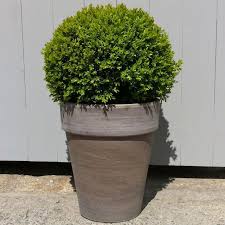
Plants like this Box ball requires a soil-based compost to thrive long term

Plants like this Box ball requires a soil-based compost to thrive long term

Soil-based composts

These are heavy, retain water well and provide a long-lasting supply of nutrients. They are the best choice for permanent plants in containers and for plants that grow tall and are top heavy. For permanent displays, use john Innes Number 3 because of its high level of nutrients.

Soil- less composts

These are lightweight, clean and easy to handle, but dry out quickly and contain few nutrients. Soil-less composts are best for temporary displays, such as bedding plants and hanging baskets. Peat-based composts are the most consistent in quality, though alternatives are improving all the time (especially some of the recycled organic matter types) and do not deplete the landscape like peat-based types.

Plants like Pelargoniums (these are in the courtyard at Old School Garden), require a very gritty soil-less compost.

Plants like Pelargoniums (these are in the courtyard at Old School Garden), require a very gritty soil-less compost.

Source: ‘Short cuts to Great Gardens’- Reader’s Digest, 1999

Old School Gardener


Portland inspiration between the paving Ernst Fuller GardensBefore starting to lay foundations for a paved area, decide on the position of plants around a terrace or patio and in planting pockets within the space and leave the areas free of foundation material and paving (wooden shuttering can be used for larger areas). Once the works are over, replace the topsoil of the planting areas with John Innes number 3 compost (and grit if you’re putting in things like Thymes). This will ensure a weed free growing medium with the right nutrients so plants establish quickly.

Source: ‘Short Cuts to Great Gardens’- Reader’s Digest 1999

Old School Gardener

rhs compostMulch- a layer of natural material spread thickly over the soil cuts down the need for watering, reduces weeding and protects and improves the soil. Mulch matting is also available from most nurseries and garden centres and can be an effective way to conserve moisture and prevent weeds.

Six types of loose mulch

  1. Bark chippings- attractive, but expensive (unless you have a supply from your own felled timber or know a friendly tree surgeon who will give you a load for free). Large chunks will last a long time and don’t blow around, though deep wood chips won’t rot quickly. Use chippings that are at least a year old as the early rotting process will ‘rob’ the soil of nitrogen.

  2. Cocoa shells- pricey but has more nutrients than most mulches. They bond together when wet so they won’t blow away.

  3. Garden compost, manure and leaf mould- free, but soon rots away. Can spread weeds unless well broken down. Compost and well-rotted manure add goodness to the soil as well as improving and protecting it, leaf mould acts as a protective layer and improves soil texture, but is less nutritious.

  4. Grass clippings- free, but turns yellow and can introduce weeds. In wet weather, they can become slimy.

  5. Composted bark- attractive, but can blow around and may support wind-borne weed seeds. Does not last as long as chipped bark.

  6. Gravel- attractive, and long -lasting, but does not add organic matter to the soil. Various grades available.

Oh, and straw can also be used around vegetables and of course strawberries (to conserve moisture and protect ground laying fruit), and if you can get hold of it, shredded paper also works!

Shredded paper mulch around dahlias

Shredded paper mulch around dahlias

No-Dig gardening, Sheet Mulching and Hugelkultur

Sheet mulching, No-dig gardens and Hugelkultur have a fair bit in common; basically using organic matter in large quantities to provide a rich growing medium without the need for digging. It depends what school of gardening you’re from as to what your preference is, coupled with your conditions.

No dig gardens rely on adding copious layers of organic material over the soil without digging it, allowing the mulch to break down and form a rich top soil, into which vegetables and fruit can be directly planted. You need lots of organic material.

Sheet mulching

Sheet mulching

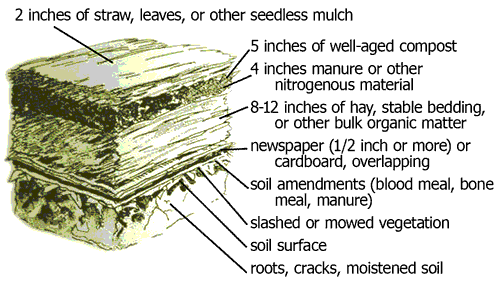
Sheet mulching (or ‘lasgane gardening’) has a similar premise to no-dig. Smother the undesirable plants, mulch heavily, make a ‘lasagne’ of carbon and compost, and plant lots. A good initial burst of energy brings minimal labour further down the line!

Hugelkultur

Hugelkultur

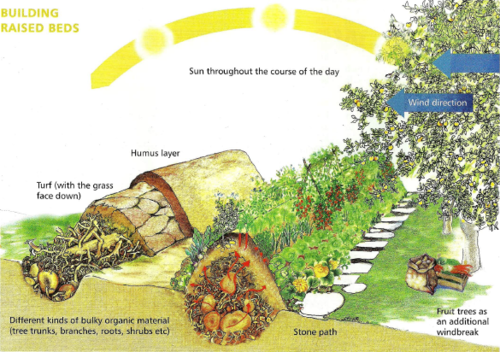
Hugelkultur (‘hill culture’) are no-dig raised beds with a difference. They hold moisture, build fertility, maximise surface volume and are great spaces for growing fruit, vegetables and herbs.

Effective mulching

Apply at the right time- mulches need to be in place by mid spring when the soil is at its wettest but is no longer cold. There is no point applying a mulch in dry summer conditions because it will stop moisture from getting to the plants and they will require even more watering than usual. Applying compost or well-rotted manure to fruit bushes and trees in the autumn and early spring will give them a boost, and applying leaf mould to bare soil in Autumn can be an effective protective layer to reduce the leaching away of nutrients in the soil during wet winters.

Apply the right thickness- to ensure effective weed control, apply a minimum thickness of loose organic material or gravel of 5cm (ideally 7cm) straight onto the soil surface.

Feed and water plants- add fertiliser before applying a mulch in spring time. Lay a seep hose under mulch matting so that you can supply water easily if needed.

Mulch in rows- when planting vegetables or bedding plants in rows, lays strips of mulch matting along the bed between the plants rather than planting them through the matting.

Problems with Mulches

  • Some mulches can be unsightly or troublesome when scattered by foraging birds

  • All mulches provide refuge for slugs and some types are a refuge for snails

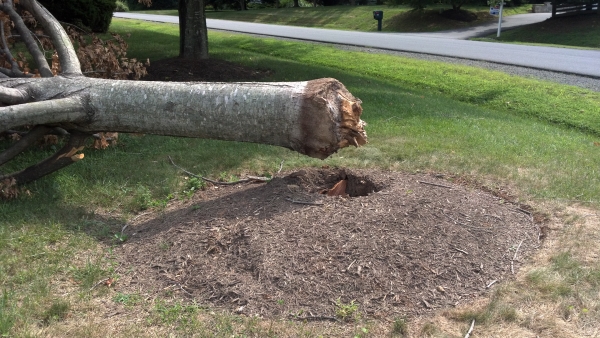
  • If mulches are laid in direct contact with tree stems they can cause it to soften, making it vulnerable to disease

  • A build up of mulch can produce a hard layer, which is difficult for water to penetrate. Avoid this by only replacing mulch when it has rotted away or fork the remaining mulch into the soil

The outcome of piling mulch up around tree stems- 'volcanoes'

The outcome of piling mulch up around tree stems- ‘volcanoes’

Sources and further information:

‘Short Cuts to Great Gardens’- Reader’s Digest 1999

RHS- Mulches and mulching

RHS- Fruit Trees- feeding and mulching

Milkwood blog– S is for Sheet mulching

Permaculture – Hugelkultur

Proper mulching- no mulch volcanoes

Old School Gardener

Get rid of the rubble....

Get rid of the rubble….

If the soil beneath your walls is especially dry, dig it out, along with any rubble, making a trench at least 60cm wide. Lay a seep hose along the length of the trench in order to make watering easier.

Fill the trench with well rotted organic matter, such as compost or horse manure, to create suitbale conditions for growing climbers or wall shrubs. Alternatively, use topsoil, available from garden centres or commercial suppliers, but you will neeed to check the quality.

Finish off with a 5cm layer of loose organic mulch in order to help retin moisture and cut down on weeding.

Source: ‘Short Cuts to Great Gardens’ – Reader’s Digest

Old School Gardener


Most plants will grow in alkaline soil, but these are particularly tolerant of high levels of alkalinity (lime).

Old School Gardener

wheelbarrow jpgI’ve been guilty of these, have you?

1. Taking on too much

2. Too optimistic about the weather

3. Misunderstanding soil

4. Forgetting to fertilize

5. Not giving plants enough space

6. Accidentally inviting bad company

For more details and some sound advice see the full article by Barbara Pleasant here

Old School Gardener

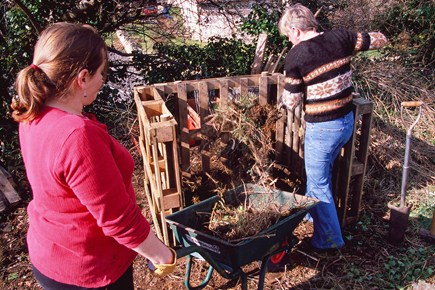
compost binFrom BBC Gardener’s World: As the growing season gets underway, so does the green waste that can be composted. So why not make DIY bin, using an old pallet?

Make a compost bin to achieve the satisfaction of turning kitchen and garden waste, into rich, crumbly compost. This will make your plants and crops thrive – so keep them, and your local landfill site, happy. Find the link here.

Old School Gardener

  • chamomile lawnDo choose drought resistant plants

  • Do conserve moisture by mulching in spring when the soil is moist

  • Do mulch problem problem soils- too dry, sandy or chalky- twice a year, in spring and autumn

  • Do build a deep no-dig bed if you want to grow fruit and vegetables

  • Don’t try to grow a conventional lawn. Instead, create patches of green with a herb lawn using thyme or chamomile.

Source: ‘Short Cuts to Great Gardens’- Readers Digest

Also- see this great article:

No Dig Gardening Demystified: Embracing the Magic of Natural Garden Nurturing

Old School Gardener

WP_20150212_15_36_39_ProMy latest session of voluntary gardening at Blickling Hall focused on the Winter Garden and Dell once more- my there are a lot of leaves out there!

We volunteers continued to clear and tidy the Dell and Winter Garden. I had the pleasure of planting some wonderful pale yellow Hellebores to bulk up the flower show in the Winter Garden with Joan, my ‘planting partner’  for the day. I also got a few blisters from forking over the borders around the trees and shrubs, but it was well worth it- several visitors commented very positively.

I’m now away from Blickling for a couple of weeks, but I’m continuing my voluntary gardening at Gressenhall from next week, beginning the ‘pre opening’ tidy up.

 Further information:

Blickling Hall website

Blickling Hall Facebook page

A 360 degree tour of Blickling Hall

Old School Gardener


Finding Nature

Nature Connectedness Research Blog by Prof. Miles Richardson

Norfolk Green Care Network

Connecting People with Nature

Discover WordPress

A daily selection of the best content published on WordPress, collected for you by humans who love to read.

Susan Rushton

Celebrating gardens, photography and a creative life

Unlocking Landscapes

Writing, photography and more by Daniel Greenwood

Alphabet Ravine

Lydia Rae Bush Poetry

TIME GENTS

Australian Pub Project, Established 2013

Vanha Talo Suomi

The Journey from Finnish Rintamamiestalo to Arboretum & Gardens

Marigolds and Gin

Because even in chaos, there’s always gin and a good story …

Bits & Tidbits

RANDOM BITS & MORE TIDBITS

Rambling in the Garden

.....and nurturing my soul

The Interpretation Game

Cultural Heritage and the Digital Economy

pbmGarden

Sense of place, purpose, rejuvenation and joy

SISSINGHURST GARDEN

Notes from the Gardeners...

Deep Green Permaculture

Connecting People to Nature, Empowering People to Live Sustainably

BloominBootiful

A girl and her garden :)