Category: Portuguese Gardens


IMG_7805

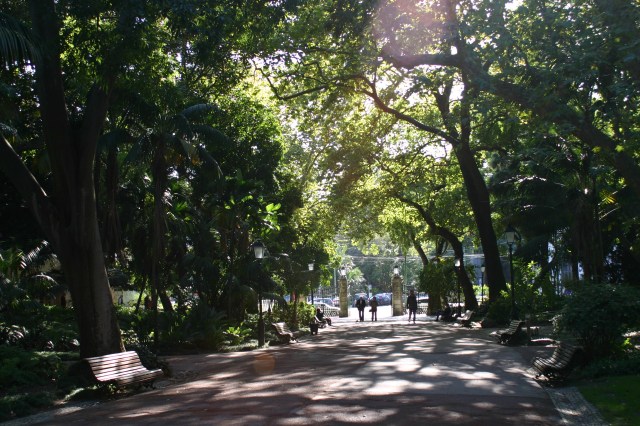
I wrote an earlier article about the ‘Star Garden’ (Jardim da Estrela) in Lisbon, singing its praises as a wonderful example of a classic public park/ gardens and how it has maintained an important role in the life of the capital. On a recent trip I managed to weave in an early Autumn visit, something I haven’t done before.

It was even better than in the Spring – luxuriant foliage was everywhere, people were out and about enjoying the space and the low autumn sunshine provided some wonderful lighting effects. I was particularly taken this time with the little ‘public library’ housed in a picturesque kiosk in the centre of the gardens. Obviously popular with a set of older men, who here, as in other parts of the gardens, were reading or playing cards- one suspects that they are regulars.

This seems to be a wonderful amenity and an idea that’s worth a try in UK parks and gardens! (or are there some examples already out there that I’m not aware of?)

I also mentioned in my previous article the various statues in the gardens and how these were placed here after the formation of the Portuguese Republic in the early 20th century. I made a point in this visit to seek some more of them out, as I had not noticed them before, hiding, as they seem to be, under trees or in mature shrubbery.

My visit felt rather like meeting up with an old friend, someone I hadn’t seen for some time. I was able to easily recollect their more important physical features and personaility traits, but was also drawn to some new features or angles on them. My ‘new look’ at Estrela was repaid not only with the uncovering  of more statues, but also with some superb scenes of dappled sunlight (including the dramatic back lighting of large exotic leaves), superb ‘Dragon’ and other trees, a fantastic decorative ceiling on the bandstand roof, lively play area, late summer blooms of Hibiscus and unusual tree conservation measures (filling in a hole in a trunk with brickwork!)

I wonder what the place must be like high summer when various events inlcuding live Jazz add yet another dimension to this magical place? Another visit beckons…..

Related article: Portuguese Gardens: Estrela Garden, Lisbon

Old School Gardener

The view to the River Tagus from the front of the Neccessidades Palace in Lisbon

The view to the River Tagus from the front of the Necessidades Palace in Lisbon

On our recent 15 mile trek across western Lisbon, we took in a park that is not often mentioned in tourist trails- that of the Necessidades Palace. The palace itself is a grand looking affair, now the country’s Foreign Office, so not open to the public. The view from outside is good in all directions- one way you look out across the River and the ‘Golden Gate- look alike’ bridge; turn round and you have the splendid pink and cream stone facade of the palace and ornamental fountains. The park is tucked round the back and has the air of somewhere that’s been a little forgotten of late.

Here’s what Wikipedia has to say about the Palace, a very important site in portuguese history:

‘Formerly a convent… it was built in the 18th century, by order of King John V, in gratitude for prayers answered by Our Lady of Needs, whose first devotional chapel stood on this site…The palace became the residence of the kings of the Braganza dynasty… Ferdinand of Saxe Coburg and Gotha, husband of Maria II, lived in this palace until his death, amassing a large collection of art, which would be dispersed after his death. The palace then underwent several renovations to accommodate the taste of the various monarchs who lived there, the most recent of which was carried out at the beginning of the twentieth century by Carlos I….

…The palace was the scene of memorable events in Portuguese history, some momentous, some tragic, some slightly ridiculous. One famous example: the king Pedro V had installed in the front door of the palace a slot through which his subjects could, if they wished to, leave messages and complaints for the attention of the sovereign. The last significant event at the palace, which would also be the epilogue of the monarchy, was the joint funeral of King Carlos and his son, Prince Luis Filipe, on 8 February 1908, after their assassination by radical republicans…’

The palace was shelled during the republican revolution in 1910 and subsequently most of its art and other treasures were moved to the Ajuda Palace (which we had visited a day or two before).

Today’s park (or ‘tapada’), evolved from a private hunting ground for the Kings of Portugal and it retains the feel of a semi wild place, but with areas of more defined botanical or garden interest. As you progress up the hill from the entrance next to the Palace you alternate between enclosed, wooded areas and open grassy plains. About half way up the scene turns into a more formal park setting with a a terrace sitting alongside a grand, glass-domed estufa (greenhouse) currently undergoing renovation. Looking rather like an enclosed amphitheatre, this space must have once been the setting for a theatrical display of a different kind- tiered ranks of exotic plants. How grand it must have looked. I hope that it will be fully restored and will no doubt be a gem of a place that will raise the profile of the park more generally.

Paths weave upward above the terrace, the otherwise peaceful setting being regularly interrupted by the sound of aircraft coming in to land at the City’s airport. Another grand building sits atop the park, set off by a fine fountain. This gives way to a wilder area with a round building that looks as though it may have been a windmill at one time. There are some superb areas of Agaves and other dramatic plants. The overall impression, though, is one of a parkland that must be great for a summer picnic, rather than a space where growing and showing interesting plants is the dominant activity. Apart from the domed glass house that is.

A place where once glorious scenes are slowly being reclaimed from the passage of time and nature’s path.

Old School Gardener

IMG_7654
Royal arms on a superb tapestry hung in the ‘waiting room’ to the royal family’s quarters.

Just before visitng the Ajuda Botanical Garden in Lisbon, we took a tour of the nearby Ajuda Palace, once the home of the Portuguese Royal Family and resplendent with rich decor, furniture, tapestries and other curiosities. A particular novelty was the indoor ‘Winter Garden’ which is a high ceilinged room hung with plants, glass grapes that catch the light, a small fountain complete with its own ‘menagerie’ and splendid bird cages. And gold is everywhere. One can imagine how this room would have been a delight in the colder months with its visual interest and birdsong.

Otherwise known as the ‘Marble Room’, this space is a good example of how controlling nature and bringing it into the house became popular in the 19th century. The walls and ceiling are lined with alabaster, the gift of the Viceroy of Egypt. This rather grand space was nonetheless intended for leisure and relaxation- a place for princely birthday parties and royal dinners on a table set around the Carrara marble fountain.

Old School Gardener

Tiered Box hedging in the lower garden

My recent trip to Lisbon, Portugal, was very much a ‘Garden Fest’ (even though it was really about seeing our Daughter and Son-in-law who live there). I seem to have found several more superb gardens and parks to add to those old favourites covered in earlier articles in the category ‘Portuguese Gardens’. The Jardim Botânico d’Ajuda (Ajuda Botanical Garden) was the first we visited, after an interesting tour of the nearby Royal Palace of Ajuda – richly decorated and with some ‘garden’ interest of its own- (more on that in a later article!).

History

The Ajuda Botanical Garden was a real find. The first and oldest botanical garden in Portugal, it is also without doubt one of the most beautiful I’ve visited in Lisbon. It was created in the 18th century for the Portuguese royal family.When the earthquake of 1755 hit Lisbon, the royal family was living in the palace of Belém (just down the hill next to the River Tagus), and which sustained relatively little damage. However, fearing more tremors, they camped in tents outside the palace for some time, and later, as the king refused to live in a brick building, the Marquis of Pombal (a powerful statesman who led the reconstruction efforts after the earthquake), had a wooden residence built for the royal family furtehr up the valley side. However (and how unlucky must the King have felt), a fire destroyed this building in 1791. So it was later replaced with the Palace of Ajuda.

In 1765, the King ordered naturalist Domingos Vandelli to create a botanical garden near the, then wooden, residence of the royal family. The king wanted to create a garden for his grandchildren, where they could play and learn about horticulture. Vandelli constructed the garden over the course of the following three years with the help of Júlio Mattiazi, who was master gardener of Europe’s oldest botanical garden in Padua, Italy.

About 25 years later Domingos Vandelli was appointed director of the Royal Botanic Gardens and in this position he collected some 5.000 different plant seeds from all over the world. During the 18th until the late 20th century, the garden was maintained by a number of different institutions, and more often than not it was neglected. In 1993, with the support of funds from the EU and the Lisbon Tourist Association, a reconstruction effort started, and the garden regained its earlier glory in 1997.


The Design

The garden is designed in Baroque style with a strict geometric layout and decorated with monuments. Occupying some 3.5 hectares on the side of the river valley, the garden is divided into two terraces connected with each other by a monumental Baroque staircase, the Escadaria Central.

The lower, bottom terrace, has an Italianesque layout with a geometric pattern of paths and long hedges of boxwood arranged around flower beds. Plenty of tall trees provide some welcome shade. At the center of the lower level stands a monumental fountain, the Fonte das Quarenta Bicas (Fountain of the Forty Spouts). The 18th century fountain actually has 41 water spouts, disguised as serpents, fish, sea horses. Other statues of frogs, shells and ducks decorate the fountain that is placed at the center of a large basin with water plants.

At the western end of the lower level there are some exotic plants as well as a small rock garden, but the most interesting exotic plants are housed on the upper level where there are some remarkable specimens, most notably a 400 year old dragon tree and an equally large Schotia Afra. There is also a fair number of smaller plants such as the colorful Tecoma Capensis and the Japanese Camellia.

As a bonus, there are not just plants in the botanical gardens; plenty of peacocks strut around the gardens, doing their best to ignore the visitors!

I also had a pleasant time chatting to one of the gardeners, who was setting out leaf cuttings in one of the large glasshouses, this one devoted to a wide ranging collection of succulents, many beautifully arranged in naturalistic table top settings. This gardener was hugely complimentary of Kew Gardens, where she had worked and  was, she said, trying to recreate something of that wonderful exotic collection here. She was doing a grand job, and I told her so.


Look out for the next instalment in this latest ‘Gardens Tour of Lisbon’!

Source: A View on Cities

Related articles:

Oranges and Azulejos: Portuguese Heritage Gardens

PicPost: Great Garden @ Pena Palace Park

PicPost: Great Garden @ Praça do Império Garden, Belem, Portugal

PicPost: Great Garden @ Buddha Eden, Portugal

Portuguese Gardens: Tropical Botanical Gardens, Belem

Portuguese Gardens: Braga

Portuguese Gardens: Estrela Garden, Lisbon

Old School Gardener

Bom Jesus de Mont

Bom Jesus de Mont

I was fortunate to visit the northern Portuguese town of Braga about 10 years ago, though it was a rather cold and wet November, so it wasn’t an ideal time for garden viewing! And as I was on a study visit focused on social enterprise, gardens and gardening were not really on my mind.

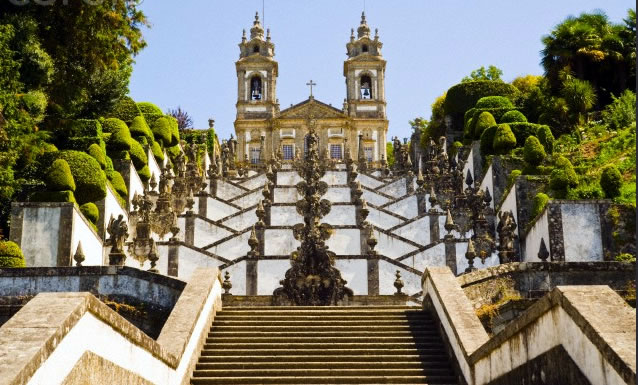
Having said that one of my hosts, a lovely lady called Isabelle, did take me to the very impressive religious centre of Bom Jesus do Mont (Good Jesus of the Mount). Braga is a noteable religious centre and this Sanctuary is a famous pilgrimage site with a monumental Baroque stairway that climbs 116 metres and is flanked by several fountains. Pilgrims were traditionally  encouraged to climb the stairs on their knees as they took a journey that contrasted the senses of the material world with the virtues of the spirit. At the same time they experienced tableux scenes of the Passion of Christ (or Stations of the Cross), and the fountains suggested purification.The culmination of their efforts was found in the Temple of God – the church on the top of the hill. This sanctuary was begun in the 18th century and work proceeded over many decades, with the stairway and area around the church being turned into a park in the 19th century.

The other major space I visited was the Garden of Saint Barbara (Jardim de Santa Bárbara). In the early winter weather this was lacking in colour or any significance, but its layout looked interesting and there was some winter structure afforded by the evergreen topiary. Some of the pictures I’ve seen since show what a wonderful colourful oasis this is in summer. The garden was laid out in 1955 and the space was formerly part of the medieval Arch Bishop’s Palace, the remains of which adjoin the garden. The layout consists of geometric designs carved from beds of boxwood, decorated with cedar topiaries and filled with summer flowering plants.

There’s another important garden in Braga – the garden of the Biscainhos Palace (Casa dos Biscainhos – today a museum). I haven’t had the pleasure of visiting this, but it appears a to be a lovely example of a mid 18th century Rococo style garden, created at a time when the area was home to some of Portugal’s finest granite sculptors. The resulting garden is both ‘lighthearted and flamboyant’ (so writes Helena Attlee). Built on three levels it includes a flower garden and some typical Portuguese elements – wall planting troughs, azulejos (colourful tiles), complex box parterres and granite statues. The garden’s most notable feature, though, is its ‘Cool Houses’ (Casa do fresco) sculpted from living Camellias to form summer retreats. I do hope that I can see it, one day.

Other articles in this series:

Portuguese Gardens: Tropical Botanical Gardens, Belem

Portuguese Gardens: Estrela Gardens, Lisbon

Oranges and Azulejos: Portuguese Heritage Gardens

Old School Gardener

If you’ve enjoyed reading this post and others on this blog, why not comment and also join some other people and sign up for automatic updates via email (see side bar, above right ) or through an RSS feed (see top of page)?

This beautiful tropical garden is  located next to the Palace of Belém (the Portuguese Presidential residence).  The 15 acre garden is a charming, yet often overlooked spot that has maintained a number of ponds, towering palm trees, and many hundreds of species of tropical plants that it had when it was created in the early 1900’s.  The Tropical Botanical Gardens (Jardim-Museu Agrícola Tropical) are also known as ‘Jardim do Ultramar’ (‘Garden of the Colonies beyond the Sea’) or ‘Jardim das Colónias’ (‘Garden of the Colonies’) as most of the plants come from old Portuguese colonies.

The entrance is an avenue created by huge California Fan palms and Mexican Fan palms, and on each side you can see several ‘living fossils’ – species that have not suffered any mutations for millions of years. On the left, Ginkgos, Dawn Redwood and Monkey-puzzle trees go back to the age of the dinosaurs. Close to the lake you can see Sago palms, native from Japan, and sacred figs from south east Asia, also known as the Buda tree. There is an oriental garden that shows off the Chinese Hibiscus.

Created in 1906 by royal decree (King D. Carlos I), and located in the grounds of a former zoo, it was opened in 1912, the presence of natural water influencing the choice of location. It sits on the slopes overlooking the River Tagus in Belem, one of the most interesting of Lisbon’s districts. It is one of three botanical gardens in the Lisbon area, the others being the Ajuda Botanical Gardens (also in Belem) and the Botanical Gardens near the Science Museum in central Lisbon.

The garden has rare tropical and subtropical trees and plants (many of them endangered species) from all over the world, such as Dragon Trees from the Canary and Madeira Islands and Brazilian Coral Trees. Most of them are labeled, so a visit here can also be a learning experience. It is a tranquil place regularly visited by leading international scientists and botanists. Its scientific work continues today and in its grounds you will find a seed bank, greenhouses, in-vitro culture laboratory and a xylarium (wood collection).

A highlight is the Macau Garden complete with mini pagoda, where bamboo rustles and a cool stream trickles. Young children love to clamber over the gnarled roots of a Banyan tree and spot the waddling ducks and geese.

It is a joy to amble along its palm – lined avenues and discover the grottos and ponds, the oriental garden and the topiary accompanied by the friendly birds. A welcome, peaceful, shady retreat on a sweltering summer’s day!

Other articles about Portuguese gardens:

Portuguese Gardens: Estrela Gardens, Lisbon

Oranges and Azulejos: Portuguese Heritage Gardens

Sources and further information:

Go Lisbon

aportugalattraction

Old School Gardener

If you’ve enjoyed reading this post and others on this blog, why not comment and join others by signing up for automatic updates via email (see side bar, above right ) or through an RSS feed (see top of page)?

PicPost: Great Garden @ Buddha Eden, Portugal

‘The Buddha Eden Garden is an area of about 35 hectares designed and conceived by Comendador José Berardo in response to the destruction of the Giant Bamyan Buddhas, sculpted in the rocks of the valley of Bamyan in central Afghanistan and which had for centuries been a cultural and spiritual reference.

Comendador Berardo was profoundly shocked by the attitude of the Taliban Government, which intentionally destroyed these unique monuments of World Heritage, considered acts of cultural barbarism which attempted to erase from memory the art of the late Gandhara period. In 2001, in response to this loss he initiated another of his dreams, the creation of an extensive oriental garden in honour of those colossal Buddhas….’

Source: Buddha Eden website

Entrance to the Estrela gardenFollowing my article about Portuguese Heritage Gardens, I thought I’d turn my attention to a few of my favourite public gardens in that country. I’m beginning with one of my real favourites, one I love to return to when I’m in Lisbon (not that that’s very often!).

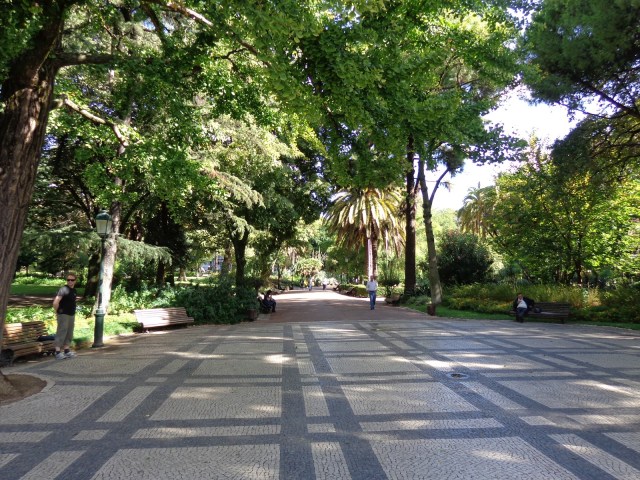
It’s the Estrela Garden (the Jardim da Estrela or Garden of the Star) which has a wonderful blend of exotic, artful, friendly charm with an atmosphere from the best of classic 19th century neighbourhood parks and gardens. It’s no surprise, then , that it remains as one of the most popular gardens in Lisbon. The orignal layout – 19th century romantic landscape style – features plenty of exotic plants and a central pond.
It is known officially as the Jardim Guerra Junqueiro (Junqueiro was a famous poet and politician who was a key figure in the downfall of the Portuguese monarchy and the establishment of the Portuguese Republic in 1910). In the 1840s the governor of Lisbon saw the need for a public garden in the densely populated city, and thanks to a donation by a wealthy baron, the governor was able to acquire the area  (5 acres) opposite the Estrela Basilica. Work on building the garden started in 1842 but due to the outbreak of war and financial difficulties, it didn’t open to the public for another ten years.

The gardens are laid out in a landscaped style with plenty of exotic trees, cacti, flower beds and a pond with fountains. The garden is especially popular with locals who come here during weekends to socialize, stroll along the paths, have a drink at the café, or play cards at one of the permanent tables among the trees.

The garden was designed by gardeners Bonard and João Francisco and it originally featured several romantic structures such as a gazebo and a Chinese pavilion. These structures are no longer there, but there are plenty of sculptures and a 19th century wrought iron bandstand, originally located at the site of the City’s main boulevard, Avenida da Liberdade. It was moved here in 1936.

After the creation of the Portuguese republic, several statues were installed in the park, the most expressive of which is of a farmer (sculptor Costa Mota,1913).  There is another of a female nude known as ‘O Despertar’ (sculptor Simões de Almeida).The most famous statue in the park is probably that of the Guardadora de Patos (keeper of the ducks) – a limestone replica of the marble original from 1914, it shows the protagonist of a popular fairy tale. Other statues include a dog spouting water from its mouth and 3 other busts depicting poets and an actor. More recent additions include a children’s playground and a pond-side cafe. The garden hosts the annual  Out Jazz festival – on Sunday afternoons during this time (usually May), Jardim Estrela will be alive with music and people enjoying the Sunday evening jazz in the open air auditorium.

Beyond the park is the English Cemetery, founded in 1717 and originally shared with the Dutch community. Novelist Henry Fielding, author of Tom Jones, died during a visit to Lisbon and is buried here.

Here are some images to let you get the feel of the place.

Source: A View on Cities

Old School Gardener

If you’ve enjoyed reading this post and others on this blog, why not comment and join others by signing up for automatic updates via email (see side bar, above right ) or through an RSS feed (see top of page)?

Paco de Sao Cipriano

Paco de Sao Cipriano

The latest meeting of the Norfolk Gardens Trust focused on historic Portuguese Gardens. Postponed from earlier in the year due to bad weather, the talk – which took place at Norwich’s John Innes Centre – was again delayed, this time due to travel problems!

I can say that it was well worth the wait. In a lively talk, gardening writer Helena Attlee explored a ‘cocktail’ of influences that have formed the typical historic portuguese garden. A fusion of historical, cultural and climatic factors has come together over the centuries, with the latest fashions and ideas in garden design being reinterpreted in the unique setting that is Portugal.

The country straddles the atlantic coast of Iberia and so its climate ranges from the warm and moist in the north to the near Mediterranean in the south, with the rocky outcrop of Sintra (just north of Lisbon) providing a microclimate that is particularly prone to damp air deposited from atlantic fronts. These climatic variations have clearly influenced the design and planting of gardens in the country, but arguably of greater impact has been the country’s historical development.

The Romans invaded in around 200 B.C. and stayed for around 500 years. Not surprisingly the gardens from this time show the features you’d expect of a roman garden – enclosed by a colonnade with a central water pool as the focus and with grand mosaics. Though even here, it seems that particularly Portuguese touches are evident – for example the curved niches and planting islands found in the pool of a reconstructed example of a roman garden at The House of Water Jets, in Conimbra.
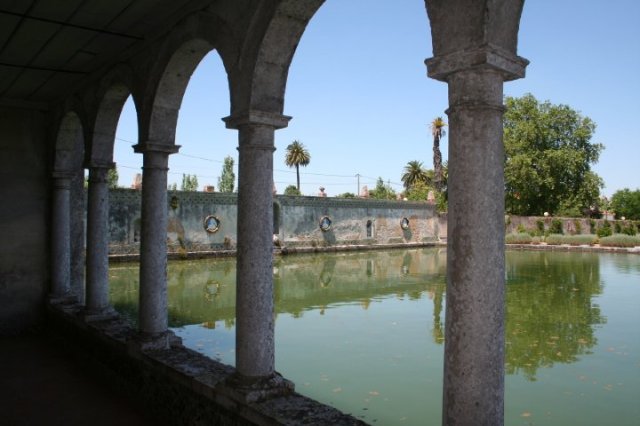
Quinta da Bacalhoa - the Water tank

Quinta da Bacalhoa – the Water tank

Possibly the greatest influence on garden design came from the invasions of arabs and other peoples from north africa – the so-called ‘Moors’. Arriving in the 8th century and remaining for about 400 years they brought with them the traditions of brimming water tanks, high walls to enclose the garden and capture the exotic scents of citrus fruit as well as decorated ceramic tiles – otherwise known as ‘azulejos’ in Portuguese. These citrus trees – bitter oranges and lemons – were introduced from the Himalayas, and it was some centuries later that sweet oranges were introduced into Europe – possibly by the italians (from india), or possibly by the Portuguese (from China).  Interestingly, up until the 20th century sweet oranges were known across europe as ‘Portugals’.

Azulejos at Quinta dos Azulejos!

Azulejos at  Quinta dos Azulejos!

Azulejos began as geometric or botanical designs and used a technique which trapped the coloured glazes in ridged areas on the surface of the tiles – the so-called ‘aresta‘ technique. They were used extensively to cover walls of gardens and buildings. The moorish aesthetic is also evident in the later patterning of box parterres which are more complex than the patterns seen in the grand gardens of France, Italy or Holland.

Even though moorish rule of Portugal ended in the 12th century, many of the skilled craftsmen stayed on and continued to influence garden and house design in the following centuries. However it was not until the growth of Portuguese economic power in the 16th century (based on its exploration and discovery of new lands and leading to the founding of the valuable spice trade) that grand Portuguese gardens started to flourish. Design ideas also travelled from the far east and were absorbed into the Portuguese style of the time – this was when complex parterres, citrus groves and water tanks came into their own, alongside further developments in azulejos. Initially imported from southern Spain by King Manuel I,  the tiles now moved away from repeat patterns of geometrical or botanical themes to assemblies of individual tiles into grand tableaux of  mythical and amusing scenes. The arrival of a new technique – Maiolica’– meant that glazes, and so pictures, could be painted directly onto the tile surface.

Complex parterres at Quinta da Bacalhoa, a superb example of an early renaissance Poprtuguese garden

Complex parterres at Quinta da Bacalhoa, a superb example of an early renaissance Poprtuguese garden. The area beyond was originally an orange grove

Following a period of rule from Spain, Portugal again found its independence in the early 17th century and this heralded a new period of rich garden making, with Delft blue tiles becoming fashionable (the Delft factory had a production line just for Portugal) and the creation of cartoon-like scenes (known as singerie) featuring monkeys and cats mimicking humans in scenes such as going to the barbers and taking piano lessons!

During the 18th century new colonial ventures in Brazil resulted in discoveries of gold and diamonds which fuelled another period of wealth, which once more found expression in the country’s gardens and houses. This second ‘golden age’ put Portugal at the forefront of europe’s economic powers, such that King Juan V was the richest monarch in the continent and could afford to order a solid gold bath for his mistress (who happened to be a nun)!

The dramatic well stairway at the Quinta da Regaleira, typical of the design work of Mannini

The dramatic well stairway at the Quinta da Regaleira, typical of the design work of Manini

This period saw influences from the Italian baroque make their mark in Portuguese gardens. Architects and designers such as Nasoni and Manini added a new flamboyance to the gardens of the wealthy and the latter in particular brought an opera set designer’s skills to create magical spaces where the rich could entertain. Further developments in azulejos also occurred during this period, with new, brighter colours and styles arriving influenced by the French Rococo. Some of these were to provide amusing Trompe d’oeil (visual tricks). The tiled canal at the palace of Queluz is perhaps the zenith of the azulejo. Here, candlelit tableaux lined the walls of the waterway, along which royalty and aristocrats glided by in their gondolas on warm summer evenings.
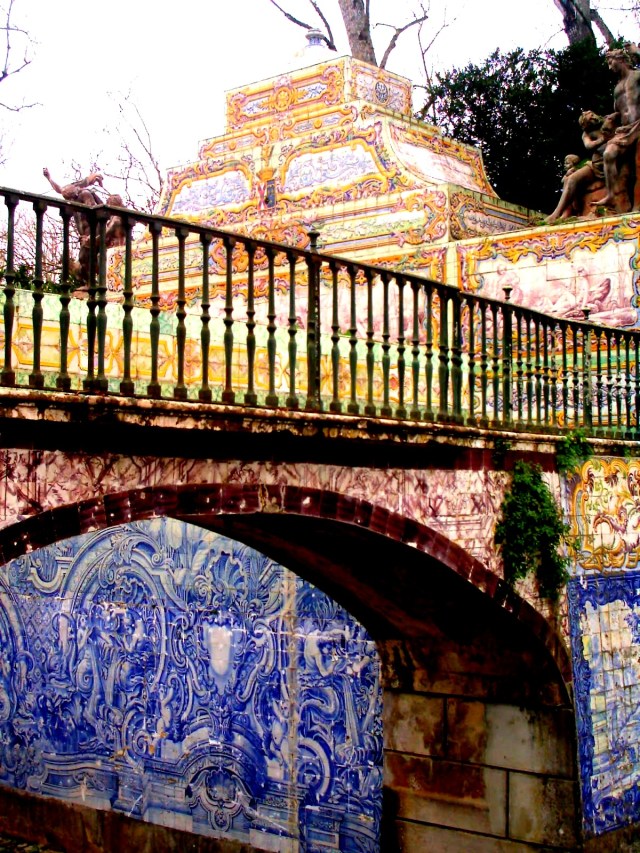
Azulejos lining the canal at Palacio de Queluz

Azulejos lining the canal at Palacio de Queluz

The Lisbon earthquake of 1755 (and ensuing fires and tsunami) wrecked huge areas of the city and its surroundings and so few great houses and gardens of the time inn tht area remained intact. A period of austerity followed during which the country’s Prime Minister, the Marquess of Pombal, removed many of the privileges of the rich aristocracy. Many of the gardens that remained fell into disrepair and few new ones of any note were created.

'Camellia Architecture' at Casa do Campo

‘Camellia Architecture’ at Casa do Campo

During the 19th century a new fashion for Camellia growing was born, centred on Porto and the north of the country where the moist warm climate favoured them. There is much evidence of the splendour of these gardens still in existence today, the Camellia bushes being trained into architectural shapes and even into ‘outside rooms’ which remained in flower between November and March when little else in the garden was of interest. During this time the discovery of new plants in far away places had its impact in Portugal as elsewhere and exotic specimens from Brazil and other countries were imported to some important gardens, including by British emigres involved in the Port trade. Further romantic – style houses and gardens were created, such as Montserrate and the National Palace of Pena at Sintra.

Parque de Serralves

Parque de Serralves

Perhaps not surprisingly, the talk concluded with a single example of a 20th century grand garden (Parque de Serralves), a rather ‘minimalist’ affair  featuring simple clipped box topiary and no other colours but that of the pinkish terracotta of walls and paths and the sky blue tiles lining rills and pools. Another garden (Casa da Pergola in Cascais, near Lisbon), originally created in the 19th century with a house that was renovated in the 1920’s gives a rather more modest ‘cottage style’ example of some of Portugal’s more modern gardens.

Casa da Pergola, Cascais

Casa da Pergola, Cascais

From my own knowledge, the 20th and 21st centuries have seen investment in public gardens and parks, which in their own ways are as important as the grand palace gardens of the earlier periods. I’ll be posting some information on some of my favourites over the coming weeks.

So, how to sum up Portuguese heritage gardens?

Well, as you can see they have absorbed and interpreted fashions, styles and ideas from other cultures and with the particular climatic, social and cultural conditions in the country have made them something uniquely Portuguese. Apart from ‘oranges and azulejos’ the other characteristic features seem to be:

  • Terraces

  • Trough or cavity walls filled with plants

  • Water tanks

  • Topiary, especially complex parterres

As far as planting is concerned, this tends to follow the local climatic conditions so features roses, succulents, palms and colourful annuals , especially in the hotter centre/south, whereas ferns, exotics and of course Camellias are common in the warm, moist north and around Sintra.

A public garden in Braga, northern Portugal.

The Garden of Santa Barbara, a public garden in Braga, northern Portugal

Sources and other information:

‘The Gardens of Portugal’ by Helena Attlee (published by Francis Lincoln, 2008)

Gardenvisit- Portuguese gardens

Article by Helena Attlee

Sheila Sim photography gallery of Portuguese gardens

Old School Gardener

If you’ve enjoyed reading this post and others on this blog, why not comment and join others by signing up for automatic updates via email (see side bar, above right ) or through an RSS feed (see top of page)?

PicPost: Great Garden @ Belem, Portugal

‘The Praça do Império Garden is located between the Jeronimo’s Monastery and the Discoveries Monument and is flanked by the Belém Cultural Centre. The garden was laid out for the 1940 Portuguese World Exhibition, which celebrated both the 800th anniversary of independence and the 300th anniversary of the Restoration. The central feature is an imposing fountain, which is lit up on special occasions, and has coats of arms around its basin. The park also displays 32 coats of arms in the layout of its hedges and flowers and there are four ponds and two sculptural groups depicting mythological horses.’

Source: Directory of attractions in Portugal website

Finding Nature

Nature Connectedness Research Blog by Prof. Miles Richardson

Norfolk Green Care Network

Connecting People with Nature

Discover WordPress

A daily selection of the best content published on WordPress, collected for you by humans who love to read.

Susan Rushton

Celebrating gardens, photography and a creative life

Unlocking Landscapes

Writing, photography and more by Daniel Greenwood

Alphabet Ravine

Lydia Rae Bush Poetry

TIME GENTS

Australian Pub Project, Established 2013

Vanha Talo Suomi

The Journey from Finnish Rintamamiestalo to Arboretum & Gardens

Marigolds and Gin

Because even in chaos, there’s always gin and a good story …

Bits & Tidbits

RANDOM BITS & MORE TIDBITS

Rambling in the Garden

.....and nurturing my soul

The Interpretation Game

Cultural Heritage and the Digital Economy

pbmGarden

Sense of place, purpose, rejuvenation and joy

SISSINGHURST GARDEN

Notes from the Gardeners...

Deep Green Permaculture

Connecting People to Nature, Empowering People to Live Sustainably

BloominBootiful

A girl and her garden :)