Whilst on a trip to nearby Antequera we made our way out of town (eventually, given a one way system, roadworks and a spanish-speaking Sat- Nav) to see the nearby limestone landscape of El Torcal. Andalucia.com says:
‘El Torcal Park Nature Reserve is known for it’s unusual limestone rock formations. … within El Torcal Park’s 17 square km are some of the most beautiful and impressive limestone landscapes in Europe. The whole area was under sea until one hundred million years ago.
Then the violent movements of the Earth’s crust forced it upward into hills and mountains up to 1.300 m, the limestone still kept its layered horizontal formation. Because of this, over the millions of years the rain and wind have been able to chisel away at these layers to form incredible shapes…’
Of the three marked routes around this fascinating ‘Karst’ limestone landscape, we opted for the shortest, which took us around 30 minutes…..
The landscape was reminiscent of our recent ‘Tor Challenge’ in Dartmoor. But here the fantastic rock sculptures (many of the more shapely ones being named after well known objects and animals) are Limestone instead of Granite, and here there was so much more exposed rock crammed tightly together, but again set within another dramatic landscape.
I’ve been writing about my recent trip to Andalucia, and in my last post covered the day we spent in Granada and especially the palaces of the Generalife and Alhambra. One of the powerful impressions of this visit was how water can be used to enhance a particular feeling or ambience of a space, so I took a couple of short videos to demonstrate this. The first is from the Generalife and is of a series of fountains in a fairly narrow court or garden. The feeling I get is of an active space, one which you’re encouraged to move through, onwards to the palace…. would you agree?
The second sound is of the Patio of the Myrtles in the Alhambra’s Nasrid Palace; a simpler, larger space where the barest burble of water adds to the restful atmosphere, and as I said in my previous post, the space is almost like an ‘outdoor cathedral’ in the way that sound is softened…enjoy…
Victoria Park in Tower Hamlets, London, has beaten off stiff competition to be crowned the nation’s favourite park in this year’s prestigious People’s Choice Award, with a record breaking 32,694 votes being cast.
In second place was Mote Park, in Maidstone, Kent and in third place was Margam Park, in Neath, South Wales.
In the vote, organised by the Green Flag Award Scheme, which presents Green Flag status to the best open spaces in the country, Victoria Park came out on top against a staggering 1,482 parks and green spaces in the annual poll. The park has won the Green Flag Award on four occasions.
Victoria Park, now a two time winner of the People’s Choice Award, and also runner up in 2013, is London’s oldest and most important historic parks, visited by millions of Londoners for nearly 170 years.
The park is the largest in Tower Hamlets at 86.18 hectares in area and has one of the highest visitor numbers of all the London parks with around 12 million visits per year.
The Park proposed in 1841
Wikipedia offers some interesting facts on the Park’s history….
The original Park was laid out by notable London planner and architect Sir James Pennethorne between 1842 and 1846. The land had originally been parkland, associated with the Bishop’s Palace, but by the mid-1800s had been spoiled by the extraction of gravel, and clay for bricks. It was opened to the public in 1845.he Bridge Association can be seen inside these alcoves. A Lido opened in 1936 and reopened in 1952 following damage during the Second World War; it was closed in 1986 and demolished in 1990. The bathing pond, unused for bathing since the 1930s, is now popular with anglers.
In the latter half of the 19th Century, Victoria Park became an essential amenity for the working classes of the East End. For some East End children in the 1880s, this may have been the only large stretch of uninterrupted greenery they ever encountered. Victoria Park’s reputation as the ‘People’s Park’ grew as it became a centre for political meetings and rallies of all types. Although any one could set up their own soapbox, the biggest crowds were usually drawn to ‘star’ socialist speakers such as William Morris and Annie Besant.
This description by J. H. Rosney, correspondent for Harper’s Magazine (February 1888) evokes a scene:
‘On the big central lawn are scattered numerous groups, some of which are very closely packed. Almost all the religious sects of England and all the political and social parties are preaching their ideas and disputing […]
On this lawn the listener, as his fancy prompts him, may assist on Malthusianism, atheism, agnosticism, secularism, Calvinism, socialism, anarchism, Salvationism, Darwinism, and even, in exceptional cases, Swedenborgianism and Mormonism. I once heard there a prophet, a man who professed to be inspired by the Holy Ghost; but this prophet ended by being locked up in an asylum, where he will have to convert the doctor before he can recover his liberty.’
The tradition of public speaking in the park continued until well after the Second World War, and was still later reflected in politically oriented rock concerts. And it is still not uncommon for marches or demonstrations to begin or end in Victoria Park. On 26th June 2014, a campaign to revive the Speakers’ Corner at Victoria Park was launched and a campaign to recreate the well-known tradition of free speech and debate in Hyde Park in East London’s Victoria Park was launched earlier this year.
Mayor of Tower Hamlets, Lutfur Rahman, said:
“I am delighted Victoria Park has reclaimed its title as the UK’s best loved open space. It is our flagship park and a fantastic asset which is enjoyed by thousands of visitors and residents alike.” Councillor Shafiqul Haque, cabinet member for culture, added: “The council works hard to ensure all parks and open spaces are maintained to an excellent standard and the borough has six Green Flag Award winning parks to be proud of. I would like to congratulate the parks team for their dedication and commitment as our parks provide essential recreation, play and leisure facilities.”
The park draws in more than 275,000 visitors a year to enjoy festivals and events which attract international superstars and boasts of a year round community programme. Facilities at the park include children’s play areas, boat hire, both summer and winter football pitches, cricket practice nets, bowling greens and tennis courts, as well as several sports clubs.
Three and a half billion visits are made to parks every year across the UK and they are vital part of communities. The Green Flag Award is a way that the public can be assured they are visiting a clean and well managed green space.
The People’s Choice Top 10 and votes cast were:
1. Victoria Park (London Borough of Tower Hamlets,England) 13212 2. Mote Park (Maidstone Borough Council, England) 3689 3. Margam Park (Port Talbot County Borough Council, Wales) 3640 4. Cassiobury Park (Watford Borough Council, England) 1695 5. Kings Park (Bassetlaw District Council, England) 1627 6. Whiteknights (University of Reading, England) 1565 7. Bute Park (The City of Cardiff Council, Wales) 687 8. Clissold Park (London Borough of Hackney, England) 642 9. Valentines Park (Vision Redbridge Culture and Leisure Ltd, England) 618 10. Millennium Country Park (Marston Vale Trust, England) 464
Our final walk. We returned to an old favourite, Pew Tor, just a short drive from Tavistock. It has a wonderful rock formation, remiding me of a dog’s head (see the picture above). It’s an old favourite because this walk has become bit of an institution in our family. We have done it many times with our children at various times in the past. Perhaps the most memorable occasion was when our, then young, son raced back down the slope with the call ‘running down the mountain, with some shouting!’
This slideshow requires JavaScript.
The walk today, another sunny afternoon, was easy. On previous occasions it has been a bit of a puff, but I guess our training on the previous five days was enough to make it a breeze. But this time something else was different. On previous occasions I’d looked around at the views and not known many, if any of the other tors and land in view.
But today, this felt like my space– I don’t know if it was the euphoria of having walked 20 tors in six days, or more the fact that I could look around, name the tors we could see, and more significantly, say we went there on…..
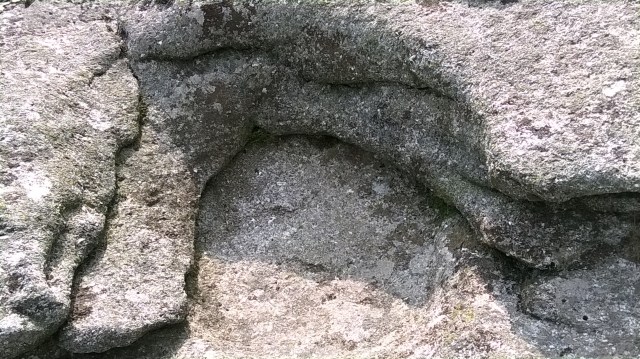
Water action has created a pool in one of the Tor’s top stones
We’ll be back- maybe for another 20 of the 160 plus tors, so that we can gradually come to know this wonderful moor even better.
Day five on our Tor Challenge involved heading out towards Princetown once more. Our start point was a small car park near to one of the tors we would be visiting and which is also home to a tall TV mast- north Hessary. A little cloudier than previous days but still dry and warm, so it looked like it was going to be a pleasant afternoon walk. and what’s more, we were aiming to cover 6 tors, which would bring us within reach of a total of 20 for the week.
As we set off we noticed an elderly couple just heading off in the same direction as us – towards Hollow Tor, and from here to the fairly indistinct Rundlestone Tor.
Hollow Tor
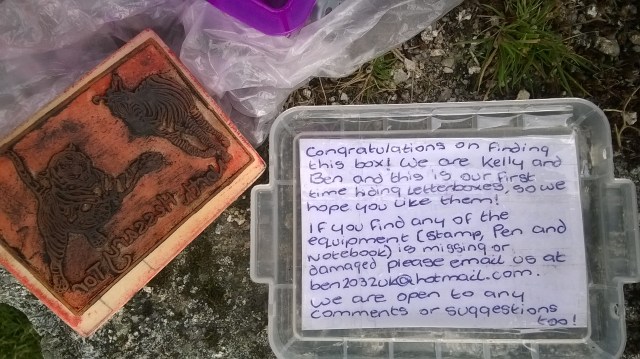
From there it was short walk long a road to the TV station and tor at north Hessary, the mast of which you can see for miles around, but which despite many years visiting the area I had never got close to. The mast is an impressive, albeit man- made intrusion in the landscape. The tor itself is rather tangled with the mast and surrounding walls and fencing, but is nevertheless and distinctive shape. I also found a small plastic box containing a stamp and notebook (see picture at the head of this article), an effort by a couple of local youngsters to place a ‘post box’ for visitors to leave a message and read those put by earlier visitors. It was a modern-day example of the Dartmoor Post Boxes, I suppose an earlier form of ‘Geocaching’:
‘A small pot (the letterbox) containing a stamp and visitors’ book is hidden on the moor, and a clue is written to lead others to its position. Clues may be as simple as a map reference and list of compass bearings, or may be more cryptic.
When a letterbox is found, the letterboxer takes a copy of the stamp, as well as leaving their own personal print in the visitors’ book.
Letterboxing began on Dartmoor but is now popular in areas all over the world.’ (source: Dartmoor letterboxing.org)
North Hessary Tor
Travellers from Muenster, Germany logged into the ‘post box’ on north Hessary
Taking a bearing to our next tor, ‘Foggintor’, we set off, but a little wary, because we had a walk guide which suggested that Foggintor was in fact an old quarry and one which you come across suddenly – beware 100 foot drops! We trudged down and then up bracken-strewn valley sides, heading for a group of rocks on the horizon which the bearing suggested was our target. We reached the edge of what looked like an old quarry but somehow the map and what we saw weren’t the same; where were we?
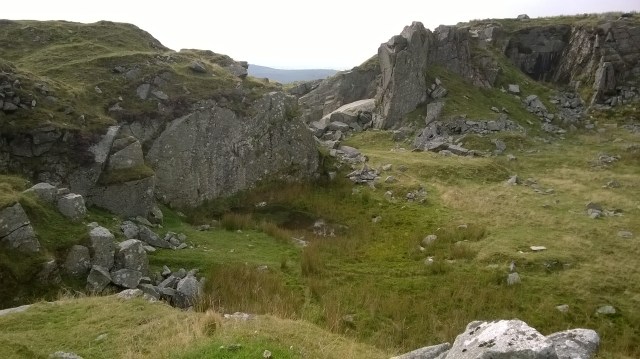
We pressed on thinking the rocks in front were what we were looking for and then looked back – in the distance and to the left of the route we’d taken, was an obvious old quarry with some apparently deep sides. We’d obviously not been accurate in our bearings and missed the quarry (I was sort of relieved, given the look of it). This is a ‘tor no more’, as the quarrying seems to have removed all evidence of the sort of rocks or peak that we’d come to expect.
Foggintor- quarry has removed what was there?
So, we were actually standing next to our fourth tor target of the walk, Swelltor, also an old quarry, but with a more discernible peak and tor like appearance.
Swelltor- more quarrying
From here it was a simple, fairly level walk across moor to our final target of the day, King’s Tor, which had some remarkable rock piles- see the pictures below.
This slideshow requires JavaScript.
The views from King’s Tor were also good, though a mist lay over the horizon so we couldn’t see as far as had been possible earlier in the week. We looked across the valley to Yellowmeade Farm, which gave us our target for the return walk to the car. This looked to be straight, fairly short walk, but the map and walk guide advised that it would be marshy ground, so wer were prepared for wet feet! But apart from a few soggy areas, the lack of any heavy rain for a week seemed to dry out the peaty conditions underfoot, so it was more a case of hopping form grassy clump to grassy clump than wading through water!
So that was it, we got back to the car only to arrive at the exact moment the elderly coupe we’d seen early did too! They were over for the weekend from Somerset and were looking for letterboxes and had apparently found quite a few.
The day had brought 6 more tors (well nearly if you count our skirting of the tor no more) and we looked forwards to our last day, when we would climb an old favourite and bring our tally up to 20 tors.
Day Four involved a figure of eight walk with a starting pont at the cross over of the 8. This was still a relatively short walk and would enable us to visit four tors; Leather Tor, Sharpitor, Leeden Tor and Ingra Tor. Our start point was a car park between Yelverton and Princetown, so once more we returned to southern Dartmoor.
Sharpitor
We were again blessed with bright sunshine. From our start it was a bit of a puff walk up the northern slope of Sharpitor, a tor with lots of broken boulders and some interesting features.
Leather Tor
From here it was a short walk across to the more impressive ‘peak’ of Leather Tor, which looked rather more like a mountain climb than was eventually required, but it was nonetheless great to clamber over rocks and stretch the tendons! After a short walk back to the car around the edge of Peek Hill, we paused for refreshments. Off again, this time we headed to the north and Leeden Tor, though our reliance on map reading and not the bearings we had planned proved to take us off the most direct route.
This slideshow requires JavaScript.
Having rechecked our bearings and double checked our map we set off for Ingra Tor, a very interesting, longish rock formation with some interesting shapes and wonderful views to the southern moor and small farms. I think this was one of my favourite tors and I took a souvenir piece of granite from it for a paperweight.
Ingra Tor – one of my favourites
Four more tors completed, taking our tally to 13 for the four days. The weather was holding and it looked like we would easily exceed our challenge of climbing 10. Day five brought some interesting new angles on the tors, including one that no longer exists!
This was the big one. Day three of our Tor Challenge was billed as an all dayer, packed lunch required. Travelling to the northern edge of Dartmoor at Meldon, near Okehampton, we headed for the reservoir, a beautiful site in itself and the starting point for our day’s walk.
Meldon Reservoir
The Dam
Longstone Hill
It was a long trudge around Longstone Hill and then across valleys and into the (today quiet) firing range, towards Black Down. From here we followed increasingly rugged and harder-to- see paths to the foot of West Mill Tor. A short, steep ascent was rewarded with a tremendous view on another beautifully sunny day. From here we could see our ultimate objectives- High Willhays (the highest point in Devon and southern England) and Yes Tor, slightly lower. It was also from here that we made our first spotting of…….a nude walker! At least that’s what it looked like as a well-tanned male torso was seen stepping out boldly towards the slopes of Yes Tor. Having got over the ‘shock’ of this sight we made our way down to a wide, well trodden path that would take us up to the ridge between the two tors we were left with.
This slideshow requires JavaScript.
This was steady walking, remembering to pick up a stone or two en route to add to the cairn atop High Willhays. It was here that we saw our nude friend once more, striding out but also rather aimlessly- was he looking for someone to show off to? (we didn’t get close enough to see if he had reason to show off…). Or was he following us? He seemed to be close to our route across to Yes Tor and even waved at me and said ‘Hi’ just after I snapped a picture to prove our point….
Adding a stone to the cairn at High Willhays
The Triangulation point on Yes Tor
View back to West Mill Tor from Yes Tor
Back to Nature- 1
Back to Nature- 2….
After a packed lunch atop Yes Tor, admiring the distant views and chatting to fellow walkers, we saw some low clouds forming to the south and so decided to pick our way back to Black Down the quick route down the slopes, but also a rather wetter one through boggy ground. So, that’s nine Tors done, how many more could we add?
The view in the morning – looking towards Tavistock from the car park near Merrivale
Having seen off the rain and mist on the first day of our ‘Tor Challenge’, we started day two with bright sunshine- you could see across the moor for miles. Today’s plan was to do two walks with a break for lunch at a well-known pub (the ‘Dartmoor Inn’ at Merrivale). The morning began with a couple of hours walk close to where we were on day one, but the contrast in weather couldn’t have been starker.
Having parked up at the pub we set off following the road back towards Tavistock and then headed inland (having taken a bearing first) ascending and crossing the rounded crest of Barn hill to the first of the targets, Feather Tor, an unassuming tor from it’s approach, but with some interesting rock formations (and a rare Dartmoor tree!).
Stone cross on Grimstone and Storridge Leat, which we crossed to ascend Heckwood Tor
Feather Tor
Heckwood Tor from Feather Tor- it looked a steep climb
From here it was a short, but steep walk up to a much more expansive tor, Heckwood. It affords a view that is truly breathtaking and I think this, on reflection, was one of my favourite tors on our challenge. The walk back to the pub involved finding a stream and following this past Vixen tor (which is a striking formation, but unfortunately not accessible to the public), and involved some boggy ground, but nothing too uncomfortable despite the previous day’s rain.
This slideshow requires JavaScript.
Lunch was a perfect combination of ‘Pannini and Pint’, after which we drove to our afternoon walk- north of Tavisotck, near Lydford this time and involving one tor I’d walked a good few years back, Brat Tor with the famous stone Widgery Cross at its summit. This was quite a climb, but again, a combination of walking poles, good boots and light clothing made it only partly puffing!
The cross was erected to commemorate the Golden Jubilee of Queen Victoria in 1887.It measures 12 feet 8 inches (3.86 metres) tall and 4 feet 4 inches (1.32 metres) across the arms. The shaft is 2 feet 1 inch (0.64 metres) square and is made of 10 layers of roughly cut granite blocks, topped off with a pointed rock. The blocks are of differing sizes, which interlock with each other to make the structure more secure. It was erected at the expense of William Widgery, the well-known local artist, and bears the inscription:‘W. Widgery, Fecit, Jubilee, V.R.’
This slideshow requires JavaScript.
From here we walked across a valley to Arms Tor (not sure if it’s called that because it has two distinctive blocks that look like arms?), which stands about 6 metres higher than Brat Tor at 457 metres.
Arms Tor…
Left Arm…
and Rght Arm?
View back to Brat Tor from Arms Tor
From here, in the warm afternoon sunshine, we made our way back to the bridge and stepping stones over the River Lyd where I recorded a short video to capture the magical sound of the rippling water…..
The end of a marvellous second day and meanign we had already completed 6 tors in our Tor Challenge! Day three was to prove a bit of an eye opener in several ways…..

 Whilst on a trip to nearby Antequera we made our way out of town (eventually, given a one way system, roadworks and a spanish-speaking Sat- Nav) to see the nearby limestone landscape of El Torcal.


 Victoria Park in Tower Hamlets, London, has beaten off stiff competition to be crowned the nation’s favourite park in this year’s prestigious People’s Choice Award, with a record breaking 32,694 votes being cast.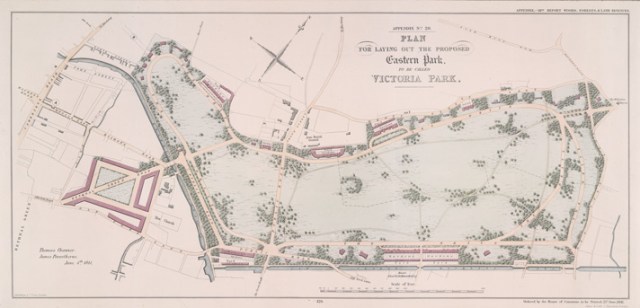
 Mayor of Tower Hamlets, Lutfur Rahman, said:












 Old School Garden