Category: Historic landscapes

We’ve been to Lisbon, Portugal quite a few times, but only on our most recent trip did we discover a beautful little restaurant/club/social centre/cultural hub close to the restaurant quarter- Casa do Alentejo.
While the outside of the former Palacio Alverca is unspectacular, its true beauty lies inside: moorish design including beautiful tiles and a huge patio. It was created 85 years ago, as a meeting place for people from Portugal’s historical province Alentejo (além Tejo means beyond the Tagus) and to cultivate its unique culture. At that time many people from this region left home in search for a better life in Lisbon.
The palace dates from the last quarter of the 17th C., but its current appearance is a result of considerable alterations carried out in 1918. Nowadays it’s the headquarters of the association of the Alentejo people. Many activities take place here: on Saturdays there are ‘Alentejo afternoons’ (tardes Alentejanas), with choral groups. On Sundays, dancing begins at 3;30 pm. Mostly elderly people come here to socialize. There’s also a library and a handicraft shop of typical products of the Alentejo region.
The dining rooms are picturesque, with open fireplaces and decorated with beautiful tiles (azulejos). The azulejo is a form of Portuguese painted, tin-glazed, ceramic tilework (Azulejo comes from the Arabic word az-zulayj, meaning polished stone).
Old School Gardener
In 1933, Neville Chamberlain opened Birmingham’s 40,000th post-war council dwelling at 30, Hopstone Road on the Weoley Castle Estate.
Chamberlain acknowledged the cost of this ambitious building programme but he asserted: (1)
I do not think there is a ratepayer who will grudge that burden, or will be otherwise than glad to have made that contribution to enable his fellow citizens to live the lives of human beings and not of wild beasts.
These are not perhaps the values of the contemporary Conservative Party.
Castle Road ©Weoley Castle Library
The overwhelming majority of these new homes were built in Birmingham’s new cottage suburbs. In the first flush of post-war idealism under the 1919 Housing Act, these homes were both expansive and expensive. After housing subsidies were slashed in 1921, the majority of later homes would be smaller and non-parlour – on the Weoley Castle Estate only a little over ten per cent…
View original post 1,618 more words

A panorama of the Cortijo where we stayed
Over our week in Andalucia, we visited the nearby town of Archidona a few times (it had a rather good supermarket). But one day we took our time…
Archidona lies in the foothills of the Sierra de Gracia. Andalucia.com describes the town:
‘… Bordering on the Granada Province, Archidona sits at the very centre of Andalucia, 660 metres above sea level. This rural community dominates the valley over which it presides……
The municipality covers an area of approximately 187 kilometres and has a population of around 10,000. Although, as with many Andalucian villages in the 1970’s, there was a grand exit from the countryside and into the larger cities, Archidona is once again a thriving little town, whose economy still depends to a large extent on the olive groves that surround the area, which yield a very high quality of olive oil…
Although Archidona has grown from a tiny village into a small town, many of today’s inhabitants still remember the days when they played marbles and hopscotch in the narrow streets. In the area knows as “Los Caños de las Monjas“, older residents in Archidona reminisce about gathering together in the hope of finding work in the olive groves, being paid at the rate of 15 pesetas a day. Woman took their washing to “Los Caños” – the public wash place. In those days, if a widow or widower remarried, the young people of the village would stand outside the house of the newly weds and make a dreadful din, often resulting in the groom chasing them down the road, firing rifle shots in the air to scare them off. Things have changed in Archidona and there is more modern housing and good facilities, but the general layout and structure of the town has remained largely unchanged…’
We made for the centrepiece of Archidona, it’s octagonal square, where we ended up having a superb lunch after looking a little further afield, including up to the mountain top church and monastery which overlooks the town…
Well, that just about sums up our week in central Andalucia, apart, of course from the actual place we stayed, alongside our welcoming and helpful hosts, Michael and Lisa. So, to round things off, here are a few pictures of the Cortijo which was a beautiful house in a wonderful setting, where I especially liked picking fresh figs and eating newly harvested almonds. It was also a joy to lie in a hammock- something I haven’t done for a long time and which felt almost foetal in its gentle two-way sway and tight wrapping…oh, and I mustn’t forget the warm red wine which we sampled, and sampled, and sampled…
Old School Gardener
Whilst on a trip to nearby Antequera we made our way out of town (eventually, given a one way system, roadworks and a spanish-speaking Sat- Nav) to see the nearby limestone landscape of El Torcal. Andalucia.com says:
‘El Torcal Park Nature Reserve is known for it’s unusual limestone rock formations. … within El Torcal Park’s 17 square km are some of the most beautiful and impressive limestone landscapes in Europe. The whole area was under sea until one hundred million years ago.
Then the violent movements of the Earth’s crust forced it upward into hills and mountains up to 1.300 m, the limestone still kept its layered horizontal formation. Because of this, over the millions of years the rain and wind have been able to chisel away at these layers to form incredible shapes…’
Of the three marked routes around this fascinating ‘Karst’ limestone landscape, we opted for the shortest, which took us around 30 minutes…..
The landscape was reminiscent of our recent ‘Tor Challenge’ in Dartmoor. But here the fantastic rock sculptures (many of the more shapely ones being named after well known objects and animals) are Limestone instead of Granite, and here there was so much more exposed rock crammed tightly together, but again set within another dramatic landscape.
Old School Gardener

‘Lovers’ Leap’ in the distance- or maybe a slumbering giant?
We took two trips to the town of Antequera, about 45 minutes away. Andalucia.com describes Antequera as ‘the crossroads of Andalucia’:
‘A visit to this historical Andalucían town is a journey almost 5,000 years back in time, beginning with the Bronze Age and the native Iberians. The timeline is there to be followed in this fascinating city’s profusion of burial mounds, dolmens, Roman baths, a Moorish Castle, Gothic churches, Renaissance fountains and baroque bell towers.
The first sighting of Antequera in the distance is that of a typical medieval town, with the spires of her many churches and the walls and towers of the great Moorish fortress silhouetted against the sky. Spread out in the valley below lie rich farmlands irrigated by the Guadalhorce River. For centuries this has been one of Andalucía’s most fertile areas, and is currently a leading producer of asparagus, cereals and olives. In summer, its fields turn brilliant yellow with sunflowers.
The enormous crag of limestone of 880 metres high, that overlooks the town and valley of Antequera (see picture, top) is known as La Peña de los Enamorados, or “The Lovers’ Leap”. The name comes from a local legend about an impossible love affair between a young Christian man from Antequera and a beautiful Moorish girl from nearby Archidona, who were driven to the top of the cliff by the Moorish soldiers, where, rather than renounce their love, they chose to hurl themselves into the abyss.The romantic fable was adapted by 18th century poet Robert Southney in his poem Laila and Manuel about two lovers: a Muslim girl and her father’s Christian slave.
The mountain is also sometimes known as “Montaña del Indio” due to its resemblance to a native Indian from certain angles.’ (It does rather look like a slumbering giant?)
Prior to a rain-soaked walk around the town (ending up with cream cakes and afternoon tea in a rather good cafe), we first visited some of the ancient dolmens on the edge of the town; megalithic burial mounds, dating from the 3rd millennium B.C. The reception building and associated explanatory video were excellent.
The dolmen called Menga is thought to be the largest such structure in Europe (25 metres long, 5 metres wide and 4 metres high), and was built with thirty-two megaliths, the largest weighing about 180 tonnes. After completion of the chamber (which probably served as a grave for the ruling families) and the path leading into the centre, the stone structure was covered with earth and built up into the hill that can be seen today. When the grave was opened and examined in the 19th century, archaeologists found the skeletons of several hundred people inside.
Later in the week we explored the town more properly (again seeming to be on auto pilot for cakes and afternoon tea). The old fortress and it’s environs were especially interesting and well-restored, with some good quality, sympathetic newer housing alongside…
Several of the nearby houses had front door curtains in fabrics in jolly patterns including the story of Don Quixote…
So having seen more of the local area, as well as the ‘jewels in the crown’ of Granada and Cordoba, what more could we fit in before the end of the week in Andalucia?
Old School Gardener

By now we had settled into our week-long home in the mountains of Andalucia. We were even getting used to driving on the ‘wrong side’ of the road.
Today’s trip was to be our furthest afield, taking a couple of hours by motorway. It is a place I’ve wanted to visit for some time, principally because of the Mezquita (the former mosque) now the city’s Cathedral- Cordoba.
Having found some parking we made our way into the city, even going past one of the old gates in the city walls, which said ‘you’ve arrived’. We stumbled upon a horse show in the buildings originally used to train up horses for the Spanish Royal family. After winding our way through the narrow streets we came out onto the banks of the River Guadalquivir and the stately old bridge which arrives at the edge of the Mezquita and other notable buildings. Later in the day we had a delightful ‘mooch’ around the old jewish quarter of the city and even found a couple of stylish patios (courtyards) which whetted my appetite for the spring festival that celebrates these – that will have to wait for another visit…..
Andalucia.com describes the City:
‘Cordoba was founded by the Romans and due to its strategic importance as the highest navigable point of the Guadalquivir River, it became a port city of great importance, used for shipping Spanish olive oil, wine and wheat back to Ancient Rome. The Romans built the mighty bridge crossing the river, now called “El Puente Romano”. But Cordoba’s hour of greatest glory was when it became the capital of the Moorish kingdom of El-Andalus, and this was when work began on the Great Mosque, or “Mezquita”, which – after several centuries of additions and enlargements – became one of the largest in all of Islam.
When the city was reconquered by the Christians in 1236, the new rulers of the city were so awed by its beauty that they left it standing, building their cathedral in the midst of its rows of arches and columns, and creating the extraordinary church-mosque we see today.
As well as the unique mosque-cathedral, Cordoba’s treasures include the Alcazar, or Fortress, built by the Christians in 1328; the Calahorra Fort, originally built by the Arabs, which guards the Roman Bridge, on the far side of the river from the Mezquita, and the ancient Jewish Synagogue, now a museum. Cordoba’s medieval quarter, once the home of the Jewish community, is called “La Judería” (The Jewry), a labyrinth of winding, narrow streets, shady flower-filled courtyards and picturesque squares such as La Plaza del Potro. In early May, homeowners proudly festoon their patios with flowers to compete for the city’s “most beautiful courtyard” contest.’
The Mezquita was undoubtedly the highlight of the day, its sheer size (both outside and in) taking my breath away. The inside was a fascinating and beautiful mix of Islamic and Christian symbols and art. The contrast between the relatively simple Islamic decoration and the gold-leaf splendour of the cathedral created within it was startling; and also evidence of the rather brutal way in which the Catholic church muscled in and sought to out do the evidence of Islam. This even extends into the large paved space outside- the original mosque wash basins set into the surface have been filled in and orange trees now fill them with their roots. It was the simpler, but exquisite architecture of the mosque that somehow left the most powerful impression on me, and which also probably appealed more to my own artistic taste…
After this we took a tour around the royal palace (the Alcázar de los Reyes Cristianos), that sits nearby and is one of Cordoba’s major landmarks. Originally built in the 8th century as a caliphate residence, this complex of buildings and gardens reached major significance during the Middle Ages, when the Catholic Monarchs Ferdinand and Isabella lived there.
The Alcázar is a composition of massive fortress and royal palace and has some impressive water gardens; complete with statuary, topiarised Box and Yew, a series of arched fountains reminiscent of the Generalife in Granada, and some curious red flowers. I think they were some sort of Celosia but were quite tall and showing distinct evidence of fasciation– when a fault in the growing tip of the plant causes the stems and the flowers to flatten and become fan-like. Apparently some varieties of Celosia are raised especially for their dependably fasciated flower heads, for which they are called “cockscomb” …
Rather numbed by the day’s series of wonderful sights, we made our way back along the motorway and mountain tracks and once more to another late night supper by the pool. Could we manage any more beauty on this scale?
Old School Gardener
Victoria Park in Tower Hamlets, London, has beaten off stiff competition to be crowned the nation’s favourite park in this year’s prestigious People’s Choice Award, with a record breaking 32,694 votes being cast.
In second place was Mote Park, in Maidstone, Kent and in third place was Margam Park, in Neath, South Wales.
In the vote, organised by the Green Flag Award Scheme, which presents Green Flag status to the best open spaces in the country, Victoria Park came out on top against a staggering 1,482 parks and green spaces in the annual poll. The park has won the Green Flag Award on four occasions.
Victoria Park, now a two time winner of the People’s Choice Award, and also runner up in 2013, is London’s oldest and most important historic parks, visited by millions of Londoners for nearly 170 years.
The park is the largest in Tower Hamlets at 86.18 hectares in area and has one of the highest visitor numbers of all the London parks with around 12 million visits per year.

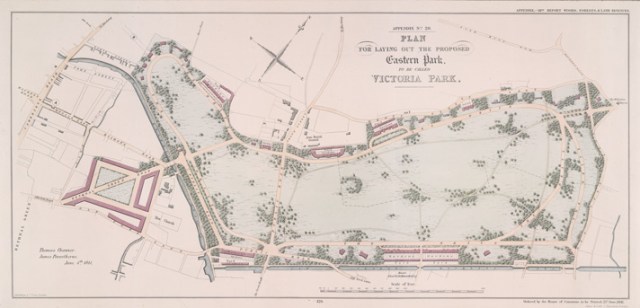
The Park proposed in 1841
Wikipedia offers some interesting facts on the Park’s history….
The original Park was laid out by notable London planner and architect Sir James Pennethorne between 1842 and 1846. The land had originally been parkland, associated with the Bishop’s Palace, but by the mid-1800s had been spoiled by the extraction of gravel, and clay for bricks. It was opened to the public in 1845.he Bridge Association can be seen inside these alcoves. A Lido opened in 1936 and reopened in 1952 following damage during the Second World War; it was closed in 1986 and demolished in 1990. The bathing pond, unused for bathing since the 1930s, is now popular with anglers.
In the latter half of the 19th Century, Victoria Park became an essential amenity for the working classes of the East End. For some East End children in the 1880s, this may have been the only large stretch of uninterrupted greenery they ever encountered. Victoria Park’s reputation as the ‘People’s Park’ grew as it became a centre for political meetings and rallies of all types. Although any one could set up their own soapbox, the biggest crowds were usually drawn to ‘star’ socialist speakers such as William Morris and Annie Besant.
This description by J. H. Rosney, correspondent for Harper’s Magazine (February 1888) evokes a scene:
‘On the big central lawn are scattered numerous groups, some of which are very closely packed. Almost all the religious sects of England and all the political and social parties are preaching their ideas and disputing […]
On this lawn the listener, as his fancy prompts him, may assist on Malthusianism, atheism, agnosticism, secularism, Calvinism, socialism, anarchism, Salvationism, Darwinism, and even, in exceptional cases, Swedenborgianism and Mormonism. I once heard there a prophet, a man who professed to be inspired by the Holy Ghost; but this prophet ended by being locked up in an asylum, where he will have to convert the doctor before he can recover his liberty.’
The tradition of public speaking in the park continued until well after the Second World War, and was still later reflected in politically oriented rock concerts. And it is still not uncommon for marches or demonstrations to begin or end in Victoria Park. On 26th June 2014, a campaign to revive the Speakers’ Corner at Victoria Park was launched and a campaign to recreate the well-known tradition of free speech and debate in Hyde Park in East London’s Victoria Park was launched earlier this year.
Mayor of Tower Hamlets, Lutfur Rahman, said:
“I am delighted Victoria Park has reclaimed its title as the UK’s best loved open space. It is our flagship park and a fantastic asset which is enjoyed by thousands of visitors and residents alike.”
Councillor Shafiqul Haque, cabinet member for culture, added: “The council works hard to ensure all parks and open spaces are maintained to an excellent standard and the borough has six Green Flag Award winning parks to be proud of. I would like to congratulate the parks team for their dedication and commitment as our parks provide essential recreation, play and leisure facilities.”
The park draws in more than 275,000 visitors a year to enjoy festivals and events which attract international superstars and boasts of a year round community programme. Facilities at the park include children’s play areas, boat hire, both summer and winter football pitches, cricket practice nets, bowling greens and tennis courts, as well as several sports clubs.
Three and a half billion visits are made to parks every year across the UK and they are vital part of communities. The Green Flag Award is a way that the public can be assured they are visiting a clean and well managed green space.
The People’s Choice Top 10 and votes cast were:
1. Victoria Park (London Borough of Tower Hamlets,England) 13212
2. Mote Park (Maidstone Borough Council, England) 3689
3. Margam Park (Port Talbot County Borough Council, Wales) 3640
4. Cassiobury Park (Watford Borough Council, England) 1695
5. Kings Park (Bassetlaw District Council, England) 1627
6. Whiteknights (University of Reading, England) 1565
7. Bute Park (The City of Cardiff Council, Wales) 687
8. Clissold Park (London Borough of Hackney, England) 642
9. Valentines Park (Vision Redbridge Culture and Leisure Ltd, England) 618
10. Millennium Country Park (Marston Vale Trust, England) 464

This last ‘garden’ from our recent trip to Portugal, is a bit of a cheat. The main attraction is the gothic splendour of the monastery and associated cathedral, but there are some wonderful outdoor spaces too, so I think its worth sharing.


