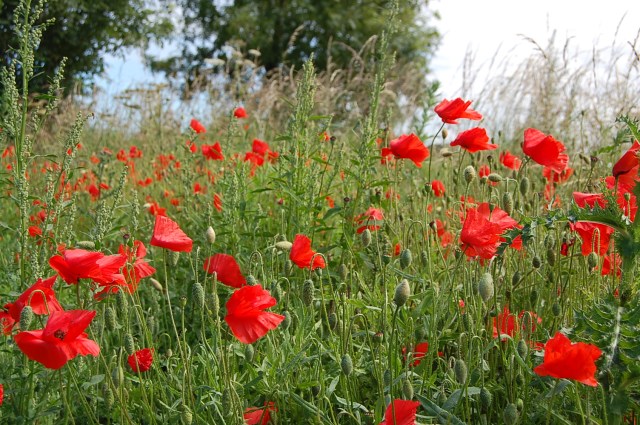
Category: Historic landscapes


PicPost: City Centre Parking

Central Park, New York

PicPost: Royal Oak

‘Here’s the Royal Oak at Boscobel House, where Charles II reportedly hid from Cromwell’s troops – we wonder what life would be like now if he had been captured?’
Pic via English Heritage

PicPost: Eastern Promise

Photo near Yaxley, Cambridgeshire, by David Bradley

HowardJones's avatarOuse Washes: The Heart of the Fens

Heritage Lottery FundIn terms of heritage, it is all happening in Littleport! Recently, I reported on the now completed HLF-funded project which resulted in the documentation of the remarkably well-preserved Family Adams shop in Littleport – see here for the previous blog post on this.

The shop window at the old Family Adams shop currently displays images, artefacts and information for a new local project: ‘The Horseman’s Word’, which aims to research the golden age of the Fenland Heavy Horse. Recently, the Heritage Lottery Fund awarded a grant to the Field Theatre Group in Littleport to carry out this project.

The Field Theatre Group’s project ‘The Horseman’s Word’ will bring together a range of people, researchers, archivists, historians, film makers, curators, photographers and heavy horse experts. In this, the Field Theatre Group will work closely with ADeC over the next 18 months to deliver this exciting new project. ADeC is also a key partner in…

View original post 335 more words

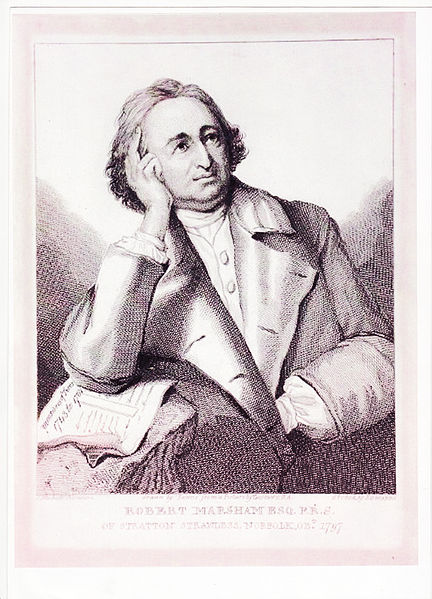
Robert Marsham - portrait by Zofany

Robert Marsham – portrait by Zofany

On a recent walk around my neighbouring village of Stratton Strawless, I visited the church and the exhibition to its most famous inhabitant, Rober Marsham. One of the oldest families in Norfolk, the Marshams held substantial estates in and around Stratton Strawless for about four centuries.

Stratton Strawless Church contains some outstanding tombs and memorials to the Marshams. The Marshams lived at Stratton Strawless Hall (just off the A140 Norwich to Cromer Road) which was completed early in the 19th Century and had extensive landscaped grounds. Humphry Repton, the famous landscape gardener and great admirer of Robert Marsham’s tree planting work, described the estate as: “a gem made out of a common by Robert Marsham”. Apart from this large scale landscaping and an avid interest in trees, Marsham is best known as the ‘father of phenology’.


Stratton Strawless Hall

Stratton Strawless Hall

What is phenology?

Phenology is the study of the times of recurring natural phenomena, especially in relation to climate. Robert Marsham was a meticulous recorder and he was the first to log the effects of nature and seasonal change. In 1736, Robert Marsham commenced this series of records that eventually developed into his 27 ‘Indications of Spring’. These included:

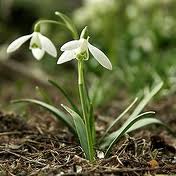
  • The first snowdrops
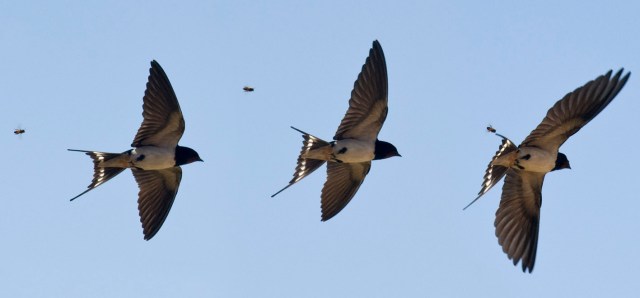
  • The first swallows seen
  • The first songs of migrant birds
  • The first butterflies in Spring
  • The first cuckoo call
  • Leafing dates of trees
The first Swallow an indicator of spring

The first Swallow an indicator of spring

Historically, in Japan and China the time of cherry and peach trees blossoming is associated with ancient festivals and some of these dates can be traced back to the eighth century. In the UK the first individual records that have been found date back to 1684. Robert Marsham was Britain’s first systematic recorder of seasonal events  and recorded his ‘Indications of Spring’ until his death in 1798. His vast database was reported to the Royal Society in 1789, the same year Gilbert White published his Natural History of Selborne.  In 1875 British phenology took a major leap forward when the Royal Meteorological Society established a national recorder network. Annual reports were published up until 1948.

Marsham provided a fascinating insight into the winter of 1739/40, the coldest year on record, when the contents of his chamber pot frequently froze overnight and the turnip crop was completely destroyed! Turnips, a Norfolk speciality, were also monitored by Marsham. He regularly recorded turnip flowering dates (needed when turnips were to produce seed) and he noted one year:

‘My farm produced me a turnip that was 19lbs and 2 oz and 39 and a half inches round.’

Marsham’s great interest in trees resulted in him being elected a Fellow of the Royal Society in 1780. Most of his tree plantings were felled for much needed timber in the First and Second World Wars and other parts of the estate were ploughed over. What is left are a few ancient trees, the remains of his avenue of oaks, and particularly his Giant Cedar (planted in 1747).This Cedrus atlantica was planted as an 18 inch sapling. It stands to the east of Stratton Strawless Hall and when measured in 2000 it measured 102 feet high and had a circumference of 23 feet.

Most of Marsham’s writings haven’t survived. However, there are articles he published in journals, some of his letters to others, and some Victorian transcriptions from his diaries. These present a picture of a man of science with an obsession with trees. James Grigor described him as “an individual who excelled all his contemporaries, in this quarter, in the work of planting, of whom his oaks form the most fitting of all memorials”. His views on planting had a wider impact as they were very influential on Humphry Repton’s landscape designs. He was also one of the first to experiment with root cutting, trenching and bark-scrubbing. He was preoccupied with improving tree growth and continually tested unorthodox methods of pruning and thinning in his forest plantations.

The first snowdrop flower an indicator of spring

The first snowdrop flower an indicator of spring

Following his death in 1797 successive generations of his family continued to record the signs of spring right up to 1958. At the time nobody realised how important these records would become. Today, with concern over climate change and its impact on wildlife and the natural world, these records have become of global importance as one of the longest and best sets of records linking climate and the natural world. A friend and fellow gardener of mine, Mary Manning, has maintained her own set of spring flowering records in Norfolk since the 1960’s.

Marsham’s records can now be compared to temperature records and provide strong evidence of how global warming is leading to earlier springs. His records for Hawthorn show how for each 1°C of temperature rise, leafing can occur up to ten days earlier. Today, a website ‘Natures Calendar’ operated by the Woodland Trust, enables everyone to record their own ‘indications of spring’ data. This website also contains lots of useful information about recent seasonal indications and educational  resources.

Another legacy of the Marsham  family is the Marsham Arms Pub just a couple of miles from my home and a favourite ‘watering hole’ of mine! It was founded by Robert’s grandson, also named Robert, in 1832, as a hostel for homeless farm labourers.marsham-arms

Sources and links:

Wikipedia

Norfolk Wildlife Trust

Robert Marsham tricentenerary

Nature’s Calendar

Woodland Trust

Phenology Wheels

US National Wildlife Federation- phenology

Old School Gardener

If you’ve enjoyed reading this post and others on this blog, why not comment and join others by signing up for automatic updates via email (see side bar, above right ) or through an RSS feed (see top of page)?

PicPost: On the border

Hadrian’s Wall

poppylandI love the North Norfolk coast and as it’s only 20 miles away I visit frequently. If you’re a visitor from further afield,  you might find a mix of holiday hotels, caravans, mobile homes and retirement bungalows. You might see only the faded charms of Cromer’s Victorian heydays coupled with its ‘kiss me quick’ seaside amusements. Look beyond these modern, man-made novelties to the natural world and the landscape retains it’s exhilarating sweep and historic romance that once drew poets and millionaires.

‘Poppyland’  stretches around the north-east arc of the Norfolk coast and takes in Sheringham, Cromer, Overstrand, Sidestrand and Mundesley. The romantic creation  of late 19th century theatre critic, travel writer and minor poet, Clement Scott, ‘Poppyland’ came to embody an area of quiet, rural, fishing backwaters which were soon to change, not least because of Scott’s popularising of the place through his writings as well as the arrival of the railway. This came a few years before his first visit, and the area soon became the ‘must see’ place for the Victorian well (and not so well) to do.


Scott’s arrival in Cromer in 1883 was not a promising one. Affronted at the locals lack of recognition of the “dramatic critic of the Daily Telegraph and it’s leading travel writer” he quickly moved on to nearby Overstrand and Sidestrand. Here, he not only found accommodation, but also fell in love with his host’s 19 year old daughter, Louie Jermy. This romantic entanglement seems never to have been fully acknowledged, due to Victorian propriety – Scott was already married. This romantic attraction, coupled with his appreciation of the area’s beauty led him to create ‘’Poppyland’’. He went on to write about Sidestrand’s lonely church tower, teetering on the cliff edge and its churchyard “Garden of Sleep”. The tower eventually toppled over the edge of the cliff in 1916.  The main body of the 14th century church (St Michael’s), had been removed (brick by brick), from its previous site to somewhere safer about three years before Scott’s discovery. The tower seems to have been abandoned as a more recent, less important addition to the ancient church.


Staying at the local Mill House with miller Alfred Jermy, his daughter Louie became Scott’s “Maid of the Mill”.  Scott had discovered a rural idyll and was to capture its essence in his poem ‘The Garden of Sleep’

The Garden of Sleep

On the grass of the cliff, at the edge of the steep,

God planted a garden – a garden of sleep!

‘Neath the blue of sky, in the green of the corn,

It is there that the regal red poppies are born!

Brief days of desire, and long dreams of delight,

They are mine when Poppy-Land cometh in sight.

In music of distance, with eyes that are wet,

It is there I remember, and there I forget!

O! heart of my heart! where the poppies are born,

I am waiting for thee, in the hush of the corn.
     Sleep!     Sleep!

From the Cliff to the Deep!    

Sleep, my Poppy-Land,
    Sleep!

In my garden of sleep, where red poppies are spread, I wait for the living, alone with the dead!

For a tower in ruins stands guard o’er the deep,

At whose feet are green graves of dear women asleep!

Did they love as I love, when they lived by the sea?

Did they wait as I wait, for the days that may be?

Was it hope or fulfilling that entered each breast,

Ere death gave release, and the poppies gave rest?

O! life of my life! on the cliffs by the sea,

By the graves in the grass, I am waiting for thee!      Sleep!     Sleep!                   

In the Dews of the Deep!                                

Sleep, my Poppy-Land,    Sleep!

Scott returned time and again to the forsaken “Garden”,  which became the focal point of the ‘Poppyland’ legend. Scott had many London contacts in the theatrical world, and these and his writings led a number of them and others from London society to come to the area. Some had houses built in Overstrand –  for a while the village was the place to visit. The Edwardian architect Sir Edwin Lutyens (he of partnership with Gertude Jekyll fame), designed some of these houses, including Overstrand Hall and The Pleasaunce as well as the more modest Methodist Church. A large hotel was also built on the cliff edge, though this slid into the sea in the 1950s! Land slips still affect the cliffs today (and make for an exciting cliff top walk).

A memorial water trough in Cromer bears the inscription: ‘To Clement Scott- who by his pen immortalised PoppyLand’. Though Scott wasn’t a particularly inspired poet, his writing helped to kick-start the Norfolk tourist industry. Today, however, fields of poppies are a rare sight due to modern farming techniques. The railway line which brought the early tourists to Poppyland is still operated as part of the national network as far as Sheringham. Here, an old station has become one end of a heritage line (the North Norfolk Railway) which runs to Holt, and is often referred to as the ‘Poppy Line’.

The memorial Water Trough- now planter - in Cromer

The memorial Water Trough- now planter – in Cromer

Poppyland’ still attracts holidaymakers. Resorts like Cromer still show the faded hallmarks of their Victorian splendour and more recent investment in the Pier, its surrounding promenades and the wider area has reinvigorated the place. Despite this, Scott would probably still recognise the landscape with its wonderful cliff – top and beach – side walks as well as the interesting villages and towns which retain a low – key attractiveness (including a beach top cafe in Overstrand that does a nice line in afternoon tea and cakes).

This is an historic landscape with loads of natural and man-made interest – if you’ve been please let me know your experiences, if not, I hope that you’ll get to visit soon.

Link:

Poppyland and the Jermy Family

Old School Gardener

If you’ve enjoyed reading this post and others on this blog, why not comment and also join some other people and sign up for automatic updates via email (see side bar, above right ) or through an RSS feed (see top of page)?

HowardJones's avatarOuse Washes: The Heart of the Fens

Heritage Lottery FundA couple of weeks ago saw the launch of a remarkable new book about the history of the Fens.

Ian Rotherham, the author of ‘The Lost Fens’ is a writer, broadcaster and Professor of environmental geography and reader in tourism and environmental change at Sheffield Hallam University.

Lost_Fens-300x300
The Lost fens, by Ian Rotherham. Source: http://www.environmentalhistories.net/?p=697
Ian_Rotherham_web2_0
Ian Rotherham

The Lost Fens is about the history of the cultural landscape of the Fen area. It tells the story of the most dramatic ecological destruction in our history. Around 8,000 sq km of wetland present in the 1600s was almost entirely obliterated by 1900. The book draws together the story of a lost ecology, of changing landscapes, lost people, lost cultures and ways of life, and lost wildlife.

The story of these lost Fens is, in Rotherham’s words “the greatest single ecological catastrophe that ever occurred in England”.

Indeed, so thoroughly…

View original post 169 more words

IMG_5527We had a very enjoyable walk around one of our local ‘haunts’ on Sunday – Sheringham Park, in north Norfolk. I think we can honestly say that we’ve visited this beautiful landscape in all weathers – I recall the children sledging down some of the steep slopes in the snow and also the time we took some visiting friends there in the pouring rain!  Fortunately the sun was shining and there wasn’t a cloud in the sky on this latest visit.

The Park surrounds Sheringham Hall (privately occupied), but Sheringham Park is in the care of the National Trust and is open for visitors. The Park was designed by the famous Landscape Gardener, Humphry Repton, who presented his proposals in July 1812 in the form of one of his ‘Red Books’ – he showed ‘before and after’ fold – out images to illustrate the differences his design proposals would make. He described Sheringham as his ‘favourite child in Norfolk’ and he is buried in Aylsham Church, about 15 miles to the south. At the time he was in his later years and his star was on the wane, but this Park is described by some as his most successful landscape design. Abbot and Charlotte Upcher bought the Estate in 1811, and successive generations of the Upcher family did much to develop it, as well as the Hall and the park, and also built a school.

The landscape has been moulded to make the most of the natural hills and vales (formed by glacial gravels). Many of the trees are now of a very mature age and there is some evidence of felling or ‘natural topple over’ as they near the end of their normal lifespans. The Trust has done much new planting and maintains the ‘wilderness’ feel of some areas, along with mature woodland with glades and pools, surrounding heathlands (with interesting views towards the restored North Norfolk Railway, the coast and North Sea), plus all the elements of the romantic landscape around the House and its setting.

The woodlands also contain a large variety of rhododendrons and azaleas. In the early 20th century Henry Morris Upcher obtained rhododendron seeds of various types from plantsman ‘Chinese’ Wilson. Many other species of tree and shrub are represented in the park, including fifteen kinds of magnolia, maples, acers,styrax, Eucryphia, Davidia involucrata and a fine example of the ‘Snowdrop Tree’,  Halesia. Several outlook towers and viewpoints provide good views over the park and of the nearby coast and surrounding countryside. Recently a new ‘Bower Garden’ has been created which provides a wonderful den building area, enclosed seating area and widllife pond which had many tadpoles, pond skaters and the like on our visit.

If you visit you’ll also have the benefit of an interesting exhibition about Repton and the development of the estate, a number of marked walks plus all the usual National Trust attractions – I particularly enjoyed some Stem Ginger Ice Cream!

Old School Gardener

If you’ve enjoyed reading this post and others on this blog, why not comment and also join some other people and sign up for automatic updates via email (see side bar, above right ) or through an RSS feed (see top of page)?
Finding Nature

Nature Connectedness Research Blog by Prof. Miles Richardson

Norfolk Green Care Network

Connecting People with Nature

Discover WordPress

A daily selection of the best content published on WordPress, collected for you by humans who love to read.

Susan Rushton

Celebrating gardens, photography and a creative life

Unlocking Landscapes

Writing, photography and more by Daniel Greenwood

Alphabet Ravine

Lydia Rae Bush Poetry

TIME GENTS

Australian Pub Project, Established 2013

Vanha Talo Suomi

The Journey from Finnish Rintamamiestalo to Arboretum & Gardens

Marigolds and Gin

Because even in chaos, there’s always gin and a good story …

Bits & Tidbits

RANDOM BITS & MORE TIDBITS

Rambling in the Garden

.....and nurturing my soul

The Interpretation Game

Cultural Heritage and the Digital Economy

pbmGarden

Sense of place, purpose, rejuvenation and joy

SISSINGHURST GARDEN

Notes from the Gardeners...

Deep Green Permaculture

Connecting People to Nature, Empowering People to Live Sustainably

BloominBootiful

A girl and her garden :)