Category: Heritage Gardens & gardening


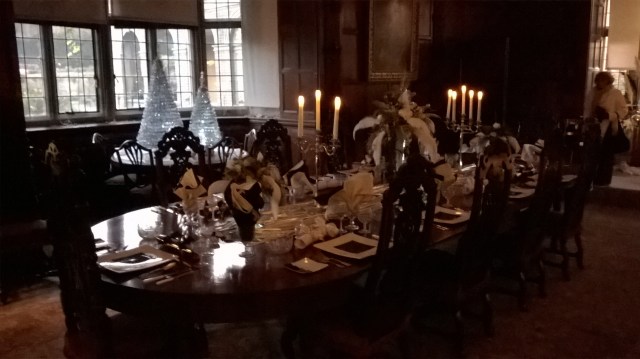
WP_20151220_15_37_30_ProI wrote about my last working session at Blickling a couple of days ago. I thought I’d add one further post about our visit to the place on Sunday, to see how staff and volunteers had dressed it for Christmas; especially the house. The theme- ‘Putting on the Glitz’, a return to the inter war years of stellar dinner parties, silverware and champagne cascades…

WP_20151220_15_35_35_ProWe were impressed (and smiled widely) as we did the normal tour route of the house… to see a wonderful rendition of a Lord Lothian Christmas complete with costumed staff (and celebrities), dinner menu and place cards and a wonderful range of floral displays. Here’s a gallery of some of the best bits…well done staff and volunteers, you did the place proud, celebrating 75 years since the house was given to the National Trust by Lord Lothian.

This slideshow requires JavaScript.

I hope that your Christmas is glitzy too!


WP_20151220_16_42_59_ProFurther Information:

Blickling Hall website

Blickling Hall Facebook page

A 360 degree tour of Blickling Hall

Old School Gardener


Chard providing a bit of winter colour in the walled garden

Chard providing a bit of winter colour in the walled garden

In the last visit to Blickling before Christmas we had only a morning session followed by a wonderful Christmas buffet lunch where all the gardeners and Thursday volunteers shared a lovely spread in the education room.
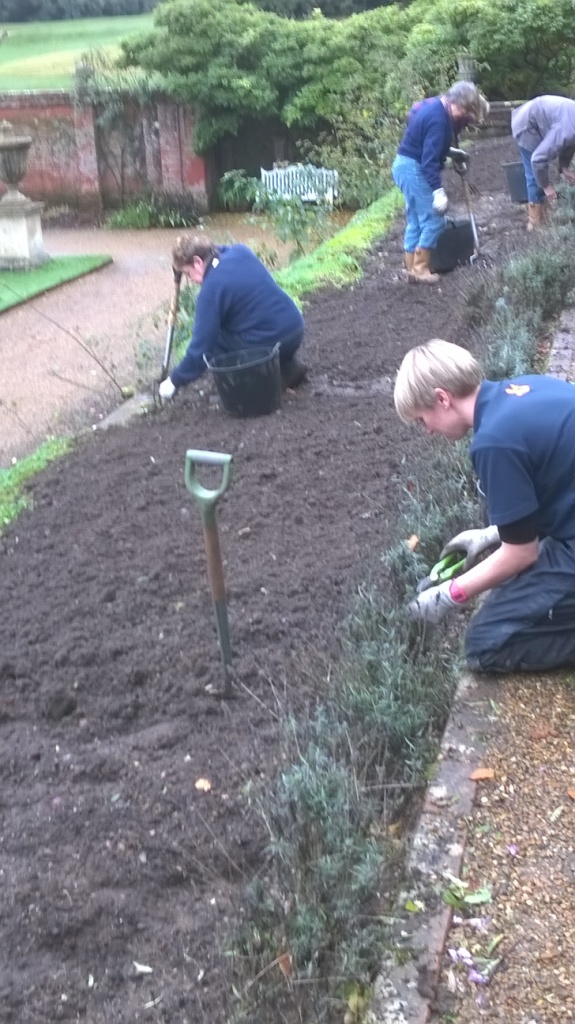
Digging over the parterre border

Digging over the parterre border

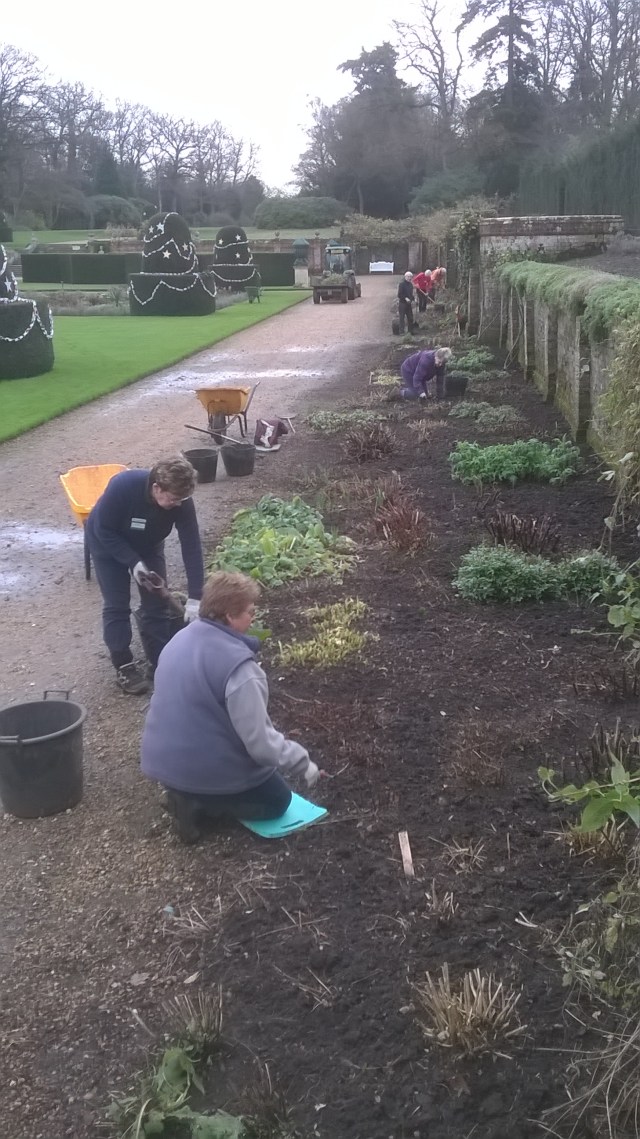
The morning’s work began with the ladies going off to dig over the long border by the parterre (you may recall we chopped down the spent growth here a week or two ago). Fellow volunteer Peter and I helped gardener Jane (newly returned from a birdwatching holiday in Australia) in tidying up (yet more) leaves. This was a case of loading up from a big pile, rather than blowing like last time. Oh, and I discovered that we volunteers will not be able to use any machinery in future unless we have been on an accredited course, so it may be my flirtation with the various bits of kit here is a brief one!

After an hour of leaf loading (they were rather wet and heavy so my arms and shoulders were beginning to ache), Peter and I headed off to the Walled Garden.

Project Manager Mike was already here. I hadn’t been in the walled garden for a few weeks and it was pleasing to see the progress and to hear of Mike’s plans for the New Year.

Taking shape- metal posts awaiting fixing alongside the main paths- they will carry a selection of apples and pears trained as fans or espaliers

Taking shape- metal posts awaiting fixing alongside the main paths- they will carry a selection of apples and pears trained as fans or espaliers

Mike himself was just finishing off hole digging for the last of many metal posts that will carry wires and a selection of apples and pears grown as fans or espaliers. Mike told me that a local apple growing project had managed to identify all of the different apple varieties growing on the walls, some of which were not as currently labelled! He’s still pondering whether to put up wooden battens to fix new wires here, but as this is not normal or historic practice, thinks it might be a case of fixing vine eyes directly into the walls.

Some of the metal path edging is in now but contractors will be finishing this off in the New Year. It also looks like the drainage is all in place. I mentioned in an earlier post that money has been secured to fit out a new gardeners’ bothy (though Mike is having second thoughts about a wood burner in here as he doesn’t want it to be too comfortable!). And the refurbishment of the second big greenhouse is also planned for early in the New Year.

So, having got the low down on everything, Peter and I set about trench digging for the wooden edging boards that will be used in some of the more minor cross paths in the growing areas. These oak boards and pegs had already been prepared by the ‘Wednesday Volunteers’ and they smelled lovely stacked up outside the bothy- in- waiting.

My trench with Peter in the background, preparing for oak edging boards.

My trench with peter in the background, preparing for oak edging boards.

It took me about 45 minutes to finish one trench, just long enough to take me up to that Christmas Lunch. It was a nice event, with Head Gardener Paul thanking us all for our efforts during the year. As well as receiving a Christmas ‘thank you’ card from all of the gardening team, we each took away a bottle of wine and a bag of apples that Mike had gathered from the walled garden. A nice touch.
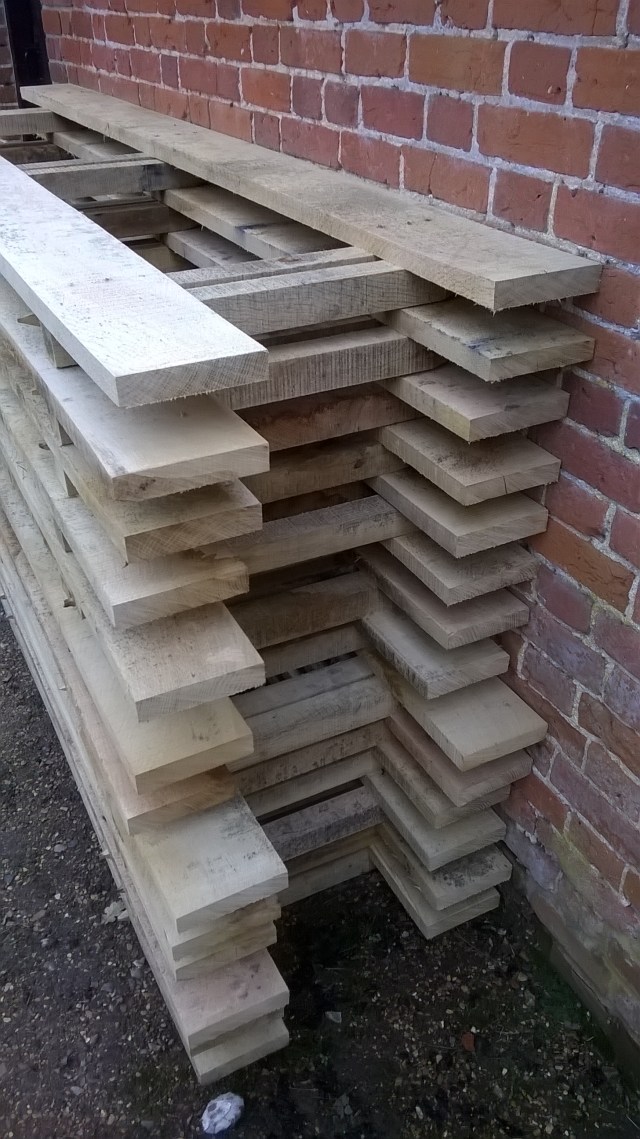
Oak boards and pegs awaiting installation

Oak boards and pegs awaiting installation

I can’t believe that it’s nearly a year since I began volunteering here; a year which has been a joy.

Further Information:

Blickling Hall website

Blickling Hall Facebook page

A 360 degree tour of Blickling Hall

Old School Gardener


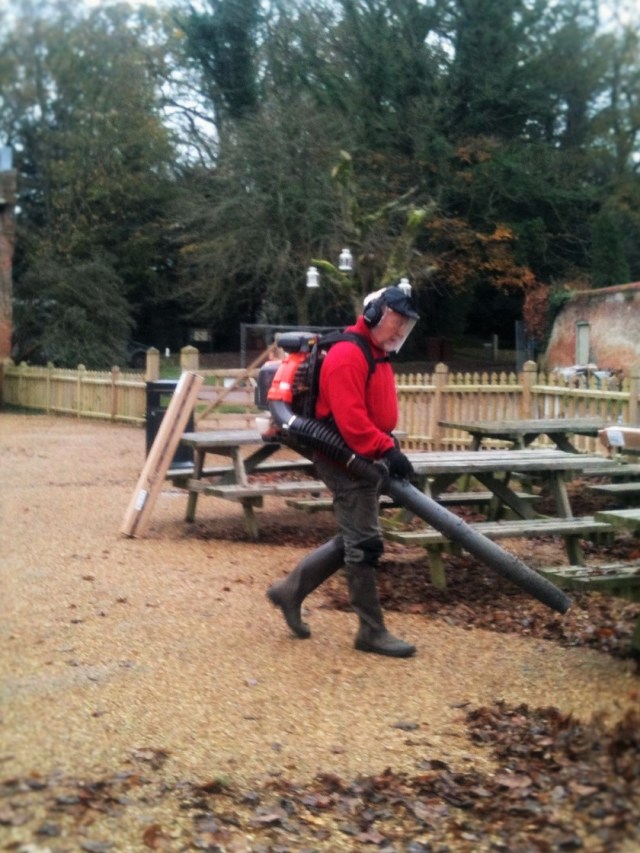
IMG-20151203-WA0002O.K. it’s me in there (captured by my wife on one of her walks)…and yes, it isn’t Ghostbusting (as my daughter suggested), but rather leaf blowing at Blickling this week!

The ladies were put to work helping the tidy up before the big Christmas events here at the Hall, and Peter, Ed and I were set to clearing the main roads and verges of some rather wet and in some places, deeply laying leaves. With the Oaks still holding on to their foliage it will be some weeks before all the leaf litter is down and can be cleared away for another year. But it was well worth doing this little bit of work to protect the grass and help to tidy up the paths and roads around the Hall.

WP_20151203_10_41_45_ProEd took me through the machine for the day – a very powerful petrol-powered back pack blower which was a bit on the heavy side, especially after a couple of hours! But, moving in a line, Peter, Ed (who had an even more powerful trolley blower) and I managed to get the leaves ready for Ed to bring round the tractor with a powerful vacuum cleaner attachment to suck up and shred the leaves ready for dumping on the leaf mould pile.

I know the use of this sort of powered leaf collection is not very environmentally friendly, but the sheer scale of the job here at Blickling (as with so many of the gardening tasks) requires this sort of kit to get anywhere in a reasonable amount of time. Still, I salved my conscience a day or two later with some manual leaf raking and dumping in my newly created leaf mould bay at Old School Garden!

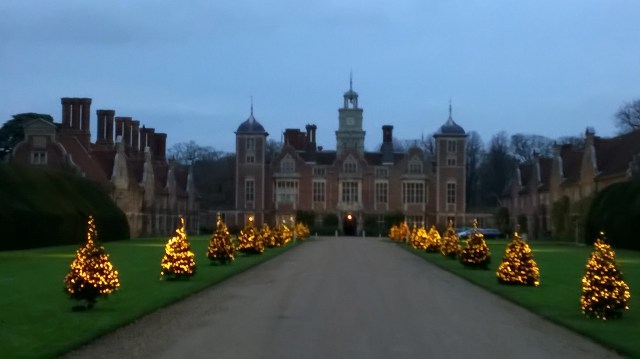
WP_20151203_15_47_48_ProThe run up to Christmas with Blickling  ‘Putting on the Glitz’ is starting to come together, and we also helped lift furniture in the courtyard where a fire pit, lanterns and other features look set to create wonderful centre piece. Staff and volunteers have been out decorating the Acorn Yews in the Parterre Garden and the traditional avenue of illuminated Christmas Trees looks wonderful once more. This year there is even a ‘Christmas Tree’ alight on the island in the lake.

Further Information:

Blickling Hall website

Blickling Hall Facebook page

A 360 degree tour of Blickling Hall

Old School Gardener


WP_20151126_13_41_03_ProYet more strimming this week in my latest session at Blickling!

The ladies finished off planting the blue Hyacinths in the top borders. Remember the new trailer I mentioned last time? Well it seems it will be kept, but an additional ramp is to be supplied to make the gradient shallower for wheelbarrow-carrying gardeners and some better grip added to the surface.

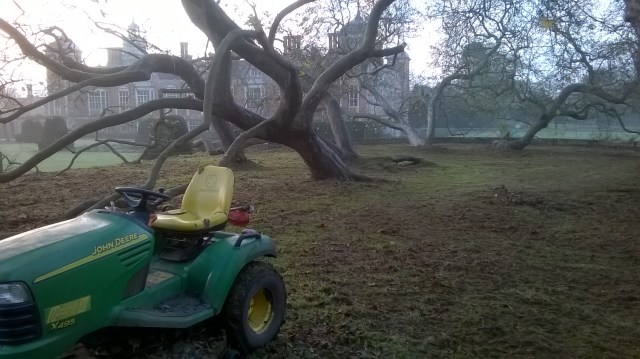
Peter and I moved across to the wonderful Oriental Plane trees and began strimming the undergrowth around these. I plumped for a large area where the rangy branches of several trees had extended their long spider-like legs. I had got about half way when gardener Ed appeared and suggested I use a ride-on mower to do most of the open grass – another bit of ‘kit’ I’m now able to use and it certainly speeded up my progress and at the same time turned the mix of leaves and grass into a finer mulch which will hopefully break down over the winter.

200 year old Oriental Planes after strimming and mowing...

200 year old Oriental Planes After strimming and mowing…

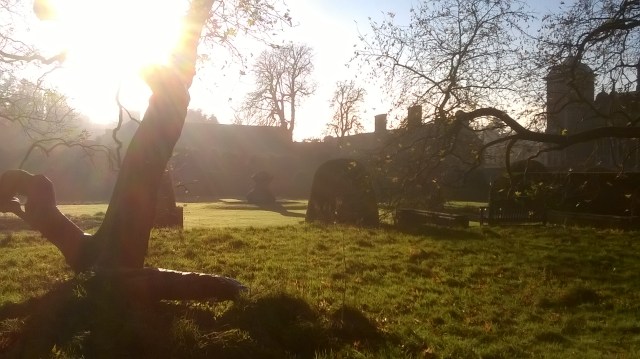
The weather was a little misty to begin with but the sun eventually shone through and it’s low angle provided some long shadows and definition to the garden features. One of these, the fountain that was being cleaned a week or two ago, is now wrapped up to prevent frost damage during the winter.

Wrapped up for Christmas...and beyond. The central fountain gets its frost proof cover.

Wrapped up for Christmas…and beyond. The central fountain gets its frost proof cover.

I gather from head gardener Paul, that money has been found to restore the gardeners’ bothy in the walled garden (to provide an additional base for the garden volunteers and staff) and also to renovate the second long glasshouse.

The Walled garden project seems to be gathering pace and next growing season will hopefully see the majority of the space turned over to food production. Current projects include finishing off the path edging (to be completed by contractors in the New Year), and putting up the wooden and wire supports for the wall-trained fruit (you may remember that measuring the lengths of wire and wood needed for this was one of my first jobs back in January).

I hope to get back into the walled garden again soon, but in the next few weeks all attention is being turned to ‘dressing’ the gardens for the Christmas celebrations at the Hall; ‘Putting on the Glitz’ seems to be the theme, as the place is turned back to the glamourous 1930’s.

WP_20151126_13_39_58_ProFurther Information:

Blickling Hall website

Blickling Hall Facebook page

A 360 degree tour of Blickling Hall

Old School Gardener


WP_20151112_14_20_33_ProThe ‘dynamic duo’ of Peter and I continued with strimming the avenues and connecting paths in the outer gardens at Blickling this week.
I arrived to find the gardeners and Peter gathered around a large, new trailer which had just been delivered. I later looked this over and had an interesting discussion about its features and how useful an addition it was going to be to the gardeners’ armoury….

Hmm...big, shiny, but how useful?

Hmm…big, shiny….

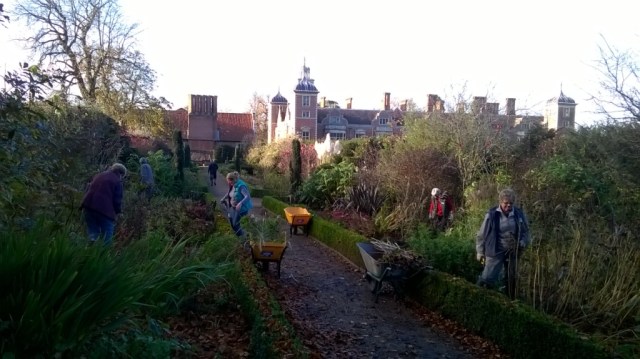
The ladies, meanwhile were finishing off cutting back and clearing the double borders, which only a few weeks ago had been resplendent in their late summer colours.

Cutting back the double borders on a beautiful autumn day

Cutting back the double borders on a beautiful autumn day

Having adjusted the belt on the strimmer I found I was really getting into my stride (or should I say ‘swing’?) with this useful machine- it was rather like old-time scything but without the muscle power needed for that. However, it was sweaty work clearing around trees and the edges of shrubs  where the mowers can’t reach.

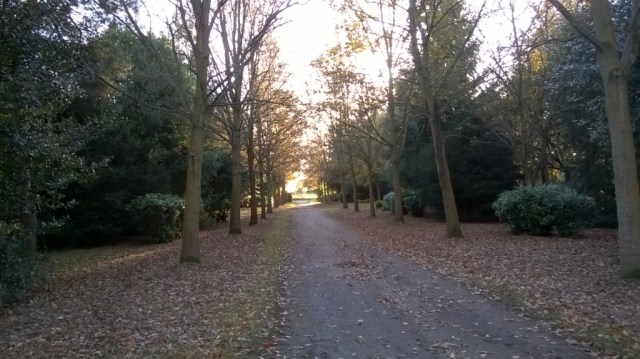
After lunch I had an interesting chat with gardener Ed and Peter about the way the avenues of Beech, Oak and other trees have to be regularly cleared of fast-growing understorey trees and shrubs such as holly, yew and rhododendrons. The impact of letting these plants over grow the trees was evident in the bent over trunks of some examples (or ‘on the huh’ as we say in Norfolk!).

The maintenance plan involves every year or so stooling (or coppicing) these vigourous plants and so maintaining  space around the avenue trees. As Ed pointed out, there are some clear examples of where action is going to be required in the near future, so perhaps Peter and I will be moved on to chain saws soon!

Blickling has a new website, why not take a look at the link below?

A virtually deserted garden at a sun-scanned Blickling..

A virtually deserted garden at a sun-scanned Blickling..

Further Information:

Blickling Hall website

Blickling Hall Facebook page

A 360 degree tour of Blickling Hall

Old School Gardener


WP_20151105_12_20_46_ProMore strimming this week in my short session at Blickling.

The ladies were whisked away to pull up the Penstemons for over wintering and to make way for next spring’s display of Hyacinths.

WP_20151105_12_29_36_ProFellow volunteer Peter and I were sent to the wider gardens where the grass had been mown a few days before, but where the mower couldn’t go, we were to strim away the long grass around tree trunks and edges etc. There are several avenues of beech and other trees radiating away form the more formal gardens area and we worked our way along and around these.

As I’ve reported before, these strimmers are pretty strong and use a plastic-sheathed metal cord which is quite capable of cutting through pretty thick stems as well as grass. We were mindful of this and were careful not to go too near the trunks of the trees for fear of ‘ring-barking’ them, which causes wounds that are open to disease and rot.

WP_20151105_12_21_22_ProThe Hall has now closed for the winter (apart from special events and group visits) and the gardens are on shorter opening hours. The last colour of flower has now pretty much disappeared and the focus in the gardens is on cutting down, pulling out, dividing and mulching in preparation for winter.

Further Information:

Blickling Hall website

Blickling Hall Facebook page

A 360 degree tour of Blickling Hall

Old School Gardener


WP_20151029_12_25_49_ProA rather dull, overcast day greeted we garden volunteers on our latest session at Blickling. The team was rather depleted, also, with a few people away on holidays.

It was to be a day of ‘stalking’- cutting down the stems of the many herbaceous plants in the long border overlooking the parterre. It was also rather busy and noisier than usual; as it’s ‘half term’ here there were lots of families around walking the gardens and enjoying some community education activities in a tent by the lake.

In the morning we continued the cutting and tidying process already begun the day before- we had about 7/8 of the border left. Apart from the occasional entanglement with the floppy stems of climbing roses, it was relatively straightforward; I dived into the borders and focused on cutting, with others doing this and collecting the cuttings and raking over the border to make it look tidy. Once this is finished (the main parterre borders had already had the treatment), the borders will be lightly dug over and then mulched with compost to provide winter cover for the soil and help to feed the plants and improve soil texture. By the end of the session we had virtuially completed the whole border- and produced several truck loads of cuttings which will be shredded and added to the Hall’s large compost heaps.

Towards the end of the morning I took a break and ‘stalked’ two people from the house and collections team who were cleaning the fountain in the middle of the parterre.  They were using toothbrushes, water sprayers and hands to peel away quite a bit of muck, accumulated over a few years. It was interesting to see how the definition of the stonework dramatically improved as they worked their way across its surface. It looks like the basic structure is, in the main, pretty good, but it is also clear that there are some areas in need of repair.

WP_20151029_12_00_58_ProFrom here I ‘stalked’ Assistant Head Gardener, Steve, who was painstakingly digging over one of the four parterre borders; to both split some of the bigger herbaceous plants and at the same time try to remove bindweed which seems to be a long term problem here.

Part One of Steve's Parterre Saga...

Part One of Steve’s Parterre Saga…

Steve was sanguine about the weed returning, but he was spacing out the plants so that it would be relatively easy to get in the border to remove it when it does return.

We talked about the new heating system being installed at Blickling, which you may have heard about. This is based on a water source heat pump which acts rather like a fridge in reverse- a coolant fluid is pumped into a long series of plastic pipes which are sunk into the lake and these are connected to a pump which draws in the warmed fluid and a heat exchanger in the house transfers this to the hot water system. Apparently there’s a gas back up boiler also being put in to cope with especially cold weather. This is set to reduce the £30,000 per annum fuel bill the Trust currently pays out for heating. Here’s a short video clip about the project.

After lunch my final ‘stalk’ was over to the Bug Village I had been working on last week, but was sorry to hear that gardener Ed -whose project this is- had seriously damaged his back trying to lift some of the large pieces of trunk he was installing in the new area- I wish him well soon.

The ‘Bug Village’ is starting to take shape nicely with several up turned stumps put in place and some further woven hazel fencing along with the large chunk that will provide a lovely seat back…in due course.

  Further Information:

Blickling Hall website

Blickling Hall Facebook page

A 360 degree tour of Blickling Hall

Old School Gardener


WP_20151007_15_37_25_ProI finally got round to visiting a place I’d wanted to see for some time- Voewood, an arts and crafts masterpiece in north Norfolk.

Taking advantage of the ‘Invitation to View’ scheme we set off on a rather wet and windy day a week or two ago to High Kelling, near Holt.

Our tour of this private house was full of surprises and curiosities. Owned by a rare books and art dealer Simon Finch (who now lives in one of the coach houses) it has been decorated over the years in a very individual style with plenty of personal mementoes and artworks, many hailing from the 1960’s and 70’s. The house with its fourteen bedrooms can be hired out and it also acts as a centre piece for an arts festival.

This slideshow requires JavaScript.

The house was designed (1903-5) by Edward S. Prior. Voewood is perhaps one of the greatest achievements of house design of the Arts and Crafts movement. More than almost any other building of the period the house fulfils the ideals for architecture developed by William Ruskin and William Morris.  In the designing and building of Voewood many of Prior’s philosophical ideas found physical expression.

Its design and construction were characterised by the use of radical planning and forms, innovative technologies, such as the use of reinforced concrete, extensive external decoration, a distinct building philosophy involving craftsmanship and the use of quality local materials and the integration of the building and its interiors with the garden and its surroundings.

The house is based on a butterfly plan. The three storey central portion of the house is flanked by splayed two-storey wings. The plan enabled Prior to maximise views out and to give the best orientation to a range of rooms. He could also relate the external spaces to the internal areas. The area contained within the splay faced the gardens, with the northern of the wings acting as the entrance, with a two storey porch and daylight basement. This wing also contained the library and billiard room at ground floor level. The wing opposite contained the kitchen and service accommodation together with the dining room. The fruit and vegetable garden lay adjacent. The entrance, through oak doors, leads into a six-sided hall up a straight flight of Hoptonwood stone stairs into an octagonal lobby.

Though never lived in by its original owners (there seem to be various theories as to why, including its proximity to a then T.B. hospital), the house was turned into an old people’s home and has also been a hotel. And despite some alterations (e.g. the closing in of two flanking loggias), it has retained most of its original features. I was especially impressed by the construction which used concrete formwork on a (then) extensive scale, resulting in nicely rounded corners to walls and window openings and some chunky concrete beams which provide an interesting, simple decorative feature to many ceilings. However, I was a little disappointed with the window and other ironmongery which, in contrast to many other houses of this style and period (see, for example my recent post on Goddards, York), was rather plain. Perhaps this is further evidence of the alterations carried out in the 1930’s.

Though visiting on a damp October afternoon when there was not much floral interest to be seen, the gardens still managed to impress. The main layout from the back of the house appears to follow its original stepped, symmetrical design, whereas the former kitchen garden to the side has been skillfully turned over to a rather more ornamental layout, though retaining many good examples of wall-trained fruit.

This slideshow requires JavaScript.

The original gardens were of great renown and highly regarded. Voewood was perhaps Prior’s greatest garden design. Garden making was a preoccupation of his middle period. Terraces extend from the wings of the house and end in steps leading down to the garden level. The garden is also reached from the terrace by a double flight of steps leading to two stone paths, separated by a water feature in the form of a stepped stone tank containing water-lilies, iris and forget-me-not. The central feature of the garden is a large basin. Pergolas with masonry walls lead east and west.

The garden at Voewood (then called Home Place) was admired by Gertrude Jekyll and Sir Lawrence Weaver, who described and illustrated it in their book Gardens for Small Country Houses;

“The stepped scheme at Home Place, Holt, designed by Professor E.S. Prior will be a counsel of perfection to most people”.

Further information: Voewood website

Old School Gardener


Peter and Ed spreading shredded bark in the new 'Bug Village'

Peter and Ed spreading shredded bark in the new ‘Bug Village’

Apologies for the title, but I couldn’t resist it. I guess a more serious alternative would be ‘weaving and strewing’!

So my latest session at Blickling Hall involved working with fellow volunteer Peter and Gardener Ed on a new project in part of the Dell Garden; this is an area that’s looked a little neglected for some time and it was good to see some work to create something different.

This was a really fun, creative day as we helped Ed work up his idea of creating a ‘Bug Village’ of different insect hotels/habitats (with fun historical references to Blickling’s owners) in a largely shady and overgrown spot.

Ed had already done some clearing of the ground and had in his mind a rough layout. We started by continuing the hazel pea stick fence he’d begun which provides a really effective, simple, permeable barrier through which you can see into different parts of the area. These sticks are harvested every year from the Estate and put to use to support climbers and vegetables of various sorts. Peter hammered in a metal fence post to create holes about 6″ apart and I pushed home the sticks and wove them together.

After this we collected several loads of shredded bark and strew these over the areas where the bug hotels were to go- a mixture of different types of habitat and mixed in with some impressive stumps and enormous slices of chestnut tree felled elsewhere in the estate and, as Ed said ‘no good for firewood’. It was great ‘designing on the hoof’ with Ed and Peter, creating bays and spots where different elements of the layout could be best fitted in.

In particular there is an elevated spot overlooking the rest of the space which would make a wonderful spot for a seat, and Ed had already identified a wonderful piece of timber- a half round slice of Oak, I think, which would make the perfect base for this. We also helped to gather smaller edging logs which further helped to define the space and again filled in around and shrubs trees with more shredded bark.

On the way...

On the way…

It will be great to see how Ed progresses this in the coming weeks and what visitors think of this new feature- created from recycled materials from around the Estate.

 Further Information:

Blickling Hall website

Blickling Hall Facebook page

A 360 degree tour of Blickling Hall

Old School Gardener


WP_20150911_14_11_48_ProSo, we were on our way home from Northumberland and stopped off for a lunchtime visit to Goddards, a National Trust property on the outskirts of York.

This one time home of Noel Goddard Terry, owner of the famous chocolate-making firm Terry’s of York was designed by architect Walter Brierley in the Arts and Crafts style and is complemented by four acres of gardens, designed by George Dillistone.

The house has selected rooms displayed to give glimpses into the family home and workings of a chocolate factory. You’ve probably heard of (if not eaten) a Terry’s Chocolate Orange (traditional for a British Christmas!), but did you know there was also once a Chocolate Apple?!

This slideshow requires JavaScript.

The garden includes yew-hedged garden rooms, a bowling green, wilderness gardens and plants for every season; it is also an oasis for wildlife.

On our visit we met an enthusiastic Garden Volunteer, whose role was to engage visitors among other things. The gardens were delightful, and obviously a lot of work is going into bringing them back to their Arts and Crafts roots. I particularly loved the classic terrace overlooking the garden, with its wicker chairs ready for a Sunday afternoon doze in the sun. Oh, and we had a lovely lunch in a traditonal style restaurant in the house too.

Further Information: National Trust website

Old School Gardener


Finding Nature

Nature Connectedness Research Blog by Prof. Miles Richardson

Norfolk Green Care Network

Connecting People with Nature

Discover WordPress

A daily selection of the best content published on WordPress, collected for you by humans who love to read.

Susan Rushton

Celebrating gardens, photography and a creative life

Unlocking Landscapes

Writing, photography and more by Daniel Greenwood

Alphabet Ravine

Lydia Rae Bush Poetry

TIME GENTS

Australian Pub Project, Established 2013

Vanha Talo Suomi

The Journey from Finnish Rintamamiestalo to Arboretum & Gardens

Marigolds and Gin

Because even in chaos, there’s always gin and a good story …

Bits & Tidbits

RANDOM BITS & MORE TIDBITS

Rambling in the Garden

.....and nurturing my soul

The Interpretation Game

Cultural Heritage and the Digital Economy

pbmGarden

Sense of place, purpose, rejuvenation and joy

SISSINGHURST GARDEN

Notes from the Gardeners...

Deep Green Permaculture

Connecting People to Nature, Empowering People to Live Sustainably

BloominBootiful

A girl and her garden :)