Category: Heritage Gardens & gardening


gressenhallfw's avatarGressenhall Farm and Workhouse

Winter on the Farm

Hannah and I have finally thawed out from the freezing cold and are enjoy the somewhat tropical temperature of 10 degrees down at Gressenhall farm. As I didn’t last time, I shall take a few words to introduce myself, my name is Tom Watson and I am the other half of the Heritage Landscape Management trainee team. We are now four months through the scheme and are still thoroughly enjoying it! Like Hannah, I am an Environmental Science graduate from the University of East Anglia and I have a keen interest in the history of the UK’s landscape and the environment. I have previously worked on a farm and my most of family are linked to agriculture in some way. And so when this traineeship at Gressenhall Farm and Workhouse became available it seemed like the perfect opportunity for me to gain skills to help me…

View original post 600 more words

herry Tree Cottage flower borderAn old Workhouse Yard has been turned into a showcase cottage garden of the 1930’s at Gressenhall Farm and Workhouse Museum, Norfolk.

What is a cottage garden?

The words ‘cottage garden’ conjure up an idyllic image involving roses round the door of a picturesque thatch cottage with towering hollyhocks and delphiniums (or something similar) either side of a brick path that leads to a picket gate. It’s all very romantic, always spring or summer – and always sunny.’ (The Enduring Gardener)

Historically, cottage gardens date from medieval times and were where labourers living in tied cottages grew a lot of their own food to bolster their poor wages. Vegetables were grown – not only to feed the family but also to perhaps to feed a household pig and a few chickens. Fruit was grown – apples and pears for example – with wild strawberries being gathered from the hedgerows. Flowering plants would have been collected from the wild and it is possible that flowers like violets, primroses, cowslips, dog rose and wild honey suckle featured in some cottage gardens.

Monasteries grew herbs for medicinal purposes and vegetables for the monks’ food. Their knowledge was much sought after and this filtered through to the poorer classes.

The 18th and 19th centuries brought many changes – the Enclosure Acts meant that wealthy landowners could remove the peasants’ right to graze animals on common land. This forced many to grow food in their gardens to feed themselves. Gradually living conditions for the poor improved – they were able to use their gardens not just to grow vegetables for food but flowers too. Gardeners exchanged ideas and plants and soon flowers and shrubs that were only ever seen in ‘the big house’ appeared in cottage gardens. The Victorian period also saw many new varieties of bright colourful annuals used as bedding plants.In the late 19th and early 20th centuries  Gertrude Jekyll developed the cottage garden style on a grand scale.

The First and Second World Wars brought food shortages and so vegetables and fruit took priority over ornamental planting in every available garden space. Once food rationing finished after the 2nd WW, people could look to their gardens to provide visual interest and not just food, so flowers and shrubs were planted once more.

Today the cottage garden retains its popularity. One approach is the traditional, smaller scale artisan style – creating the garden as you go along, often dividing, collecting seed and gratefully receiving gifts of cuttings or plants from neighbours or friends. Others prefer the more designed approach, with carefully planned borders and precisely laid paths, perhaps in a larger scale setting.

Cherry Tree Cottage Garden

The Museum’s records show that Cherry Tree Cottage and its adjacent open space were created in the 1850’s, probably to house elderly couples (‘no longer of child-bearing age’) from the main Workhouse. It seems that it may have actually housed three couples with a shared kitchen/dining room. The open space was probably just a yard used for sitting or exercise and there is no evidence of it being planted with flowers or vegetables.  In 1932, the cottage housed Workhouse staff and it is during this period that possibly a garden was introduced.

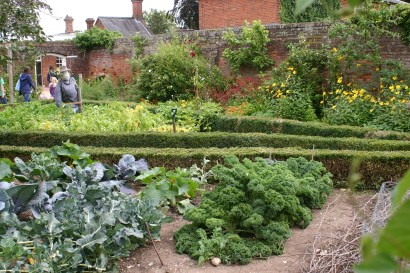
The current garden was created in the 1980’s by a team of volunteer gardeners, some of whom are still volunteering today!  Mary Manning created the original design to demonstrate a typical cottage garden of the 1900’s, and this was based on extensive research, including the local Women’s Institute. Their members’ memories were used in the garden to reflect  the Cottage, which had been set out to resemble a 1912 interior. Later changes in the cottage were also reflected in the garden and today it aims to show how a typical 1930’s rural cottage garden would have looked and been gardened. It includes:

Flower borders – traditional cottage garden plants such as lupins, asters, rambling roses and Buddleja. The snowdrops (Galanthus plicatus) derive from bulbs brought back from the Crimean War in the 1850’s by a Captain Aldington who was from near Swaffham. His mother gave some to a friend in Warham where it is said the local rector, Charles Digby, grew them in the Church yard – they became known as the Warham Snowdrop. This variety is still available today. More recently some heritage daffodils from the 1800’s have been planted in the garden.

Cherry Tree Cottage and some of the vegetable growing area (left)

Vegetable Crops – the  early vegetable plots grew a wide range of crops and some old seed varieties of pea (‘Simpsons Special’) and broad beans (‘Big Penny’) ‘were acquired from celebrity gardener Percy Thrower and a local retired gardener respectively. The museum ha some old seed catalogues from two local seed merchants – Daniels and Taylors –  and these have been used to research the varieties that might have been grown in the 1930’s. Many of the varieties of fruit and vegetables that were grown in the 1930’s can be seen in the garden today. Garden Organic and The Heritage Seed Library have donated many of the seeds.

Herbs – a range of well known herbs are grown in the garden today. Herbs were used both for flavouring food and medicinal uses – for example a paste made from Comfrey leaves would be used to aid the healing of broken bones hence its common name of ‘Country Knit Joint’!

The garden also houses a chicken run, as it was common for many cottagers to keep chickens , which gave them a good supply of eggs. The chicken manure was also used as a fertiliser on the vegetable plot.

The garden paths were originally grass edged with flint. These were gradually replaced with bricks, local tiles (‘pamments’) and cinder;  traditional methods used in cottage gardens. Todays paths are a mix of brick, pamments and gravel – the latter is easier to maintain and is more accessible for wheelchair users.

The Potato Clamp and Scarecrow at Cherry Tree Cottage Garden

The Potato Clamp and Scarecrow at Cherry Tree Cottage Garden

Whilst the gardening volunteers are trying to follow gardening practices typical of the 1930’s, sometimes these have to be avoided (e.g avoiding the use of dangerous pesticides).  But some interesting examples of old techniques have been demonstrated – for example the creation of a ‘Potato clamp’ which was a method for storing potatoes during the winter months before indoor storage space became more readily available.

Acknowledgement: I am grateful to Kay Davis, Heritage Gardening Trainee 2011-12, for permission to use her article on Cherry Tree Cottage for most of the material used in this post.

Sources and further information:

Plantax 3: Sweet Peas- cottage garden favourite

Unique heritage gardens at Norfolk museum

Old Workhouse Garden a wildlife oasis at Norfolk Museum

The Cottage Garden Society

Quizzicals:

answers to the two in previous post  Transfer Window- 7 tips for successful seedlings

  • Set fire to Ms Allen – Torch lily
  • Mythical creature that enjoys a game of cards – Snapdragon

Here are a couple of gardening ditties….

Snowdrops keep falling on my head

Theme tune from The Lone Hydrangea

(with thanks to Les Palmer)

Old School Gardener

If you’ve enjoyed reading this post and others on this blog, why not comment and also join some other people and sign up for automatic updates via email (see side bar, above right ) or through an RSS feed (see top of page)?

PIC00026Gardens of Court and Country: English design 1640–1730

Dr David Jacques, Garden Historian

6.30 pm, Wednesday 30 January, The Gallery, 70 Cowcross Street

Most traditional histories of the English garden treat formal gardens as a single and unvaried period, filling the gap between the Elizabethan and the landscape garden, but David Jacques’s forthcoming book demonstrates that, by contrast, each generation made huge changes in the design of its gardens. The emergence of the landscape garden is shown in proper context, and connections are made to politics, religion, men’s fashion, gastronomy, the development of carriages, the symbolism of parks, foreign influence, and many other aspects of seventeenth and early eighteenth century life.

Led by the Land

Kim Wilkie, Landscape Architect

11th Annual GHS Lecture at the RHS

6.30 pm, Wednesday 20 February, Royal Horticultural Halls & Conference Centre

Kim Wilkie will explore the future of landscape architecture as set out in his new book, Led by the Land, covering projects such as Transylvania, Longwood Gardens and Boughton Park to illustrate his ideas. He will show how the ancient tradition of sculpting the land can inspire new forms and meanings, merging innovative landscapes with revered historic ones. Mavis Batey has said in interview: “All over the world people want to know how he does it”. This will be your chance to learn.

‘Harmony Compleat’ —
Music in the Garden from Renaissance Italy to Georgian England

Judy Tarling, Specialist in Historical Performance (music and gardens)

6.30 pm Wednesday 27 February, The Gallery, 70 Cowcross Street

Judy Tarling will talk about how music was performed and experienced in gardens from renaissance Italy to Georgian England, illustrated with musical example and images. She will investigate who played which instruments, where, the nature of the audience if there was one, and the repertoire. Judy will show how music, from the sound of water and bird-song to fully staged dramatic performances, was an essential part of the historical garden from the 16th to 18th centuries.

A little bit of Surrey in the sun?
A hundred years of the national botanic gardens of Burma

Dr David Marsh, Garden History Researcher/Lecturer

6.30 pm, Wednesday 6 March, The Gallery, 70 Cowcross Street

Maymyo was a poor relation in the family of Kew-inspired tropical botanic gardens. Established late in colonial rule by ‘amateurs’, it quickly suffered from staff turnover and uncertainty as to its role. After the war and independence it fell further into decline but has recently been ‘privatized’ by the government. Uncovering its story has been difficult but offers a different perspective on the history and political role of botanic gardens and their possible future in the developing world.

Passion, Plants and Patronage:
Three Hundred Years of the Bute Family Landscapes

Robert Peel, Vice Chair of GHS, Kristina Taylor, Vice Chair of GHSS

6.30 pm, Wednesday 20 March, The Gallery, 70 Cowcross Street

Several generations of the Bute family have been intimately involved in the development and maintenance of landscapes in Scotland, England and Wales. This talk will link the personalities and landscapes, with particular reference to the two most prominent family members in the field of parks and gardens, the 3rd Earl in C18 and the 3rd Marquess in C19, and discuss the happy condition of these landscapes today.

Contact:

The Garden History Society

Email: events@gardenhistorysociety.org

Office (information and press enquiries): 020 7608 2409

Website: http://www.gardenhistorysociety.org

Website for press information: www.gardenhistorysociety.org/press

Venues and Times 2013:

11TH Annual GHS Lecture at the RHS

Lecture by Kim Wilkie (20 Feb)

Royal Horticultural Society Halls and Conference Centre.

Greycoat Street, London SW1P 2QD (Victoria, St James’s and Pimlico Stations).

Doors open at 5.45 pm, lecture starts at 6.30 pm.

Lectures by Dr David Jacques (30 Jan), Judy Tarling (27 Feb),
Dr David Marsh (6 Mar), Robert Peel (20 Mar) at

The Gallery, 70 Cowcross St, London EC1M 6EJ (Farringdon Station).

Doors open at 6.00 pm, lectures start at 6.30 pm


Tickets

RHS: £15.00 in advance for members of the GHS and RHS, £18.00 for all tickets purchased at the door.

The Gallery, Cowcross Street: £8.00 in advance for members of the GHS, £10 for all tickets purchased at the door (one glass of wine included).

SEASON TICKET FOR ALL LECTURES: £43.00 members, £54.00 non-members.

A booking form can be downloaded from http://www.gardenhistorysociety.org/events

THE GARDEN HISTORY SOCIETY is widely recognised for its expertise and advice. In its role as statutory consultee, its professionally qualified conservation officers are consulted by government agencies and local authorities on a wide range of issues affecting historic parks and gardens. The Garden History Society also

  • promotes the study of the history of gardening and horticulture in all its aspects
  • promotes the conservation of historic parks, gardens and designed landscapes, and advises on their restoration
  • encourages the creation of new parks, gardens and designed landscapes.

 The events at The Gallery are supported by Alan Baxter & Associates

The event at The Royal Horticultural Hall and Conference Centre is supported by

The Royal Horticultural Society


The Garden History Society

70 Cowcross Street, London EC1M 6EJ

020 7608 2409

events@gardenhistorysociety.org

http://www.gardenhistorysociety.org

Old School Gardener

The Master's Garden as it looked in the 1970's

The Master’s Garden as it looked in the 1970’s- evidence of food growing when ‘Beech House’ old people’s home occupied the buildings.

In the second of a series about the gardens at Gressenhall Farm and Workhouse Museum, Norfolk, I explain how the former Workhouse Master’s garden has been turned into a wildlife oasis.

During the 19th and early 20th centuries the Master of the workhouse looked down on the walled garden from his family accommodation. There is no evidence of what it looked like or what was grown here then, but during more modern times, when the Workhouse became an Old People’s home, it seems that the area was used to grow food (see photograph).

Today the area is used mainly as a wildlife garden and was the subject of a major overhaul a couple of years ago with financial support from the Big Lottery and Friends of the Museum (totalling £13,000) as well as donations from local nurseries and others. Originally created in the mid 1980’s the Wildlife Garden has been the subject of several awards, but as time passed, with fewer volunteers  able to maintain it, the garden was less attractive and the thugs of the plant world rather took over. The pond liner was punctured and the plastic safety cover and overgrown water plants were throttling what life did exist!

The Wildlife Garden before it's recent makeover

The Wildlife Garden before it’s recent makeover

All in all the garden was looking very sad!

After a review it was decided to improve access to the garden by:

  • widening one entrance and adding another and a new path
  • renovating and re-laying the existing circular path with new infill material between the slabs
  • relocating and enlarging the pond to make it a central feature of the garden
  • strengthening the different types of habitat for wildlife
  • providing some seating and a wheelchair bay
  • improving interpretation for visitors so that they can appreciate what is in the garden and why.
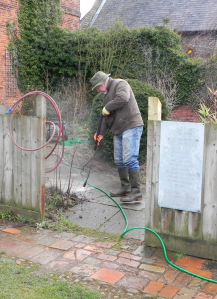
Cleaning the slabs that were later re-used

Cleaning the slabs that were later re-used

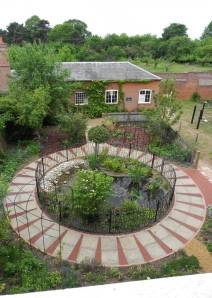
There is now a central pond (with shelved edges, a pebble beach and shallow water to act as portals for insects), and surrounding bog areas. Other habitats  are ranged on each side – a hot and dry gravel garden on the south facing side, a darker and damper shade garden towards the north-facing side. There are some other wildlife friendly features here such as bug hotels and bat and bird boxes which were originally installed in the 1980’s. There is a new attractive interpretation board encouraging visitors to look out for different types of wildlife, including the resident Newts (named either Nigel or Nigella- no one has got close enough to tell their gender!). I find it amazing how quickly amphibians, insects etc. have been attracted to the pond and surrounding areas, so that today a wide range of wildlife can be seen (if you’re patient and quiet).

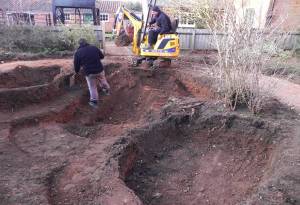
Excavating the new pond

Excavating the new pond

The new garden under construction

The new garden under construction

The new Wildlife Garden

The new Wildlife Garden

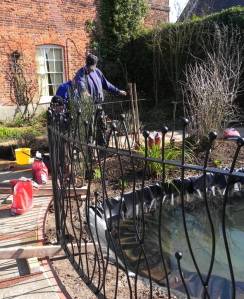
I designed and managed the project and with other volunteers put in the new plants and did some of the other renovation work. The main contractor for the new pond, borders and paths was Ian Chatten Ltd. and Kontorted Iron created the wonderful ‘organic’ fence around the pond, together with metal pergolas and an arbour– all in black wrought iron to link with other items in the Museum including the nearby old cattle- weighing machine, originally from Fakenham Market. The Gardening Team’s tool store and sheds are also ranged along one side. The arbour has taken advantage of an old ‘Rambling Rector’ rose growing in the corner of the garden – this has been pruned and tied around the frame of the arbour and provides both a wonderful sight and a romantic spot from where to view the garden in summer.

There’s also a  ‘Really Useful Patch’  of flowers, herbs and shrubs. Until very recently households had to be self-sufficient in flavourings, medicines, insecticides, cleaning products and so on. The plants in this garden were all used in the past by the housewife to keep her family healthy. The only other criterion for this area was that it was to cost nothing so all the plants have been grown from cuttings or division, or have been donated or ‘recycled’.

Installing the new wrought iron fence

Installing the new wrought iron fence

The new Wildlife Garden from the new entrance

The new Wildlife Garden from the new entrance

The coming season promises to see the planting and features mature further and hopefully the ‘critters’ will enjoy it too!

Quizzicals (courtesy of Les Palmer):

two more cryptic clues to the names of plants, fruit or veg…
  • The noise of a bird imitating a cat
  • How Australians describe English rock  

Old School Gardener (with thanks to Christine Walters for some of the photographs)

If you’ve enjoyed reading this post and others on this blog, why not comment and also join some other people and sign up for automatic updates via email (see side bar, above right ) or through an RSS feed (see top of page)?

garden pic gressenhallThere are around ten different heritage gardens or other tended spaces at Gressenhall Farm and Workhouse Museum, near Dereham, Norfolk.

I’ve been a garden volunteer here for the last couple of years and spent time as a trainee Heritage Gardener. I plan to explore these spaces in my blog over the coming weeks. Here’s some background information.

References to ‘gardens’ in the Workhouse records (from  late 18th to mid 20th centuries) are relatively few, as most of the spaces within the walls of the former Workhouse were ‘yards’ of various kinds, being used for exercise or work by the inmates (including stone crushing). Records indicate that there were areas of active cultivation, mainly to grow food for the Master, staff and inmates. Major areas of food cultivation (most located just outside the Workhouse walls) no longer exist.

The current workhouse buildings were developed in the late 18th century after an Act of Parliament encouraged ‘Houses of Industry’ to be set up. People unable to look after themselves and/or their families were able to live in the buildings and do work to earn their keep. Before this, from Tudor times, the poor were the responsibility of local parishes and prior to this were looked after by religious orders, or informally by neighbours, friends or family.

The Workhouse meant a harsh, regimented life

The Workhouse meant a harsh, regimented life

1834 saw the Poor Law Reform Act  which converted the House of Industry into The Workhouse. Conditions became much harsher with families split up into different groups – adult males, adult females, boys, girls, unmarried mothers with babies, tramps (or ‘casuals’) etc. Dickens’ novel Oliver Twist conveys the strict regime.

Union Farm showcases historic farming practices with animals and fields

Union Farm showcases historic Norfolk farming practices

Gressenhall and other Norfolk workhouses expanded and reorganised accordingly and this system remained largely the same for the next 100 years. The Poor Law  was eventually abolished just after the 2nd World War and Gressenhall became an old peoples’ home- ‘Beech House’ (named after the magnificent Copper Beech tree in the main courtyard). Finally, in 1979 the old peoples’ home closed and the site was developed as the Norfolk Rural Life Museum, including the acquisition and development of the adjacent Union Farm as a showcase for farming methods and practices of yesteryear.

The historical role of today’s heritage gardens has resulted in most of them being enclosed by the walls of the workhouse buildings, boundary or dividing walls and sometimes, native species hedges or other natural boundaries. These ‘Gressenhall Gardens’ are principally the result of voluntary effort beginning in the 1980’s. The spaces were developed to support the Museum’s role in telling the story of the Workhouse and Farm, Norfolk’s broader landscape and rural life, as well as the more contemporary issues of environmental sustainability and biodiversity.

an aerial view of Gressenhall Farm and Workhouse Museum

An aerial view of Gressenhall Farm and Workhouse Museum, Norfolk

Several of these heritage gardens are domestic in scale and style with mixed planting and other features,  probably due to their clear definition into manageable spaces coupled with the interests and ideas of volunteers and staff. Some of them perform specific roles in helping to interpret this Norfolk museum site and deliver some of it’s messages;

  • Cherry Tree Cottage Garden illustrates a typical Norfolk cottage garden of the 1930’s, using plants and techniques from that time
  • The Wildlife Garden has habitats, planting and other features that are conducive to wildlife. A small border also features ‘useful plants’
  • The Orchards are growing varieties of apple and other fruit native to Norfolk (this is located on the graveyard of the old Workhouse)
  • The Dyers’ Garden features plants used in natural dyeing
Cherry Tree Cottage garden is set out like a typical 1930's cottage garden with vegetable varieties and techniques of the time

Cherry Tree Cottage garden is set out like a typical 1930’s Norfolk cottage garden with vegetable varieties and techniques of the time

A recent development has focused on the ‘Education Garden’, which is an important space used by the Museum’s Learning Team and others, adjoining as it does the Learning Centre. A new ‘Curiosity Corner’  provides an area for children under 5 to explore – it has various natural and other ‘child-size’ features; eg a willow tunnel, turf seat, rock pile, fossils, various metal birds, insects and animals and a hazel ‘wig wam’.

Over the coming weeks I’ll introduce you to some of the more important heritage gardens in this important Norfolk museum.

Further information:

Gressenhall Farm and Workhouse Museum on Facebook

Gressenhall Farm and Workhouse Museum blog

Old School Gardener

Finding Nature

Nature Connectedness Research Blog by Prof. Miles Richardson

Norfolk Green Care Network

Connecting People with Nature

Discover WordPress

A daily selection of the best content published on WordPress, collected for you by humans who love to read.

Susan Rushton

Celebrating gardens, photography and a creative life

Unlocking Landscapes

Writing, photography and more by Daniel Greenwood

Alphabet Ravine

Lydia Rae Bush Poetry

TIME GENTS

Australian Pub Project, Established 2013

Vanha Talo Suomi

The Journey from Finnish Rintamamiestalo to Arboretum & Gardens

Marigolds and Gin

Because even in chaos, there’s always gin and a good story …

Bits & Tidbits

RANDOM BITS & MORE TIDBITS

Rambling in the Garden

.....and nurturing my soul

The Interpretation Game

Cultural Heritage and the Digital Economy

pbmGarden

Sense of place, purpose, rejuvenation and joy

SISSINGHURST GARDEN

Notes from the Gardeners...

Deep Green Permaculture

Connecting People to Nature, Empowering People to Live Sustainably

BloominBootiful

A girl and her garden :)