

Category: Heritage Gardens & gardening
The ‘Garden Party’ on BBC Radio Norfolk (28th September) went off to Gressenhall Farm and Workhouse for a look at a garden, designed (by me) with wildlife in mind. Plus your questions to the expert panel – Alan Gray, Ian Roofe and Joe Whitehead. Hosted by Thordis Fridriksson. Listen to the programme on iplayer until 5th October – the pieces about the gardens are 25 minutes and 1 hour 35 minutes into the whole programme.
 A rather lower key garden visit this one, but still very enjoyable.

The Godolphin Estate is the former seat of the Dukes of Leeds and the Earls of Godolphin. It contains one of the most fashionable Tudor/Stuart mansions in Cornwall. The present house is remnant of a larger mansion. At one time it was a secondary seat of the Dukes of Leeds, but the Duke sold it in 1929. The Estate is a total of some 550 acres (220 ha). The early formal gardens (dating from around 1500) are said to be among the most important historic gardens in Europe, having barely changed over the years.
These include some interesting formal walled gardens and further afield remnants of grassed areas, ponds and ancient trees, with the addition of some meadow areas. The atmosphere is one of quiet and restraint, typical of its age and predating some of the more exuberant formal and landscape gardens of the following centuries.
It was very pleasant exploring the gardens on a sunny August afternoon, the peace and quiet, interrupted only by the sound of bees humming around a series of hives which are part of a study looking into the qualities of the Cornish bee, one of the oldest breeds around. In some areas the gardens and planting are in need of careful restoration and renovation, to bring out their full interest and attractiveness. This process is being pursued by the National Trust, which has also been improving public access to the Estate. since they acquired it in 2000.


Further information :
National Trust Website
Old School Gardener
If you’ve enjoyed reading this post and others on this blog, why not comment and join others by signing up for automatic updates via email (see side bar, above right ) or through an RSS feed (see top of page)?

We went to Waddeston by default! We were planning to visit another garden in Oxfordshire, but as we got close we decided to check the details of the garden, especially how to find it. The trouble was the garden details also showed that we were visiting on a day when it was closed. Oops!!
Plan B quick! Luckily we found another garden literally a mile from where we had parked up to get directions to our original destination. From the description in our book, the garden at Waddeston did not sound my style of gardening but the architecture of the house itself sounded interesting. So we decided to go and have a look.
We arrived to discover Waddestonto be an architecturally fussy building in the style of a French chateau. I admired it but didn’t like it. Jude, the Undergardener liked it a lot.


There were lots of fussy little…
View original post 181 more words
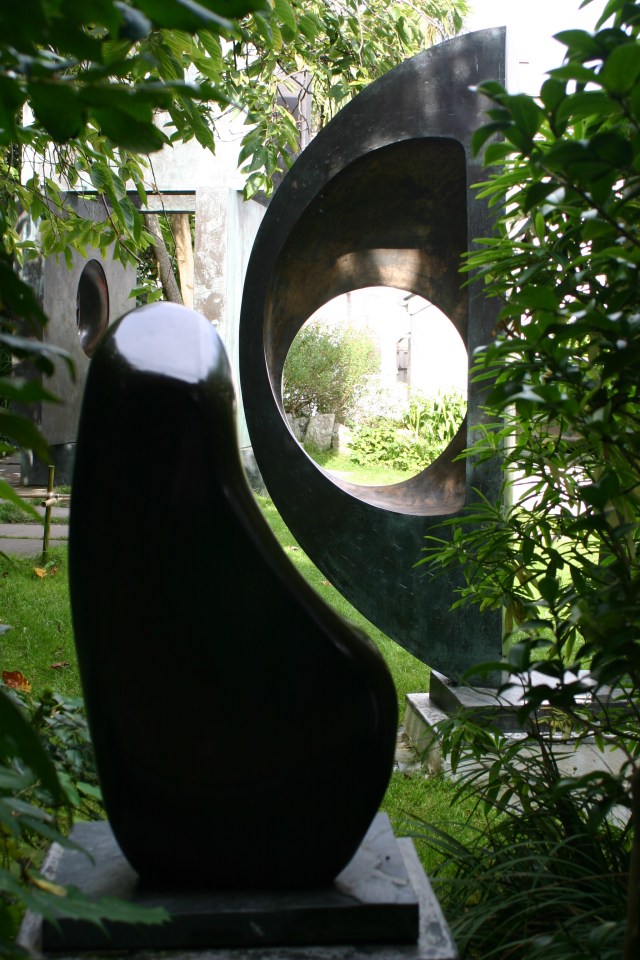 Whilst on holiday near St. Ives, Cornwall, recently I took the chance to visit the Tate Art Gallery – something of an ‘icon’ of the town – and the Barbara Hepworth Sculpture museum and garden. The Tate is an impressive building, but I found it a little disappointing, mainly because of it’s relatively small display areas. There are plans afoot to expand the place and that should help to further strengthen its impact.

The Hepworth Garden, by contrast was a rich, intense experience and one which, despite many visitors, I was able to enjoy on a beautiful summer’s day. The Tate website provides the following background information:
‘Barbara Hepworth first came to live in Cornwall with her husband Ben Nicholson and their young family at the outbreak of war in 1939. She lived and worked in Trewyn studios – now the Barbara Hepworth Museum – from 1949 until her death in 1975. Following her wish to establish her home and studio as a museum of her work, Trewyn Studio and much of the artist’s work remaining there was given to the nation and placed in the care of the Tate Gallery in 1980.
‘Finding Trewyn Studio was a sort of magic’, wrote Barbara Hepworth. ‘Here was a studio, a yard and garden where I could work in open air and space.’ When she first arrived at Trewyn Studio, Hepworth was still largely preoccupied with stone and wood carving, but during the 1950s she increasingly made sculpture in bronze as well. This led her to create works on a more monumental scale, for which she used the garden as a viewing area. The bronzes now in the garden are seen in the environment for which they were created, and most are in the positions in which the artist herself placed them. The garden itself was laid out by Barbara Hepworth with help from a friend, the composer Priaulx Rainier.’
I particularly liked the way sculpture and planting are treated as complementary, the masses, textures and forms of the plants being used to echo or contrast with those of the sculpture and vice versa. There is also an amazing sense of space in this relatively small garden, achieved by the winding, gently rising and falling path which opens up views across the garden to the sculptures which, together with some impressive trees, bamboos and shrubs provide height which draws your eye away from the boundaries of the garden, themselves clothed in plants.
A classic design trick for smaller gardens this – using features with height inside the space to draw the eye inwards, coupled with a masking of the boundaries to convey uncertainty about where the garden begins and ends. I hope that you enjoy the photo montage I snapped on a sunny day in August.


Further information:
Tate St. Ives and Hepworth Sculpture garden website
Old School Gardener
If you’ve enjoyed reading this post and others on this blog, why not comment and join others by signing up for automatic updates via email (see side bar, above right ) or through an RSS feed (see top of page)?

The Oregon Garden, Silverton via Gardening Fans
 I was privileged to be invited to the opening of a ‘new’ glasshouse at Peckover House, Wisbech last week.

You may recall that I spent some time here as a Heritage Gardening Trainee last year, and really learnt a lot from the Gardener in Charge, Allison and her cheerful accomplices, Jenny and Janet. I wrote a lengthier piece about the garden earlier in the year (see link below), and at that time it wasn’t yet certain that the fast – decaying Orangery in this superb Victorian Garden was going to be saved. But thanks to some local fundraising and additional funds and wisdom of the owners, the National Trust, I’m very pleased to say that this focal point in the garden has been saved. Or rather, recreated, as the original was in such a poor condition, that further repairs weren’t possible. The replacement is a faithful rendition of the old structure, with a few minor amendments to make life easier for the gardeners. The former tiled floor, surrounding walls and walled containers with three ancient Orange trees have been retained, now with a new covering made, as was the original, in timber and glass. It includes sash window ventilation and roller blinds to help with temperature and light control.
During the rebuild the 300 year old orange trees were exposed to the elements and what a stroke of luck that we had one of the best summers in recent years, for they have obviously benefitted from that exposure to fresh air and sunshine!
The overall feeling is of a light, colourful and inviting atmosphere. The old Orangery had a typically Victorian air of ‘gothic gloom’ about it, especially as some of the older specimens accompanying the oranges were mature and shaded the interior. I guess the replacement plantings alongside the outer wall will eventually make their mark, but for now I do like the open, bright interior. The inner, sun – facing side of the Orangery is once more populated with a colourful array of terracotta pots containing a wide variety of tender specimens, all laid out on benches ans shelves in the spirit of the Victorian passion for collecting the unusual and exotic. Here are some pictures of the opening event and the new Orangery.


The overall project cost over £200,000. I’m sure it will be worth it as the garden- already a jewel in the National Trust’s crown – would have seemed empty without it. If you’re ever near to Wisbech in Cambridgeshire the place is well worth a visit – as you can see from this selection of pictures taken last week. 


Congratulations National Trust, the Peckover House Gardening team and all those others who contributed to the project!
Related article- ‘Banker’s bonus: Secret Garden Gem’
Old School Gardener

This Rocky island crowned by a medieval church and castle was another of my West Country garden visits – or rather ir wasn’t. Access to the gardens was restricted to certain days during the summer (as a a conservation measure) and yes, we chose one of the closed days! So my visit was confined to aerial views from castle ramparts, glimpses through gates and over hedges. Still, I managed to get a good idea of what the gardens are like and I’ve tried to convey this in the photo montage below.
The island – a ‘twin’ with Mont St. Michel in Normandy on the other side of the English Channel – has some buildings dating from the 12th century. It’s sub-tropical Gardens feature exotic plants clinging to steep granite cliffs and terraces laid out with a mixture of formal and informal borders. These terraces are tiered close to the rocky water’s edge.
I witnessed an ‘abseiling gardener’ carrying out some ‘extreme strimming’ on the grassy slopes!
Plants that are natives of Mexico, the Canary Islands and South Africa thrive in the mild micro-climate created by the sun-warmed cliffs. As we found in many other parts of West Cornwall plants like Agapanthus, Fuchsia, Crocosmia ‘Montbretia’ and Hydrangea thrive here as well as along road – sides and more modest domestic gardens in the area.


I will revisit at some point to get the ‘up close and personal’ experience of actually being in the gardens, but from the views I managed they do seem mightily impressive.
Further information:
St. Michael’s Mount Garden Itinerary
Wikipedia- St. Michael’s Mount
Old School Gardener
If you’ve enjoyed reading this post and others on this blog, why not comment and join others by signing up for automatic updates via email (see side bar, above right ) or through an RSS feed (see top of page)?

Pelargoniums display at Calke Abbey via Colin Garratt

Chateau de Hautefort, Dordogne, France – via Richard Wright

The ‘Cornwall Gardens Guide’ mentions 9 gardens beginning with ‘Tre’ (Cornish for ‘homestead’ or ‘town’). Having just returned from two weeks there and in Devon, I visited three of these (Trengwainton and Trelissick as well as Trerice) as well as Godolphin, Glendurgan and St. Michael’s Mount. They all share Cornwall’s mild climate and several have river valley settings and their associated semi – tropical microclimates. Despite these similarities, I found these wonderful gardens to have a range of distinctive styles or features, largely reflecting the historic interests of their owners and gardeners.
Over the coming weeks I’ll do a photo feature on each of these as well as Killerton Gardens (near Exeter, Devon) and will throw in a couple of very special places – the Barbara Hepworth Sculpture Garden in St. Ives and Chysauster Ancient Village, both in Cornwall. I begin where we began our tour, at Trerice near Newquay, a place we visited en route to our destination of St. Ives. This Elisabethan house and gardens is described by the National Trust as:
‘An intimate Elizabethan manor and a Cornish gem, Trerice remains little changed by the advances in building fashions over the centuries, thanks to long periods under absentee owners.’
The house is certainly delightful to look at, with its rust coloured granite stone, ‘dutch’ gables and ancient leaded windows – many of which are cracked from the test flights of ‘Concorde’ 50 years ago! These ‘sonic booms’ must have been especially noticeable in what is otherwise a very quiet, peaceful place, far away from busy roads or settlements (we managed to get very lost in some frighteningly narrow country lanes trying to find our way to our next destination).
A formal approach to the house sets it off beautifully and the other garden areas include a grass labyrinth, ancient bowling alley, a woven – fenced kitchen garden and some more recent sloping borders containing a mix of food and ornamental plants – I imagine this might be something of a challenge at harvest time! Of particular interest is an Elisabethan garden in the making, based on a ceiling design in the house as a nod to the sort of layout the original might have been based on, records of what actually existed not being available. This was in the course of setting out when we visited, but a very good artist’s impression shows how this will look – a formal pattern of Box hedging enclosing lavender and roses, which will be a great addition to these lovely gardens.
And the house is of great interest too, with some very friendly and helpful guides to show you around and help you (and any younger members of your party) try on suits of chain mail and pose with a longbow!


Further information:
Old School Gardener
If you’ve enjoyed reading this post and others on this blog, why not comment and join others by signing up for automatic updates via email (see side bar, above right ) or through an RSS feed (see top of page)?





 Old School Garden