Category: Heritage Gardens & gardening


The Dell, Blickling- scene of this week's voluntary push..

The Dell, Blickling- scene of this week’s voluntary push..

I had a varied menu of gardening at Blicking this week…

I began with some ‘rescue pruning’of some old Espalier Pear trees on the orchard wall next to the Walled Garden. These hadn’t been pruned for some time and had put on a lot of thin growth (and some thicker, more rangy branches) in the past year or two. Working with Mike, Project Manager of the Walled Garden, we also tidied up the beds and paths near these old specimens and it now presents itself as ‘looked after’.

Mike was telling me there’d been a problem with something nibbling the newly emerging tulip leaves in the Walled Garden raised beds- pheasants were the suspected culprits! A few sheets of ‘Enviromesh’ over these was now adding some protection. I mulched around these with some shreddings to create walkable paths and finished off with the same treatment around an old Mulberry Tree in the corner of the garden; this will keep weeds down and moisture in over the growing season to come.

'Enviromesh' keeping the Pheasants from the Tulips..

‘Enviromesh’ keeping the Pheasants from the Tulips..

After lunch I joined the rest of the volunteers in ‘The Dell’, which lies next to the Winter Garden I’d been helping to tidy up in previous weeks. The Winter Garden was more or less finished (bar planting out some new Hellebores) and it looks splendid in the low afternoon sun, with the flowers of Witch Hazel, Daphne, Sarcococca, Snowdrops and Hellebores standing out against the cleared and ‘tickled’ dark soil- the fragrance of the Daphne is especially memorable.


The Dell is a sunken garden with different interest. Heavily shaded, and quite steeply sloping in places, it is home to a collection of ferns, evergreen shrubs and other such plants. We pruned some of the hollies back, tidied away on the slopes, pruning back dead stems and foliage, and of course removed- you guessed it-  more leaves!

 Further information:

Blickling Hall website

Blickling Hall Facebook page

A 360 degree tour of Blickling Hall

Old School Gardener


WP_20150129_14_19_53_Pro

This week’s little jaunt at Blickling was a revisit to the Winter Garden, which I helped to start clearing of leaves and generally tidying up, last week.

The crisp cold day began with more leaf clearing and I was soon joined by half a dozen other volunteers who were kind enough to start clearing and loading the various leaf piles I made as I went across the borders. Fortunately I’d finished raking by lunchtime and could begin ‘tickling’ the matted soil surface with a border fork; generally perking up the look of the borders, including revealing many more clumps of snow drops and hellebores and doing the odd bit of pruning to Dogwoods that were starting to layer.

After and hour the heavens opened- thunder, lightning and a heavy snow shower made the going rather more challenging. We continued for a while, but it was soon clear that the snow was settling and we couldn’t see the earth for turning, so ‘an early bath’ was in order. Thanks to the ‘Leaf Maidens’ who diligently gathered in next year’s leaf mould and worked with me to improve the appearance of this garden.

Sorry about the poor quality photographs- a combination of wet screen, poor light and shaking hands (in the cold) made for a bit of ‘shake’ on the ‘phone camera!

WP_20150129_14_20_18_Pro


WP_20150129_14_26_03_ProFurther information:

Blickling Hall website

Blickling Hall Facebook page

A 360 degree tour of Blickling Hall

Old School Gardener

 

WP_20150122_12_03_53_ProMy latest session as a volunteer gardener with the National Trust at Blickling Hall involved working in another area of the gardens- the Winter Garden, which I think was planted up a few years ago as an area to feature colourful stems, fragrance and flowers at this quiet time of the year in the garden.

Work in the Walled Garden has been continuing, however, and with a few frosty nights it has been possible to move and spread the rest of the farmyard manure over the beds. As you can see below, this has helped to give definition to these planting areas…

Muck spreading in the Walled Garden- get to work worms! Picture: Michael Owers

Muck spreading in the Walled Garden- get to work worms! Picture: Michael Owers

For gardener Rebecca, me and the other ‘Thursday volunteers’, this week involved raking off a thick quilt of Sweet Chestnut and other leaves, tidying up spent stems and foliage and sprucing up the Hellebores…. as well as uncovering the first snowdrops. When I say ‘quilt’ I’m not joking – I just hope the plants underneath haven’t been as shocked as I have been, recently, emerging from under my own quilt in the frosty mornings!

So, for me the day that was spent almost entirely raking and loading leaves into trailers to be carried away for turning into leaf mould. Definitely one that required a ‘Radox Bath’ on my return home!

Even though it was repetitive work, it was also very satisfying, showing off this lovely garden with its over-arching trees and understory of shrubs and winter perennials- and hopefully giving some of the plants a good chance to ‘pick up’ as the seasons move on.

Further information:

Blickling Hall website

Blickling Hall Facebook page

A 360 degree tour of Blickling Hall

Old School Gardener
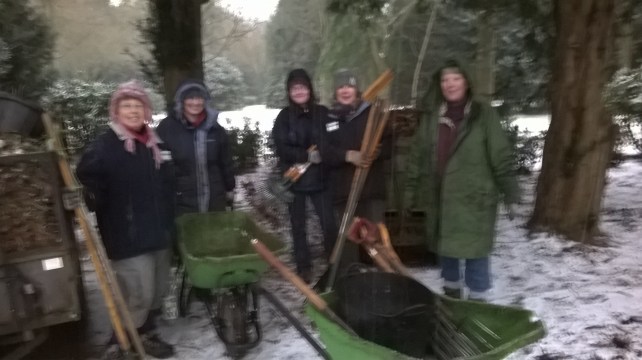
 

Volunteers tidying the kitchen garden beds at Blickling Hall

Volunteers tidying the kitchen garden beds at Blickling Hall

My second day as a volunteer gardener with the National Trust at Blickling Hall involved cleaning up the recently used kitchen garden, and along the way meeting some of the other garden volunteers… oh, and uncovering some plant mysteries…

You may recall that last week I helped Project Manager Mike and gardener Rebecca to make a start in preparing the ground in the main walled garden. With lots of rain since then there had been little chance of doing much more- in fact there were sections that were reminiscent of a World War I trench system, complete with mud and puddles!

‘Ooh, there’s a row of something…’

So, today we turned our attention to the long bed along the south-facing wall, an area that in recent years had been cultivated as a kitchen garden and nursery bed. There were clearly areas of bare soil, some  a bit weedy, whilst other areas still had the remains of last season’s plantings, including Chard, Penstemons, Dahlias and some less obvious herbaceous perennials.

At the start it looked like I might need to weed and then use a spade to dig over the soil, but it turned out that the soil is quite workable and so a border fork proved up to the job. I was soon joined by a platoon of other garden volunteers who turned their attention to other sections of the bed; uncovering rows of planting here and there (and trying to identify and label these as we went), tidying away spent stems and foliage and generally giving the soil its first ‘breath’ of the new year.

I think the plan is to use this bed in due course as a place for demonstrating different approaches to vegetable growing, but for this year Mike is focusing on a holding operation, working around existing groups of plants that can be left and no doubt seeing what other surprises might appear along the way; for example I think I uncovered an area of Rhubarb crowns towards the end of my stint.

Part of the team, proud of the day's work

Part of the team, proud of the day’s work

It was a satisfying day. There’s something ‘optimistic’ about seeing a newly dug border, the dark, rich soil contrasting with the brighter colours of surrounding plants, and looking forward to creating a progressively finer tilth as the days lengthen and temperatures.

My reward at the end of the day- sunset over mid Norfolk

My reward at the end of the day- sunset over mid Norfolk

Further information:

Blickling Hall website

Blickling Hall Facebook page

A 360 degree tour of Blickling Hall

Old School Gardener
 

SONY DSCI’ve mentioned recently that I’m commencing a stint as a volunteer gardener with the National Trust at Blickling Hall, a wonderful Jacobean House and estate just outside Aylsham, about 8 miles from home.

I’m particularly interested in helping with a project to regenerate a two acre walled garden that once supplied the household with an array of vegetables and fruit. Like many walled gardens of its time this was domestic food growing on a huge scale- almost like operating a mini farm.

I was reminded of this near agricultural scale of operation on my first day as the whole space has been deep ploughed (using an implement called a ‘sub soiler’ pulled behind a conventional tractor) to try to break up the compacted soil.

One of my first jobs involved marking out the main pathway structure using canes, so that plentiful supplies of farmyard manure can be tipped and spread on the growing areas and not wasted on areas which will soon be hard-surfaced. Fortunately the Project Manager, Mike Owers, had already set out some marker pegs around  the periphery of the garden from which we could run lines and so get our bearings over the rough terrain. Other members of the gardening team then trailered in what seemed like a never-ending stream of manure  (it was still being delivered as I left at dusk). Mike, Rebecca (one of the gardeners) and I then started the task of spreading this lovely stuff over the ground so that the worms can get to work incorporating it into the newly turned soil- a Rotatator may be used in due course to fully integrate this material.

My other main job on my first day was to work out the materials needed to restore the walled fruit support system around three walls (the fourth side of the garden is hedged). Many old espalier trained fruit bushes remain, though over the years, as the garden was not in commission, these have not been regularly pruned, so some careful renovation is called for. In some cases, the bushes may be beyond recovery, but a good basic structure exists on two out of three walls. Mike had been researching different ways of supporting these bushes and come up with a system used at another of the Trust’s properties, Scotney Castle in Kent. Here oak battens provide vertical supports for stretched wires which run along a series of vine eyes (and incorporate straining bolts at the ends of each run to ensure the wires are kept taut).

This avoids screwing the vine eyes themselves into the ancient walls, which I must say, as you’d expect, look a little fragile in places. The battens will be placed at roughly 4 metre intervals, which more or less corresponds to the spaces between the existing bushes. I did a quick sketch diagram of each wall showing the rough placement of the battens, straining bolts etc. and finished off with some basic calculations of the materials required- interestingly my estimate on the wire (which will be in 7 rows spaced around each 5 brick courses) at 1324 metres was close to Mike’s early estimate, so hopefully the figure is more or less on target!

I’m due back at the Gardens this week and will post a brief update as this work unfolds. The next few months are promising to be especially interesting as the basic structure of the garden- paths, irrigation, greenhouses etc – are put in place and the garden is readied for its first season of growth for many years.

Further information:

Blickling Hall website

Blickling Hall Facebook page

Old School Gardener


Beckley Park topiary garden, Oxfordshire

Beckley Park topiary garden, Oxfordshire

‘I doe not like Images Cut out in Juniper or other Garden stuffes: They be for Children. Little low Hedges, Round, like Welts, with some Pretty Pyramides, I like well.’

Sir Francis Bacon

‘What right have we to deform things given us so perfect and lovely in form? No cramming of Chinese feet into impossible shoes is half so wicked as thwe wilful and brutal distortion of the beautiful forms of trees’

William Robinson- ‘The English Flower Garden’ 1898

Personally, I really enjoy topiary- growing it, trimming it and admiring others’ creativity and skill in producing the rather more fantastic forms it can take; oh, and they also make me smile!

OK, so you are cutting back natural growth, but aren’t we doing that when we prune things anyway? What do you think?

Old School Gardener


WP_20140928_17_26_24_ProThis last ‘garden’ from our recent trip to Portugal, is a bit of a cheat. The main attraction is the gothic splendour of the monastery and associated cathedral, but there are some wonderful outdoor spaces too, so I think its worth sharing.

The monastery was founded by the first Portuguese King, Afonso Henriques, in 1153, and has maintained a close association with the Kings and Queens of Portugal throughout its history, housing several royal tombs and the national pantheon.

The church and monastery were the first gothic buildings in Portugal, and, due to its artistic and historical importance, was listed by UNESCO as a World Heritage Site in 1989. The Cathedral is the largest church building in Portugal and has a relatively simple undecorated interior- I was fully expecting golden baroque splendour on entering, but was pleasantly surprised.

The Cathedral is perhaps most famous for housing the tombs of King Pedro I and his mistress, Ines de Castro, assassinated, in 1355, under the orders of Peter’s father, King Afonso IV. After becoming King, Pedro ordered the remains of his beloved to be transferred to her tomb in Alcobaça and, according to a popular legend, had her crowned as Queen of Portugal and ordered court members to pay her homage by kissing her decomposing hand.

This pair of Royal tombs, of unknown authorship, are among the best works of gothic sculpture in Portugal. The tombs are supported by lions, in the case of the King, and half-men half-beasts, in the case of Ines, and both carry the recumbent figures of the deceased assisted by a group of angels. The sides of Pedro’s tomb are magnificently decorated with reliefs showing scenes from Saint Batholomew’s life, as well as scenes from Pedro and Ines’ life. Her tomb is decorated with scenes from the life of Christ.

The monastery complex provides an interesting, and, as expected, relatively simple series of rooms and spaces where the monks went about their everyday business.

This slideshow requires JavaScript.

Outside, the cloister is a most inspiring space, simply furnished (and with some sympathetic conservation) with a few trees and close-cut box bushes- I was fortunate to capture it in the afternoon sun. The monastic gardens- not open to the public- are a fine example of box-edged parterres enclosing a series of beds that once were used for growing food and herbs. This important site lies about an hour’s drive north of Lisbon and is an area I hope to visit again as there are other landscapes and historical sites nearby, that we didn’t have time to visit.

Source and further information: Wikipedia

 Old School Gardener

WP_20141117_15_07_28_Pro

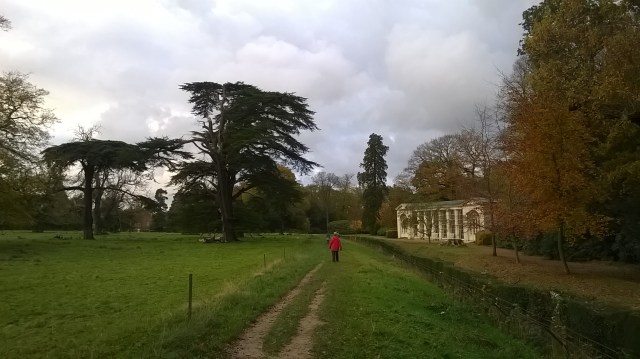
Cedars and the Orangery at Blickling Hall, Norfolk this week

Old School Gardener

IMG_0851Our recent visit to Portugal included a longer trip 1 hour north from Lisbon to a fascinating park (it is too big to be called a garden)- in fact it is billed as the biggest oriental park in Europe, stretching to around 35 hectares.

Developed within the Quinta dos Loridos vineyard, the Buddha Eden Peace Park was inspired as recently as 2001, when wealthy Portuguese investor and art patron José Berardo was shocked by the Taliban government’s destruction of the Giant Buddhas in Afghanistan.  In response to the demolition of these masterpieces of the late Gandhara period, Berardo initiated the Buddha Eden in an homage to these cultural and spiritual monuments.

Buddhas, pagodas, terracotta statues and carefully placed sculptures (modern and western) can be found throughout the park. It is estimated that some six thousand tons of marble and granite were used to create this monumental work of art.

This slideshow requires JavaScript.

It is certainly an impressive achievement and one which has been laid out to a monumental scale. There are beautifully framed views and a wide range of interesting features to capture your attention as you wander round the clearly defined pathways. The planting, as you might expect at this scale, is simple and must look dramatic earlier in the season when masses of Agapanthus are in flower.

The central staircase is the focal point of the park, where the reclining golden Buddha, despite its size, creates a sense of calm.

At the central lake, Koi (Japanese carp) fish can be seen, and sculpted dragons rise out of the water.

This slideshow requires JavaScript.

There are seven hundred hand-painted terracotta soldiers, each of them unique copies of those which were buried some 2,200 years ago in China. These looked to be in need of repainting (and in one or two cases more significant repair), but being able to walk among them (they were all well over 6 feet tall) was a strangely unnerving (but enjoyable) experience.

The park is certainly a fantastic visitor experience, though by the end of our visit I was feeling a little ‘over buddhad’ and almost overwhelmed by the monumentality of everything. Perhaps some thought needs to be given to creating some smaller, more human scale spaces which can complement the rest of the Park – and in doing so, perhaps making the experience of this even more intense.

The park seems to be unsure of what it is trying to be, perhaps at a stage of transition from one man’s passionate and bold move to preserve a cultural legacy to something akin to a modern-day theme park- nicely captured by the electric train that ferries visitors unwilling or unable to walk around the site!

Old School Gardener

IMG_0788Our 2014 September visit to Portugal featured some interesting new places, including three wonderful gardens. The first I’m featuring was a visit to the home of wealthy ex pat Brits when it was established over a century ago. Monserrate sits in the mountains north-west of Lisbon in the regal suburb of Sintra.

The website which covers many of the Sintra garden gems describes Monserrate gardens and its palace as:

‘..one of the most beautiful architectural and landscape Romantic creations in Portugal… unique representatives of 19th century eclecticism.The Palace combines gothic and Indian influences as well as Moorish suggestions together with exotic and plant motifs which are harmoniously extended to the exterior. The gardens have received species from all corners of the world, which were planted according to their geographical origin. The front lawn of the Palace provides a well-deserved rest, while discovering one of the richest Portuguese botanical gardens.’

It was built in 1858 for Sir Francis Cook, an English baronet who had amassed a fortune as a trader and textile baron and was created Visconde de Monserrate by King Luis. Cook turned to an English architect, James Knowles jr. for the house design. He took inspiration from the many countries Cook had dealings with and also the flamboyantly oriental Royal Pavilion in Brighton, England, built for the Prince Regent, later Goeorge IV over 50 years earlier. I loved the round tower and proportions of the palac, the use of reflected light under the wide eaves with subtle creamy and terracotta hues to create a lovely warm glow. The rich decoration is a generally successful blending of eastern, moorish and gothic revival styles. Here are some pics of the house….

This slideshow requires JavaScript.

Cook hired William Nevil as Botanical expert and landscaper. The project was completed within 5 years and was Cook’s summer residence. The entire estate was put up for sale in the 1920s by Cook’s great-grandson, and after many years of neglect was purchased by the state in 1949. Since then it has been open to the public as a national monument.

The English influence emanates throughout the gardens which have a romantic feel, especially as you wind your way along rough paths through shaded glades with waterfalls, pockets of sunlight and mock ruins, and eventually up to the rather more manicured lawn (the first laid in Portugal) that stretches away from the house down to the grounds. These also include specialist and exotic gardens with non-native plants from Cook’s personal collection. Here are some pics of the gardens and grounds…

This slideshow requires JavaScript.

The Monserrate Palace is the smallest of Sintra’s three palaces but it is by far the most decorative – and beautiful-  and certainly captivated me, as did the winding and varied gardens – especially the Mexican Garden, some pics of which follow…

This slideshow requires JavaScript.

It has taken 20 years to restore the gardens and the result was recognised in 2013 when they were voted the winner of the European Garden Awards in the category for “Historical parks”. In 1995 the park was recognised by the UNESCO as a World Heritage Site as a part of several palaces and parks in Sintra. The citation for its latest award says:

‘Light and shadow, exotic and rare plants, winding paths and breath-taking views, but even new garden sections, such as the rose garden that was opened in the year 2011 by the Prince of Wales, make a visit to Monserrate, in spite of the many other wonderful parks in Portugal, a unique, fascinating and therefore “prize worthy” event.’

 IMG_0786Old School Gardener

Finding Nature

Nature Connectedness Research Blog by Prof. Miles Richardson

Norfolk Green Care Network

Connecting People with Nature

Discover WordPress

A daily selection of the best content published on WordPress, collected for you by humans who love to read.

Susan Rushton

Celebrating gardens, photography and a creative life

Unlocking Landscapes

Writing, photography and more by Daniel Greenwood

Alphabet Ravine

Lydia Rae Bush Poetry

TIME GENTS

Australian Pub Project, Established 2013

Vanha Talo Suomi

The Journey from Finnish Rintamamiestalo to Arboretum & Gardens

Marigolds and Gin

Because even in chaos, there’s always gin and a good story …

Bits & Tidbits

RANDOM BITS & MORE TIDBITS

Rambling in the Garden

.....and nurturing my soul

The Interpretation Game

Cultural Heritage and the Digital Economy

pbmGarden

Sense of place, purpose, rejuvenation and joy

SISSINGHURST GARDEN

Notes from the Gardeners...

Deep Green Permaculture

Connecting People to Nature, Empowering People to Live Sustainably

BloominBootiful

A girl and her garden :)