Category: Heritage Gardens & gardening


WP_20150611_15_48_05_ProTwo weeks on and I was finally back in the Walled Garden at Blickling this week.

I arrived later than usual as I was giving a talk to a group called ‘Inspired Gardeners’ in Aylsham. 25 gardeners were inspired enough to turn up and hear me talk about Water Management in the Methodist Hall. What a splendid group they are, with my session but one in a packed programme of talks and garden visits to keep them on their (senior) toes! I’ll put together a precis of the Water Management talk and feature it in a future article.

The handful of other garden volunteers were hard at it weeding under the large Mulberry Tree in the Walled Garden, but I was detailed by Project Manager Mike to help him plant out some Pumpkins, the first things to go into the newly cultivated borders in the Walled Garden! The digging on one of the hottest days of the year so far certainly generated some perspiration, even after only half an hour, before we paused for lunch.

After lunch we pressed on and in total put in some 36 plants of different varieties. Mike’s thinking is to get something going in the new borders, even if it isn’t part of the full and final plan for the different spaces, just to get the ground covered and producing something; pumpkins with their ‘space invader’ habit are perfect for that.

After loosening up the bottom of each generous planting hole we filled them with plenty of farmyard manure, mixed this with loose soil and put in the well-watered plants, which had been inside the (very full) Greenhouse. We created a saucer-like depression around each mounded plant to encourage water gathering around the roots and then topped off each with some organic ‘rocket fuel’ and a generous mulch of more manure (having given each plant a good soaking).

Very satisfying seeing something going into the new borders, and hopefully it won’t be long before more things are introduced. Certainly the irrigation seems to have been fully installed and I gather the metal edging for the paths will be done in the next month or two as the other members of the gardening team have a little more time on their hands to help with this mammoth job.

I mentioned in my last post a rather lovely ‘artist’s impression’ of the regenerated Walled Garden and I’m grateful to Mike for sending me a copy, which I set out for you to see below. It was done by local artist Fiona Gowen.

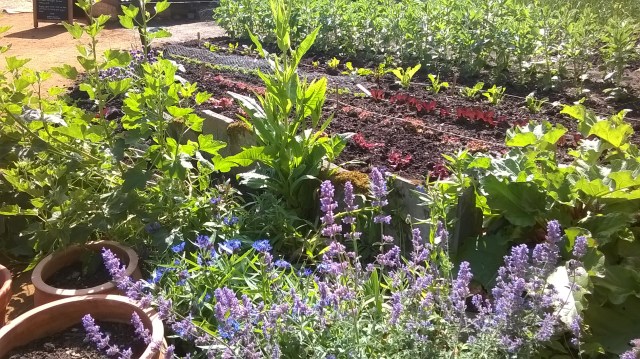
Blickling Walled GardenA3 (2)Having a few minutes to spare I planted a few Basil and Lettuce plants near the front of the main cultivated strip of the Walled Garden, which all in all is starting to look very good, as the various vegetables and flowers are bulking out and putting on colour.

I also had the chance to see the beautiful, blousy Peonies which, two weeks on, were now getting fully into their stride.

Further Information:

Blickling Hall website

Blickling Hall Facebook page

A 360 degree tour of Blickling Hall

Old School Gardener


WP_20150604_14_12_41_ProYesterday’s session at Blickling was spent planting 6 million Penstemons ( I exaggerate)…

Chance would have it that the day I was to spend on my knees in the Long Borders, was the first day I’d wear shorts! Having finished off raking the bare soil, my fellow volunteers and I set to work planting out a large number of over wintered plants, which were brought over from the Walled Garden for us. The system worked well- a couple of helpers bringing plants to the three of us digging holes and planting; fairly close together, as the soil isn’t wonderful here and the plants, apparently, don’t seem to get very large.

Four hours later (and after a mild panic when we thought we’d run out of plants), the job was done. Apart from the sore knees, it was lovely planting out in the sun and with the fragrance of nearby Wisteria and Honeysuckle filling the air. It will be good to see how these mixed plants (some of the pots had been amusingly labelled ‘unkown’), progress in the next couple of months.

I also took a look at the Peony borders I featured a few weeks ago. Surprisingly, they haven’t yet fully opened, but there were a few blooms to give us a taste of what will come- hopefully soon, if the weather warms up a bit.

Over lunch Mike, the Walled Garden Project Manager, showed me a lovely ‘artist’s impression’ of the Walled Garden;  a wonderful vision of how it will look in a few years time and something to spur those involved in pressing on with the regeneration project. I’ll see if I can share this picture with you at some point.

This slideshow requires JavaScript.

Further Information:

Blickling Hall website

Blickling Hall Facebook page

A 360 degree tour of Blickling Hall

Old School Gardener


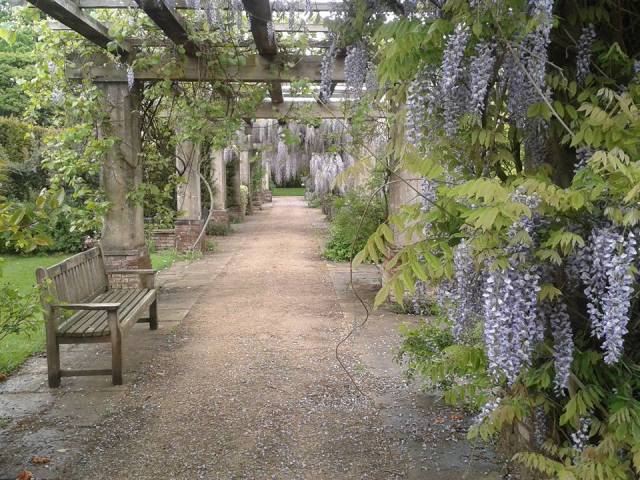
Wisteria Walk, Stoke Poges Memorial Gardens

Wisteria Walk, Stoke Poges Memorial Gardens

WP_20150515_12_13_25_ProAfter leaving Emmetts Garden on our way home from Sussex last week, we also stopped off to see a place that I’ve wanted to visit for a long time- Red House, in Bexleyheath, London. The house and garden designed by Philip Webb with fellow Arts and Crafts man William Morris, is a wonderful monument to all that exuberant artistic endeavour of the mid and later 19th centuries.We had a stimulating guided tour of this lovely house and garden that has been a major influence on English architecture and garden design.
Part reaction to the impact of industrialisation, part a response to its social consequences, William Morris and the movement- which had close ties to the Pre Raphaelite Brotherhood and early socialist thinkers- have perhaps become most closely associated with floral prints in wallpaper and fabric. I hold my hands up- we are definite fans and have some Morris designs in the Old School.

The garden here rather plays second fiddle to the house, which was meant to be ‘something medieval’ and does conjour up images of courtly love, knights in armour and Arthurian legend…

This slideshow requires JavaScript.

But the garden sets off this fabulous building very neatly and today also boasts a kitchen garden. The original design was as unique as the house, with Morris insisting on integration of the design of both. The garden was divided into four, small square gardens by trellises on which roses grew. The flower beds were bordered with lavender and rosemary while lilies and sunflowers had also been planted in the garden. White jasmine, roses, honeysuckle and passion flower were planted to climb up the walls of the house.

This slideshow requires JavaScript.

Further information:

National Trust website

Wikipedia

Old School Gardener

Southover Grange Gardens, Lewes, Sussex, recently

Southover Grange Gardens, Lewes, Sussex, recently

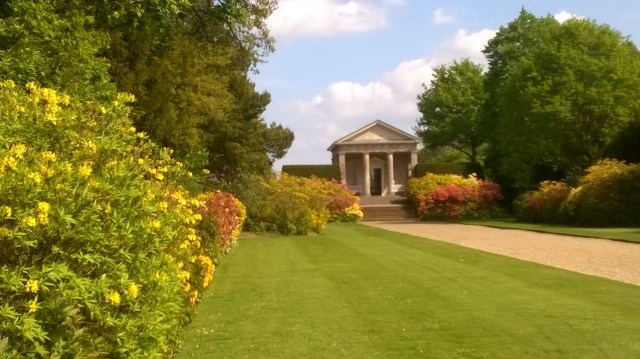
WP_20150521_15_40_07_Pro I think it must be three weeks since I was last at Blickling. I got a chance to look around at the end of my working session and there were several highlights I hadn’t seen before, most notably the Azaleas round the Temple, the wall-trained Wisterias, the masses of Forget-me-Nots and Honesty in the Dell and some of the colour combinations in the double borders; especially the Tulip ‘Queen of Night’ and the black foliage of Mongo Grass and Black Elders.

My fellow volunteers were bit thin on the ground this week, and the gardening team pretty much seemed to be tied up in interviews all day, so we were left to our own devices! But the task was simple, weeding in the rose borders in the main Parterres. I went to work with my hoe (I really enjoy this task) and though the borders were pretty clear, there were a few odd weeds (including patches of Oxalis which the other volunteers dug up) and some edging of the grass to be done.

The session was punctuated with chats to vistors who were very complimentary about the gardens. One couple from Bury St. Edmunds envied us the light soil we have in this area- they have to tackle thick clay.

Head Gardener Paul informed us that the National Trust Gardens advisor had recently visited and was full of praise for the gardens and what the whole team had achieved; that was good to hear.

This slideshow requires JavaScript.

Work in the Walled Garden has continued with the hard core for the main paths being laid and consolidated. The next job is installing 800 metres of metal edging- I don’t envy the Team that job!

Further Information:

Blickling Hall website

Blickling Hall Facebook page

A 360 degree tour of Blickling Hall

Old School Gardener


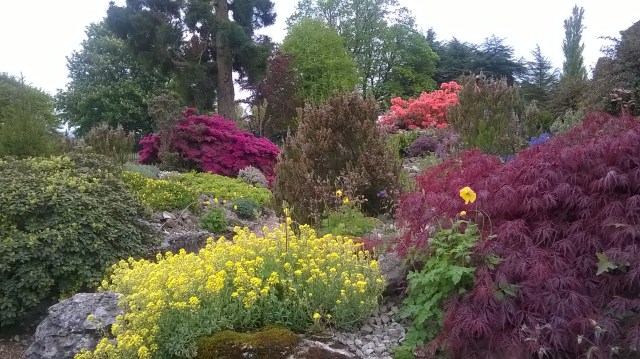
WP_20150515_11_05_33_ProOn our way home from Sussex last week, we manged to call in on two other National Trust properties. The first was Emmetts Garden, near Sevenoaks, Kent.

Though situated in a commanding hillside location, the garden is tucked away a bit, but we eventually found it after some tortuous lanes and slippery hill climbs! Our stay was short,but the garden didn’t disappoint- masses of spring interest, including a very attractive rockery with plenty of alpines on display. The Rhododendrons, Azaleas and Bluebells were also looking superb in the bright sunshine.

This slideshow requires JavaScript.

Wikipedia describes the gardens:

‘Emmetts Garden was open farmland until 1860 when the present house was built. The name ’emmett’ is a local word for ant and refers to the giant anthills that covered the area until the 1950s. The house and land was purchased in 1890 by Frederic Lubbock, a banker and passionate plantsman. Lubbock’s elder brother was John Lubbock, 1st Baron Avebury, coincidentally a world expert on ants, which may have influenced his decision to purchase the property.

The gardens were initially laid out between 1893 and 1895 under the influence of Lubbock’s friend William Robinson in the fashionable Edwardian style popularised by Gertrude Jekyll. The shrub garden was added later in 1900-1908.

After Lubbock’s death (1927), the estate was acquired by an American geologist Charles Watson Boise. He made various alterations to both house and garden but retained the original character of the gardens…

The garden, which covers an area of about six acres (approximately 2.5 hectares), occupies a commanding site on a 600-foot (180 m) sandstone ridge, overlooking the Weald. One of the highest points in Kent, it offers expansive views towards the North Downs.

It is mainly planted with trees and shrubs in the form of an arboretum; a magnificent 100-foot (30 m) Wellingtonia fortunately survived the Great Storm. There is also a rose garden located next to the Victorian house to which the gardens once belonged.’

Further information: National Trust website

Old School Gardener

WP_20150512_14_16_43_ProAnother trip out and another chance to visit some interesting and inspiring gardens last week. We travelled to see friends in Sussex and our lunch time stop was Knole near Sevenoaks, Kent, a large estate still owned by the Sackville family (of Vita fame) and part run by the National Trust. We were very lucky because we tipped up on a Tuesday, when the private Sackville gardens are open to the public, and we availed ourselves of a very engaging guided tour…

Beginning in the classical orangery, the tour wound its way around a fascinating garden, with some highlights to savour; the longest Wisteria on a wall outside China; the longest ‘Green Alley’ circumnavigating the walls of the garden; a champion fastigiate Oak tree and some wonderful azaleas with eye popping colour.

This slideshow requires JavaScript.

The house- a splendid mix of architectural styles- is undergoing some major alterations, but the grounds and gardens are breathtaking. Wikipedia describes the estate:

‘a 1,000-acre (4.0 km2) park, within which the house is situated. Knole is one of England’s largest houses, the National Trust attribute a possibility of its having at some point been a calendar house which had 365 rooms, 52 staircases, 12 entrances and 7 courtyards. Its grade I listing reflects its mix of Elizabethan to late Stuart structures, particularly in the case of the central façade and state rooms. The surrounding deer park has also survived with little having changed in the 400 years since 1600 although its formerly dense woodland has not fully recovered from the loss of over 70% of its trees in the Great Storm of 1987….

As a walled garden, Knole’s is very large, at 26 acres (11 ha) (30 including the ‘footprint’ of the house) and as such is large enough to have the very unusual — and essentially medieval feature of a smaller walled garden inside itself (Hortus Conclusus). It contains many other features from earlier ages which have been wiped away in most country-house gardens: like the house, various landscapers have been employed to elaborate the design of its large gardens with distinctive features. These features include clair-voies, a patte d’oie, two avenues, and bosquet hedges.

WP_20150512_14_46_18_Pro Further information: National Trust website

Old School Gardener

WP_20150508_13_43_47_ProOur final garden visit whilst travelling home from the Lake District last week, was to Southwell workhouse, Nottinghamshire.

We’d begun, you might recall, with the landed gentry at Kedleston Hall, then seen something of Victorian commercial and scientific endeavour at Biddulph Grange. It somehow seems appropriate, then, to find ourselves in the midst of gardening at the other end of the social spectrum- the poor.

Built in 1824 as a place of last resort for the destitute, it’s architecture was influenced by prison design and its harsh regime became a blueprint for workhouses throughout the country. We went round this fascinating building with the benefit of a number of helpful room guides and an audio tape guide- they say the best pictures are on radio, and the sparsely- furnished rooms came alive in the colourful descriptions and ‘real time’ excerpts from the workhouse regime. The garden is, as you might expect, exclusively for food growing, and though it is more of a demonstration of more general Victorian horticultural pratices, it captures the spirit of how gardening was practiced in the workhouse.

The cultivation of a garden and the rearing of livestock was frequently a feature of workhouse operation. There were a number reasons for this, mostly aimed at reducing the cost of providing poor relief. First, a garden could provide the workhouse with a cheap and ready source of food. Any surplus or unwanted produce could be sold off and provide funds for the running of the house. Another benefit of a garden was that it offered a convenient and regular form of employment for the inmates of the workhouse. Finally, training pauper children in agricultural or horticultural work could equip them with skills that would make them employable in their later life, rather than being a drain on the parish.

WP_20150508_14_43_04_ProSources and further information:

National Trust website

Workhouse Gardens and Farms

Old School Gardener

Stoke Poges Memorial Gardens

Stoke Poges Memorial Gardens

Finding Nature

Nature Connectedness Research Blog by Prof. Miles Richardson

Norfolk Green Care Network

Connecting People with Nature

Discover WordPress

A daily selection of the best content published on WordPress, collected for you by humans who love to read.

Susan Rushton

Celebrating gardens, photography and a creative life

Unlocking Landscapes

Writing, photography and more by Daniel Greenwood

Alphabet Ravine

Lydia Rae Bush Poetry

TIME GENTS

Australian Pub Project, Established 2013

Vanha Talo Suomi

The Journey from Finnish Rintamamiestalo to Arboretum & Gardens

Marigolds and Gin

Because even in chaos, there’s always gin and a good story …

Bits & Tidbits

RANDOM BITS & MORE TIDBITS

Rambling in the Garden

.....and nurturing my soul

The Interpretation Game

Cultural Heritage and the Digital Economy

pbmGarden

Sense of place, purpose, rejuvenation and joy

SISSINGHURST GARDEN

Notes from the Gardeners...

Deep Green Permaculture

Connecting People to Nature, Empowering People to Live Sustainably

BloominBootiful

A girl and her garden :)