Category: Heritage Gardens & gardening


WP_20150814_11_38_42_ProCoimbra, the second capital of Portugal (succeeded by Lisbon), is a fascinating place. Apart from some lovely river side parks and an historic centre, it has Portugal’s oldest University, which is perched on top of the steep hill at the centre of the old town, from where it dominates both the skyline and overall impression of the town. It also has university students who, as elsewhere in Portugal, wear long black cloaks over black suits and white shirts; very much in the style of Harry Potter and Co. (or should that be the other way around?).

We paid an interesting visit to the University, especially its OTT baroque library and other grand rooms (no photography allowed), which testify to its ancient past. We also had a lovely evening meal overlooking the river and paced our way through the city streets, including falling on an unusual fountain garden which was originally part of an adjacent religious centre and put together by one of Portugal’s’ most famous sculptors…

On the morning of our last day we also paid the Botanical Gardens a visit and these, like others I’ve visited elsewhere in the country, have an impressive range of mature trees, shrubs and other plants.

I found this tree fascinating; not sure of what it is, but it has developed a useful technique of growing its own buttresses as it extends its branches...

I found this tree fascinating; not sure of what it is, but it has developed a useful technique of growing its own buttresses as it extends its branches…

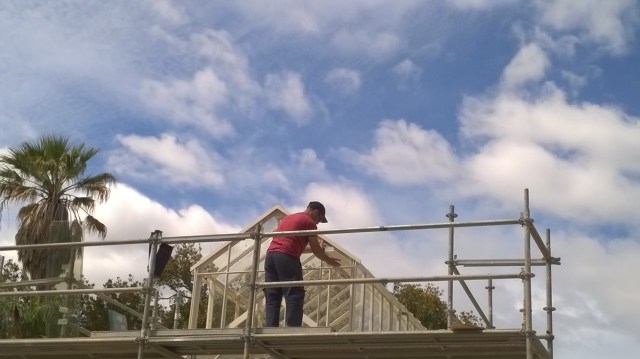
It was encouraging to see the major glasshouse in the course of regeneration and the novel introduction of an adventure trail with close supervision as you (not me!) slide your way around and between the many very tall trees.

This slideshow requires JavaScript.

Old School Gardener

WP_20150814_13_52_49_ProAs you may have picked up, I’ve been in Portugal again  recently. As well as visiting some old favourites, we ventured north to the old capital of the country, Coimbra (more on this in later posts), and on our way back to Lisbon stopped off at a wonderful historical site called Conimbriga. This site, a few miles south of Coimbra, was the Romans’ capital while they were here in Portugal, some two millenia ago.

OK, I know that this blog is supposed to be about gardens and gardening. But I occasionally feature something that is only loosely connected (if at all), just to add a bit of variety. And in truth, there is a link to gardening here, as you’ll see later.

This extensive site displays the bones of an important Roman settlement and includes some sensitive reconstruction to help you get the scale and proportions of the place- the recreation of the Forum is particularly impressive.

And the other immediately remarkable thing is the wealth of mosaic floors on show, some open to the air, others carefully protected under a large sheltering canopy.

But the really noteworthy feature- well I think so- is the re-creation of the Fountain Gardens, including (for 50 cents a go) the chance to see the way the fountains might have embellished this calm, sheltered space set amid the bustle of the wider settlement.

After touring the open site, it was something of a relief (from the sun) to get inside the nearby Museum, which helps add further interpretation to the site and houses a range of beautiful artefacts discovered here.

Old School Gardener


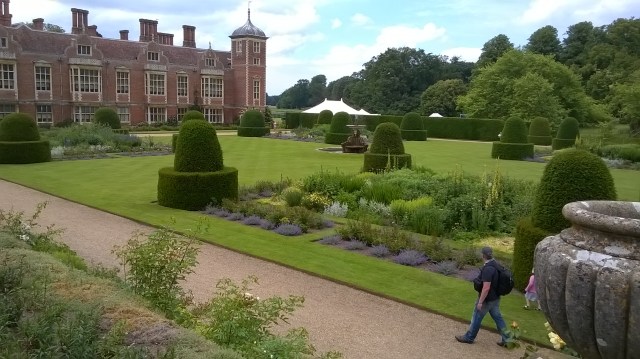
WP_20150820_13_53_12_ProMy muscles were decidedly stiff after being away from gardening for a couple of weeks. But my latest session of volunteer gardening at Blickling was very enjoyable. The team was on good form and we had lots of news to share, not least that two of the volunteers had just secured jobs, one starting that very afternoon and the other to take up a role as an Assistant Gardener at Blickling!

My session began on the edge of the car park backing the Walled Garden, where earlier in the year I’d helped Project Manager Mike prune some wall fruit and tidy up a rather messy edge where weeds had forced their way through tarmac and concrete to ‘adorn’ the old red brick walls. It was a case of ‘more of the same’ a few months on, and I was pleased with the results…see picture below.

WP_20150820_13_56_57_ProSo, after an hour here it was back to the walled garden proper with the rest fo the team to wed and mulch one of the new beds brought into cultivation, this one containing a wide range of flowers. Again, a pleasing result after a couple of hours…

This bed is at the ‘frontier’ of the newly cultivated areas in the walled garden, which I suppose must now be about a quarter in productive use. So still a long way to go in achieving the vision of a rejuvenated garden, but some steady progress. I was especially pleased to see that the first lengths of metal path edging had gone in, which start to ‘shape up’ the whole plot.

Metal edging starting to define the beds in the Walled Garden

Metal edging starting to define the beds in the Walled Garden

And the pumpkins and squashes I helped to plant out have gone to town, providing lush cover to a large area of the garden….

I took some time to look around the main area of cultivation in the Walled Garden and I must say, all credit to Mike and the team as the rows of vegetables and cut flowers look great. And it seems the rustic supports that Peter and I put up are doing their job supporting a promising crop of runner beans and sweet- smelling sweet peas….

I couldn’t help notice that the formal gardens – the parterres and double borders- were also full of summer colour; the reds, oranges and yellows of the double borders (including some impressive dahlias I  helped to plant out) looking particularly impressive….

Oh, and the white border continues to look a treat….

WP_20150820_13_51_56_ProOld School Gardener

WP_20150810_13_00_34_ProOn my latest trip to Portugal, I was thinking there must be another classic garden to visit in the mountain hideaway of Sintra. But having checked, it seems I’ve been to all of them, and if you’re interested you can see them in my series ‘Portuguese Gardens’.

But there remained a lingering doubt (or was it hope?), that there must be an historic garden somewhere close. Looking at the Lisbon map, and planning our days out, it stood out in that large green lung that is the Monsanto Park: the Palace of the Marquesas Fronteira.

This classic house, originally built in 1670 as a hunting lodge in what was then the rolling, wooded hills of northern Lisbon, is still lived in by the current Marquis and his family, so the house is only partly open to visitors (via a very informative 45 minute guided tour). Today, the views are of the sprawling Lisbon suburb of Benfica, including the red-arched Estadio da Luz, home to that famous football team of the district. About 100 years after its inception, after the infamous Lisbon earthquake had destroyed his main home, the then Marquis decided to extend his hunting lodge and make this palace home.

WP_20150810_12_52_39_ProAfter being asked if we’re mind waiting for a later house tour (to enable the rest of the party to benefit from the French version), I had a little wander into this compact, but interest-filled garden. And I went round again after hearing about and seeing some sumptuous interiors.

The centre-piece, especially as viewed from the upstairs rooms of the house as well as the high terrace overlooking the formal pool, is a rather intricate box parterre, where the shapes are closely edged, leaving what seems to be an impossibly narrow gap between the bushes: still the gardener seems to manage somehow.

This impressive feature was only partly filled with a selection of roses, and though traditional, I find the combination of close-clipped box and rather more unruly roses not as satisfying as when the enclosed beds contain slightly shorter plants that themselves have a rather more symmetrical form, e.g. lavender or perhaps catmint.

The elevated terrace with its display of sculptures of Portuguese kings surrounded by metallic-glazed tiles, is also very satisfying to walk along and gaze from, including downwards to a well-stocked carp and goldfish pool, with a lone, and rather aggressive black swan! I could picture this pool being the centre of 18th century fun and games, with rowing boats taking important guests from one little grotto to another, deftly avoiding the fountains of water (which today at least, were not in operation).

This slideshow requires JavaScript.

Nearby is a rather more naturalistic garden with tall trees and what must be at other times beautiful borders of hydrangea and agapanthus (I took the opportunity of gathering some seed heads of the latter). The walls of this area and indeed the rest of the garden, are beautifully tiled with traditional, if rather simply designed tiles, or azulejos, plus a vivid blue paint, the latter beautifully setting off fresh green foliage.

This slideshow requires JavaScript.

There is also a rather lovely terrace with immediate access to and from the first floor of the palace, with another impressive array of classically-inspired sculpture, leading to another large grotto, this one covered inside with the broken pieces of crockery and other shattered ceramics, apparently some coming from the plates used at the Palace’s inauguration, and smashed to commemorate the event!

Similar in style to other Portuguese palaces and gardens of the time, Fronteira is nonetheless well worth a trip, especially for the way our guide brought it to life.

Further information:

Fronteira Palace website

Gardens and Landscapes of Portugal

Old School Gardener

WP_20150714_14_08_43_ProThe second half of the recent Blickling volunteers and staff day out involved a trip to nearby Corpusty Mill, a garden developed over many years by its owner Roger Last and his late brother John since 1965. The RHS says of it:

‘Water is used extensively (ponds, streams, a small lake and a river) and there are strong architectural elements, garden buildings or follies, including a vast flint wall with the heads of Roman emperors, a Gothic arch and window, a grotto (with four chambers), a ruined tower, a classical pavilion and stainless steel spire. The planting is knowledgeable, varied and controlled. Most visitors come away quite amazed by the beauty and ingenuity of what they have seen.’

I must admit to being blown away by the thoughtful, clever and sensitive design and the sheer beauty of this five acre garden laid out in three distinct parts.  The main and more complex layout is on an intimate scale near to the house and there are two landscaped meadows.  Each area has its own character and atmosphere. A recent Country Life article comments:

‘Although the garden’s buildings and plantings are very varied, all are governed by three general ideas. First, the brothers felt it was important to manage visual effects ‘with some restraint’, thus hedges and borders were positioned so that only one building showed at a time. Next, to mitigate the possible dullness of an essentially flat site, they created innumerable changes of level, most of which were only modest, but, as Mr Last points out: ‘Even a few feet can make a huge difference.’ Finally, they wanted to create marked changes of mood, so some areas are open and light-filled, but others are densely planted and shaded.’

This slideshow requires JavaScript.

All I can say is that ‘it works’- a sensitively designed and fantastic blend of planting, statuary, humourous features and attention to detail.

Further information:

Corpusty Mill Garden website

Country Life article 2014

Old School Gardener

WP_20150714_10_41_49_ProThe volunteers and staff at Blickling had a fabulous day out recently, visiting two nearby gardens not normally open to the public. Our first visit was to the medieval manor of Oxnead Hall.

Wikipedia says:

‘Oxnead is a lost settlement in Norfolk, England, roughly three miles south-east of Aylsham. It now consists mostly of St Michael’s Church and Oxnead Hall. It was the principal residence of the Paston family from 1597 until the death of William paston, 2nd Earl of Yarmouth in 1732. Under Sir William Paston (1610–1663), Oxnead was the site of several works by the architect and sculptor, Nicholas Stone, master-mason to Kings James I and Charles I…

The house was originally built for Sir Clement around 1580 but was remodelled by Nicholas Stone, for Sir William Paston, between 1631 and 1632. At its zenith, the house had seventy-nine rooms but under the Earls of Yarmouth it declined until by 1744 it was described as ruinous….

Nothing remains of the garden statuary installed by Nicholas Stone, though his Hercules, originally from Oxnead, can be seen in the Orangery at Blickling Hall. Blickling, in its parterre, also has a sixteenth or early seventeenth century fountain, consisting of a basin on a base, bought from Oxnead in 1732.’

The gardens here are extensive, with some lovely changes in level as they tip towards the River Bure. A recent occupant ws also something of an enthusiast for garden features; he added a ‘folly’ near the river and one or two other garden buildings broadly in keeping with the overall style. He also added a rather grand extension which, whilst in keeping with the roginal building, did not have planning permission, so is not occupied. The gardens are formally laid out near to the house, with agrand parterre of box and simple landscaping of the ruins of the old Hall, which have been left exposed and which in one or two cases, have been graced with further statuary.

I particularly liked the water gardens which weave among the River and give lovely views to the Hall and the rest of the gardens. the Head Gardener here (a former Blickling gardener), is making steady progress in restoring the grounds to their historic pattern, including a walled kitchen garden.

This slideshow requires JavaScript.

To end the trip we all enjoyed some coffee and cakes prepared by the Gardener’s wife. Though impressive and well looked after, Oxnead’s gardens by and large lacked floral or other planting interest to suit my own taste in gardens, which leans towards the arts and crafts tradition where planting design and variety takes a more central role.

WP_20150714_11_39_31_ProOur second visit of the day was to prove right up my  alley…

Read more in a day or two’s time!

Old School Gardener

WP_20150803_10_44_29_ProI’ve posted about the Plantation Garden in Norwich before. A couple of days ago I had a few things to do in Norwich, so I took the chance to pay it another visit. It was a lovely sunny morning and the place was nearly deserted; I sat, secreted away in this beautiful spot. Enjoy the pictures…

Old School Gardener


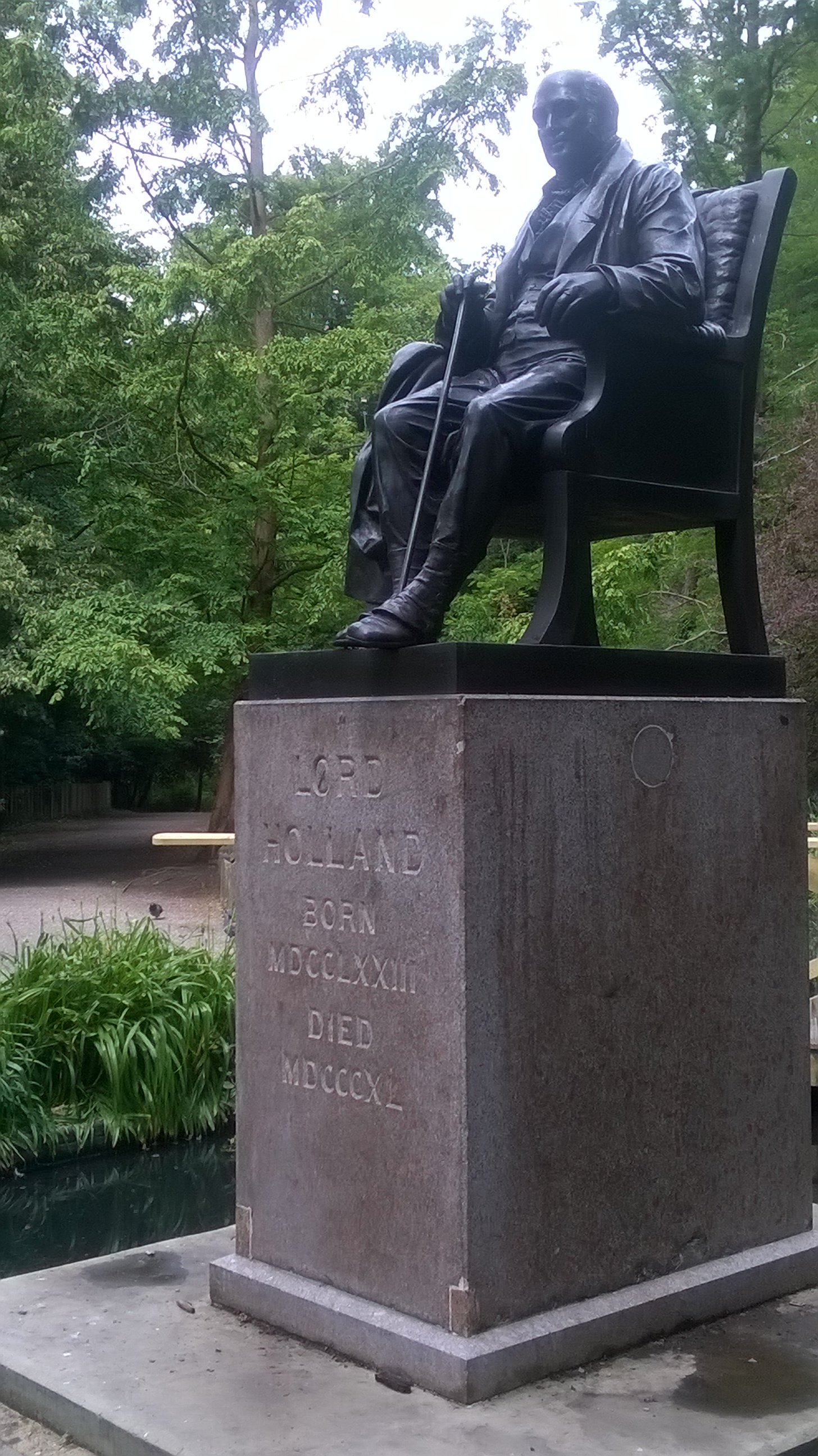
Working out at Holland Park, London

Working out at Holland Park, London

Old School Gardener

WP_20150621_11_23_49_ProWe were staying with our daughter and her boyfriend in London. It was Fathers’ Day and a special day out was planned, incorporating a trip to Holland Park, a quick visit to St. John’s Wood Church Gardens (where we discovered the grave of John Sell Cotman, a well-known watercolourist of the Norwich School and a favourite artist of mine) and a vintage car event nearby. The weather was kind and the day was brilliant.

I really enjoyed Holland Park, which Wikipedia describes:

‘Holland Park is about 22 hectares (54 acres) in area and is considered one of the most romantic and peaceful parks of West London. The northern half or so of the park is semi-wild woodland, the central section around the ruins of Holland House is more formal with several garden areas, and the southernmost section is used for sport.

Holland House is now a fragmentary ruin, having been devastated by incendiary bombing in 1940, but the ruins and the grounds were bought by London County Council in 1952 from the last private owner, the 6th Earl of Ilchester. Today the remains of the house form a backdrop for the open air Holland Park Theatre, which is the home of  opera Holland Park. The green-roofed commonwealth Institute lies to the south.

The park contains a cafe as well as the Belvedere Restaurant that is attached to the orangery, a giant chess set, a cricket pitch, tennis courts, two Japanese gardens – the Kyoto Garden (1991) and the Fukushima Memorial garden (2012), a youth hostel, one of London’s best equipped children’s playgrounds, squirrels and (impressively for a London park) peacocks. In 2010, the park set aside a section for pigs whose job was to reclaim the area from nettles etc., in order to create another meadow area for wild flowers and fauna. Cattle were used subsequently to similar good effect.

The new Holland Park Ecology Centre (2013), operated by the borough’s Ecology Service, offers environmental education programs including nature walks, talks, programs for schools and outdoor activity programs for children.’

This slideshow requires JavaScript.

I loved the scale and variety of the park which is broken up into separate gardens and spaces, each with its own character, and including a range of formal, semi formal and wild areas.

There is a delightful series of mural paintings on a wall beside a covered  walkway, which captures the park in earlier days.

I especially enjoyed the Japanese gardens, which use a range of typical design features to great effect in a relatively small space; tumbling water cascades, clipped evergreens, Acers, rocks etc. I think I will try to use some of these in my own pond project here at Old School Garden; e.g the clever use of interlaced thick bamboo poles to form a semi permeable screen. However, it did seem rather open and lacking the sorts of intimate, small spaces associated with ‘quiet contemplation’. Maybe this is down to the relative youth of the gardens- we can expect some of the trees and other planting to fill out with time. It might also be a conscious design feature, bowing to the inevitable demands on such a space in a public park; the many feet and bodies that undoubtedly pass through it.

This slideshow requires JavaScript.

This Park is obviously well-loved and well looked after, a true community resource and one which serves an area much larger than its immediate posh neighbourhood in Kensington and Chelsea. Well worth a visit if you can.

Old School Gardener

WP_20150625_14_59_03_ProAnother two week break from Blickling, and this week’s session was hot, hot, hot!

Shorts (well, nearly), were the order of the day along with my new National Trust polo shirt. I joined the other volunteers in the Orangery Garden initially, weeding among the Hellebores and ferns, an area I’d helped tackle earlier in the season, but which now was awash with Foxglove seedlings.

Quite satisfying working in the shade and after a good shower of rain a few days before, working my border fork around the plants and leaving the odd seedling where there was an obvious gap. The ladies and I managed to clear one of the island beds just before lunch, and a couple of us then went over with gardener Rob to the Double Borders to continue filling gaps with Dahlia tubers, some not looking up to much, but we shall see…

The Parterre looking neat and with early hints at the colour to come...

The Parterre looking neat and with early hints at the colour to come…

These borders, typical of many British gardens at this time of year, have completed the first spring rush of fresh foliage and flower colour and are giving way to the clipped forms of shrubs and the more subtle colouring and tones that presage a  later summer riot of colour, which I look forward to seeing. To add a further bit of interest, there’s also currently a sculpture display in the gardens, featuring some lovely stained glass and various shells.

The garden team have obviously been busy in recent weeks filling the gaps left by the spring bulbs with a host of annuals, all looking ready to romp away. The plant that yielded most visitor interest while we were planting was the Beetroot (‘Bulls blood’) which had been cleverly grouped at the front of the borders and gives a really vibrant splash of red when the other colours around at this time are more muted. Well, we finished our planting task in good time as the warmth of the day reached its peak…

Beetroot 'Bull's Blood' causing a stir in the Double Borders

Beetroot ‘Bull’s Blood’ causing a stir in the Double Borders

And later I came along for another ‘roasting’- a most enjoyable ‘Hog Roast’ put on by the Trust as a ‘thank you’ for staff and volunteers. I had a good chat with Head Gardener, Paul and a couple of other volunteers, one who acts as a room guide in the House, the other as a guide in the R.A.F. Oulton Museum on site. There was a Jazz band and the food was scrummy too. 

Further Information:

Blickling Hall website

Blickling Hall Facebook page

A 360 degree tour of Blickling Hall

Old School Gardener


Finding Nature

Nature Connectedness Research Blog by Prof. Miles Richardson

Norfolk Green Care Network

Connecting People with Nature

Discover WordPress

A daily selection of the best content published on WordPress, collected for you by humans who love to read.

Susan Rushton

Celebrating gardens, photography and a creative life

Unlocking Landscapes

Writing, photography and more by Daniel Greenwood

Alphabet Ravine

Lydia Rae Bush Poetry

TIME GENTS

Australian Pub Project, Established 2013

Vanha Talo Suomi

The Journey from Finnish Rintamamiestalo to Arboretum & Gardens

Marigolds and Gin

Because even in chaos, there’s always gin and a good story …

Bits & Tidbits

RANDOM BITS & MORE TIDBITS

Rambling in the Garden

.....and nurturing my soul

The Interpretation Game

Cultural Heritage and the Digital Economy

pbmGarden

Sense of place, purpose, rejuvenation and joy

SISSINGHURST GARDEN

Notes from the Gardeners...

Deep Green Permaculture

Connecting People to Nature, Empowering People to Live Sustainably

BloominBootiful

A girl and her garden :)