
Category: Grow your own food
 My fifth offering from a book I bought in a charity shop recently…..
Glut
The trouble with overspill is that you find yourself being nice to neighbours you never liked.
Corollary: when the radish season is at it’s height, a neighbour in need is a friend indeed.
Plenty
The number of any given relatives, friends,business colleagues and acquantainces a gardener may have at any given time varies in direct proportion to the season; i.e. whether the raspberries and strawberries are ripe.
Corollaries:
1. The number increases or decreases with the type of gardener- the one who picks the fruit for you and the one who says, ‘Help yourself’.
2. Nothing from the country garden is given away, except for a very good reason.
From : ‘Mrs. Murphy’s Laws of Gardening’ – Faith Hines (Temple House books, 1992)
Old School Gardener
My old friend Richard has built himself a great little shed from pallet and other ‘skip wood’. Here it is, along with a picture of his allotment in Bristol. Just shows what you can do with a recycling turn of mind!


Old School Gardener
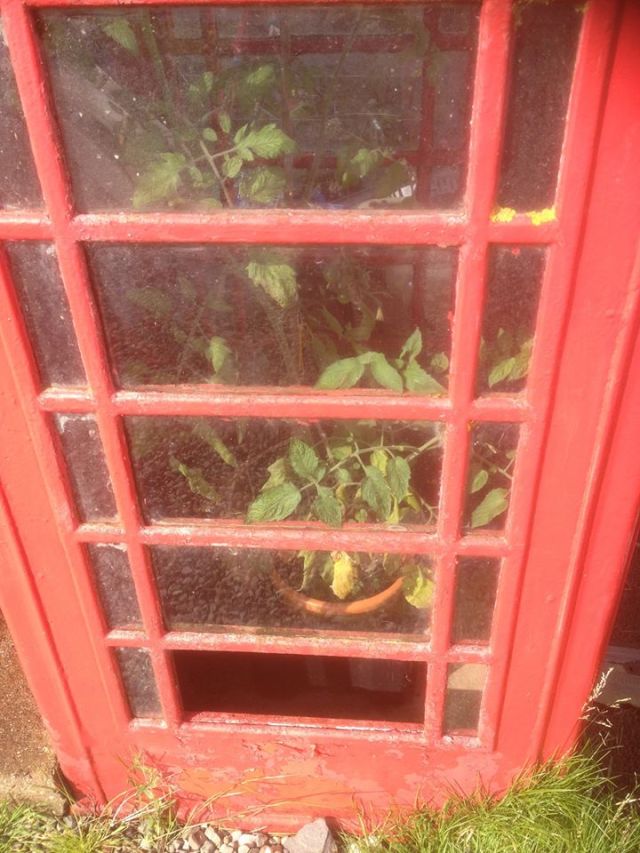
What a lovely idea for using a redundant ‘phone box- greenhouse on the Isle of Mull, Scotland.
Old School Gardener

A great idea for dealing with food gluts- a free food sharing cupboard! This Dutch example reminds me of the growth in mini, free libraries in redundant phone boxes around the UK, and in some ways, sadly, Food Banks. Maybe this is another use for an old Telphone box in your area, or perhaps you can put up a ‘cupboard’? I could certainly have stocked one with cucumbers and courgettes this summer!
Old School Gardener

- Some of the apples developing nicely in Old School Garden– but due to a late frost, flower wilt and insect attack, most of the trees are showing only a few, if any, fruit.
‘Is it not a pleasant sight to behold a multitude of trees round about, in decent form and order, bespangled and gorgeously apparelled with green leaves, blooms and goodly fruits as with a rich robe of embroidered work, or as hanging with some precious and costly jewels or pearls, the boughs laden and burdened, bowing down to you, and freely offering their ripe fruits as a large satisfaction of all your labours?’

Ralph Austen ‘A Treatise of Fruit – Trees’ 1653

Pears on a ‘super column’ in the kitchen garden- looks like the first good harvest since they were planted a few years ago

Good sized plums on this old tree in the orchard- I thinned them out in June.
Old School Gardener
 Summer fruiting raspberries are just about coming to the end here at Old School Garden, but Lee Mason of Whetstone has had a disappointing harvest:
‘I planted some ‘Malling Promise’ raspberry canes back in February. They’ve grown pretty well, but the harvest has been disappointing and the new growth looks to be weak. Would a fertiliser feed help?’
Malling Promise canes (and any other summer fruiting raspberries for that matter), planted in February would have benefitted from cutting down in their first season to 100 mm (4 inches) high canes back in March to encourage strong new root development, as well as new canes for fruiting in the following season. In short, Lee, you’ve ‘got a bit ahead of yourself’! I suggest that you cut down all growth next March. You will lose a season’s cropping, but the sacrifice will be worth it in the long run. Giving the canes a good mulch of organic matter or a general fertiliser like fish, blood and bone should also help, if applied next spring.
Raspberry flavour
Have you been disappointed with the flavour of your raspberries? Sulphate of potash is a good fertiliser to use to enhance raspberry flavour, but only if the raspberry variety you grow has some natural flavour of it’s own. Varieties like Malling Admiral have little natural flavour, whereas Malling Jewel or Malling Promise are better.
Shrivelled fruit
Are your raspberries shrivelled up? This might be because you’ve been a little too enthusiastic in digging around the canes! Avoid digging over the ground near the roots, as raspberries are surface rooters and don’t like any cultivation anywhere near the canes. This breaks the roots- which can spread out quite a way- and as a result the plants will be unable to cope with the extra stress at fruiting time. If you restrict your cultivation to the use of a Dutch hoe and follow this up with a good deep mulch of organic matter in the spring this will do wonders for the quality of your fruit.

- Cut down the canes of autumn fruiting raspberries in early March
Pruning Autumn (and Summer) raspberries
The first autumn raspberries are starting to appear here at Old School Garden (earlier than normal probably due to the mild winter and spring). It looks like we’ll have a good harvest. With these, the fruit comes on canes produced in the current season, so after fruiting (which can last into October) the old canes need to be cut back, but when is the best time to do this? Well not immediately after harvesting, apart from damaged or broken canes. It’s best to leave the rest until the following spring (early March), when all the remaining canes can be cut down almost to ground level. This ensures that some protection for the newly emerging canes is provided over winter. In July weak growth can be removed so that only the strongest canes are left for fruiting.
With summer fruiting varieties it’s best to cut down the canes that have fruited immediately after harvesting has finished and to select the strongest new canes and tie these into wire supports to protect them over winter. In spring the tops can be cut back by about 6 inches or alternatively these can be looped over and tied into the top wires.
Old School Gardener
If you’ve enjoyed reading this post and others on this blog, why not comment and join others by signing up for automatic updates via email (see side bar, above right ) or through an RSS feed (see top of page)?

 In the wake of the 2008 food price crisis, which exacerbated food insecurity and increased smallholder farmers’ vulnerability to shocks and stresses, recognition of the barriers smallholders face in becoming more productive and developing their farms as commercial businesses has been growing. In 2010, the UN Food and Agriculture Organisation implemented the Multidisciplinary Fund (MDF) project to help develop policies supportive of smallholder commercialisation in Africa, in particular identifying the heterogeneity amongst smallholders in terms of their attitudes to commercialisation.
A new report, Understanding smallholder farmer attitudes to commercialisation – the case of maize in Kenya, by the FAO, focuses on maize producers and rural youth in Kenya by investigating “attitudes, strategies and opportunities related to maize commercialisation” in Meru and Bungoma regions in the country. The report is based on key informant interview, focus group, farmer survey and stakeholder workshop data.
At present farm management is not undertaken…
View original post 500 more words


 Old School Garden